Lauren arrived shortly after lunch.
I had made coffee and put two cups on the table.
She came inside carrying her handbag and a small paper bag from a shop.
She placed the bag beside her chair.
"I brought you something."
I asked what it was.
"Just a few things."
She took out a small container of food and set it on the counter.
I thanked her.
She smiled, and for a moment, I felt the tension between us ease.
We sat down.
She asked about my week.
I told her about a few errands I had run and some work I had finished in the office.
She listened without interrupting.
Then she told me about something that had happened to her.
I asked questions.
She answered them.
It was the kind of conversation I had missed.
No discussion about property.
No questions about signatures.
No suggestion that I needed to let her take charge.
I found myself relaxing.
Perhaps we had both needed time to cool down.
Perhaps she had finally accepted that the house wasn't going to be transferred to her.
I wanted to believe that.
After a while, Lauren got up to refill her cup.
She looked toward the hallway.
"Have you been using that office much?"
I felt my guard rise again.
"Most days."
She returned to the table.
"Do you still keep all your records there?"
"Some of them."
She watched me.
"And the older papers?"
I put my cup down.
"Lauren."
She looked at me.
"What?"
"We agreed not to spend the afternoon discussing this."
She sighed.
"I was only asking."
"I know what you're asking."
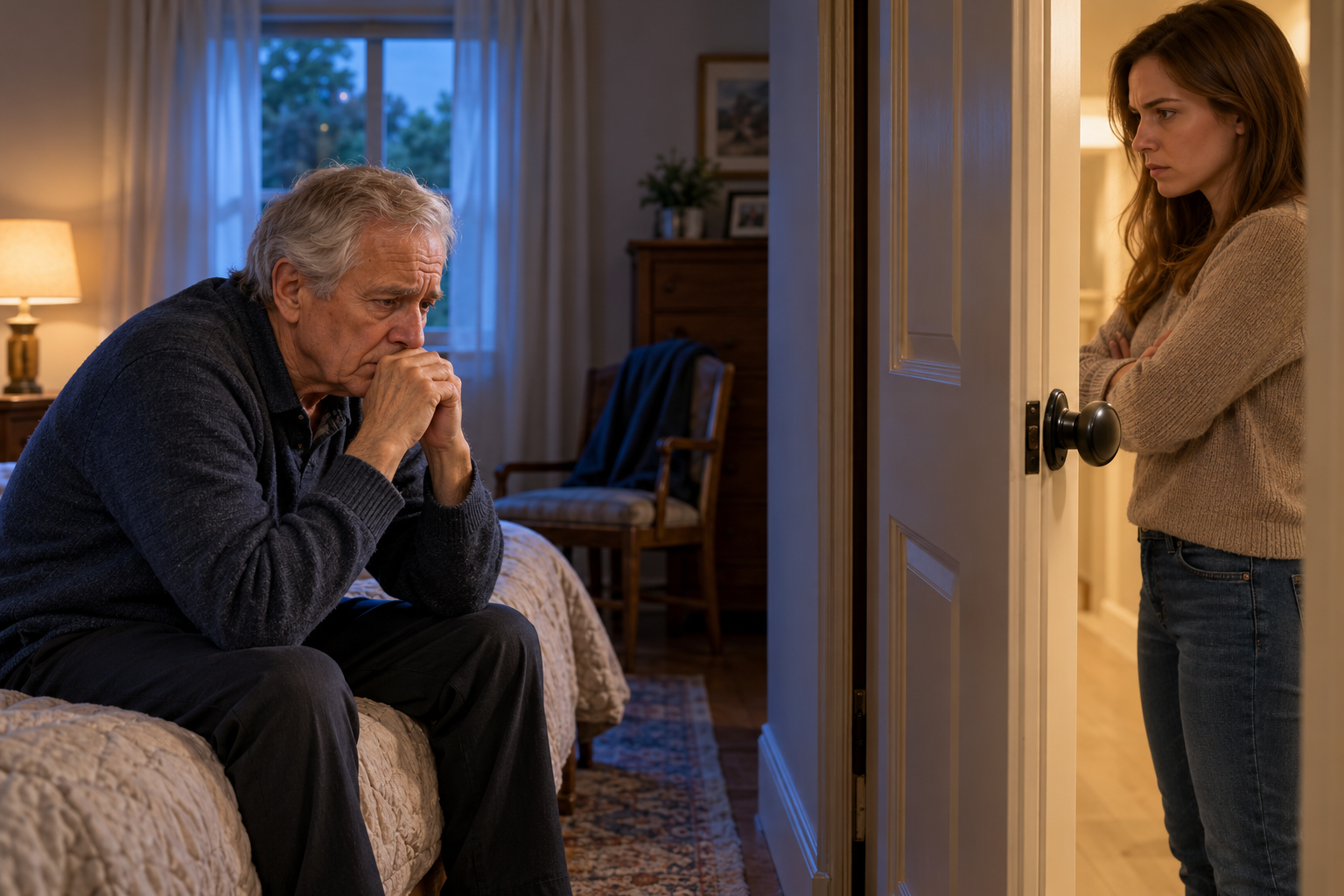
Her expression hardened.
For several seconds, she stared at me.
Then she looked away.
I wished I could have found a way to answer that didn't lead us back to the same place.
But I had already tried being patient.
I had tried being gentle.
I had tried explaining that I was capable of managing my own affairs.
Nothing had changed.
I couldn't keep pretending the questions were harmless just because she asked them quietly.
She finished her coffee.
Then she asked whether she could look around the house.
I frowned.
"You know the house."
"I haven't been in every room for a long time."
I didn't see a reason to refuse that request by itself.
She had grown up there.
There were rooms she hadn't visited recently, but nothing about that seemed unusual.
I told her she could look around.
She stood and walked down the hallway.
I remained at the table.
At first, I heard only her footsteps.
Then a door opened.
Another few seconds passed.
I heard a door close.
I called out to ask whether she needed anything.
"No," she replied.
Her voice sounded normal.
I returned to my coffee.
A few minutes later, she came back into the kitchen.
She looked at me briefly, then picked up her handbag.
"I should go."
I stood up.
"All right."
She walked to the front door.
Before leaving, she turned toward me.
"You really should think about what I've said."
I felt my patience slipping.
"I have thought about it."
"And?"
"And my answer is still no."
She stared at me.
Then she left.
I closed the door and stood in the hallway.
I couldn't remember exactly which rooms she had visited.
I had heard doors opening and closing, but I hadn't paid attention to the sequence.
I told myself there was no reason to be suspicious of someone simply for walking through a house she had known since childhood.
Still, something about the visit bothered me.
It wasn't any one thing she had done.
It was the feeling that she had been looking for something.
I tried to put the thought aside.
I went into the office and worked until late afternoon.
When I finished, I walked through the house to close the curtains.
As I passed the hallway, I glanced toward the door of the forgotten room.
I stopped.
I couldn't explain why I stopped.
The door was closed.
The lock looked ordinary.
I walked closer and examined it.
Nothing seemed wrong.
I went back to the office and retrieved the black key.
When I returned, I unlocked the door and stepped inside.
The room looked the way I remembered it.
The stored items remained in place.
The folders were still where I had left them.
I checked the documents carefully.
Nothing appeared to be missing.
I stood there longer than necessary.
Then I locked the door and put the key away.
I was angry with myself for being unable to relax.
I was also angry that I had begun to feel this way in my own home.
The next morning, I decided to spend some time outside.
I had errands to run, and I wanted a reason to stop thinking about the house for a few hours.
I returned in the early afternoon.
There was no message from Lauren.
I made lunch and sat at the table.
For most of the day, nothing happened.
Then, near evening, my phone rang.
Lauren asked whether I was home.
I told her I was.
She asked whether I had been feeling all right.
I said I had.
She told me she had been worried about me.
I asked why.
She said I sounded tired lately.
I told her I was getting older, but that didn't mean I needed someone else making my decisions.
She went silent.
Then she said I always found a way to turn her concern into an argument.
I closed my eyes.
I didn't want to repeat the conversation.
"I appreciate you checking on me," I said. "But I need you to respect my answers."
She said she understood.
We ended the call politely.
I hoped that would be the end of it.
That night, I slept badly.
I kept thinking about the forgotten room and the black key.
I couldn't prove Lauren had done anything there.
I couldn't even prove she had been looking for the room.
I had to be honest about that.
My suspicions were not facts.
But the repeated questions about the documents were facts.
The requests to transfer the house were facts.
Her refusal to explain what she wanted was a fact.
I could acknowledge those things without inventing anything else.
The next morning, I reviewed the property papers again.
I wanted to be absolutely certain that I understood what they established.
I read through the documents slowly.
I checked the names and signatures.
I examined the records I had kept over the years.
Everything confirmed the same thing.
The property belonged to me.
I didn't need Lauren's permission to keep it.
I didn't need her agreement to make decisions about it.
And I didn't have to surrender my records because she believed she could manage them better.
I put the papers away.
Then I went to the kitchen and made another cup of coffee.
I sat near the window, holding the warm mug between my hands.
I thought about calling Lauren.
I considered asking her to come over so we could talk without discussing ownership.
But I decided against it.
I had already made enough attempts to reach her.
It was her turn to decide whether our relationship mattered more than getting her way.
That afternoon, she sent a short message asking whether I was home.
I replied that I was.
She said she might visit the next day.
I told her she was welcome to call first.
She didn't respond.
I put the phone away.
For the first time, I understood that protecting my property wasn't only about keeping documents locked away.
It was also about refusing to let fear dictate every decision I made.
I wasn't going to spend the rest of my life hiding in the office.
I wasn't going to stop answering the door.
And I wasn't going to pretend I had done something wrong by keeping what belonged to me.
I still loved my daughter.
That hadn't changed.
But love didn't mean I had to ignore the things that troubled me.
I went to bed that night determined to keep that distinction clear.
I had no idea how difficult it would become to remember it when the next problem arrived.
Click here to continue reading: PART 8: I Had Kept the House, the Keys, and My Records Under My Control, Yet I Had Not Considered What Might Happen Behind a Closed Door
I Thought My Daughter Wanted the House Until I Realized She Needed Something I Had Never Agreed to Give Her
Part 7 of 20