The first thing I wanted to know was why my dead husband had sent me to Costa Rica.
The second was whether I had been stupid enough to come.
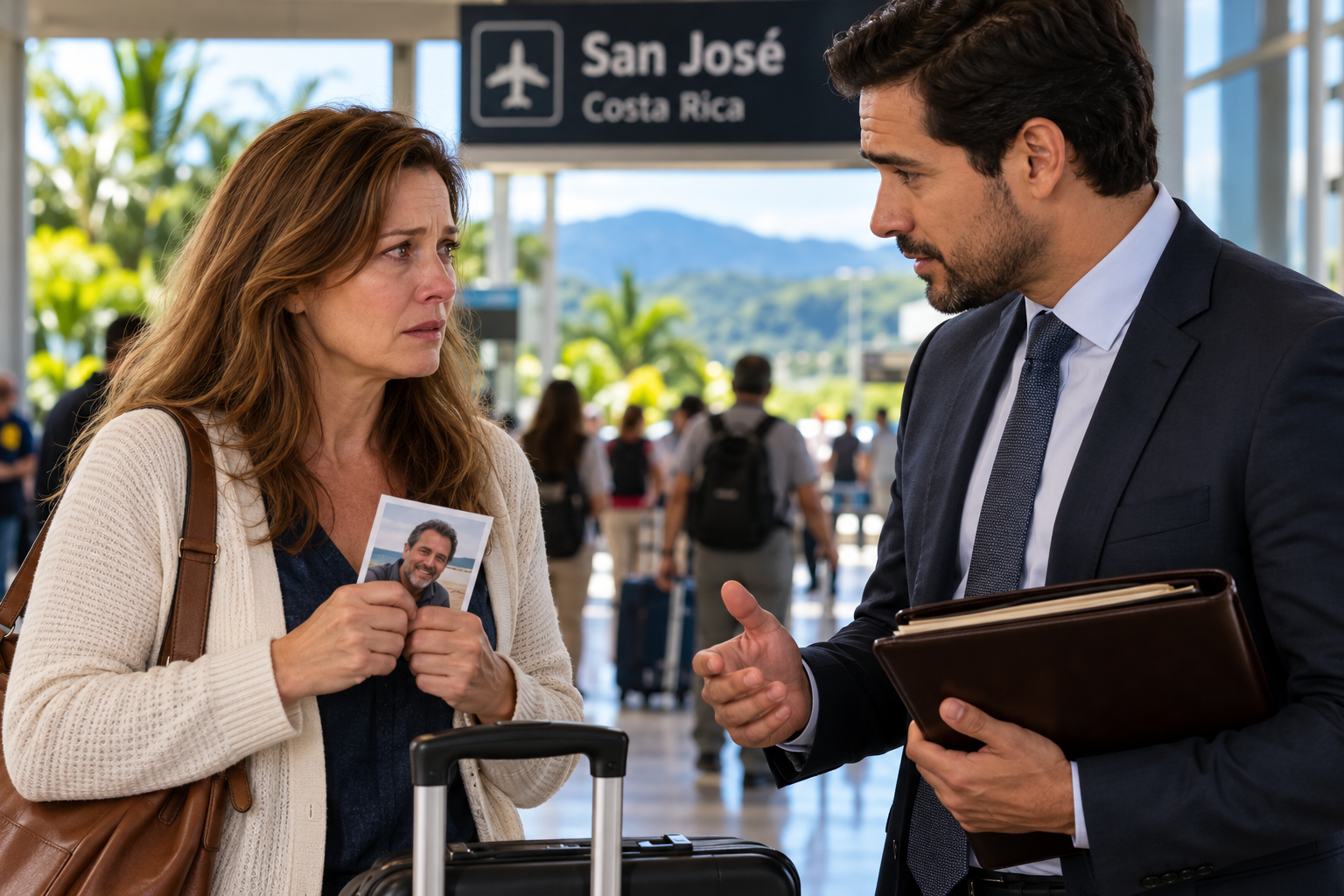
I stood inside the airport in San José with a photograph pressed between my fingers and a suitcase beside my leg. People moved around me in every direction, talking, laughing, checking their phones, looking for familiar faces.
I had none.
My husband was dead.
Our children had money waiting for them.
And I had a one-way ticket that had brought me thousands of miles from home.
I kept staring at the photograph, as if the answer might appear if I looked long enough.
It didn't.
I had spent the flight trying to make sense of what had happened. I had replayed the last weeks of my husband's life, remembering the conversations I had dismissed, the questions he had avoided, and the things he had told me not to worry about.
At the time, I had believed he was simply tired.
Now I wasn't sure I had ever understood him.
I had loved my husband for years. I had raised our children with him, built a home with him, and trusted him with the ordinary details of our lives.
I knew how he took his coffee.
I knew the sound of his footsteps in the hallway.
I knew the way he rubbed his forehead when he was thinking about something he didn't want to discuss.
Or at least, I thought I did.
The man who had died was the same man who had arranged this trip.
But I couldn't understand why.
A one-way ticket.
Costa Rica.
A photograph.
That was what I had been given, and none of it felt like enough.
I looked toward the airport doors again.
Every few seconds, someone arrived to meet a traveler. A woman hurried forward to hug a young man carrying a backpack. An older couple waved at a little girl who ran toward them with her arms out.
I watched them longer than I should have.
I was jealous.
That is an ugly thing to admit, but it was true. I wanted someone to be waiting for me because they were happy to see me, not because a dead man had left instructions behind.
I wanted to go home.
I wanted my husband to be alive.
Mostly, I wanted to stop feeling as though everyone else knew something I didn't.
I had almost decided to find a taxi and leave when a man approached me.
He looked to be in his forties, perhaps a little older. He wore a dark suit, carried a leather folder, and moved with the careful confidence of someone who had a reason to be there.
He stopped a few feet away.
"Mrs. Henderson?"
I looked up.
"Yes?"
He extended his hand and introduced himself as Daniel Ruiz, an attorney based in San José.
I shook his hand because I didn't know what else to do.
His grip was firm, and his expression was serious without being unfriendly.
He told me my husband had arranged for him to meet me at the airport.
Then he explained that he had been given specific directions about what to tell me after I arrived.
I pulled my hand away.
For a moment, I couldn't make myself answer.
My husband had arranged this?
How?
He was dead.
I said so.
Daniel didn't look surprised.
He told me he already knew.
That answer made me angrier than I expected.
If he knew my husband was dead, then why was he standing there speaking as if this were an ordinary appointment? Why had nobody explained anything to me before I boarded the plane?
I wanted to ask all of that.
Instead, I tightened my fingers around the photograph.
I was afraid that if I let it go, I would have nothing left to hold on to.
Daniel glanced toward the entrance as travelers passed between us. He seemed to understand that I was close to losing my patience.
He told me he realized the situation was difficult.
Then he asked me to come somewhere private, explaining that my husband had anticipated my questions.
That was when I finally said what had been bothering me since I landed.
"Why did he send me here?"
Daniel paused.
It wasn't a long pause, but I noticed it.
He didn't immediately answer. He looked at me as if he were weighing his words, and for the first time, I wondered whether he was afraid of telling me something.
I had spent years thinking my husband was a straightforward man.
He worked, paid the bills, helped with the children, and came home at the end of the day. He could be stubborn, sometimes distant, but I had never thought of him as someone who maintained a separate life I knew nothing about.
Now I was standing in a foreign airport with a lawyer who claimed to be following my husband's instructions.
I felt foolish.
Not because I had trusted my husband.
Because I had never thought to ask how much I didn't know.
Daniel offered to take my suitcase.
I told him I could manage it.
He accepted that without argument.
I followed him away from the arrivals area, passing a row of waiting drivers and people holding signs. The airport seemed louder now, although nothing around me had changed.
My suitcase wheels rattled over the floor.
I kept the photograph in my hand.
Daniel didn't try to fill the silence with small talk. I appreciated that more than I wanted to admit.
When we reached a quieter area, he stopped and turned toward me.
He said my husband had made arrangements before his death and had been unusually precise about how they should be carried out.
I asked whether those arrangements involved our children.
He said he would explain everything once we were somewhere private.
That answer brought my attention back to the thing I had been trying not to think about.
The money.
My children had been left millions.
That was what I understood from the estate arrangements. Whatever else my husband had decided, he had made sure our children would be financially secure.
I should have been grateful.
I was grateful.
But there was another feeling underneath it, one I had tried to bury since the first time I heard the details.
I had been left with questions.
Our children had been left money.
And I had been sent away.
I didn't know what that meant, but I couldn't stop comparing the two things.
I wondered whether my husband had believed I would be better off here. I wondered whether he had wanted me away from something. I wondered whether this trip was a gift, a warning, or a punishment for something I hadn't even known I had done.
Every possibility made me feel worse.
I asked Daniel whether my husband had left a message for me.
He said there were instructions he needed to discuss with me.
That wasn't the same as a message.
I told him so.
He looked at me for a moment, then said he understood why I was upset.
I nearly laughed.
Understanding my anger wasn't the same as answering my questions.
But I followed him anyway.
I had come too far to turn around without knowing why.
And if my husband had gone to the trouble of arranging a meeting on the other side of the world, I needed to know what he thought was so important.
I also needed to know whether I could trust the man waiting to explain it.
Daniel Ruiz was a stranger.
My husband had trusted him.
Until that moment, I hadn't realized those were two very different things.
Click here to continue reading: PART 2: The Attorney Knew My Husband’s Instructions, but Every Answer Seemed to Lead Me Toward Another Question I Was Afraid to Ask
My Husband Was Gone, Our Children Had Inherited Millions, and Somehow I Had Ended Up Alone in a Country I Barely Knew
Part 1 of 20