I had thought the end of the journey would be the moment everything finally made sense.
It wasn't.
The end was quieter than that.
It came when I stopped expecting Daniel to give me the one answer no one could provide.
My husband was gone.
The arrangements had been made.
Our children had been left millions, and I had been sent to Costa Rica to hear information he had decided should be explained in person.
I had listened to Daniel.
I had asked my questions.
I had tried to understand the decisions without pretending that I knew the private reasons behind every one of them.
Some things had become clearer.
Others remained uncertain.
I had to accept that distinction.
When the meeting was finished, I thanked Daniel for taking the time to explain what he could.
I meant it.
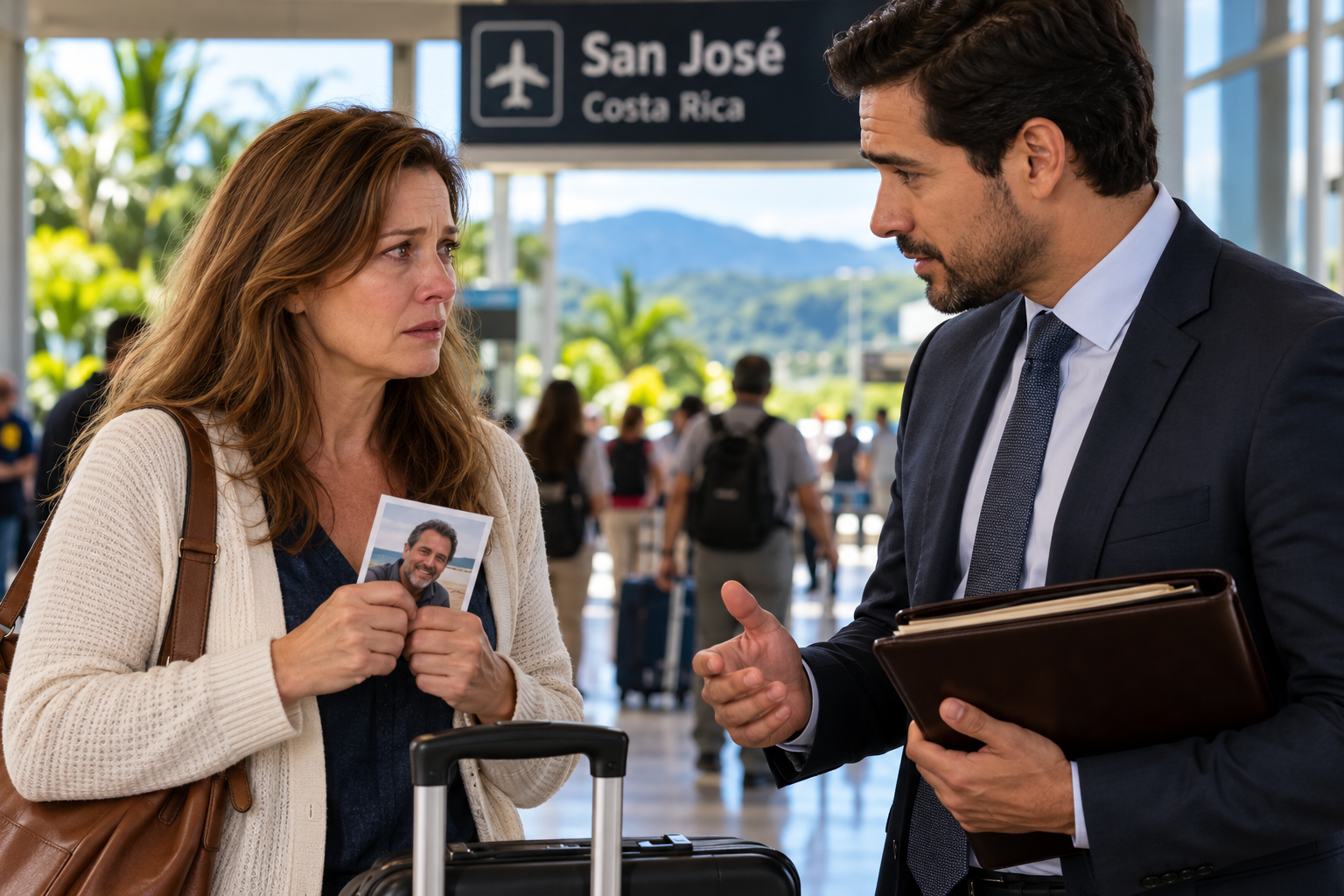
I had not trusted him when I first saw him at the airport.
I had assumed that his careful manner meant he was hiding something from me.
Sometimes he had been unable to answer my questions, but that did not mean he had been trying to deceive me.
He had been doing the work my husband had asked him to do.
He had also allowed me to question the arrangements rather than demanding that I accept them.
I was grateful for that.
I asked whether there was anything else I needed to know before I left.
Daniel reviewed the practical matters with me once more.
I listened carefully.
Then I asked him to clarify one final point.
He did.
I thanked him again.
There was no dramatic moment in which the room seemed to change.
No sudden understanding that made every painful question disappear.
Just a conversation that had finally reached its end.
I picked up my bag.
The photograph was inside.
I could feel its shape through the fabric, and for a moment I considered taking it out.
Instead, I left it where it was.
I didn't need to hold it to remind myself of the journey.
I would remember.
I would remember standing in the airport, watching families reunite while I waited for a stranger to explain why I had been sent so far from home.
I would remember the anger I felt when Daniel told me that my husband had arranged the meeting.
I would remember how badly I wanted to leave before hearing the explanation.
And I would remember the moment I decided to stay.
That decision mattered.
I had not stayed because my husband had the right to control what I did after his death.
I had stayed because I wanted to understand.
There was a difference.
I had finally begun to recognize that difference, and I intended to keep it with me.
When I thought about returning home, I no longer imagined that I would step through the door and immediately feel like the person I had been before the trip.
I would not be that person again.
I had learned that even a long marriage could contain unanswered questions.
I had learned that trusting someone did not mean knowing every part of them.
I had learned that grief could make uncertainty feel like betrayal, even when the truth was more complicated.
And I had learned that I could be angry with someone I loved without allowing anger to become the only memory I kept.
Those lessons had cost me something.
I wished they had come in another way.
But I could not change how I had learned them.
I could only decide what to do with them.
I thought about our children.
They had inherited their father's money.
They had also inherited the memories of the man who had raised them.
I didn't want my confusion to take those memories away from them.
If they wanted to remember their father with gratitude, they had every right to do so.
If they had questions about his choices, they had the right to ask them.
I would not tell them what to feel.
I would tell them what I knew.
I would explain that their father had made arrangements I had not understood, and that I had traveled to Costa Rica because I wanted to hear what he had left behind.
I would be honest about the fact that the trip had been difficult.
I would not pretend that every question had been answered.
And I would not ask them to choose between loving their father and understanding why his decisions had hurt me.
They did not owe me that.
They were his children.
I was his wife.
We had each lost him in our own way.
I needed to let them grieve without making my unanswered questions the center of their loss.
That was one of the decisions I could make for myself.
I thought about my husband again.
For a long time, I had wanted the final explanation to tell me whether he had trusted me.
I had wanted to know whether he had believed I could handle the truth.
I had wanted to know why he had chosen a stranger to deliver information he could have discussed with me himself.
Those questions still mattered.
I could not honestly say they no longer hurt.
But I was beginning to understand that I might never receive answers that satisfied me completely.
I could spend the rest of my life trying to imagine what he had been thinking.
I could examine every memory for a sign that I had missed something.
I could replay old conversations and wonder whether a different question might have changed what happened.
Or I could accept that our marriage had been real, that my trust had been genuine, and that his final decisions were not the only measure of the years we had shared.
I chose the second path.
Not because it was easier.
Because it was more honest.
My husband had loved our children enough to plan for their financial future.
He had made arrangements that brought me to Costa Rica.
I did not understand every reason behind those choices.
I did not have to pretend otherwise.
I could acknowledge what he had provided without denying what he had left unresolved.
I could remember the kindness he had shown me without excusing every decision.
I could admit that I was hurt without deciding that the whole marriage had been a mistake.
That was the truth I could live with.
I picked up my suitcase.
It felt lighter than it had at the airport.
Perhaps that was only because I was no longer gripping the handle so tightly.
I had arrived carrying the belief that someone else held the answer to my future.
I was leaving with the understanding that some of the decisions ahead belonged to me.
I would decide what to do with the information Daniel had given me.
I would decide how to speak with our children.
I would decide what I needed to ask next, and what I would have to accept without an answer.
I would decide how to remember my husband.
Those decisions would not be easy.
But they would be mine.
I thought about the photograph one last time.
It had traveled with me from home, through the airport, and into a conversation I had feared having.
I had treated it as though it might contain the answer to everything.
Perhaps I had needed something small and solid to hold while the rest of my life felt uncertain.
I understood that now.
The photograph had not solved the mystery.
It had reminded me that I was still the person carrying it.
I could keep it without asking it to explain my husband's choices.
I could return home without pretending the journey had settled every question.
And I could continue living without requiring the past to become perfectly clear before I allowed myself a future.
That was what my husband had not been able to decide for me.
Whatever he had intended, he could not choose how I would live after hearing his instructions.
He could not tell me what to forgive.
He could not tell me which memories to keep.
He could not decide whether I would spend the rest of my life angry with him.
Those choices belonged to me.
I had spent too much of the journey trying to understand why he had sent me away.
Now I understood something more important.
I did not have to let the way he had left me determine the way I lived from that point forward.
I could grieve him.
I could question him.
I could love him.
I could be disappointed in him.
And I could still move on.
Not because everything had been explained.
Because I was ready to stop waiting for someone else to give me permission.
When I thought of my husband now, I no longer saw only the man who had sent me to Costa Rica with a one-way ticket.
I also remembered the man who had helped raise our children, who had worked to provide for them, and who had shared years of ordinary life with me.
Neither memory erased the other.
I would carry both.
I would carry the questions, too.
But they would no longer be the only things I carried.
I had arrived in Costa Rica believing that my husband's final secret would decide what our marriage had meant.
I was leaving with a different understanding.
His choices were part of our story.
They were not the whole story.
And they would not be the final decision I made about my own life.
The End
Read more original stories on Feel Every Story.
My Husband Was Gone, Our Children Had Inherited Millions, and Somehow I Had Ended Up Alone in a Country I Barely Knew
Part 20 of 20