Daniel continued explaining the arrangements, and I tried to follow without letting my thoughts run ahead of him.
It was harder than I expected.
I had spent the journey imagining that the mystery would become easier once someone finally began talking.
Instead, every explanation reminded me of another question.
I wanted to understand the practical details.
I also wanted to understand the man who had made the decisions.
Those were two different kinds of understanding, and I was beginning to see that I might not receive both at once.
Daniel explained what he had been asked to handle and why my presence mattered to the meeting.
I listened closely.
When he paused, I asked whether the arrangements had been made before my husband's death.
He confirmed that the instructions had been given beforehand.
I had already suspected as much, but hearing it made the situation feel more deliberate.
My husband had not simply left behind an unfinished task.
He had made a plan.
He had decided that I would travel to Costa Rica.
He had decided that Daniel would meet me.
He had decided that I would hear the explanation in person.
And he had done all of that without telling me what I would be asked to face.
I pressed my lips together.
I didn't want my anger to become the only thing I could hear.
Daniel had not asked me to approve the plan.
He had been asked to carry it out.
I needed to remember that.
I asked whether my husband had given him a reason for choosing Costa Rica.
Daniel answered within the limits of what he knew, but he did not offer a simple explanation that made the trip seem ordinary.
I leaned back.
"So even you can't tell me everything about why he chose this place?"
Daniel explained that there were things he could clarify and things he could not answer on my husband's behalf.
I looked at him for a long moment.
It was an uncomfortable answer, but a reasonable one.
He was not my husband.
He could explain instructions.
He could describe what had been arranged.
He could tell me what he had been asked to do.
But he could not give me a complete account of every thought my husband had kept to himself.
I had been hoping he could.
That hope had been unfair.
I looked down at the folder.
There was something almost insulting about how ordinary it seemed.
A few papers.
A leather cover.
A man's careful handwriting, perhaps, somewhere among the documents.
I had expected the secret to announce itself.
I had imagined that the explanation would arrive with a dramatic revelation, something so clear that I would immediately understand why I had been sent across the world.
Instead, I was sitting in a quiet place listening to an attorney explain arrangements one step at a time.
That was how real life often worked.
The important things did not always arrive with a warning.
Sometimes they appeared as paperwork.
Sometimes they appeared as a question that had been ignored for too long.
And sometimes they arrived after the person who could explain them had died.
I asked Daniel whether my husband had intended the meeting to settle something.
He said the meeting had a purpose, and he wanted to make sure I understood it properly.
I didn't press him for a more specific answer.
I was beginning to recognize the difference between a question that moved the conversation forward and one that simply repeated my frustration.
I wanted to ask useful questions.
I wanted to hear something I could work with.
I wanted to leave this conversation with a clearer understanding of what my husband had intended.
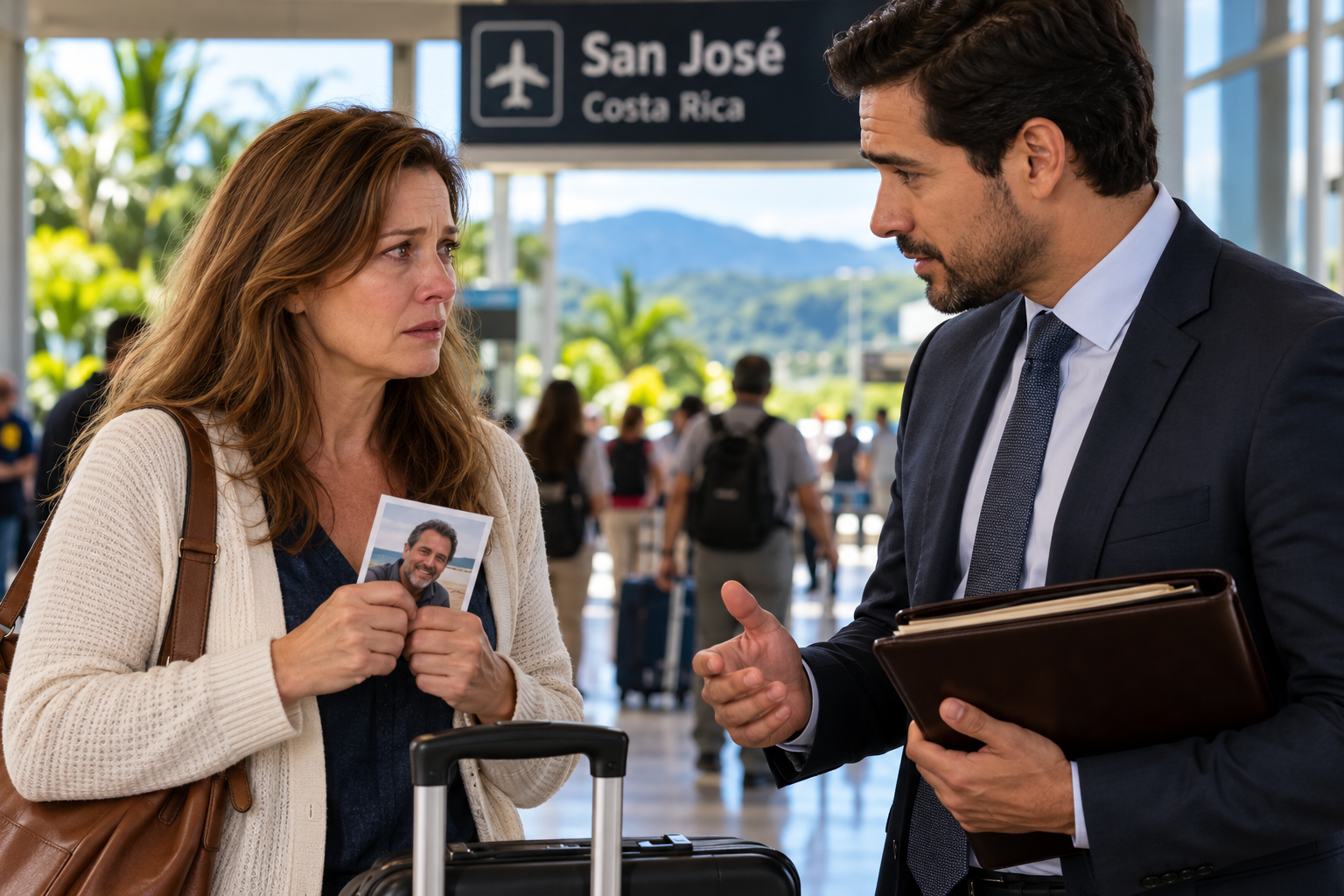
I glanced toward my bag.
The photograph was still there.
I had nearly forgotten about it while listening to Daniel.
That bothered me.
I had carried it from home as though it were the key to the whole situation, but I had no evidence that it explained anything.
I took it out and placed it beside me.
Daniel noticed the movement.
For a brief moment, his attention rested on the photograph.
I looked at him.
"Do you recognize it?"
He did not immediately answer.
I felt my heart beat harder.
It was the first time since we had begun talking that something seemed to interrupt the careful pattern of his responses.
I waited.
Daniel looked at the photograph again, then returned his attention to me.
He did not offer an explanation that I could use to draw a conclusion.
I felt disappointed, but I also realized that I might have mistaken his glance for recognition.
People look at things without knowing what they mean.
I had to stop treating every movement as a clue.
I picked up the photograph and held it carefully.
"I don't know why I keep carrying this around," I admitted.
Daniel said it was understandable to hold on to something familiar during a difficult journey.
His answer was kind, but it didn't explain why I had chosen that particular photograph.
I returned it to my bag.
For a moment, I thought about my husband holding it before he died.
I wondered whether he had known I would bring it.
Then I stopped myself.
I was making up a scene that might never have happened.
I had to distinguish memory from imagination.
The distinction had become important.
My husband had left me with unanswered questions, but that didn't give me permission to invent the answers.
I looked at Daniel again.
"Did he tell you how he wanted me to react?"
Daniel said he had not been instructed to demand any particular response from me.
That surprised me.
I had expected my husband to have planned even that.
Perhaps I had underestimated how much of this situation remained uncertain, even for the people involved.
I asked whether I was free to disagree with whatever he had arranged.
Daniel made it clear that I could ask questions and form my own judgment about what I heard.
I felt some of the tension leave my shoulders.
I didn't know what I would do with the information once I had it.
But at least I would not be expected to pretend that I agreed simply because my husband had made the arrangements.
That mattered more than I could explain.
I had loved a man who could be certain about things long before everyone else was ready to decide.
Sometimes his confidence had helped our family.
Sometimes it had left little room for anyone else's opinion.
I had learned to live with that habit because I believed we were working toward the same goals.
Now I needed to know whether his final decision had been made with the same assumption.
Had he believed that I would eventually understand?
Had he believed that I would accept his reasoning?
Or had he simply decided that explaining himself was no longer necessary?
I couldn't know.
I was beginning to accept that the answer might remain uncertain even after Daniel finished speaking.
That didn't mean the meeting was pointless.
It meant I needed to judge the information for what it was, rather than demanding that it explain every part of my marriage.
Daniel continued.
I listened.
I asked questions when something was unclear.
And for the first time since arriving, I felt that I was participating in the conversation rather than being carried through it.
I still didn't know why my husband had chosen this country.
I still didn't know what the photograph meant.
But I was no longer willing to let my fear decide what those things had to mean.
I would hear the rest.
Then I would decide what to believe.
Click here to continue reading: PART 11: The More I Learned About the Arrangements My Husband Had Made, the More I Realized That His Silence Had Left Me With a Decision of My Own
My Husband Was Gone, Our Children Had Inherited Millions, and Somehow I Had Ended Up Alone in a Country I Barely Knew
Part 10 of 20