
I used to think that the hardest part of losing someone was learning to live without them.
I had been wrong.
The hardest part was discovering that there were things you could no longer ask.
There would be no more late-night conversations with my husband. No more chances to bring up an old argument and hear his version of what happened. No more opportunities to ask why he had made a decision that had hurt me.
Death had taken away the person who could answer those questions.
And now, somehow, his decisions were still directing my life.
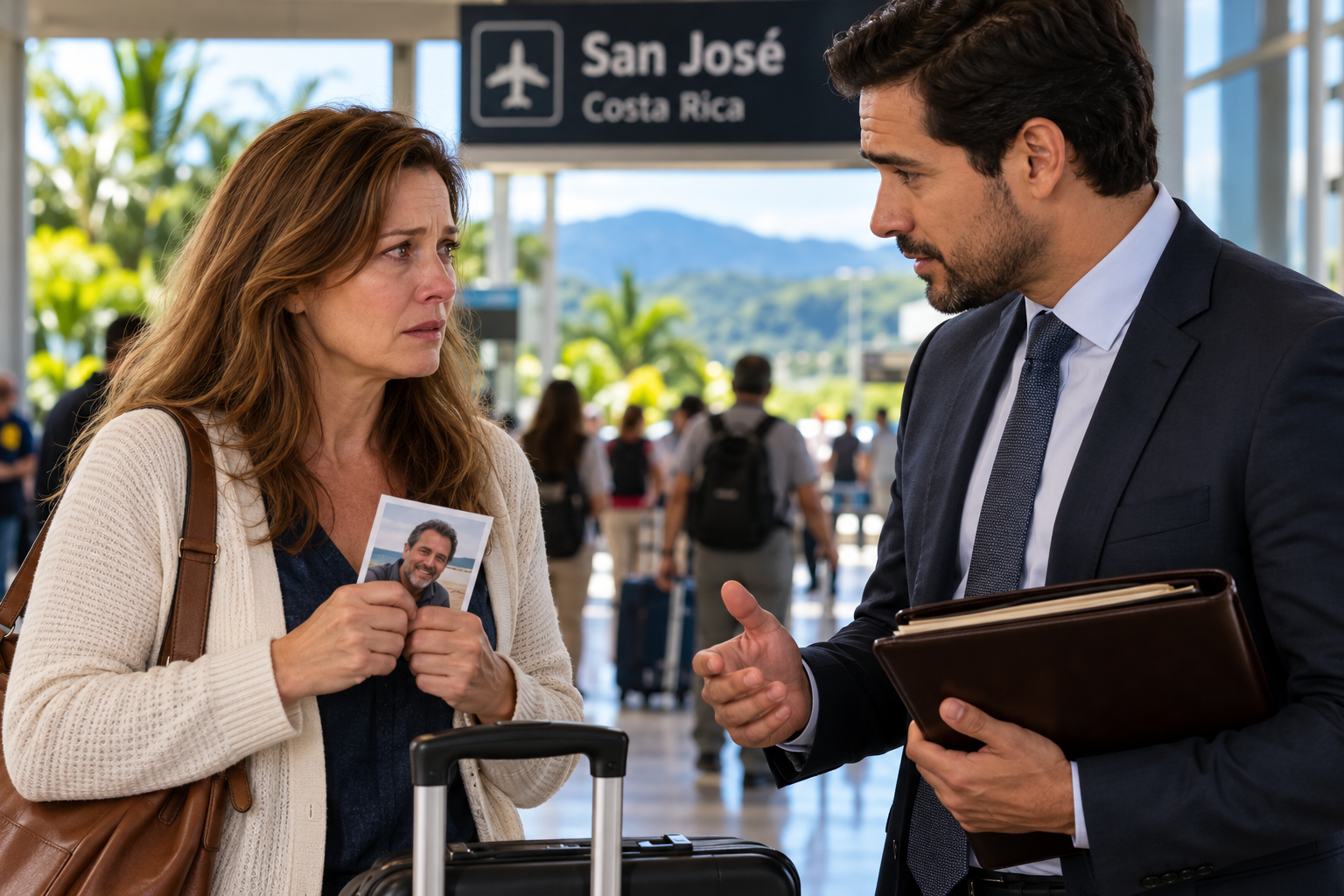
I stood beside Daniel with my suitcase and tried to imagine what my husband had been thinking when he arranged the trip.
Had he known I would be frightened?
Had he expected me to be angry?
Had he believed that, once I arrived, everything would become clear?
I couldn't answer any of those questions.
The more I tried, the more I found myself returning to the same facts.
He was gone.
Our children had been left millions.
I had been sent to Costa Rica on a one-way ticket.
And Daniel Ruiz had been told to meet me.
There was no reason to believe those things were connected by accident.
I had to stop pretending otherwise.
I asked Daniel whether he could tell me at least one thing my husband had wanted me to understand before I arrived.
He considered the question.
For a moment, I thought he might finally give me something useful.
Instead, he told me that my husband had wanted the meeting to happen in person.
I looked at him in disbelief.
"He could have called me."
Daniel didn't argue.
"He could have written me a letter."
Again, Daniel remained quiet.
"He could have told me before he died."
My voice had become sharper with each sentence.
I wasn't trying to frighten Daniel. I was trying to make him understand that this wasn't a simple matter of paperwork or travel arrangements.
I had lost my husband.
I had been separated from the familiar life I was trying to hold together.
And I was being asked to accept that a man who had loved me had deliberately left me with no explanation.
I couldn't make those things fit together.
Daniel said he understood that the circumstances were painful.
I looked away before he could see my expression change.
I didn't want sympathy.
I wanted an answer.
For years, my husband had been part of every important decision I made. Even when I disagreed with him, I knew where to find him. If I needed to discuss something, I could wait until he came home or call him when he was away.
There had always been another opportunity.
Now there wasn't.
I felt the weight of that absence more strongly than I had during the flight.
At home, grief had been surrounded by familiar things. The kitchen table. The rooms we had shared. The ordinary objects that reminded me of the life we had built together.
Here, there was nothing familiar enough to soften it.
I didn't know the streets.
I didn't know the people.
I didn't even know what my husband expected me to do next.
I was a widow standing in a foreign country, depending on a stranger who had been told more about my future than I had.
The realization left me feeling helpless.
I hated that feeling.
I had spent much of my life making sure our family had what it needed. I had learned to handle problems, to keep going when I was tired, and to make decisions even when there was no perfect choice.
I had not expected to become someone who needed permission to understand her own circumstances.
I asked Daniel whether he had been instructed to tell me everything at once.
He said he had been given a clear set of directions for the meeting.
I asked whether those directions had come directly from my husband.
Daniel confirmed that my husband had provided the instructions before his death.
I waited for more.
Nothing followed.
I rubbed my thumb along the edge of the photograph inside my bag.
I could feel the slight bend I had made in it earlier.
That small imperfection bothered me. It was evidence that I had been gripping the photograph too tightly, as though I could force it to reveal something by refusing to let go.
I had always believed that holding on was a virtue.
Hold on to your marriage.
Hold on to your family.
Hold on to the memories that make a difficult day bearable.
But there was a difference between holding on to a person and holding on to the idea of who you thought that person was.
I was beginning to understand that difference.
My husband had clearly kept something from me.
I didn't yet know whether he had done it to protect me, to protect someone else, or because he believed I would never understand.
I didn't know whether his secret was connected to the money left to our children.
I didn't know whether the photograph had anything to do with it.
And I didn't know why the answer had to be waiting in Costa Rica.
I had no evidence that the truth would be cruel.
But I had no reason to assume it would be kind.
I looked at Daniel again.
He seemed prepared to continue waiting until I was ready to move.
That made me realize something uncomfortable.
He could wait.
He had a job to do, and he knew what it involved.
I was the one whose life had been turned upside down.
I was the one who had boarded a plane without knowing what awaited me.
I was the one who had to decide whether to keep following a plan made by someone who could no longer explain himself.
I could leave.
The thought came suddenly.
I could take my suitcase, find a way back to the airport counter, and arrange to return home. I could refuse to participate in whatever my husband had planned.
For a few seconds, the idea felt wonderful.
I imagined stepping onto a plane and putting the whole experience behind me.
I imagined going home, closing the door, and refusing to think about the ticket again.
Then I thought about our children.
They had inherited millions, but they had also lost their father. Whatever else my husband had arranged, there might be a reason he had wanted me to hear something in person.
If I turned away now, I might never know.
I might spend the rest of my life wondering whether I had walked away from the one explanation he had tried to leave me.
That possibility frightened me more than the airport did.
I had come because I needed to understand.
I could not leave simply because understanding had become uncomfortable.
I told Daniel I would continue with the meeting.
He nodded, accepting my decision without making it seem like a victory.
I appreciated that.
He did not tell me I was doing the right thing. He did not pretend to know how I felt. He simply acknowledged that I was ready to proceed.
I picked up the handle of my suitcase.
My fingers were stiff from gripping it.
I loosened them and tried again.
Then I took one final look around the airport.
People were still arriving.
Families were still embracing.
Suitcases were still rolling over the floor.
The world had not changed because my husband was dead.
That was perhaps the cruelest part.
Everyone else could continue with their lives while I stood there trying to understand the one I had been left with.
I turned away from the arrivals area.
Daniel moved ahead, and I followed.
I still didn't trust him completely.
I didn't trust the instructions my husband had left.
And I no longer trusted my own memories enough to assume that I knew everything about the man I had married.
But I had made my decision.
I would hear what Daniel had to say.
I would ask the questions that mattered.
And if my husband had left me a secret, I would find out what it was.
Not because I owed him obedience.
Because I owed myself the truth.
Click here to continue reading: PART 5: I Followed the Attorney Away From the Airport, Hoping the Man My Husband Had Trusted Would Finally Tell Me Why I Was There
My Husband Was Gone, Our Children Had Inherited Millions, and Somehow I Had Ended Up Alone in a Country I Barely Knew
Part 4 of 20

One Comment on “PART 4 – The More I Tried to Make Sense of the Ticket, the More I Realized That My Husband Had Left Me Outside a Story Only He Could Explain”