I had imagined returning home many times during the journey.
At first, I pictured myself leaving the airport, finding a way back to the terminal, and boarding the first flight I could manage.
Later, I imagined going home after Daniel explained everything.
In that version, the trip would finally make sense, and I would be able to put the confusion behind me.
Neither picture seemed realistic anymore.
I couldn't return to the life I had known before my husband's death.
Even if I boarded a plane that evening, the questions would come home with me.
The only difference would be that I would have heard less of what Daniel had been asked to explain.
I didn't want that.
I wanted to finish the conversation.
Daniel continued reviewing the remaining information, and I listened with the patience I had struggled to find earlier.
I asked questions when I needed to.
I made sure I understood the answers.
I did not pretend that a point was clear simply because I wanted the meeting to end.
That was something I had learned during the hours we had spent talking.
Silence could be useful.
But silence could also hide confusion.
I had spent too much of my life trying to keep difficult moments comfortable.
I wasn't going to do that now.
When Daniel finished explaining a point, I asked whether there was anything else connected to it that I needed to understand.
He answered carefully.
I listened.
Then I considered the information before moving on.
The process was slow.
It was also more honest than the way I had begun the day.
I had arrived angry and frightened, ready to believe that every hesitation meant something terrible.
Now I was beginning to see that uncertainty did not automatically mean danger.
Sometimes it simply meant that I did not know enough yet.
I could wait for more information without inventing the worst possibility.
I could remain cautious without treating everyone as an enemy.
I could admit that my husband had hurt me without deciding that his entire life had been a lie.
I had needed to learn those things.
I wished I had not needed to learn them this way.
At one point, Daniel asked whether I wanted to review anything we had already discussed.
I considered the question.
There were parts I wanted to hear again, but I didn't want to repeat the entire conversation simply because I was afraid of missing something.
I asked him to clarify the details that still seemed uncertain.
He did.
I thanked him.
For the first time, I noticed that I was speaking to him without the sharpness I had carried through the airport.
I wasn't trying to punish him for being the person my husband had chosen.
I was beginning to see him as himself.
He was Daniel Ruiz, an attorney who had been given instructions by a man who was no longer alive.
He could help me understand those instructions.
He could not make my husband come back.
He could not tell me exactly what my husband had felt.
And he could not decide what I should do with the information.
Those limits did not make him useless.
They made him human.
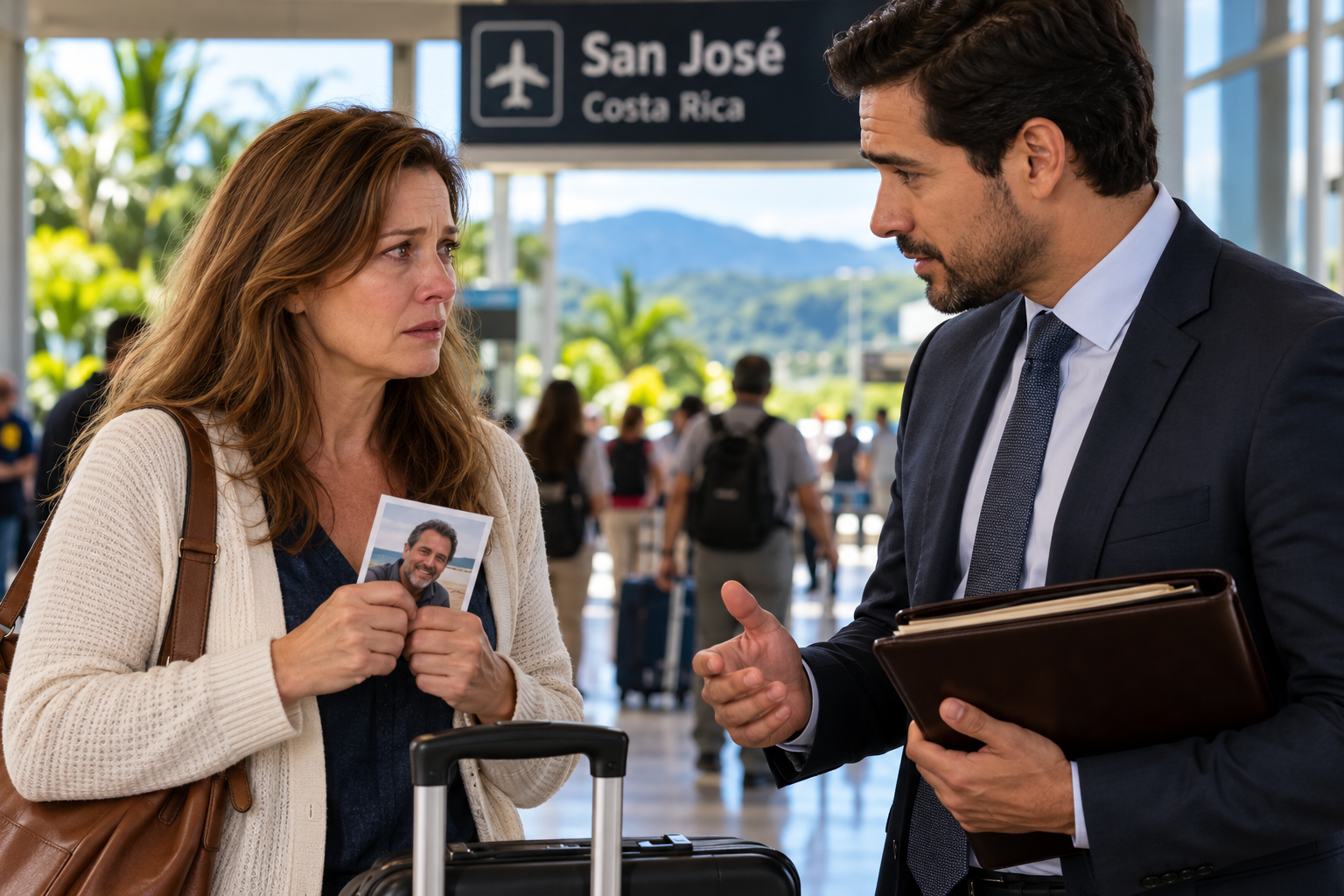
I looked at the photograph inside my bag.
I thought about taking it out, but I decided not to.
I had begun to understand that I didn't need to keep checking whether it was there.
I could trust that I had brought it with me.
I could examine it again when I was ready.
For now, I needed to concentrate on the conversation.
Daniel finished the information he had been explaining and gave me time to consider it.
I sat quietly.
I thought about our children and the money their father had left them.
I thought about the years we had spent building a family.
I thought about the way I had reacted when I first learned I was expected to travel.
I had felt abandoned.
I had felt angry.
I had wondered whether my husband had trusted me at all.
Those feelings had not disappeared.
But I was beginning to understand that they were only part of what I would carry home.
I would also carry the knowledge that I had come here despite being frightened.
I had listened even when I was angry.
I had asked questions even when I worried that the answers might hurt.
I had refused to agree to something I did not understand.
Those were things I could be proud of.
I had spent too much time wondering whether I had failed my husband by not knowing what he had planned.
I had not failed him simply by being unaware of decisions he had never explained.
I had lived the life I believed we were sharing.
I had loved him as honestly as I knew how.
I could not be responsible for every thought he had kept to himself.
That was a difficult truth to accept.
It was also a necessary one.
I looked at Daniel.
"I think I understand more than I did when I arrived," I said.
He nodded.
"But I don't think I'll ever know every reason he had."
Daniel acknowledged that there were limits to what he could tell me.
I appreciated his honesty.
I had been trying to force the story into a shape where every question had an answer.
Perhaps some questions would remain open.
That didn't mean I had learned nothing.
It meant I had to decide what mattered most now.
I wanted to return home.
I wanted to see our children.
I wanted to sit in a familiar room and allow myself to grieve without the pressure of trying to understand a stranger's instructions.
But I did not want to return home pretending that the trip had meant nothing.
I had learned something about my husband.
I had learned something about myself.
And I had learned that love did not make uncertainty disappear.
I could remember the good things he had done without ignoring the questions he had left behind.
I could acknowledge the pain of his final arrangements without reducing our entire marriage to them.
I could be grateful for what he had provided for our children and still feel hurt by the way I had been left out of the explanation.
I did not have to choose one feeling and discard the others.
I could carry all of them.
I sat back and let the silence settle.
Daniel waited until I was ready to speak again.
I told him I wanted to make sure I had understood the next steps correctly.
We went through them once more.
I listened, asked for clarification, and made sure I understood what was expected of me.
Then I gathered my things.
I checked my bag.
My documents were there.
The photograph was there.
Everything I had brought with me remained in its place.
I had arrived in Costa Rica feeling as though I had lost control of my own story.
I still didn't know how the story would end.
But I was no longer willing to let fear write the next part for me.
I would return home when the arrangements allowed me to do so.
I would speak to our children.
I would take the time I needed to understand what I had learned.
And I would decide for myself how to remember the man I had loved.
Not as a perfect husband.
Not as a stranger.
As a real person who had shared years of his life with me, made choices I understood, and left others I might never fully comprehend.
That was the most honest answer I could give myself.
And for the first time since arriving, it felt like enough to take the next step.
Click here to continue reading: PART 20: I Returned to the Life My Husband Had Left Behind, Carrying the Questions He Could Never Answer and the Freedom to Decide What His Choices Would Mean
My Husband Was Gone, Our Children Had Inherited Millions, and Somehow I Had Ended Up Alone in a Country I Barely Knew
Part 19 of 20