I woke before sunrise.
That was normal for me.
At seventy-seven, my body had developed its own schedule, and it rarely cared whether I had slept well the night before.
I lay in bed for a while, looking at the pale light beginning to gather around the curtains.
The house was quiet.
Usually, I liked that hour.
It belonged to me.
No telephone calls.
No errands.
No one needing anything.
That morning, however, the quiet felt different.
I could not stop thinking about Benjamin.
I wondered whether he had slept peacefully after sending his messages.
I wondered whether his wife had been pleased that I was staying away.
Then I caught myself doing what I had done for years.
I was trying to understand their feelings before allowing myself to acknowledge my own.
I got out of bed.
My feet found the slippers beside the mattress, and I walked slowly toward the kitchen.
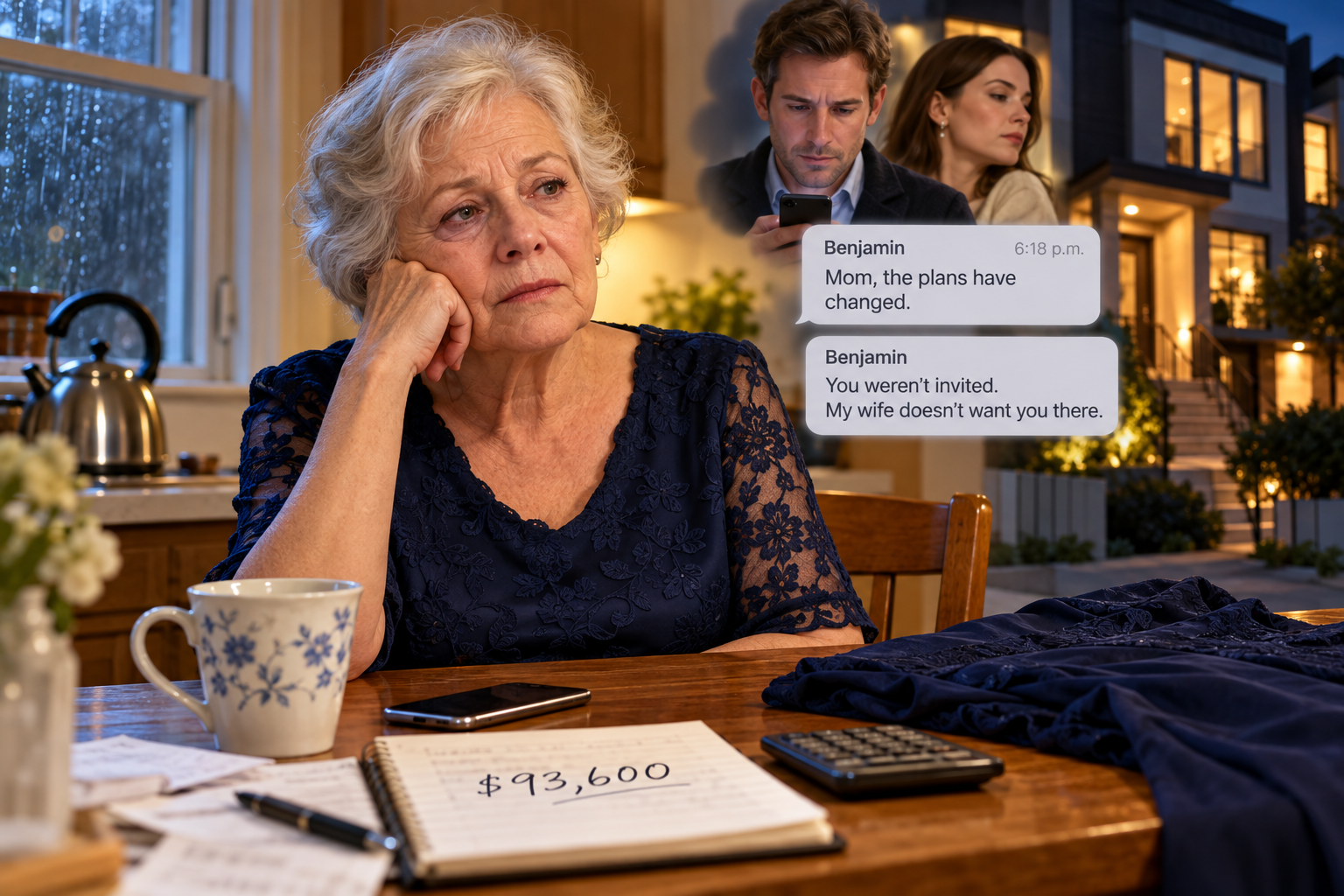
The navy dress was still draped over the chair where I had left it.
I picked it up and carried it to the bedroom.
I hung it in the closet.
I did not want to look at it anymore.
When I returned to the kitchen, my phone was exactly where I had left it.
There were no new messages.
I turned it over.
The screen showed the time and a few ordinary notifications.
Nothing from Benjamin.
I told myself that he was probably busy.
Then I realized I had no idea what he was doing, and that thought made me uncomfortable.
For years, I had known when he was having trouble.
Sometimes he called directly.
Other times, he began with a casual question.
How was I feeling?
Had I been to the bank?
Was everything all right at home?
The conversation would wander for a few minutes before he mentioned the problem.
A bill had arrived unexpectedly.
An expense had been larger than he anticipated.
Something needed to be paid before a certain date.
He never began by demanding money.
That was part of why I had been so willing to help.
He sounded embarrassed.
He sounded worried.
He sounded like the little boy who used to come into my room after a bad dream and stand quietly beside the bed until I lifted the blanket for him.
I would listen.
I would ask questions.
And eventually, I would offer to take care of whatever was troubling him.
Sometimes he accepted with a sigh of relief.
Sometimes he hesitated long enough for me to reassure him.
He always thanked me.
At least, that was how I remembered it.
I went to the cupboard and took down the tin where I kept my tea.
My hands were steady as I prepared breakfast.
That seemed important.
I wanted to know that I could still do ordinary things without the evening before interfering with every movement.
I toasted a slice of bread.
I spread a little butter on it.
I sat at the table and ate slowly.
Then I opened the drawer and took out my notebook again.
I had no intention of confronting Benjamin with it.
I wanted only to understand how the year had reached that total.
I turned to the first page of payments.
There were dates, amounts, and short notes written in my own handwriting.
I had not always recorded the reasons.
Sometimes I wrote only the date and the amount.
Other times, I included a few words to remind myself what had happened.
I moved through the entries one by one.
Some made me remember conversations I had nearly forgotten.
Others brought back the same familiar feeling of urgency.
I could recall sitting at my desk with the telephone pressed against my ear while Benjamin explained why he needed help.
I could recall opening my banking application afterward and checking that the transfer had gone through.
I could recall telling him not to worry.
Those words had come so easily.
Don't worry.
I'll help.
We'll work it out.
I had used them so often that I had stopped thinking about what they meant.
They were not merely words of comfort.
They were promises.
And I had been making those promises with money I had spent decades saving.
I paused over one entry.
Then I turned the page.
I did not want to get trapped in individual memories.
The total was what mattered.
Ninety-three thousand six hundred dollars.
I had paid that much in one year.
The number looked larger in the daylight than it had the night before.
Perhaps because the house was quiet enough for me to think.
Perhaps because I was no longer preparing myself to see Benjamin and had nothing else to occupy my attention.
I reached for a calculator and checked the figure again.
The result was the same.
I sat back in my chair.
I had enough savings to live comfortably if I remained careful.
I had planned my retirement around that fact.
I had worked, saved, and avoided unnecessary spending because I did not want to become a burden to anyone.
I had never expected to live extravagantly.
I wanted a safe home, enough money for food and bills, and the freedom to make my own decisions.
I wanted to know that if something happened to me, I could manage without asking my son to rescue me.
That had always been important.
Yet I had spent a year helping him in ways that made me wonder whether I had been protecting his independence at the expense of my own.
I closed the notebook.
Then I opened it again.
I felt foolish for having allowed the number to grow without stopping to consider what it was doing to me.
But I also knew that I could not judge every decision by its outcome.
When I had sent the money, I believed I was helping my son through a difficult period.
I had not sent it in exchange for dinner invitations.
I had not sent it because I expected him to praise me.
I had certainly not imagined that he would owe me affection in return.
That would have been wrong.
A mother could not buy love and then complain that the purchase had failed.
I knew that.
But I also knew the difference between buying affection and expecting basic consideration from someone who claimed to love you.
I had not asked Benjamin to repay me with gratitude every day.
I had not demanded that he agree with me about everything.
I had only wanted to remain part of his life.
And now, after a year of financial help, he had told me that I was not welcome at a dinner he had arranged.
I placed the notebook on the table and pressed both palms against the cover.
I was angry.
Not only with Benjamin.
With myself, too.
I had been so determined to make his life easier that I had rarely stopped to ask whether I was making my own life harder.
I had mistaken being needed for being valued.
That was the part I found most difficult to face.
Because being needed had given me a purpose after the house grew quieter and the years began to pass.
It had made me feel useful.
When Benjamin called with a problem, I could do something.
I could listen.
I could help.
I could make a frightening situation less frightening.
I could still be his mother in a way that felt familiar.
I had not noticed how much I had come to depend on that feeling.
The morning light reached the far edge of the kitchen table.
I gathered the papers scattered around me and arranged them in a neat pile.
Then I took a clean sheet of paper and wrote the total again.
$93,600.
I looked at it for a long time.
Underneath, I wrote a question.
How much more?
I stared at those two words.
They were not an accusation.
They were not even a decision.
They were simply something I had never asked myself before.
How much more could I give without putting my own future at risk?
How much more was I willing to give if Benjamin continued to treat my presence as something he could accept or reject whenever it suited him?
And how much longer would I keep telling myself that the next payment might somehow make things better?
I put the pen down.
I had no answers yet.
But I knew I could no longer pretend the questions did not exist.
I gathered the notebook and the sheet of paper.
I placed both in the drawer beside the refrigerator.
Then I shut it.
For the first time since Benjamin's message arrived, I felt that I had done something for myself.
It was a small thing.
I had simply written down what I was afraid to ask.
Still, it mattered.
I spent the rest of the morning doing ordinary tasks.
I washed the breakfast dishes.
I wiped the kitchen counter.
I checked the mail.
I watered the plants near the front window.
Each task gave me a reason to keep moving.
I did not call Benjamin.
I did not send another message asking him to explain himself.
I did not apologize for something I had not done.
At noon, I heated soup and ate it at the table.
My phone remained quiet.
By afternoon, I had begun to accept that I might not hear from him that day.
That realization hurt more than I expected.
I had spent so much time being available that I had forgotten what it felt like not to wait for someone.
I took a book into the sitting room and tried to read.
I managed a few pages before my attention drifted.
Then I returned to the kitchen and looked at the drawer where I had put the notebook.
I did not open it.
I did not need to.
The total was already in my head.
So was the question I had written beneath it.
How much more?
That evening, I prepared a simple meal and ate alone.
I did not set an extra place.
I did not keep the telephone beside my plate.
I placed it on the counter instead.
The house was still quiet, but I was no longer listening for a message every few minutes.
I was trying to learn how to let the silence belong to me.
Before going to bed, I checked my phone one final time.
There was still nothing from Benjamin.
I set it down and turned off the light.
I did not know whether my son understood what he had done.
I did not know whether he regretted it.
But I knew something had changed in me.
I was no longer willing to measure my worth by how quickly I could solve his problems.
And I was beginning to understand that helping someone did not mean surrendering every right to be treated with care.
Click here to continue reading: PART 3: I Had Kept Every Payment in Good Faith, but the More I Looked at the Records, the Less Certain I Became About Our Arrangement
I Had Already Paid for So Much of My Son’s Life That I Never Imagined He Would Tell Me I Was Not Welcome
Part 2 of 20