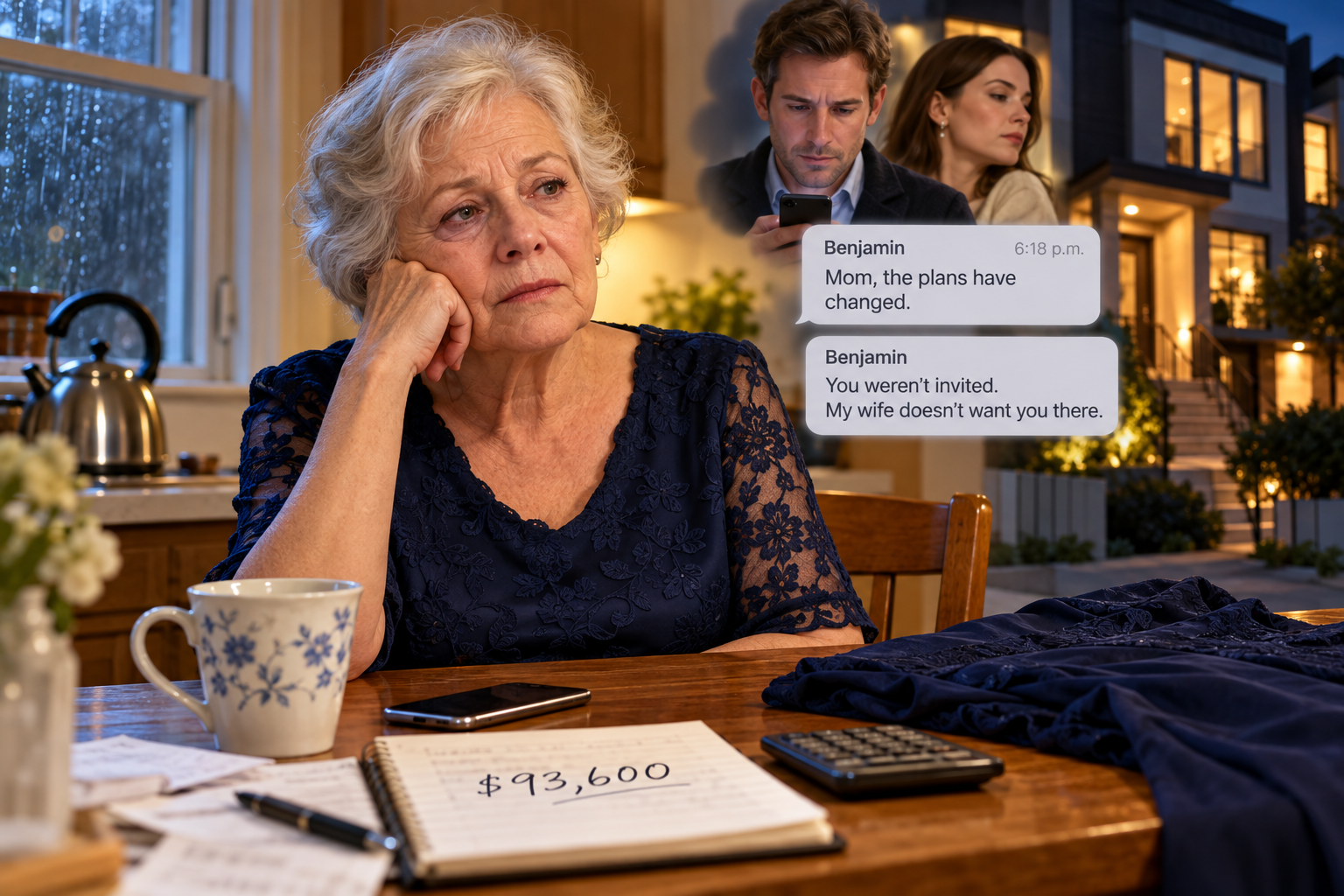
The next morning, I took the notebook out again.
I told myself I was only checking the arithmetic.
That was partly true.
I also wanted to see the payments in one place, without the conversations and reassurances that had accompanied them.
Numbers were easier to examine than memories.
They did not soften their meaning because someone sounded frightened on the telephone.
They did not become smaller because the person receiving the money was my son.
I spread the pages across the table.
Then I began checking the entries against the records I had kept.
I was careful.
At my age, I had learned that memory could be generous to people I loved.
I did not want to accuse Benjamin of anything simply because I was hurt.
If I was going to question my own decisions, I wanted to do it honestly.
I checked one entry.
Then another.
The dates matched.
The amounts matched.
I moved to the next page.
My handwriting varied from one month to another.
Some entries were neat and precise.
Others had been added in a hurry, with the ink pressed hard into the paper.
I could tell which payments had worried me most.
Those were the ones where I had written the amount twice or drawn a small line beneath it.
I had never intended those marks to mean anything.
Now they looked like signs I had left for myself and then ignored.
I stopped to make another cup of tea.
The kitchen was bright that morning.
Rain had given way to a clear sky, and sunlight rested on the windowsill.
I carried my cup back to the table.
For a moment, I considered putting the notebook away.
I had already checked the total.
I had already admitted that the amount was larger than I should have allowed.
What more could I learn by looking at the same pages?
Then I remembered Benjamin's message.
The way he had written it.
The certainty of it.
He had not asked whether I would mind staying home.
He had not explained that the evening might be difficult.
He had simply informed me that I was not wanted.
I returned to the records.
The problem was not that I had helped him.
The problem was that I had made helping him so easy that I had stopped asking what the arrangement was becoming.
I had never sat down with him and discussed how much I could reasonably contribute.
I had never established a point at which I would say no.
Whenever a new difficulty appeared, I treated it as a separate emergency.
I did not connect it to the previous one.
I did not ask whether the situation was improving.
I only asked what he needed.
That was how I had reached the end of the year with $93,600 written in my notebook.
One request at a time.
One transfer at a time.
One promise at a time.
I put my pen beside the page.
I wanted to be fair to Benjamin.
He was not a stranger taking money from me.
He was my child, and I knew that life could become difficult in ways a person had never planned.
I had seen good people struggle.
I had seen responsible people make mistakes.
I had made my own.
There was no reason to assume that every request for help had been dishonest.
I had no proof of that.
What I did have was a record of my own choices.
I had continued paying.
I had continued reassuring him.
I had continued believing that if I remained patient, things would settle down.
And when he told me not to come to dinner, I had immediately wondered what I had done wrong.
That was the detail I could not ignore.
I had been excluded from his home, yet my first instinct had been to examine myself for the cause.
I had not asked whether he had treated me fairly.
I had asked whether I had failed him.
I folded my hands and sat quietly.
There was a time when Benjamin depended on me for almost everything.
He had been a little boy who came home hungry and tired, a teenager who believed the world was unfair, and a young man who thought he could manage anything until something went wrong.
I had watched him grow through all those stages.
I remembered the way he used to call from another room when he needed help finding something.
He never had to wonder whether I would answer.
I had always answered.
Perhaps that was part of the problem.
I had taught him that I would come whenever he called.
I had not taught either of us what should happen when I could not.
I could not say when that lesson had changed.
There was no single conversation I could point to.
No particular day when Benjamin stopped seeing my help as a gift and began seeing it as something available whenever he needed it.
Maybe the change had happened slowly.
Maybe I had contributed to it by treating every request as proof that I was still important to him.
I did not know.
I only knew that I could not continue without thinking.
I took a clean envelope from the drawer and placed the checked pages inside.
Then I put the envelope away with the rest of my financial records.
I was not preparing to confront my son.
I was trying to make sure I understood my own position before I made another decision.
That afternoon, I went for a short walk.
I wore comfortable shoes and carried my phone in my coat pocket.
The air was cool, and the pavement was still damp in places.
I walked slowly, stopping once to adjust my cardigan beneath my coat.
Normally, I would have used that time to think about what Benjamin might need next.
I might have wondered whether he was managing his expenses.
I might have considered calling to ask if everything was all right.
Instead, I tried to pay attention to the things around me.
The sound of a car passing.
The movement of branches in the breeze.
The ordinary rhythm of people going about their day.
I had spent so much time worrying about whether my son was all right that I had neglected the simple experience of being outside without a task to complete.
It felt strange.
Not unpleasant.
Just unfamiliar.
When I returned home, I checked the mailbox.
There was nothing important inside.
I sorted the envelopes and placed the bills on the counter.
Then I sat down and looked at my phone.
I had not received a message from Benjamin since the evening he told me not to come.
At first, I had thought he might contact me the following morning.
Perhaps he would explain that he and his wife had argued.
Perhaps he would say that the message had been written in haste.
Perhaps he would tell me he had not intended to hurt me.
I had imagined several versions of that conversation.
In each one, I ended up reassuring him.
I would tell him that I understood.
I would tell him not to worry.
I would find a way to make the whole thing smaller.
That was what I had always done.
But the more I considered those imagined conversations, the less I wanted to have them.
I did not need Benjamin to be perfect.
I did not need him to agree with every choice I made.
I did not even need him to invite me to every dinner.
I needed him to speak to me as though my feelings mattered.
And if he could not do that, I needed to stop pretending that money would somehow fill the space where consideration should have been.
I put the phone down.
I was not ready to make a final decision.
I was still his mother.
That had not changed simply because he had hurt me.
But being his mother did not require me to keep making the same mistake.
I returned to the kitchen and opened the drawer.
The notebook lay beneath a few folded papers.
I lifted it out and turned to the page with the annual total.
For a long time, I stared at the number.
Then I closed the cover.
I did not tear out the page.
I did not throw the notebook away.
I wanted to keep the record because it was part of my life, and I had no intention of pretending that year had never happened.
The money had been real.
The help had been real.
So had the hurt.
I put the notebook back in the drawer.
This time, I did not feel compelled to open it again.
I had seen enough to know that something needed to change.
I just did not yet know how far I would have to go.
Click here to continue reading: PART 4: By the Time I Looked at the Full Year of Giving, I Could No Longer Convince Myself That Another Payment Would Repair What Had Broken
I Had Already Paid for So Much of My Son’s Life That I Never Imagined He Would Tell Me I Was Not Welcome
Part 3 of 20