For the next few days, I tried to return to my usual routine.
I woke early.
I made breakfast.
I took care of the house.
I answered the telephone when it rang.
I went through the mail and kept track of the ordinary things that needed attention.
From the outside, nothing appeared different.
But I was no longer moving through my days in quite the same way.
Whenever I reached for my phone, I noticed what I was doing.
Was I checking the time?
Was I looking for a message?
Was I hoping Benjamin had finally decided to speak to me?
Often, the answer was the last one.
I did not like admitting that.
I had spent decades teaching myself to be independent.
I had managed a household, raised a child, and faced losses that could not be repaired with money or patience.
I knew how to get through difficult days.
Yet a few words from my son had left me waiting beside a telephone as though I needed his permission to feel settled again.
That realization stayed with me.
I began leaving the phone on the counter while I worked in another room.
At first, I worried that I might miss a call.
Then I asked myself what I would actually miss.
If Benjamin needed something urgently, he could leave a message.
I did not have to be ready at every moment.
The thought seemed obvious once I allowed myself to consider it.
Still, changing a habit was harder than recognizing it.
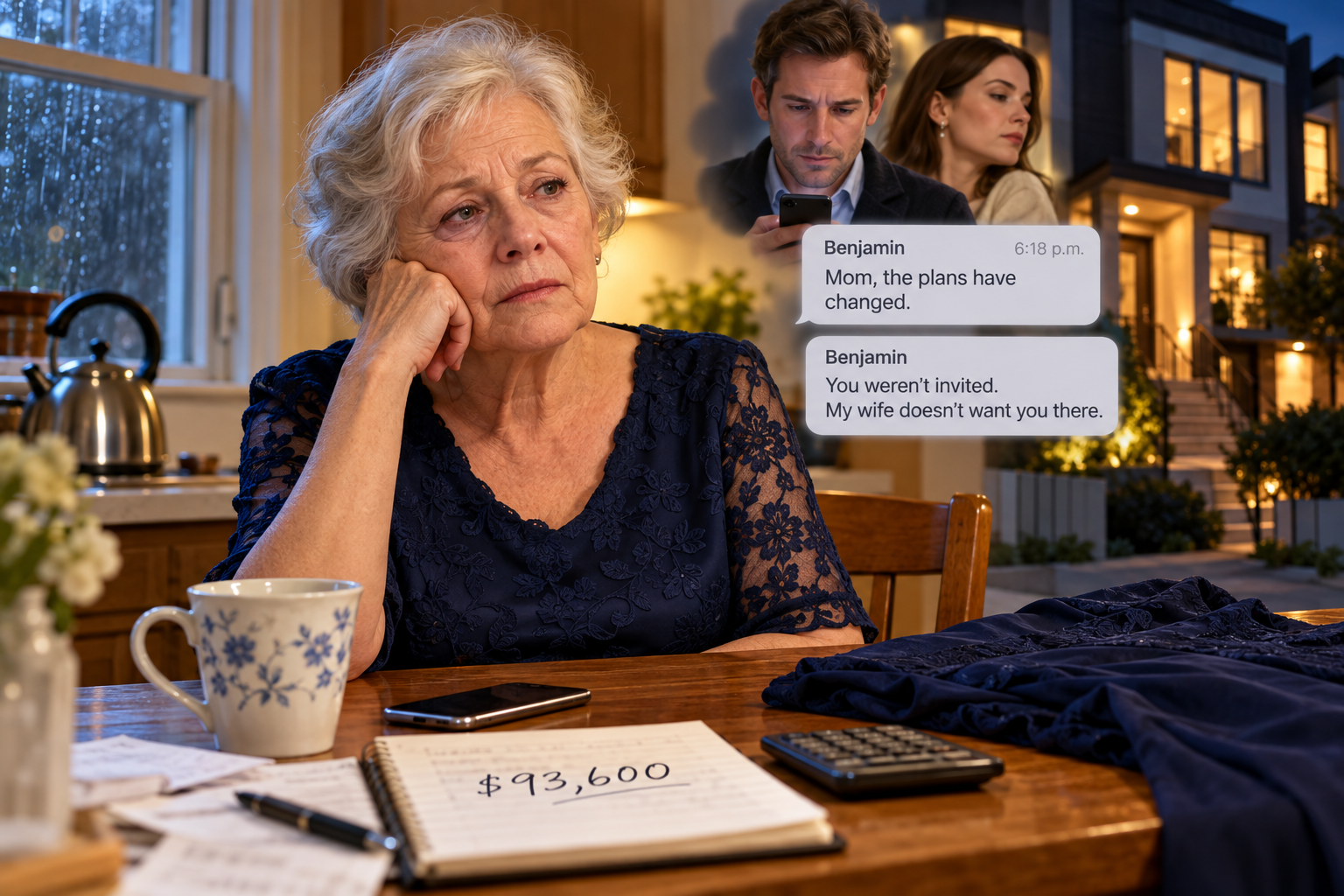
On the third morning, I took the notebook out one last time.
I wanted to make sure the yearly total was accurate.
I checked the figures carefully.
I followed each entry with the tip of my pen.
When I reached the end, I added the amounts again.
The result did not change.
$93,600.
I sat back.
There was no satisfaction in being right.
I had not wanted the number to be so large.
I would have been happier if I had discovered a mistake, something that made the total less frightening.
But the records were clear.
I had covered that amount during the year.
I had done so willingly, at least in the sense that no one had forced my hand.
I had made the transfers because I wanted to help my son.
I had believed the assistance would make his life easier.
I had not considered how much of my own security I was placing behind that belief.
I put the pen down and looked around the kitchen.
The table was old, but it was sturdy.
The chairs had served me for years.
The cupboards held the dishes I had collected slowly, buying replacements only when something broke.
There was nothing extravagant in the room.
I had never needed much.
That was why the amount bothered me.
It was not simply a large number on a page.
It represented years of careful decisions, hours of work, and the small sacrifices I had made without telling anyone.
I had saved because I wanted to remain independent.
Then I had begun giving so much away that I had put that independence under pressure.
I had done it out of love.
I could admit that without pretending the decision had been wise.
Love did not make every choice sensible.
And good intentions did not protect a person from consequences.
I closed the notebook and placed it in the drawer.
I was finished checking the total.
For the first time, I did not feel that I needed to prove anything else to myself.
The amount was what it was.
The question now was what I would do about it.
I began with something simple.
I decided I would not make another financial commitment without taking time to consider it.
No immediate promises.
No quick reassurance.
No agreeing to something merely because Benjamin sounded worried.
If he asked for help again, I would listen.
I would consider what he said.
But I would not answer before I understood what I could afford and what the request would mean for me.
It was not a punishment.
I wanted to make that distinction clear, even if I was the only person who needed to hear it.
I was not trying to make Benjamin suffer because he had hurt me.
I was trying to stop making decisions that left me feeling frightened, resentful, or foolish afterward.
I had a right to protect what remained of my savings.
I had a right to consider my own future.
I had a right to say that I needed time.
Those rights had not disappeared because I was a mother.
Nor had they disappeared because I was seventy-seven.
That afternoon, I made myself a proper lunch.
I set the table for one.
I placed a folded napkin beside my plate and poured myself a glass of water.
The sight of the empty chair across from me brought back the dinner I had expected to attend.
For a moment, I imagined the townhouse.
I imagined Benjamin and his wife sitting down to eat.
I wondered whether they had discussed my absence.
I wondered whether my son had thought about me at all.
Then I stopped.
I could not know what had happened in their home, and I was tired of filling the gaps with explanations that made me feel worse.
I ate my lunch.
When I finished, I washed the plate and dried it.
I returned the napkin to the drawer.
The afternoon continued.
I read for a while.
I watered the plants.
I sorted a small pile of papers that had been waiting on my desk.
The tasks were ordinary, but I found comfort in completing them.
They reminded me that my life was still mine to manage.
I did not need to solve the entire problem that day.
I only needed to stop making it harder for myself.
Later, I checked my phone.
There was a message from Benjamin.
My stomach tightened before I opened it.
That reaction made me angry with myself, though I knew I could not simply command the feeling to disappear.
I read the message.
It did not offer the explanation I had hoped for.
There was no acknowledgment of the way he had spoken to me.
No question about how I had spent the evening.
No indication that he understood why I might have been hurt.
I read it again, searching for something I might have missed.
Then I set the phone down.
I did not answer immediately.
That was new for me.
In the past, I would have replied at once, trying to keep the conversation warm.
I would have looked for a way to make things comfortable between us.
I might even have asked whether he needed anything.
This time, I let the message sit.
I went to the window and stood there for a few minutes.
The navy dress was hanging in the closet now, out of sight.
But I could still remember the way I had smoothed the fabric while waiting for dinner.
I had wanted to look nice for my son.
I had wanted the evening to feel ordinary.
I had not expected anything grand.
Just a seat at the table.
A conversation.
The chance to spend time with my child without wondering whether I had become an inconvenience.
I returned to the kitchen and picked up the phone.
I read the message one final time.
Then I placed it on the counter without replying.
I did not know whether Benjamin would notice the delay.
I did not know whether he would care.
But I knew I could no longer keep rushing to make him comfortable while ignoring how uncomfortable I had become.
That evening, I ate alone again.
I did not turn on the television.
I listened to the quiet sounds of the house and allowed myself to think about what I wanted the next part of my life to look like.
I wanted to remain generous.
I did not want disappointment to turn me into someone who measured every relationship in dollars.
I wanted to help people when I could.
I wanted to love my son without keeping a running account of every kindness.
But I also wanted to stop treating my own needs as though they were less important than his.
Those things could exist together.
I was beginning to understand that.
Before bed, I opened the drawer and touched the cover of the notebook.
I did not take it out.
I simply rested my hand there for a moment.
The record would remain.
So would the memory of the dinner I never attended.
I could not change either one.
What I could change was what happened next.
For years, I had believed that when Benjamin needed something, I should find a way to provide it.
Now I was finally considering another possibility.
Perhaps the most loving thing I could do was stop promising that I would always pay the price.
I turned off the kitchen light and went to bed.
The next morning would come whether my son called or not.
And when it did, I intended to begin it without making his silence the center of my life.
Click here to continue reading: PART 5: I Had Spent Years Making Sure Benjamin Never Had to Worry About Money, Until I Realized I Had Stopped Asking Whether I Could Afford It Myself
I Had Already Paid for So Much of My Son’s Life That I Never Imagined He Would Tell Me I Was Not Welcome
Part 4 of 20