A week passed before I heard from Benjamin again.
I tried not to count the days.
Still, I noticed.
I noticed the quiet mornings when my phone stayed on the counter.
I noticed the evenings when I wondered whether he would call.
I noticed how quickly my mind could turn an ordinary silence into a question about our relationship.
I was learning to recognize those thoughts without allowing them to decide what I did next.
I did not send a message simply to find out whether he was thinking about me.
I did not call to ask whether he had solved his financial difficulty.
I trusted that he could contact me if he wanted to.
That did not mean I had stopped caring.
It meant I was trying to leave room for him to manage his own life.
The distinction remained difficult.
One morning, I opened the drawer to put away a receipt and saw the notebook.
I took it out.
The cover felt familiar in my hands.
I turned to the page where I had written the total.
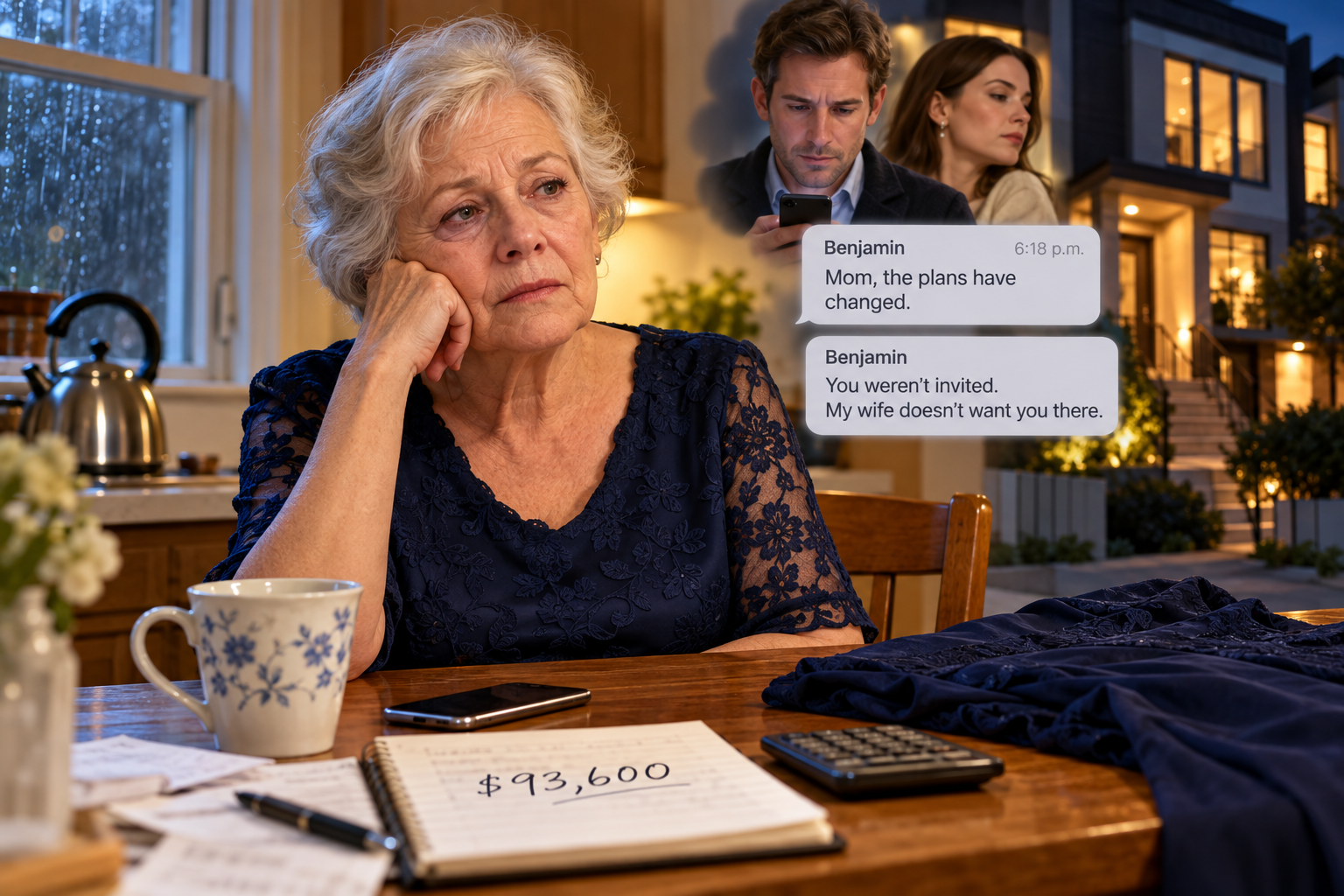
$93,600.
I looked at it for a moment, then turned to the blank page after the last entry.
I considered writing something beneath the number.
Perhaps a note about what I had learned.
Perhaps a reminder not to make decisions while frightened.
But I decided against it.
I did not want the notebook to become a place where I recorded every disappointment I had experienced with my son.
It was a financial record.
It could remain that.
I closed it and put it away.
Then I went about my morning.
I cleaned the kitchen.
I watered the plants.
I prepared lunch.
I spent part of the afternoon reading by the window.
The ordinary rhythm of the day helped me feel steady.
I was beginning to understand that healing did not always involve a dramatic decision.
Sometimes it meant refusing to reopen the same wound every hour.
Sometimes it meant letting yourself enjoy a quiet afternoon without feeling guilty for not solving someone else's problem.
That evening, Benjamin called.
I answered after the phone rang twice.
"Hi, Mom."
"Hello, sweetheart."
He asked how I was doing.
I told him I was well.
He said he had been busy.
I listened while he spoke about the week.
I did not ask whether the difficulty he had mentioned was resolved.
If he wanted to tell me, he could.
After a while, the conversation slowed.
I thought about the dinner again.
I could have allowed the call to end without mentioning it.
Part of me wanted to.
I was tired of feeling disappointed.
I was tired of hoping that he might bring it up on his own.
But I also knew that ignoring the hurt would not make it disappear.
I did not want to spend the next several years speaking to my son while carrying an unspoken question between us.
So I asked him about it.
"Benjamin, have you thought any more about what happened before the dinner?"
He was quiet.
I waited.
I did not fill the silence with excuses for him.
I did not tell him that it was all right.
Finally, he said he knew I had been upset.
I listened.
He did not explain why he had sent the message.
He did not tell me what had happened in his home before he sent it.
I could not make him offer an explanation he was not ready to give.
But I also could not pretend that acknowledging my feelings was the same thing as resolving the problem.
"I want us to be able to speak honestly," I told him.
"I don't want to argue with you."
He said he did not want an argument either.
I believed him as far as I could.
Then I added that I had been looking forward to the evening and that being told not to come had hurt me.
I kept my voice quiet.
I did not mention the money.
I did not list the payments or tell him what I had sacrificed.
I wanted him to hear the simple truth without feeling that I was presenting him with a bill for affection.
"I understand," he said.
Again, his answer was brief.
I felt disappointment rise inside me.
I had hoped he might say more.
I had hoped he might tell me he was sorry.
But I reminded myself that I could not control what he chose to say.
I had asked for an honest conversation.
I had not asked him to repeat words merely because I wanted to hear them.
We spoke for another few minutes.
The subject changed to ordinary things.
I answered his questions.
I asked about his week.
We were polite with each other.
When the call ended, I sat quietly for a while.
I felt no great sense of resolution.
The hurt remained.
The financial questions remained.
The distance between us remained, though I could not measure exactly how much.
Still, I was glad I had spoken.
I had not used money to keep the conversation pleasant.
I had not apologized for being hurt.
And I had not demanded that Benjamin make everything right before I would speak to him again.
I had left room for a relationship without pretending that nothing needed to change.
That was not the ending I wanted.
But it was a more honest place to begin.
I went into the kitchen and prepared a cup of tea.
The kettle clicked softly when it finished.
I poured the water and carried the cup to the table.
For a moment, I remembered the evening I had waited in my navy dress, believing I would soon be sitting across from my son at dinner.
I remembered the rain.
The cold kettle.
The message that had changed my plans in a few seconds.
The memory still carried pain.
But it no longer made me feel that I had to rush toward Benjamin and repair something he had not yet acknowledged.
I could let the memory remain what it was.
A painful evening.
A turning point.
A moment when I began to understand that loving my son did not require me to abandon myself.
I finished my tea and washed the cup.
Then I turned off the kitchen light.
Before bed, I checked my phone.
There was no new message.
I placed it on the bedside table and settled beneath the covers.
I still hoped for a better relationship with Benjamin.
I hoped he would eventually understand that I wanted to be part of his life without having to earn my place through financial help.
I hoped I would continue learning to set boundaries without turning them into punishments.
Most of all, I hoped that we could find a way to speak to each other that did not leave either of us afraid of the next conversation.
I could not make those things happen alone.
For years, I had tried to do more than my share.
Now I was learning to leave some responsibility where it belonged.
I closed my eyes.
The house was quiet.
And for once, I did not mistake that quiet for a problem I had to solve.
Click here to continue reading: PART 13: I Had Told Benjamin the Truth About His Message, but I Was Beginning to Understand That Being Heard and Being Understood Were Two Different Things
I Had Already Paid for So Much of My Son’s Life That I Never Imagined He Would Tell Me I Was Not Welcome
Part 12 of 20