The next morning, I woke before the alarm I no longer needed.
I lay still for a few minutes, listening to the house.
There was a faint sound from the kitchen, probably the refrigerator starting up.
I had lived in the same home long enough to recognize its ordinary noises.
They usually comforted me.
That morning, they reminded me how much time I had spent waiting for a telephone call that might never come.
I got out of bed and made my way to the kitchen.
The navy dress was still hanging in the closet.
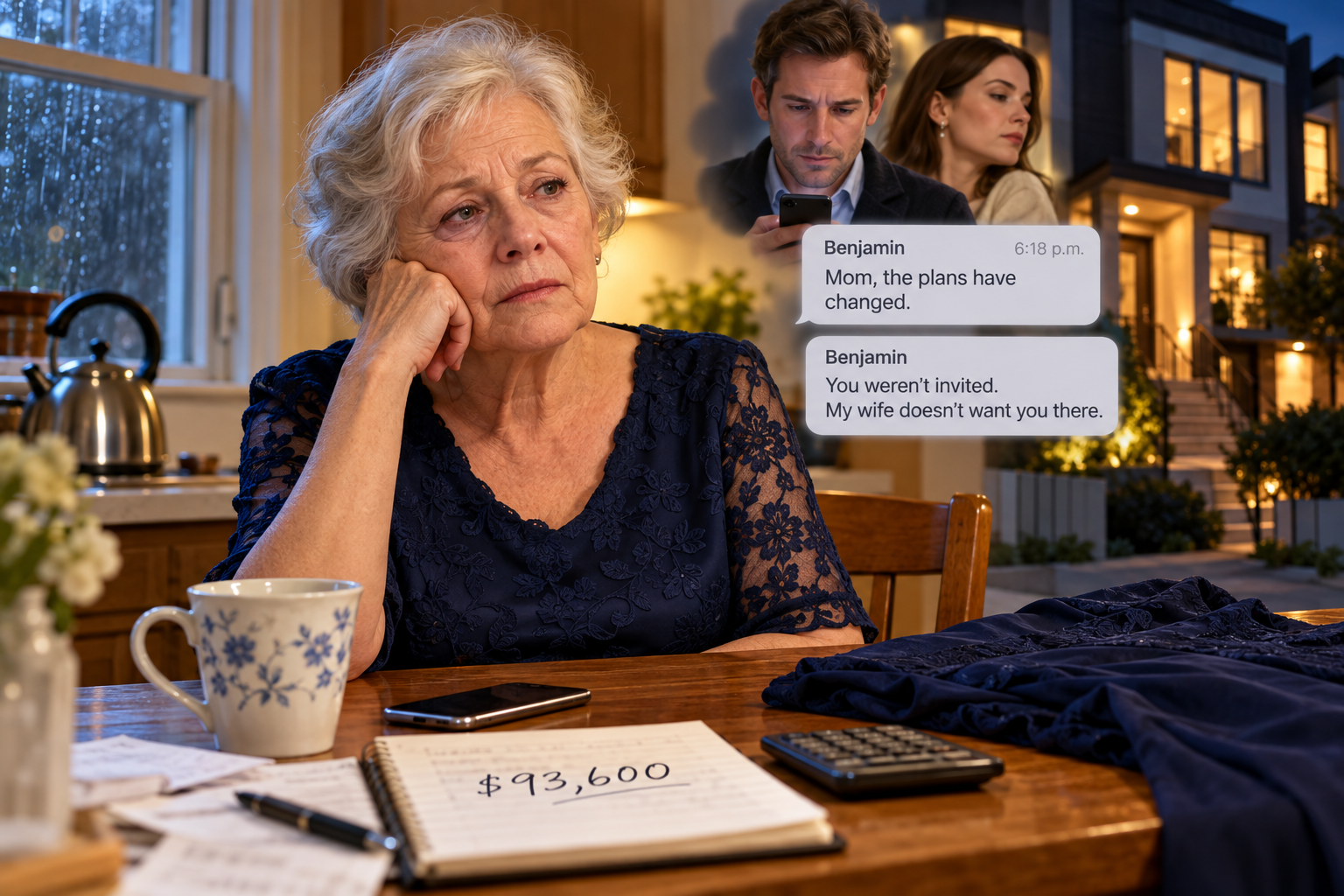
I had not worn it since the evening Benjamin told me not to come to dinner.
I had considered putting it away in a storage box, but I had not done so.
There was no good reason to hide it.
The dress had done nothing wrong.
I had bought it because I wanted to look nice for my son.
That intention was still innocent, even if the evening had ended badly.
I made tea and sat at the table.
My phone rested on the counter.
I did not reach for it.
Instead, I opened the newspaper I had brought in the previous afternoon and read the first page.
I managed several paragraphs before my thoughts drifted back to Benjamin.
His last words to me had been brief.
He understood that I had been hurt.
But he had not explained why the dinner invitation had been withdrawn in such a cold way.
I had hoped that speaking honestly would lead to a longer conversation.
Perhaps I had expected too much from one call.
Perhaps he needed time to think.
I could allow for that possibility without deciding that everything was fine.
I had spent too many years making excuses before I knew the facts.
This time, I wanted to leave room for the truth, whatever it turned out to be.
I finished my tea and cleared the table.
Then I opened the drawer where I kept my notebook.
I needed to put away a receipt, and the notebook was beneath the folder.
I lifted it out and looked at the cover.
For a moment, I thought about the $93,600 I had spent helping Benjamin during the year.
The figure still troubled me.
But it no longer seemed like the only question worth asking.
I had been so focused on how much I had given that I had nearly overlooked something else.
I had been afraid to tell my own son that he had hurt me.
That fear had shaped more of our relationship than I wanted to admit.
I had feared that honesty would make him withdraw.
I had feared that a refusal would make him stop calling.
I had feared that if I stopped solving his problems, I might discover that the financial help had become the main reason he turned to me.
Those fears had not appeared overnight.
They had grown slowly, through a series of conversations in which I tried to keep things pleasant and avoided saying what I really thought.
I could not blame Benjamin for every part of that pattern.
I had participated in it.
I had made myself available without limits, then felt hurt when the arrangement left little room for my own needs.
That did not excuse his message.
It did mean I had work to do that did not depend on him changing first.
I put the receipt away and returned the notebook to the drawer.
Then I went outside.
The garden needed attention.
I watered the plants and pulled a few weeds from the soil near the edge of the path.
The work was slow.
I had to bend carefully, and my knees reminded me that I could not move as quickly as I once had.
I took breaks when I needed them.
That, too, was something I had been learning.
I did not have to push myself past my limits to prove that I could still manage.
By lunchtime, I had finished what I wanted to do.
I washed my hands and prepared a sandwich.
I ate at the kitchen table with the window open a little.
The air was cool.
I could hear a car passing on the road.
Nothing about the afternoon required me to solve a family problem.
For a while, I allowed myself to enjoy that.
Later, my phone rang.
I was in the sitting room, and I recognized Benjamin's number before I picked it up.
"Hello, sweetheart."
He asked how I was doing.
I told him I was well.
He asked about the garden.
I explained that I had spent part of the morning tending to the plants.
He said that sounded nice.
The conversation was ordinary.
I found myself wishing it could remain that way for a little longer.
We talked about the weather and the week ahead.
Then Benjamin mentioned that he had been thinking about our previous conversation.
I sat up a little straighter.
I did not want to rush him.
I waited.
He said he knew the dinner message had upset me.
I told him that it had.
There was a pause.
Then he said he had not wanted the situation to become an argument.
I listened carefully.
I understood that he might have wanted to avoid conflict.
But avoiding conflict had not made the message less painful.
I told him that I did not want an argument either.
I simply wanted to be spoken to with consideration, even when plans changed or someone did not want me present.
He said he understood.
Again, the words were brief.
I wanted to ask whether he agreed with what had happened.
I wanted to know whether he believed the message had been fair.
But I did not ask every question that came into my mind.
I had learned that a conversation could only hold so much.
Instead, I told him that I loved him and wanted us to have a good relationship.
"I know, Mom," he said.
His voice sounded quieter then.
I could not tell whether he was uncomfortable, thoughtful, or simply tired.
I decided not to guess.
We spoke for a few more minutes before ending the call.
Afterward, I sat with the phone in my lap.
I was glad we had talked.
I was also aware that the central question remained unanswered.
I still did not know why he had sent the message as he had.
I still did not know how much of the decision had been his and how much had come from his wife.
And I still did not know whether he understood how deeply the evening had affected me.
I could not force those answers from him.
I could only continue to be honest about my own feelings and pay attention to what happened next.
That evening, I took the navy dress from the closet.
I held it up and examined the front.
The fabric was still smooth.
The creases I had worried about before the dinner were gone.
I almost smiled at that.
I had spent more time worrying about the appearance of a dress than I had spent asking whether I felt comfortable in the relationship I was walking into.
I folded the dress and placed it back on the hanger.
I was not ready to wear it again.
But I no longer felt the need to hide it.
I switched off the bedroom light and went to bed.
I had not received every answer I wanted.
Still, I had spoken honestly.
For now, that was enough.
Click here to continue reading: PART 14: I Had Always Believed That Giving My Son More Time Would Make Things Easier, Until I Realized Time Alone Could Not Change Our Habits
I Had Already Paid for So Much of My Son’s Life That I Never Imagined He Would Tell Me I Was Not Welcome
Part 13 of 20