The next morning, I found the little block room exactly where Ethan had left it.
I was carrying laundry downstairs when I noticed it beside the couch.
The walls were still standing.
The doorway was open.
One small figure lay on its side outside the entrance.
I set the laundry basket down and crouched beside the structure.
I did not pick anything up.
I had learned that even a harmless question could feel different when someone was already worried about what they remembered.
I stood and continued toward the kitchen.
My mother was preparing breakfast.
“Ethan's building is still in the living room,” I said.
She glanced toward the doorway.
“I noticed.”
“Did he say anything about it?”
“Only that he wanted to leave it there until he came home.”
I nodded.
That was all I needed to know.
When Ethan came downstairs, he saw me looking toward the living room.
“Don't knock it over,” he said.
“I won't.”
“I'm not finished.”
“Then I'll leave it alone.”
He sat at the table and began eating.
I watched him for a moment, then turned back to my coffee.
There had been a time when I would have taken the block room as an invitation to ask about the place he remembered.
I might have asked whether the doorway looked familiar or whether the walls had been the same color.
I might even have asked whether the figure lying outside was supposed to be him.
But I did not know what any of those details would mean.
A child could build a room because he had seen one in a book, because he had played in one at school, or because he was trying to picture something he could not remember clearly.
The structure could be meaningful to him without being evidence of a particular event.
I did not want to confuse those things.
After breakfast, Ethan went to school.
My mother left to pick up a prescription and buy a few groceries.
I had the house to myself for about an hour.
I used the time to clean the kitchen, fold the towels, and answer messages.
Then I found myself standing near the front hall again.
The envelope was still in the ceramic bowl.
I looked at it, then at my phone.
The officer had not contacted me.
I could have called to ask whether there was any new information, but I had no new facts to report and no reason to believe another call would change the situation.
I put my phone away.
Instead, I sat at the kitchen table with a notebook.
I wrote down what I actually knew.
The envelope was addressed to me.
It had been found in the ceramic bowl under the keys.
Ethan said he had noticed it when we came home and thought Grandma might have left it.
My mother had confirmed that she had not left it.
The police had been informed, had documented the situation, and had asked us not to open or move the envelope.
I stopped there.
I did not write down who I thought might have left it.
I did not write down that I feared someone had been watching the house.
I did not write down that I suspected the envelope was connected to Ethan's father.
Those were possibilities I had considered, not facts I could support.
I stared at the page.
The list looked almost disappointingly short.
But it was honest.
For the first time, I could see how much of my worry had grown in the space between what I knew and what I feared.
The blank spaces had become places where I kept putting possibilities.
Some were reasonable.
Others were no more than thoughts I had repeated until they felt familiar.
I closed the notebook.
There was no need to punish myself for being afraid.
I only needed to stop treating fear as proof.
When Ethan came home, he ran into the living room to check his block room.
He looked pleased that it had not fallen apart.
He moved the figure back through the doorway and placed another figure inside.
Then he called me over.
“Look. I fixed it.”
I stood beside him.
“What did you fix?”
“The person kept falling over, so I made the floor bigger.”
I looked at the small structure.
The floor extended a little beyond the walls now.
“That seems to help.”
He grinned.
“Now it stays up.”
He pushed the figure gently.
It remained standing.
I smiled.
“Good job.”
He sat back on his heels and looked at the room.
“Sometimes things don't fit the first time.”
“No,” I said. “Sometimes they don't.”
He glanced at me.
“Then you have to change something.”
“Sometimes.”
He returned to his blocks.
I walked back to the kitchen.
I knew the conversation had been about a toy.
I did not need to turn it into a message about the envelope or his memory.
Still, the ordinary truth of what he had said stayed with me.
Not everything made sense the first time.
Sometimes a person needed to look again, gather more information, or admit that something did not fit.
Sometimes the right response was to wait rather than force a conclusion.
That afternoon, I received a message from the officer asking me to confirm that the envelope remained undisturbed.
I replied that it did.
He thanked me and said he would contact me if there were further instructions.
I put my phone down.
My mother came into the kitchen carrying a bag of groceries.
“Anything new?”
“No. Just a check-in.”
She put the bag on the counter.
“Then let's have lunch.”
We made sandwiches and cut an apple for Ethan.
He ate at the table while telling us about a classmate who had forgotten his homework and tried to convince the teacher that the dog had hidden it.
My mother asked whether the classmate even had a dog.
Ethan admitted that he did not know.
“That makes the excuse less convincing,” she said.
He laughed.
I laughed too.
The moment was small, but it reminded me that our days were still full of things that had nothing to do with the questions waiting in the front hall.
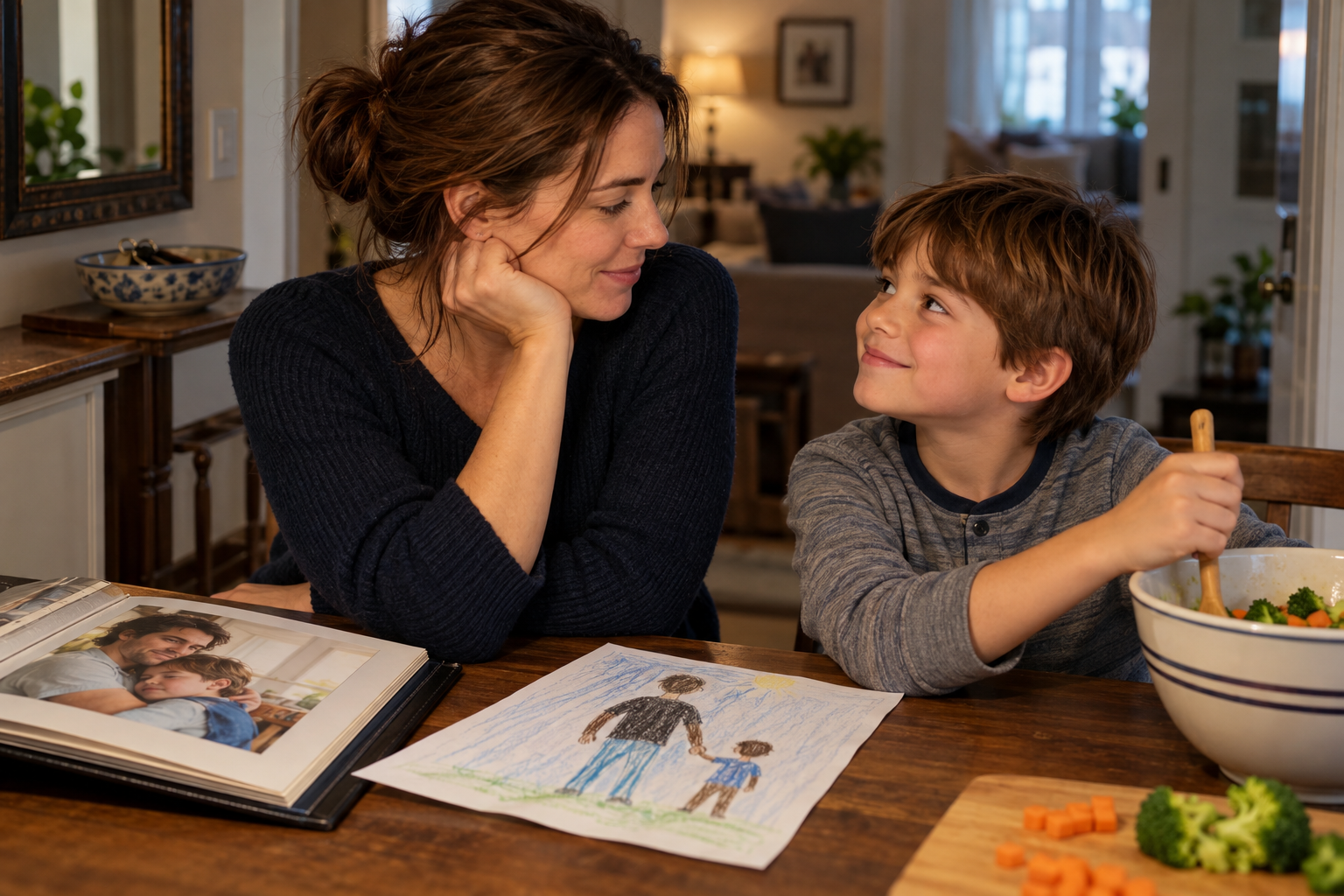
That evening, Ethan asked whether we could take the photograph album out again.
We sat together on the couch.
He found the picture of his father holding him and studied it quietly.
“Do you think I looked like Dad?”
“You had some of the same expressions.”
“Which ones?”
“You both used to wrinkle your noses when you were trying not to laugh.”
He tried it.
I laughed because he looked exactly like his father in that moment.
Ethan noticed.
“What?”
“Nothing bad. You just reminded me of him.”
He smiled and looked back at the picture.
“Can I keep this beside my bed?”
“You can.”
He carried it upstairs.
I closed the album and returned it to the cabinet.
I did not search through the remaining pages for another clue.
I did not need to turn every family photograph into a question.
The pictures could simply be pictures.
The memories could simply be memories.
And if Ethan eventually remembered more about the room, we would listen to what he said without deciding in advance what it had to mean.
Click here to continue reading: PART 16: I Finally Understood That Waiting for the Truth Was Different From Waiting for Something Terrible
The Barber Said Something About My Nine-Year-Old Son That I Could Not Explain, and Then a Familiar Name Changed Everything
Part 15 of 20