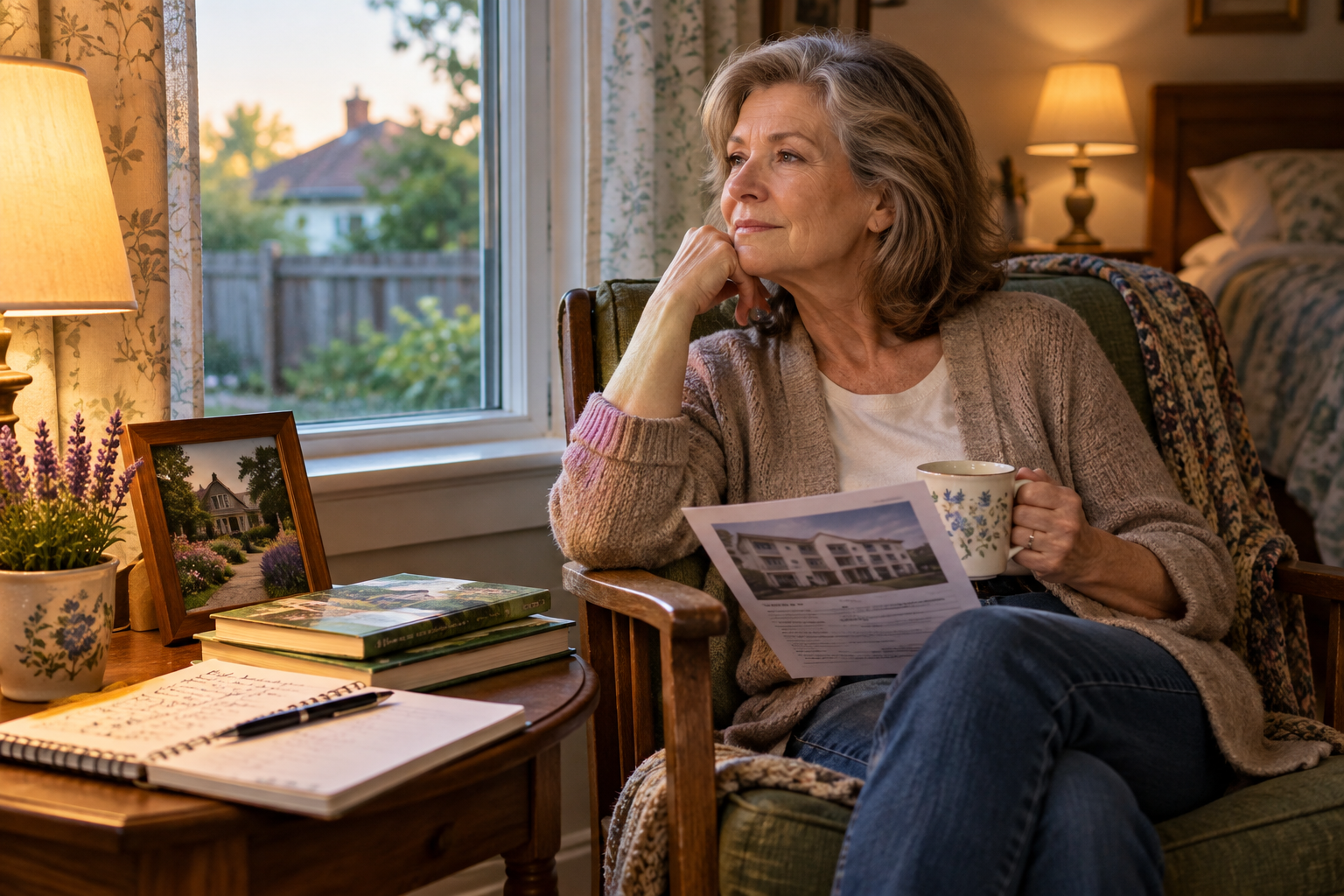
I used to believe that being needed by your children was another way of being loved.
It took me seventy-two years to learn that the two things could look almost identical from the outside.
Sometimes, the difference was sitting across the dinner table from you.
My roast chicken was losing its warmth.
The potatoes had gone soft beneath the gravy, and a small dish of green beans sat near the middle of the table, untouched by anyone except me.
I had spent most of the afternoon preparing that meal.
Not because Sunday dinner was a special occasion.
Because I lived in my son's house now, and I had come to believe that making myself useful was the easiest way to make sure nobody regretted having me there.
Michael sat opposite me with his fork resting between his fingers.
Jessica, his wife, kept her attention on her plate.
My grandsons, Owen and Caleb, had gone quiet.
They were eight years old, old enough to recognize when something unpleasant was happening, but still young enough to hope that adults would correct themselves before things got worse.
Clare, their sixteen-year-old sister, watched me.
She didn't say anything.
Neither did I.
My son had just told me that if I couldn't accept my responsibilities without complaining, I was free to leave his house.
He had delivered the message without raising his voice.
That was what made it difficult to respond.
If he had shouted, I might have found the courage to shout back.
If he had slammed his hand against the table, I might have stood up and told him that I would not be spoken to that way.
Instead, he spoke calmly, almost casually.
As though we were discussing who should take out the rubbish.
I looked down at my plate.
There was too much salt in the potatoes.
That was what I thought about first.
Not my son.
Not the words he had used.
Not the fact that I had sold my own home to come live with him.
The potatoes.
I picked up my napkin and folded it once.
Then I folded it again.
My fingers needed something to do.
I had no idea what my face was showing, but I hoped it was nothing that would invite another remark.
Michael returned his attention to his food.
Jessica reached for her water glass.
The boys looked at each other, then down at their plates.
Clare kept watching me.
I remember that most clearly.
She was the only person at the table who seemed to understand that something had happened that could not simply be taken back.
I was seventy-two years old.
I had raised a son, buried a husband, paid bills, repaired what I could afford to repair, and learned to sleep alone in a house that sometimes made noises after midnight.
I had managed more difficult things than a dinner table.
Yet there I sat, carefully folding a piece of cloth because I couldn't think of anything else to do with my hands.
My suitcase was already packed.
It was sitting in the room Michael and Jessica called my bedroom, although I had never quite learned to think of it as mine.
I had put most of my clothes inside it that morning.
Not because I had made a final decision.
I had simply reached a point where I wanted to know I could leave if I needed to.
There is a difference between wanting to go and being ready to go.
I had been standing somewhere between the two for days.
Perhaps longer.
Three months earlier, I would never have imagined that I would be sitting at my son's dinner table wondering whether I still had a place in his life.
Back then, I thought I was making a sensible choice.
My little house near Hudson had become too much for me to manage comfortably on my own.
The roof needed attention.
The steps were becoming difficult in winter.
The heating system had started making a noise that required a repairman, and every unexpected expense seemed larger than the one before it.
I could have continued living there.
People do harder things every day.
But I had also begun to feel the quiet loneliness of returning home to an empty room after running errands, knowing that there was nobody waiting to ask how my day had gone.
I missed the sound of children.
I missed having a reason to get up early.
I missed being part of a family that moved around me without my having to arrange every little thing myself.
When Michael called and explained that he and Jessica were struggling to manage the children alongside their work and other responsibilities, I listened carefully.
He didn't ask me to rescue him.
At least, that wasn't how I heard it.
He told me that the boys needed someone dependable after school.
He mentioned Clare's schedule.
He explained that their days had become difficult to organize, and he wondered whether I might consider staying with them for a while.
I heard the uncertainty in his voice.
Or perhaps I heard what I wanted to hear.
I thought about my empty house.
I thought about my grandchildren.
Then I imagined a home where people came through the door in the afternoon, where somebody called from another room, where supper was not something I prepared for one person.
I told myself it might be good for all of us.
Michael said they had room.
Jessica said they would be glad to have me.
Nobody talked much about money.
That seemed natural at the time.
I was family.
They were family.
I had spent years helping Michael in one way or another, and I couldn't imagine charging him for being his mother.
He had never suggested that I should.
So I sold my house.
I packed the belongings I wanted to keep, gave away some furniture, and let go of things I had once believed I would never part with.
I kept a small collection of photographs.
I kept my husband's old watch, although it no longer worked.
I kept the blue ceramic bowl that had sat on my kitchen counter for years.
And I packed my clothes.
When I arrived at Michael's house, I brought more boxes than I had intended and fewer things than I thought I would need.
Jessica showed me the room at the end of the hallway.
It had a bed, a dresser, and a narrow window overlooking the side yard.
The closet was already partly occupied by things the family had stored there.
I didn't mind.
I put my clothes in the available space and arranged my photographs on the dresser.
The blue bowl went on the windowsill.
For the first few days, everything felt promising.
Owen and Caleb were delighted to have me nearby.
They came into my room to show me toys, school drawings, and small treasures they had found outside.
Clare was quieter, but she thanked me when I made breakfast and sometimes sat at the kitchen counter while I prepared lunch.
Jessica seemed relieved to have another adult in the house.
Michael smiled more often during those first weeks.
Or perhaps I simply paid closer attention to the smiles.
I wanted the arrangement to work.
That desire made me overlook things I might otherwise have noticed.
The first time Michael asked me to watch the boys for an entire afternoon, I agreed without hesitation.
The second time, I agreed again.
Soon, I was arranging my days around the children's schedules.
I learned which mornings Owen had trouble finding his school shoes.
I learned that Caleb would eat carrots if I cut them into thin sticks but refused them if they were served in rounds.
I learned that Clare preferred to be left alone for a while after school before anyone asked about her day.
These were small things.
I enjoyed knowing them.
I liked being the person who remembered.
When the boys came home, I was there.
When somebody needed a snack, I made one.
When homework became frustrating, I sat beside them until the problem seemed smaller.
When Jessica and Michael had plans, I stayed with the children.
Sometimes they told me about those plans in advance.
Sometimes they mentioned them while putting on their coats.
I didn't object.
I told myself this was what families did for one another.
And often, it was.
But slowly, the arrangement changed.
I stopped asking whether Michael and Jessica needed me to watch the children.
They began assuming I would.
My afternoons became their afternoons.
My evenings became the time when they could leave the house without worrying about finding a sitter.
If the boys were sick, I stayed with them.
If school was closed, I adjusted my plans.
If Jessica had an appointment or Michael needed to finish something, I was the person they called.
I wasn't asked whether I had anything else I wanted to do.
At first, I didn't think to mention it.
I was afraid that asking for time to myself would make me sound ungrateful.
After all, they had given me a room.
They had made space for my belongings.
They had welcomed me into their home.
I kept a quiet account of those things in my mind, as though I owed them something that could never quite be paid off.
Looking back, that was where I began to lose my footing.
I confused gratitude with an obligation to accept everything.
And because I rarely complained, they had little reason to think I was unhappy.
Or perhaps they knew and preferred not to ask.
I couldn't say which possibility hurt more.
By the time I had been there for three months, I had developed a routine that left very little room for my own preferences.
I woke before everyone else.
I made coffee.
I checked what the boys needed for school.
I helped with breakfast, straightened the kitchen, and kept track of the things that seemed to disappear as soon as they were put away.
Then I waited for the next request.
Some days were pleasant.
The boys made me laugh.
Clare occasionally joined me while I cooked.
Jessica sometimes thanked me for helping.
Those moments mattered to me, perhaps more than they should have.
They made it easier to dismiss the other moments.
The hurried instructions.
The assumption that I would be available.
The way Michael could discuss an evening out as though my time had already been reserved.
I told myself that this was temporary.
I told myself that once everyone settled into the new arrangement, things would become more balanced.
I told myself many things.
Then came Sunday.
I had decided to make roast chicken because it was a meal Michael had liked since he was a boy.
I remembered him sitting at my old kitchen table, asking for another helping before he had finished the first.
I remembered cutting his food when he was little and telling him not to talk with his mouth full.
There were so many versions of my son in my memory.
The small boy with scraped knees.
The teenager who sometimes slammed his bedroom door.
The young man who called me after his first difficult day at work because he wanted to hear a familiar voice.
I had carried all those versions of him into his house with me.
Perhaps I expected them to protect me from the man he had become.
That afternoon, I prepared the chicken, seasoned the potatoes, and arranged the vegetables in a serving dish.
I set the table.
I called everyone when the food was ready.
For a little while, it was an ordinary family dinner.
Then Michael made a comment about the children needing more consistency.
I don't remember his exact opening words.
I remember that he was talking about their routines, and I thought he was asking for help.
I started to explain that Owen had been struggling with his homework and that Caleb had been tired after school.
Michael interrupted me.
He said Jessica and he needed the freedom to enjoy their lives without constantly worrying about the children.
I looked at him.
I wasn't sure what he wanted me to say.
I had been looking after the boys every day.
I had changed my schedule around theirs.
I had made myself available whenever they needed me.
Still, I asked whether something had happened that I should know about.
Michael's expression tightened.
He told me that caring for the children was the reason I was there.
He spoke as if the matter had already been settled long before I arrived.
Then he made it clear that if I couldn't accept the arrangement, I could leave.
The room went quiet.
I could hear the faint sound of a fork touching a plate.
I looked at my son and waited for him to soften his words.
He didn't.
So I folded my napkin and lowered my eyes.
Not because I agreed.
Because I was trying to keep the last little piece of my dignity from falling apart in front of everyone.
Click here to continue reading: PART 2: The Room at the End of the Hallway Had Never Felt Entirely Mine, but I Was Finally Beginning to Understand What That Meant
I Had Spent Three Months Making Myself Useful in My Son’s House, Until One Ordinary Sunday Dinner Changed What I Could Bear
Part 1 of 20