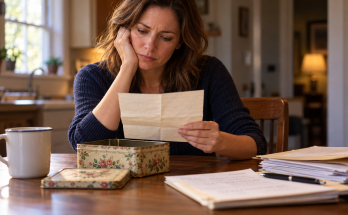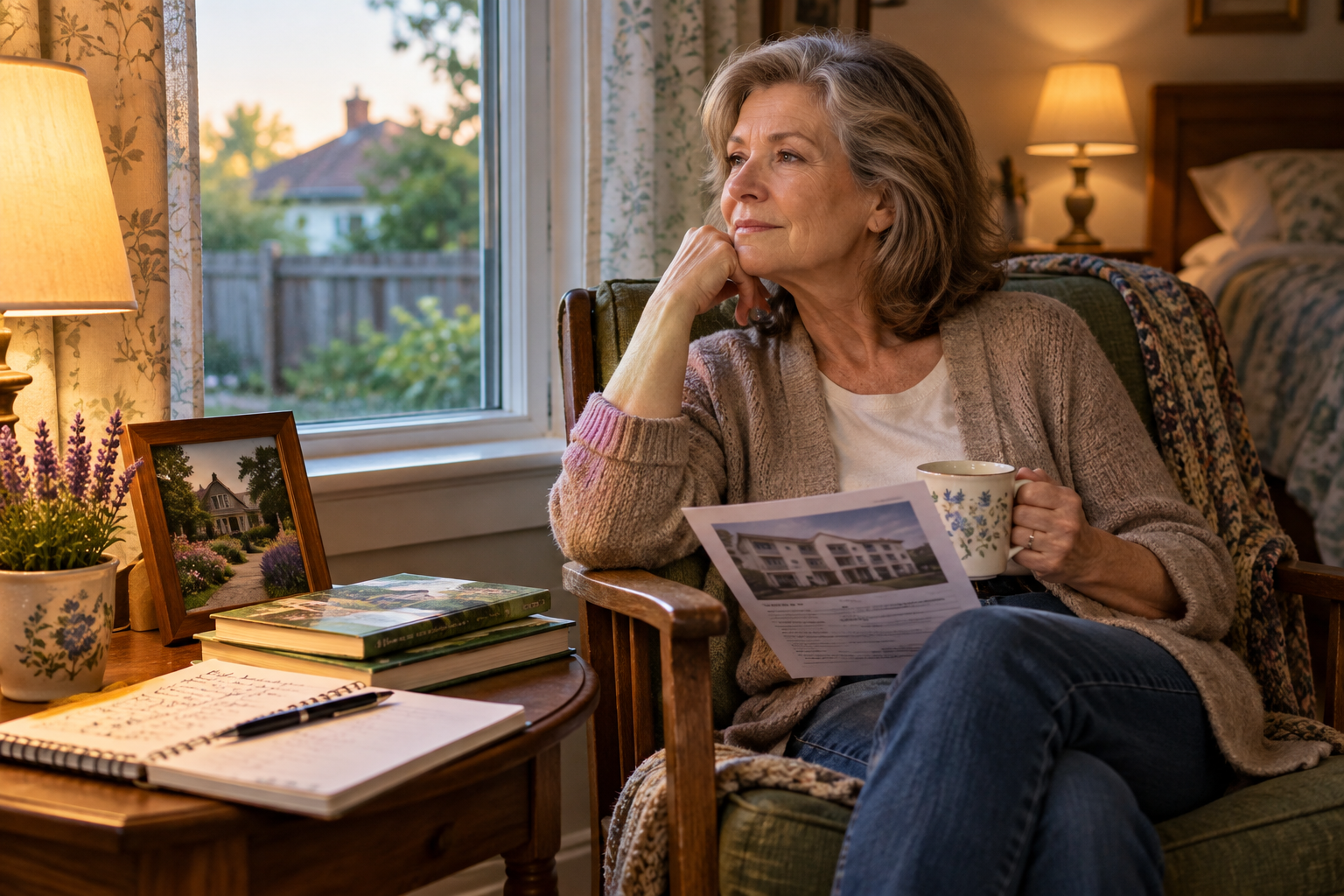
The notebook stayed on my nightstand for three days.
I opened it each morning, read the two sentences I had written, and closed it again.
I am allowed to decide how I spend my time.
Helping my family does not mean I have no life of my own.
They were simple words.
I had written them in my ordinary handwriting, the same handwriting I used for grocery lists and birthday cards.
Still, I found myself reading them as if someone else had written them for me.
On Tuesday morning, I went downstairs before anyone else was awake.
The kitchen was dim, and the refrigerator hummed in the quiet.
I filled the kettle and set it on the stove.
The house looked different before the children came downstairs. There were no backpacks blocking the hallway, no shoes scattered beside the door, and no television playing in the family room.
I liked those few minutes.
They reminded me of the mornings in my little house near Hudson.
I used to make coffee, sit beside the window, and watch the light move across the garden.
Some mornings I read the newspaper.
Other mornings I did nothing at all.
I had never understood how valuable those ordinary minutes were until I moved into a house where somebody always needed something.
I took my cup to the kitchen table and sat down.
The chair opposite me was pulled out slightly.
I straightened it without thinking, then stopped with my hand still on the backrest.
Nobody had asked me to straighten it.
Nobody would have cared if I left it where it was.
I sat back down.
It was a small thing, almost silly, but I wanted to see whether I could leave one ordinary thing unfinished without feeling responsible for it.
A few minutes later, Jessica came downstairs.
Her hair was tied loosely behind her head, and she wore the gray sweatshirt she usually put on before work.
She glanced at the kettle.
“Did you make enough coffee for me?”
“Yes.”
She took a mug from the cabinet.
For a moment, I expected her to ask about Saturday.
She had heard me tell Michael that I had plans, and she knew I had gone out to meet my friend.
Instead, she poured her coffee and checked her phone.
“Michael said the boys need their permission slips signed today.”
“They’re in their backpacks.”
“Could you check?”
I looked at her.
She was already scrolling through a message.
“I can remind them,” I said. “They should sign their own papers, though.”
Jessica lifted her eyes.
“They’re eight.”
“I know how old they are.”
My voice sounded sharper than I intended.
I took a breath.
“I can help them find the papers. I just think they can learn to take care of little things themselves.”
Jessica leaned against the counter.
“I wasn't criticizing you.”
“I didn't say you were.”
The words hung between us.
She looked tired, and I knew I looked tired too.
We had both been awake before sunrise for different reasons.
Finally, she sat down with her coffee.
“I don't know what you want me to say about Sunday.”
I had not expected her to mention it.
For a moment, I could only look at her.
“I don't know either,” I said honestly.
She turned her mug slowly between her hands.
“Michael was frustrated.”
“I noticed.”
“He didn't mean that you had to leave.”
“He told me the door was right there.”
Jessica looked down.
“He says things badly when he's upset.”
I thought about the way he had spoken.
There had been no shouting, no raised voice, no dramatic movement.
He had cut into his chicken, looked at me, and told me that if I didn't like watching his children for free, I could leave.
That was what made the memory so difficult to dismiss.
He had said it as if he were explaining something obvious.
“I don't think he was confused about what he said,” I replied.
Jessica rubbed the side of her mug with her thumb.
“He feels like you're unhappy here.”
“I am unhappy about some things.”
“You know we appreciate everything you do.”
I looked at her carefully.
“I would like to believe that.”
She looked up then.
There was hurt in her face, but there was something else too.
Perhaps she had expected gratitude to settle the matter.
Perhaps I had expected silence to keep it from becoming a problem.
Neither of us knew what to do when those habits stopped working.
Jessica took a sip of coffee.
“We have a lot going on.”
“I know.”
“Work has been difficult. The children need so much attention.”
“I know that too.”
“And having you here has helped more than you realize.”
I waited.
She did not add anything.
I wanted to tell her that helping was not the problem.
I wanted to tell her that I had never expected payment for making dinner or helping the boys with their homework.
I had not moved into the house with a list of demands.
I had simply wanted to be part of the family without feeling that my own needs had become an inconvenience.
But the words were difficult to arrange.
“I didn't come here because I wanted to be paid for loving my grandchildren,” I said at last.
Jessica's expression softened a little.
“I know.”
“I came because I wanted to be close to all of you.”
“We wanted that too.”
“Then I need us to find a way for me to be here without feeling that every hour of my day belongs to somebody else.”
She was quiet.
I heard a car pass outside.
The kettle clicked as it cooled on the stove.
Jessica looked toward the hallway.
“The boys will be down soon.”
“I know.”
She stood and put her mug in the sink.
“I have to get ready.”
“All right.”
She left the kitchen without another word.
I stayed at the table.
The conversation had not solved anything.
Still, I was relieved that I had said what I meant without apologizing for saying it.
The boys came downstairs a few minutes later.
Owen had one sock pulled higher than the other.
Caleb was carrying a toy dinosaur in one hand and trying to zip his backpack with the other.
“Grandma, have you seen my blue folder?” Owen asked.
“Where did you last have it?”
He frowned.
“I don't know.”
“Then let's think about it.”
He looked toward the stairs.
“Mom said you could find it.”
I felt the old response rise in me.
I could have stood up, searched the family room, checked the sofa cushions, and opened every backpack until I found the folder.
It would have taken less time than explaining why he should look for it himself.
Instead, I pulled out the chair beside me.
“Sit down for a minute.”
He did.
“Where did you do your homework yesterday?”
“At the table.”
“Which table?”
“The one in the family room.”
“Then where should we look first?”
He thought about it.
“The family room.”
“That's a good place to start.”
Caleb joined us, still holding the dinosaur.
“I saw it by the television.”
Owen jumped up and ran into the next room.
A moment later, he returned with the folder.
“Found it!”
“Good work,” I said.
He smiled, pleased with himself.
It was such a small success that I almost laughed.
I had spent months doing things the boys could have learned to do with a little patience.
I had told myself I was making their lives easier.
Perhaps I had also been making it easier for the adults to forget that I was a person with limits.
After breakfast, I reminded the boys to put their dishes in the sink.
Caleb did it without complaint.
Owen asked whether he could leave his bowl because he was already late.
“You can carry it while you walk,” I told him.
He gave me a look that suggested I had invented an unreasonable new rule.
Then he picked up the bowl.
I watched them leave with their backpacks bouncing against their shoulders.
Clare came downstairs last.
She was wearing her school jacket and carrying a notebook against her chest.
“Morning, Grandma.”
“Good morning.”
She opened the refrigerator, took out a bottle of water, and glanced at me.
“Are you going somewhere today?”
“I might go to the library.”
“Really?”
Her surprise made me smile.
“Yes, really.”
“That's good.”
She said it casually, but she looked at me for another second before closing the refrigerator.
I wondered how much she had noticed during the past few weeks.
Teenagers often seemed absorbed in their own lives, but that did not mean they missed everything happening around them.
“Do you need a ride?” I asked.
“No, Dad's taking me.”
She paused at the doorway.
“Grandma?”
“Yes?”
“Are you okay?”
I looked at her.
It was the second time in a few days that someone in the house had asked me that question.
The difference was that Clare seemed prepared to wait for the answer.
“I'm trying to be,” I said.
She nodded slowly.
“Okay.”
Then she left.
I finished my coffee and rinsed the mug.
I did not wash the breakfast dishes the boys had left in the sink.
I put on my coat, took my handbag from the bedroom, and walked to the library.
The air was cold enough to make my eyes water.
I had forgotten how much I enjoyed walking somewhere without being responsible for anyone else's schedule.
At the library, I wandered through the shelves without looking at the clock.
I picked up a book, read the first page, and put it back.
Then I found a collection of short stories and sat near the window.
I stayed for nearly two hours.
Nobody called to ask where I was.
Nobody needed a snack.
Nobody asked me to find a missing shoe.
For those two hours, my time belonged to me.
When I returned to the house, the kitchen was empty and quiet.
I put my coat away and went upstairs.
My suitcase was still beside the bedroom door.
I looked at it for a long moment.
I had packed it because I wanted to be ready to leave if I decided I could no longer stay.
Now I understood that being ready did not mean I had to leave immediately.
It meant I had given myself a choice.
I sat on the edge of the bed and opened my notebook.
Under the two sentences I had already written, I added another.
I can love people without making myself smaller for them.
I read it twice.
Then I closed the notebook and put it beside my husband's old watch.
For the first time since moving into Michael's house, I felt that I had taken one small step toward being myself again.
Click here to continue reading: PART 10: When Michael Finally Asked Why I Had Changed My Routine, I Realized He Had Mistaken My Constant Availability for Proof That Everything Was Fine
I Had Spent Three Months Making Myself Useful in My Son’s House, Until One Ordinary Sunday Dinner Changed What I Could Bear
Part 9 of 20