By the end of the month, the schedule had become familiar enough that we no longer needed to discuss every detail at breakfast.
The boys went to their after-school program on Tuesdays and Thursdays. Michael tried to finish work earlier on Fridays, and Jessica handled most of the school messages.
My Wednesday mornings remained mine.
Saturday afternoons were still marked on the calendar in a different color.
Sometimes I spent them with my friend. Sometimes I went to the library or walked through the shops in town. Once, I spent nearly two hours looking at gardening books without buying anything.
I was learning that a day did not need to be productive to be worthwhile.
The chair beside my window had become my favorite place in the house.
I kept a book there, along with my notebook and a small lamp. The boys sometimes came in to tell me something, and I welcomed them when I was available.
When I wanted quiet, I closed the door.
At first, closing it felt rude.
Then I discovered that a closed door could simply mean I was resting.
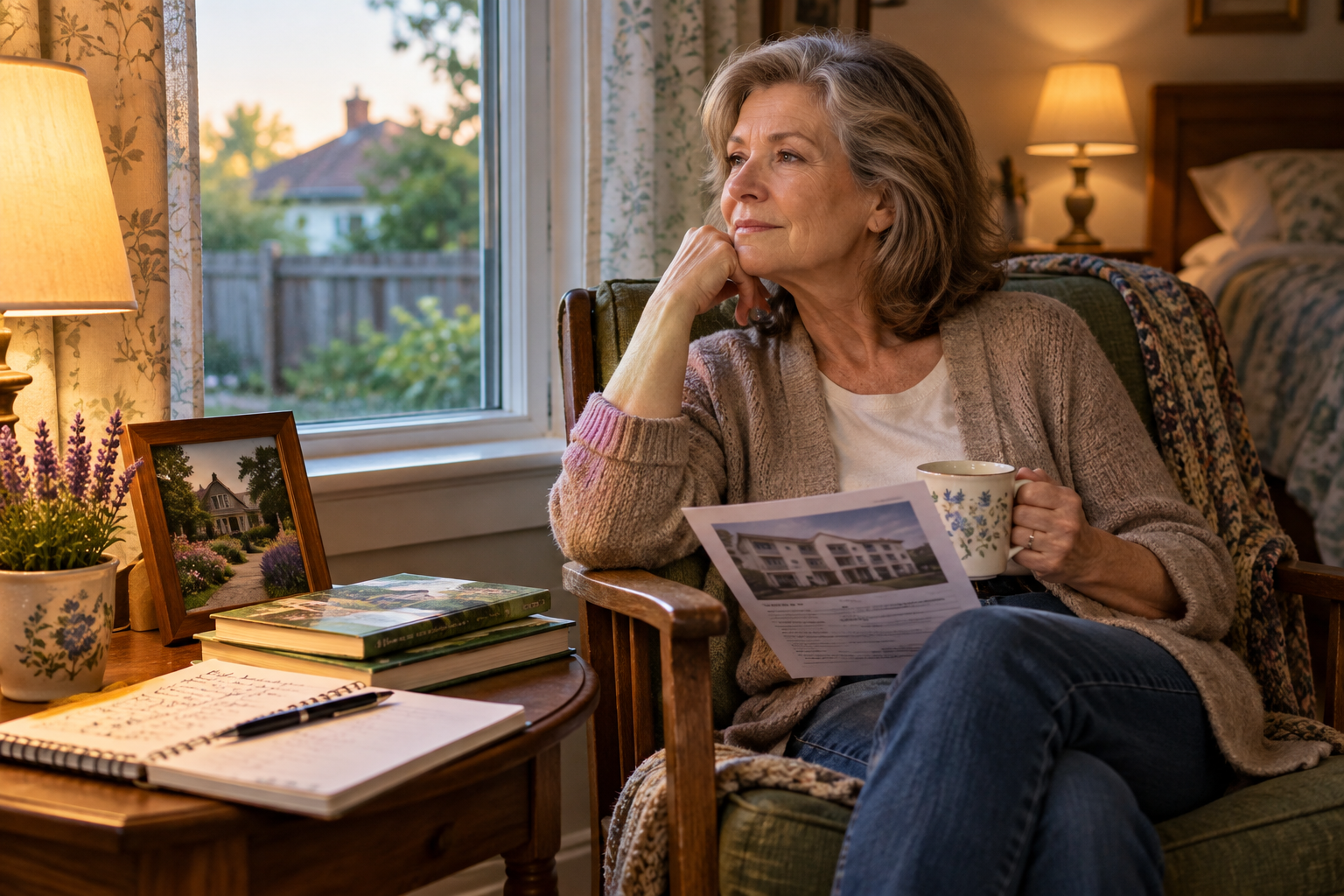
One Wednesday morning, I sat in the chair with a cup of tea and watched a bird hop along the fence.
The apartment information sheet was open on my lap.
I had called Mrs. Parker the previous week to ask whether the apartment was still available. She had told me that it was, though another person had expressed interest.
She hadn't pressured me.
She had simply asked whether I wanted to come back and see it again.
I had said I would think about it.
Now I was thinking about it again.
The apartment was small, but it was clean and bright. The rent would be manageable if I kept a careful budget. I would need to buy a few things and leave enough money untouched for emergencies.
I would have to get used to living alone again.
There would be no boys racing down the hallway, no Jessica asking whether I wanted tea, and no Michael coming into the kitchen late at night looking for something to eat.
There would also be no assumption that I could collect the children whenever plans changed.
No one would fill my closet with boxes.
No one would need to be asked before I rearranged a room.
I could make soup for dinner because I wanted soup. I could leave the dishes until morning if I was tired. I could spend a whole afternoon reading without anyone wondering where I had gone.
The thought made me feel both peaceful and lonely.
I had been lonely in a house full of people.
I knew that now.
But I also knew that living alone could bring a different kind of loneliness, one that I would need to meet honestly rather than pretending it wouldn't happen.
I put the information sheet on the table and wrote two headings in my notebook.
Reasons to stay.*
Reasons to move.*
Under the first, I wrote the children's names.
I wrote that I loved being part of their daily lives. I wrote that Michael and Jessica were beginning to listen and that the new schedule had made things better.
I wrote that the house was familiar and that I had a room of my own, even if the rest of the home belonged to them.
Under the second heading, I wrote that I wanted my own home again.
I wanted to choose my furniture, keep my own hours, and decide who came through my door.
I wanted to know that when I helped my family, I was offering something rather than surrendering something.
Then I put down my pen.
Neither list was longer in any way that mattered.
I wasn't choosing between a good life and a bad one.
I was choosing between two possible lives, each with things I would gain and things I would miss.
That was a harder decision than I had expected.
Later that morning, Jessica knocked on my door.
“Are you busy?”
“Not really.”
She came in and sat on the edge of the bed.
“I wanted to ask how you're feeling about everything.”
I closed my notebook.
“Better than I was.”
“That's good.”
She glanced at the chair and smiled.
“You seem to use that a lot.”
“I do.”
“I'm glad you bought it.”
“So am I.”
Jessica folded her hands in her lap.
“I've been thinking about what you said about being able to stay and still have a life of your own.”
I waited.
“I think I understood the words before, but I didn't understand what they meant in practice. I thought if we asked you instead of telling you, that would solve it.”
“It helps.”
“But it's not everything.”
“No.”
She looked down at her hands.
“We've been thinking about how much we've come to depend on you. I don't think we realized how much of our routine was built around assuming you would be there.”
I didn't want to make her feel worse simply because she was finally being honest.
“I was happy to help when I moved in,” I said. “I still am, sometimes.”
“I know.”
“But the arrangement changed. It became harder to say no because everyone was used to hearing yes.”
She nodded.
“I think that's true.”
We sat quietly for a moment.
Then she asked, “If you decided to move, would you want us to help?”
The question surprised me.
I had imagined telling Michael and Jessica that I was leaving. I had imagined their disappointment, the practical questions, and the possibility that Michael would hear my decision as a judgment on him.
I had not imagined Jessica asking how she could help.
“Yes,” I said. “I would appreciate help with the practical things. I would still want to see the children.”
“Of course.”
“And I would want us to plan visits instead of assuming that I would come over every day.”
“That makes sense.”
She took a breath.
“I hope you stay. But I don't want that to be the only answer you feel you can give.”
I looked at her for a long time.
“Thank you.”
She stood and straightened the blanket at the foot of the bed, a small habit she had whenever she was nervous.
“I should get back to work.”
“All right.”
At the door, she paused.
“Can I ask one more thing?”
“Of course.”
“Would you tell us when you decide? I don't want you to feel that you have to hide it until everything is arranged.”
“I can do that.”
She nodded and left.
I sat in the chair after she was gone.
Her words had not made the decision for me.
They had made it easier to imagine making the decision honestly.
That evening, Michael came home carrying a paper bag from the grocery store.
He found me in the kitchen, putting vegetables into a bowl.
“Mom, do you have a minute?”
“Yes.”
He set the bag on the counter.
“I talked to Jessica.”
I looked at him.
“About what?”
“About the apartment. About you possibly moving.”
I waited for the rest.
“I want you to know that I would miss having you here.”
The words were simple, and I believed him.
“I would miss you too,” I said.
“But I don't want you to stay because you think we can't manage without you. We can manage. We may have to change things, but we can manage.”
I felt something loosen in my chest.
For months, I had worried that leaving would mean abandoning my family at the very moment they needed me.
Hearing him say that they could manage did not make me feel less loved.
It made me feel that my choice might finally be mine.
Michael leaned against the counter.
“I also want to apologize for what I said at dinner.”
I stopped arranging the vegetables.
He looked directly at me.
“When I told you the door was right there, I was treating you like an employee who was complaining about a job. You were my mother, and you had moved into our home because you wanted to help us. I shouldn't have spoken to you that way.”
The kitchen seemed unusually quiet.
I could hear the refrigerator humming and the faint sound of the boys upstairs.
I had imagined this apology more than once.
In some versions, I had answered with every hurt I had carried. In others, I had told him it was all right because I wanted to spare him the discomfort.
Neither felt right now.
“Thank you for saying that,” I told him. “It hurt me more than you understood.”
“I know.”
“I don't want us to pretend it never happened.”
“We won't.”
I looked down at the vegetables.
“I also don't want that one dinner to decide everything about our relationship.”
He nodded.
“Neither do I.”
I turned back toward him.
“I love you, Michael. I want you in my life. I want the children in my life. But I need to make a decision about where I live based on what will be right for me, not on whether anyone feels guilty.”
“I understand.”
“I haven't decided yet.”
“That's okay.”
He picked up the grocery bag and began putting the food away.
We talked about the boys' school schedule and the groceries we still needed. Nothing about the conversation had magically repaired every old habit.
But the apology remained in the room with us, honest and unhurried.
Later, I went upstairs and took the apartment information sheet from my notebook.
I called Mrs. Parker.
The apartment was still available, she told me, and I could come by again on Friday if I wanted to see it in daylight.
I looked at the calendar.
Friday was open.
“Yes,” I said. “I'd like to see it again.”
After the call, I sat at the small table beside my window.
I had not applied for the apartment. I had not given notice or started packing boxes.
I had simply decided to take the next step.
That felt right.
I opened my notebook and read the sentence I had written weeks earlier.
I do not have to know where I will live next to begin deciding how I want to live.*
I understood it differently now.
I wanted a life in which I could be generous without being taken for granted. I wanted to be close to my family without being responsible for every gap in their plans.
I wanted my own choices, even when those choices disappointed someone.
And I wanted to be able to love Michael without pretending that he had never hurt me.
I wrote one more sentence beneath the old one.
I can choose a home without choosing whether I love my family.*
Then I closed the notebook.
Downstairs, the boys were laughing at something. Jessica called for them to get ready for bed, and Michael reminded them that they had school in the morning.
I smiled at the sound.
Whatever happened next, those voices would still be part of my life.
I did not know yet whether I would hear them from this bedroom or from a small apartment across town.
For the first time, I knew that I could decide without having to prove my love by staying.
I turned off the lamp and left the apartment information sheet on the table.
Friday would come soon enough.
For tonight, I was home.
And I was allowed to think about what home meant.
The End
Read more original stories on Feel Every Story.
I Had Spent Three Months Making Myself Useful in My Son’s House, Until One Ordinary Sunday Dinner Changed What I Could Bear
Part 20 of 20