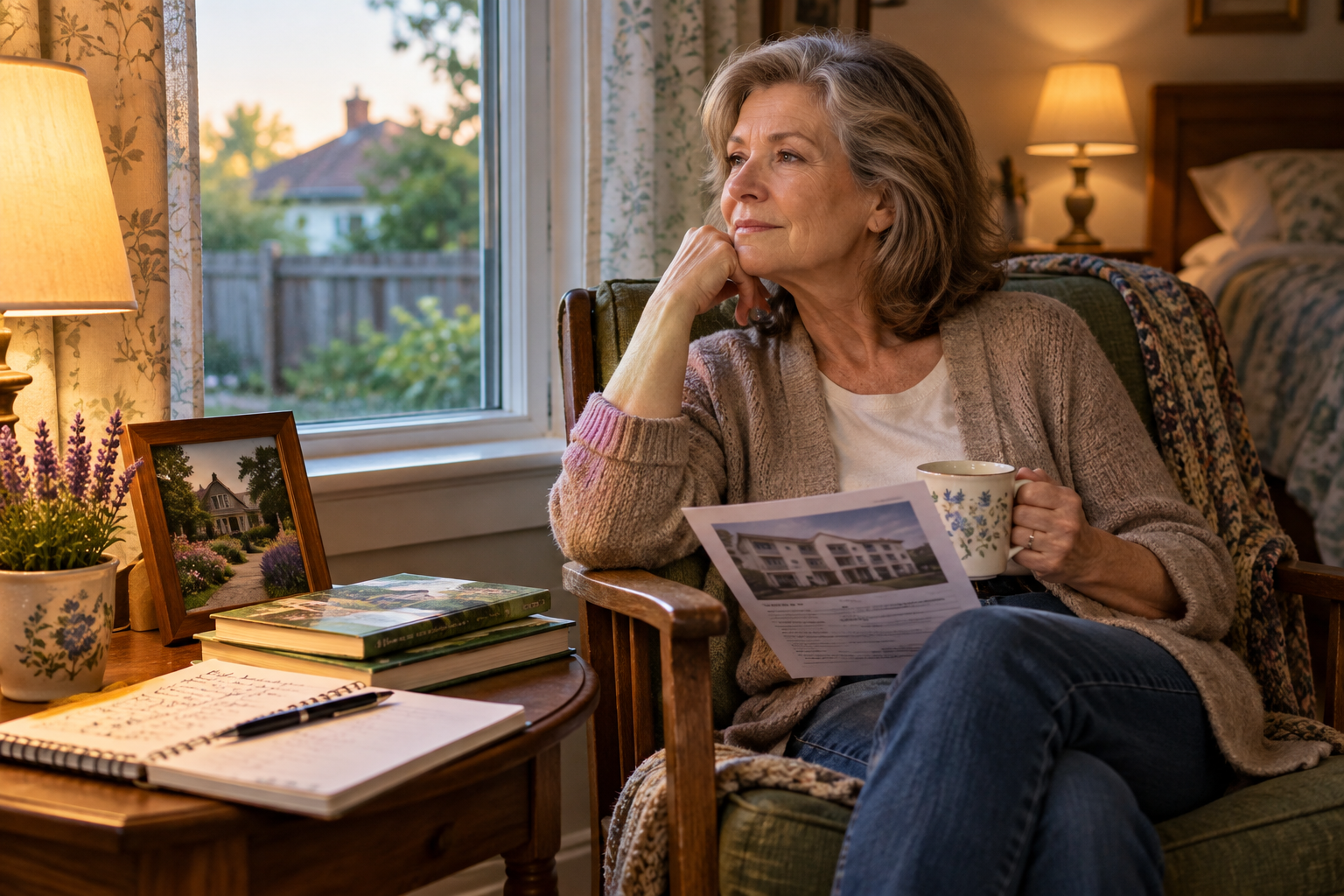
The suitcase stayed beside my bedroom door for two days.
Nobody asked about it.
I wondered whether Michael had noticed it when he passed the room, or whether he had decided that whatever I did with my belongings was none of his concern.
Either possibility seemed possible.
I had stopped trying to guess what he was thinking.
It was a relief, although not a complete one.
I still woke in the morning expecting to hear him mention Sunday dinner.
I still found myself listening for footsteps outside my door.
Some foolish part of me wanted him to come upstairs and tell me that he had been wrong.
But every morning arrived without that conversation.
The house continued to operate around me.
The boys needed breakfast.
Clare needed to leave for school.
Jessica needed help with the afternoon schedule.
Michael needed someone to remember what the rest of the family had forgotten.
And I was still there.
For the first time, though, I began asking myself a question before saying yes.
Did I actually want to do this?
It was a small question.
I had spent most of my adult life answering a different one.
Who needs me?
That question had guided me through marriage, motherhood, and the years after my husband died.
It had helped me keep going when I was tired.
It had also made me believe that my own needs could wait indefinitely.
Now I was trying to learn something that should have been obvious.
I could love my family without making myself responsible for every problem in their lives.
The first real test came on a Thursday afternoon.
Jessica was standing near the kitchen counter, looking through her calendar on her phone.
She mentioned that she and Michael had plans for Saturday evening.
Then she asked whether I could stay with the children.
I had already been thinking about calling my friend again.
We had spoken earlier in the week, and she had suggested that we meet for coffee if I could get away.
I hadn't made a promise.
I had simply begun to imagine sitting across from someone who knew me before I moved into this house.
Someone who might ask about my life without immediately asking what I could do for somebody else.
Jessica waited for my answer.
I looked at the calendar on the refrigerator.
Saturday was two days away.
"I might have plans of my own."
She lowered her phone.
"Oh. What kind of plans?"
I nearly apologized.
The words were ready before I had even decided what to say.
I could have explained that I hadn't arranged anything definite.
I could have told her I would probably be available after all.
Instead, I kept my answer simple.
"I'm hoping to see a friend."
Jessica looked uncertain.
She said she would have to check with Michael.
I nodded.
There was nothing else to add.
After she left the kitchen, I stood beside the counter for a while.
My heart was beating faster than it should have been.
I had declined a request to babysit my own grandchildren for one evening.
I had not insulted anyone.
I had not accused anyone of taking advantage of me.
I had simply said that I might have something else to do.
Still, I felt as though I had broken a rule.
That feeling stayed with me until lunchtime.
Then I reminded myself that I had not agreed to become the family's permanent childcare arrangement.
I had come to help.
I had not promised to stop being a person.
Later that afternoon, Owen came home with a paper folded into quarters.
He had received a good mark on a school assignment and wanted me to see it.
I looked at the paper carefully.
He waited while I read the teacher's comments.
"That's very good," I told him.
His face brightened.
Caleb came over to see what we were looking at.
Soon both boys were talking at once.
I laughed.
For a few minutes, I forgot about the argument.
I forgot about the suitcase.
I was simply their grandmother, sitting at the kitchen table while two boys tried to tell me everything they had done that day.
That was the part I wanted to keep.
Not the assumption that I would always be available.
Not the feeling that I had to earn my place.
The ordinary affection.
The jokes.
The drawings and school papers.
The little hands reaching across the table to show me something they were proud of.
I wanted those things to remain part of my life.
But I was beginning to understand that I couldn't protect my relationship with the children by pretending my relationship with their father was fine.
The two things were connected.
They were not the same.
That evening, Michael came home while I was putting away the dinner dishes.
He opened the refrigerator, took out a bottle of water, and asked whether I had spoken to Jessica about Saturday.
I dried my hands.
"She asked me to watch the children."
"And?"
"I told her I might be seeing a friend."
He looked at me as though he had expected a different answer.
He said that he and Jessica had already made plans.
I waited for him to ask whether I could change mine.
Instead, he reminded me that the children needed someone at home.
I felt the old pressure immediately.
There it was again.
The suggestion that my plans were less important because I was retired, because I lived in his house, or because I was their grandmother.
I couldn't tell which reason he believed.
Perhaps he believed all three.
"I understand that," I said.
"Then what's the problem?"
I looked at him.
For a moment, I couldn't believe he had asked.
I wanted to tell him that the problem was not Saturday evening.
The problem was that he had begun treating my availability as a permanent arrangement.
The problem was that he had spoken to me at dinner as though I were an inconvenience he could send away.
The problem was that he had not asked how I felt about any of it.
But I was tired of trying to explain everything at once.
"I need some time for myself, Michael."
He shook his head slightly.
He said he didn't understand why I was making things difficult.
Those words hurt more than I expected.
Not because they were new.
Because they showed me how far apart we were.
I thought I was asking for a little consideration.
He thought I was creating a problem.
I looked down at the dish towel in my hands.
Then I folded it and placed it beside the sink.
"I'll let you know what I decide about Saturday."
He didn't answer.
He walked out of the kitchen.
I remained where I was.
I had not won an argument.
I had not changed his mind.
But I had stopped agreeing simply to make the conversation end.
That night, I called my friend and told her I would meet her on Saturday if I could arrange it.
She said she would be glad to see me.
We agreed on a time.
When I hung up, I wrote it down on the small calendar I kept beside my bed.
It was only a coffee date.
But I had put something of my own back into my life.
And I intended to keep it.
Click here to continue reading: PART 6: The Hardest Thing Was Not Packing My Belongings, but Admitting How Much I Had Given Up Without Anyone Asking Me To
I Had Spent Three Months Making Myself Useful in My Son’s House, Until One Ordinary Sunday Dinner Changed What I Could Bear
Part 5 of 20