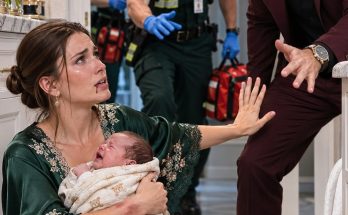
It was Mara Ellison, the family-law attorney I had first contacted six months earlier.
Behind her came Danielle Price, the hospital social worker who had stood near the door the previous afternoon.
Mara carried a slim leather case.
Nothing about her appearance suggested drama. Gray trousers. Navy sweater. Hair tied back. Reading glasses tucked into one hand.
That was one of the reasons I trusted her.
She never made fear bigger than it already was.
“How are you feeling?” she asked.
“Sore.”
“I meant otherwise.”
I looked toward the bassinets.
“Ask me after today.”
Mara pulled a chair close to my bed.
“Fair enough.”
Danielle closed the door but remained nearby.
Mara opened her case.
“The petition was filed electronically at six twelve this morning.”
My stomach tightened despite knowing it was coming.
“And?”
“The judge issued a temporary order maintaining the children’s current placement pending review.”
I released the breath I had been holding.
“They can’t take them?”
“Not today.”
Not today.
It wasn’t the sweeping victory people liked to imagine in stories.
There was no judge pounding a gavel and announcing that everyone except me had been wrong.
There was simply time.
And after the previous twenty-four hours, time felt precious.
Mara placed several pages on the rolling tray beside me.
“Yesterday’s documents are important,” she said. “But not for the reason Julian thinks.”
I looked at her.
“Because of the clause?”
“Partly.”
She tapped the copy she had made before Julian arrived.
Six months earlier, Mara had told me something that had changed the way I approached everything.
Don’t try to catch him being cruel, she had said.
Find out what he is afraid of being examined.
At first I had thought the answer was the affair.
It wasn’t.
The affair had hurt me.
But it had never frightened Julian.
Money did.
Records did.
Questions did.
And the clause buried inside yesterday’s custody agreement was the first time he had connected those fears directly to our children.
Mara turned the document toward me.
“They conditioned payment not merely on custody and confidentiality,” she said. “They also attempted to prohibit you from making inquiries into entities that appear to contain marital assets.”
“So signing helped?”
“It established what they wanted.”
I swallowed.
“But I signed away custody.”
“You signed proposed agreements while hospitalized three days after major surgery, after being presented with a financial payment tied to immediate relinquishment, without independent counsel present in the room, despite your husband knowing you were represented.”
She paused.
“And those documents still require judicial approval before any custody arrangement becomes enforceable.”
I stared at her.
“You knew they would bring papers.”
“We suspected they might.”
“Not all of those papers.”
“No.”
That mattered.
Because the part that made my hands tremble the previous afternoon—the clause about Julian’s family company—had not been something Mara predicted.
That had come from Julian.
His mistake.
Not our trap.
Mara disliked the word trap.
“Courts deal in evidence, not traps,” she had reminded me repeatedly.
But privately, in my own mind, the word had helped me endure.
Six months of pretending not to notice.
Six months of sitting across from Julian at breakfast while knowing he was transferring money between companies I had never heard of.
Six months of saying nothing when he returned late, claiming meetings.
Six months of building a record instead of an argument.
Yesterday had been the final connection.
Not proof of every suspicion.
But enough to ask the right people to look.
Danielle stepped closer.
“There’s something else you should know.”
Her voice was gentle.
“The hospital documented the circumstances surrounding the signing. Nobody is saying you were incapable of making decisions. But the environment matters.”
Twenty relatives.
My husband.
His mistress.
A woman recovering from surgery.
A six-figure payment.
Two newborn children sleeping nearby.
When Danielle said it aloud, I finally heard how strange the scene had been.
Yesterday I had been too focused on surviving it.
“Julian said they were coming at ten,” I whispered.
Mara checked her watch.
“Nine thirty-eight.”
My mouth went dry.
“What do I say?”
“The truth.”
“And if he gets angry?”
“We leave.”
Simple.
No performance.
No dramatic speech.
No revealing everything I knew.
That surprised me.
For six months, I had imagined the moment Julian finally realized I wasn’t helpless.
In those imaginary scenes, I always had the perfect sentence.
Something elegant.
Something devastating.
But now that the moment had arrived, all I wanted was peace.
At exactly ten fourteen, there was a knock.
Danielle answered.
Julian stood outside with his mother, Eleanor.
No crowd this time.
No Sienna.
Julian looked rested, showered, confident.
Eleanor carried two expensive baby blankets folded over her arm.
For one strange second, she looked less like the woman who had discussed collecting my sons as though they were luggage and more like an ordinary grandmother bringing gifts.
That almost made things harder.
Julian stepped inside.
“Ready?”
Mara stood.
His expression changed.
Only slightly.
But I saw it.
“Mara,” he said.
“Julian.”
His eyes moved to me.
“What’s going on?”
I looked at Leo.
Then Oliver.
Then back at him.
“The boys are staying with me.”
Silence.
Eleanor’s grip tightened on the blankets.
Julian gave a short laugh.
“You signed.”
“Yes.”
“You signed every page.”
“I did.”
His eyes shifted toward Mara.
She handed him a document.
“A temporary order was entered this morning.”
Julian read the first paragraph.
Then the second.
His face did not explode into rage.
He simply became still.
That stillness frightened me more than shouting would have once.
But Mara had told me not to interpret silence.
So I waited.
Finally Julian asked, “On what basis?”
“Several,” Mara replied.
“This is ridiculous.”
“It may be reviewed at the scheduled hearing.”
He looked at me.
“You planned this.”
“No.”
That answer seemed to confuse him.
I continued.
“I planned to protect myself. Yesterday was your decision.”
Eleanor sat down slowly.
“What does that mean?”
Mara’s eyes went to me.
My choice.
For once, truly mine.
I looked at Eleanor.
“Did you read the papers Julian asked me to sign?”
“Of course.”
“All of them?”
Her hesitation was brief.
“No.”
Julian turned.
“Mom.”
“What?”
“I told you—”
“You told me they were standard divorce agreements.”
“They are.”
Mara removed another page.
“Mrs. Vance, were you aware that one clause sought to prevent Claire from reviewing transactions associated with Vance Meridian Holdings and related entities?”
Eleanor stared at her son.
The room changed.
Not dramatically.
But enough.
“What transactions?” she asked.
Julian folded the temporary order.
“Nothing you need to worry about.”
She stood.
“It is my company too.”
“Mom.”
“My father started that company.”
“Which is exactly why you should let me handle it.”
I had known Eleanor for eleven years.
She was proud.
Sometimes rigid.
Often too concerned with appearances.
But I had never seen Julian speak to her as though she were irrelevant.
Apparently, neither had she.
She put the blankets on the chair.
Then she looked at me.
“Did you know something about the company?”
“I found records.”
“What kind?”
“Eleanor,” Julian said sharply.
She ignored him.
“What kind, Claire?”
I thought of Mara’s warning.
Do not make accusations you cannot prove.
“Transfers I didn’t understand.”
“To where?”
“I don’t know yet.”
Julian exhaled.
“This is absurd. She found routine internal movements and decided she’s an accountant.”
“I didn’t decide anything,” I said. “That’s why I asked professionals.”
For the first time, the confidence left his face completely.
Not panic.
Recognition.
He understood now.
I hadn’t spent six months building a case against him.
I had spent six months making sure qualified people could determine whether there was a case at all.
That distinction mattered.
It was also exactly what he had never expected from me.
Julian had always assumed that because I hated conflict, I hated facts.
He was wrong.
Eleanor turned toward him.
“Who are these professionals?”
Nobody answered.
Then she looked at Mara.
“Who?”
Mara’s expression remained polite.
“That information will be handled through the appropriate process.”
Eleanor looked back at Julian.
“You told me Claire was walking away.”
“She agreed to.”
“No,” I said quietly. “You offered me money to.”
His eyes snapped toward me.
“I offered you security.”
“You offered me money in exchange for disappearing from my sons’ lives.”
“You wanted out of this marriage.”
“Yes.”
“Then why make this difficult?”
There it was.
Not cruelty.
Something more ordinary.
And perhaps more disappointing.
Julian genuinely believed those were the same thing.
Leaving him.
Leaving my children.
Giving up a marriage.
Giving up motherhood.
He had folded all of those choices together because separating them would have required seeing me as someone independent of him.
“I wanted out of our marriage,” I said. “I never wanted out of Leo and Oliver’s lives.”
Eleanor looked toward the bassinets.
Her face softened.
“I never wanted that either.”
Julian stared at her.
“You were standing here yesterday.”
“I thought she wanted the arrangement.”
I almost laughed.
Instead I asked, “Why would you think that?”
Eleanor’s answer came slowly.
“Because Julian said you did.”
The room became very quiet.
That was the first crack.
Not in the business.
In the family story Julian had been telling.
He had apparently told them I wanted freedom.
That motherhood overwhelmed me.
That the money was my request.
That he was giving me an opportunity to begin again.
Each fact contained just enough truth to sound possible.
I had been overwhelmed.
I had wanted financial independence.
I had said I wanted a different life.
Julian had simply rearranged those truths until they meant something else.
Eleanor sat again.
“I should go.”
Julian followed her toward the door.
Before leaving, he turned back.
“We’ll deal with this in court.”
“Yes,” Mara said.
He looked at me instead.
“I hope you know what you’re doing.”
For years that sentence would have shaken me.
Yesterday it might have.
That morning, with Leo stretching in his sleep and Oliver making tiny dreaming sounds beside him, it didn’t.
“I’m learning,” I said.
Julian left.
Eleanor followed.
But before the door closed, she looked back once.
Not at me.
At the boys.
And there was something in her expression I had never expected to see.
Doubt.
Not doubt about loving Julian.
A mother could love her son and still begin to question him.
I was learning that too.
I was discharged two days later.
Mara arranged for me and the twins to stay temporarily with my older sister, Rachel.
Rachel lived forty minutes away in a quiet neighborhood filled with maple trees and bicycles abandoned on lawns.
She had transformed her dining room into what she called “command central.”
Diapers.
Formula.
Water bottles.
Medication chart.
Blankets.
A notebook where she tracked which baby ate when because I had already confused them twice at three in the morning.
Rachel had always been the practical one.
When I told her about Julian’s affair months earlier, she hadn’t insulted him.
She had asked whether I had eaten lunch.
Then she made soup.
That was Rachel.
She believed most disasters were easier to face with food and clean sheets.
On my second evening at her house, I sat on the couch holding Oliver while Rachel folded laundry.
“You know what I keep thinking?” I said.
“That you should sleep?”
“That too.”
She smiled.
“What?”
“I keep thinking maybe Eleanor really didn’t know.”
Rachel stopped folding.
“Does that matter?”
“I don’t know.”
“Then don’t decide yet.”
That was another thing Rachel was good at.
Allowing uncertainty.
The next several days passed quietly.
Not easily.
Quietly.
There were feedings and pediatric appointments and court documents.
There were moments when I cried while washing bottles and couldn’t explain why.
There were other moments when I felt so relieved that guilt followed immediately behind it.
Julian sent messages only through the parenting communication system Mara had recommended.
His tone was restrained.
He asked about the babies.
Their feeding schedule.
Their checkups.
Whether he could see them.
Mara advised me to respond reasonably.
So I did.
I wasn’t trying to erase Julian.
I was trying to build boundaries around the part of my life he could no longer control.
Our temporary arrangement allowed short visits at Rachel’s home while the custody questions were reviewed.
The first time Julian arrived alone, he looked uncomfortable.
Rachel opened the door.
“Shoes off.”
He stared at her.
“My carpet,” she said.
Julian removed his shoes.
I almost smiled.
For ninety minutes, he sat in the living room holding Leo.
Something unexpected happened.
He was gentle.
Not performatively gentle.
Awkwardly gentle.
He checked the baby’s head position three times.
He whispered to him.
When Leo began crying, Julian looked at me with genuine uncertainty.
“What does he need?”
“He just ate.”
“Then what?”
“Try standing.”
Julian stood.
“Like this?”
“Support his neck.”
“I am.”
“A little higher.”
For a moment, we were simply two exhausted parents.
Then his phone lit up.
SIENNA.
He turned it facedown.
The old ache moved through me.
But it was different now.
Less like an open wound.
More like pressing a bruise to see whether it still hurt.
It did.
But pain was no longer making my decisions.
When the visit ended, Julian placed Leo carefully into the bassinet.
At the door, he said, “I didn’t know newborns were this small.”
I blinked.
“You saw the ultrasounds.”
“That isn’t the same.”
“No.”
He looked toward the living room.
“I thought my mother knew what she was doing when we were babies.”
“She probably did.”
“She said she had nurses.”
I almost laughed.
Of course she had.
Julian put on his shoes.
Then he hesitated.
“Claire.”
“Yes?”
“Did you send the company records somewhere?”
“I’m not discussing that.”
His jaw tightened.
But he nodded.
“All right.”
That small acceptance surprised me more than anger would have.
Then he left.
Three weeks later, Mara called.
“I need you to come in.”
Rachel stayed with the twins while I drove downtown.
Mara’s office overlooked a courtyard with one stubborn tree growing between two concrete buildings.
A forensic accountant named Samuel Reed was waiting.
I had met him once before.
Samuel wore bright socks beneath very serious suits.
That day they had tiny green bicycles on them.
He opened a folder.
“We reviewed the records you provided.”
My heart beat faster.
“Was I wrong?”
“No.”
He didn’t smile.
“But what you found is different from what you suspected.”
“How?”
“You believed Julian was moving marital assets out of reach.”
“Yes.”
“He was.”
I sat straighter.
“But?”
“But not all the transfers originated with him.”
Samuel slid a page toward me.
Three names appeared.
Julian Vance.
Graham Vance.
And—
Eleanor Vance.
My stomach dropped.
“His mother?”
Samuel held up a hand.
“Her authorization appears on several transactions. That does not establish why she authorized them.”
I remembered her face in the hospital.
Her confusion.
Her anger.
“Could she have signed without knowing?”
“Yes.”
“Could she have known?”
“Yes.”
It was the most frustrating answer imaginable.
Mara leaned forward.
“There’s another issue.”
Samuel showed me a series of payments from an entity called Meridian Advisory Partners.
I recognized the name.
One of Julian’s shell companies, I had assumed.
Except Samuel had discovered something I hadn’t.
The company was formed four years earlier.
Its registered contact was not Julian.
It was his father, Graham.
Julian had only become an authorized officer eighteen months ago.
Around the time Graham underwent heart surgery and stepped back from daily operations.
“So Julian didn’t start it,” I said.
“No.”
“Then why hide it?”
“That,” Samuel replied, “is the question.”
He turned another page.
One payment had been made to a consulting company I recognized immediately.
Kestrel Strategy Group.
Sienna worked for Kestrel.
I felt the room tilt.
“Sienna?”
“We don’t know whether she personally received anything.”
My mind raced backward.
Sienna at company dinners before I knew about the affair.
Sienna laughing beside Julian at charity events.
Sienna once telling me that Kestrel had “helped modernize some Vance systems.”
At the time I hadn’t cared.
Why would I?
Now everything looked different.
I left Mara’s office with more questions than answers.
That evening, I sat at Rachel’s kitchen table after the twins were asleep.
My phone buzzed.
An unknown number.
I almost ignored it.
Then a message appeared.
Claire, this is Eleanor.
I stared.
A second message followed.
I would like to speak with you privately. Not about custody. About Meridian Advisory Partners.
My breath caught.
Then came a third message.
I found something in Graham’s study.
Something Julian may not know exists.
For several seconds, I simply watched the screen.
Six months ago, I had believed the hidden truth belonged to Julian.
Three weeks ago, I had begun wondering whether Eleanor was part of it.
Now I was facing a possibility I hadn’t considered at all.
Perhaps Julian had not created the secret inside the Vance family.
Perhaps he had inherited it.
And perhaps the person who could finally explain it was the woman who had stood beside him in my hospital room.
I looked toward the baby monitor.
Leo and Oliver slept peacefully beside one another.
Then I typed five words.
Where would you like to meet?
-END OF PART 2, –PRESS NEX PART IN BOTTOM OF PAGE TO READ NEXT PART
PART 3 THE SIGNATURE THEY THOUGHT MEANT GOODBYE: A MOTHER’S QUIET ROAD BACK TO TRUST
Eleanor chose a small café halfway between Rachel’s house and the Vance estate.
That alone told me something.
For as long as I had known her, Eleanor preferred places where someone knew her name.
The club.
The hotel dining room.
The restaurant where the manager kept her preferred table available even when the reservation book was full.
The café she chose had mismatched wooden chairs and handwritten pastry cards near the register.
Nobody looked twice when she entered.
She seemed relieved by that.
I arrived first.
Mara knew where I was.
So did Rachel.
Not because I believed Eleanor intended anything harmful.
Because after six months of secrets, I had learned that trust did not require carelessness.
Eleanor entered wearing a long camel coat.
She carried a document envelope beneath one arm.
When she saw me, she stopped.
For a moment neither of us knew how to greet the other.
A hug would have been absurd.
A handshake felt too formal.
Finally she sat.
“You look better,” she said.
“I am.”
“And the boys?”
“Good.”
She nodded.
“I’m glad.”
The waitress approached.
Eleanor ordered tea.
Then she looked at me.
“I owe you an apology.”
I had rehearsed several versions of this meeting during the drive.
None included that sentence.
She continued before I could answer.
“I believed Julian.”
“About what?”
“That you wanted to leave.”
“I did want to leave.”
“The children too.”
I lowered my eyes.
“I never said that.”
“I know.”
There was something painful about the simplicity of her answer.
Not because it repaired anything.
It didn’t.
But because she wasn’t defending herself.
Eleanor folded her hands.
“Julian told us you had been unhappy for years. He said the twins were unexpected and that you felt trapped. He said the settlement was your condition for making the divorce easy.”
I almost interrupted.
Then stopped.
I wanted the whole truth, not just the parts that made me feel vindicated.
“He said you didn’t want the public attention that might come with a custody disagreement,” Eleanor continued. “He said he was protecting everyone.”
“That sounds like him.”
“Yes.”
She looked toward the window.
“I once admired that about him.”
“What?”
“His ability to make a complicated situation sound simple.”
I understood.
Julian had always been good at certainty.
He could enter a room where five people had five opinions and somehow leave everyone believing his plan had been obvious from the beginning.
For years, I found that reassuring.
Then one day I realized his certainty often depended on nobody asking what had been omitted.
Eleanor touched the envelope.
“My husband was the same.”
Graham.
I had known Julian’s father for eleven years.
He was not loud.
Not unkind.
He simply carried the quiet authority of someone accustomed to making decisions.
At family dinners, Graham rarely spoke first.
But everyone waited to hear whether he approved.
“What did you find?” I asked.
Eleanor slid the envelope across the table.
Inside was a photocopy of a handwritten letter.
Not to Julian.
To Eleanor.
The date was nearly five years old.
My dear Ellie,
There are several financial structures I created while expanding Meridian. They began as legitimate protective measures during the restructuring, but I permitted them to become more complicated than they should have been…
I stopped.
My mouth went dry.
Eleanor watched me.
“Keep reading.”
The letter continued.
Graham admitted that certain family funds had been moved through advisory entities to reduce the appearance of company debt during a difficult acquisition.
Not stolen.
Not hidden overseas.
Nothing cinematic.
But misleading.
Risky.
Potentially serious if regulators or lenders believed company disclosures had been inaccurate.
Graham wrote that he intended to correct the records after the acquisition stabilized.
He never did.
Then came his heart surgery.
Then recovery.
Then partial retirement.
Julian stepped in.
At the bottom, Graham had written:
Julian knows enough to understand the structure, but not enough to know how it began. I fear I have taught our son that protecting the family sometimes means protecting the story we tell about the family.
I read that sentence twice.
Eleanor’s tea arrived.
She waited until the waitress walked away.
“I found it inside an old tax binder,” she said.
“Did Graham ever give this to you?”
“No.”
“Why write it?”
“I think he intended to.”
“But didn’t.”
“No.”
I looked at the handwriting.
It was unmistakably Graham’s.
“What does he say now?”
Eleanor’s face changed.
Not with anger.
Sadness.
“He says he barely remembers writing it.”
Graham’s health had declined more than I knew.
Nothing dramatic.
Memory lapses.
Confusion late in the day.
Occasionally forgetting conversations.
Eleanor had hidden much of it because Graham hated being treated as fragile.
Suddenly the past four years looked different.
Julian hadn’t merely taken over a company.
He had inherited a structure he did not create from a father increasingly unable to explain it.
That did not excuse what Julian had done.
But it changed the shape of it.
“Why the clause?” I asked. “Why stop me from investigating?”
Eleanor stared into her tea.
“I asked him.”
My heart quickened.
“And?”
“He said because discovery in the divorce could expose everything.”
“Everything meaning the accounts?”
“Yes.”
“He knew.”
“He knew there were problems.”
“How much?”
“I don’t know.”
I leaned back.
“And Sienna?”
At her name, Eleanor’s mouth tightened.
“Julian says Kestrel was hired to review operational systems.”
“Was it?”
“Yes.”
“Then why were payments routed through Meridian Advisory?”
“I don’t know.”
Neither of us spoke for a while.
Then Eleanor said something I didn’t expect.
“I don’t think Julian began the affair because of Sienna.”
I looked at her.
“I think he began the affair because he had already stopped telling anyone the truth.”
That landed differently.
For months I had blamed Sienna because it was easier.
There was a clean shape to that story.
A woman entered my marriage.
My husband chose her.
My marriage ended.
But real relationships rarely broke in straight lines.
Long before Sienna, Julian had stopped coming to me with uncertainty.
He brought me decisions.
Schedules.
Completed thoughts.
I had mistaken efficiency for intimacy.
Maybe he had too.
“What are you going to do with this letter?” Eleanor asked.
“Give it to Mara.”
“I assumed.”
“You’re giving it to me willingly?”
“Yes.”
“Even if it hurts Julian?”
She looked at me directly.
“I am not choosing between you and my son.”
It was the kind of answer she would have given six months earlier.
But then she added:
“I am choosing not to help either of you hide from the truth.”
That was new.
Mara sent the letter to Samuel.
Samuel advised that Graham’s attorney and the company’s independent directors should be informed.
Nobody called the police.
Nobody stormed the Vance offices.
Instead, meetings began.
Auditors arrived.
Records were preserved.
The company board retained independent counsel.
That was how real consequences entered our lives.
Quietly.
Through calendar invitations and sealed envelopes.
Through people asking questions nobody could casually dismiss anymore.
My divorce continued at the same time.
So did motherhood.
Those two realities felt oddly disconnected.
In the mornings, I discussed asset disclosures.
At noon, I sterilized bottles.
At two, I answered Mara’s questions about property.
At three, Oliver fell asleep on my shoulder and drooled down my shirt.
It was impossible to feel like the heroine of some grand strategic battle when half my day involved searching for missing pacifiers.
That helped.
It kept me inside my actual life.
Not the fantasy version where winning meant Julian losing.
I no longer wanted that.
I wanted clarity.
Safety.
A future that did not require me to monitor someone else’s secrets.
Julian continued seeing the twins.
Gradually, his visits lengthened.
He learned how Leo liked being held upright after feeding.
He learned that Oliver could sleep through the vacuum cleaner but woke whenever someone opened a bag of chips.
He learned to pack a diaper bag.
Badly at first.
Once he arrived with eleven diapers and no wipes.
Rachel stared into the bag.
“What exactly was your plan?”
Julian looked embarrassed.
“I assumed there were wipes here.”
“There are.”
“Then my plan worked.”
Rachel tried not to smile.
It was the first time I heard them joke with each other since everything began.
Small moments like that complicated my anger.
Not erased.
Complicated.
Julian had failed me as a husband.
That did not automatically mean he would fail forever as a father.
I needed to remember both truths.
One evening, after the twins were asleep, he lingered near the door.
“I know about the letter.”
I looked up.
“Your mother told you?”
“Yes.”
“What did Graham say?”
“Not much.”
Julian looked exhausted.
“He gets confused.”
“I’m sorry.”
He nodded.
For several seconds he said nothing.
Then:
“I thought he had created Meridian Advisory because of the recession.”
“He didn’t tell you?”
“He told me pieces.”
Julian sat in the chair near the entryway.
I remained across the room.
The distance felt right.
“He used to say a family business survives because someone is willing to carry the things other people can’t,” Julian said.
“What does that mean?”
“I thought it meant responsibility.”
“And now?”
He laughed softly without humor.
“Maybe it meant secrets.”
I waited.
Julian rubbed his hands together.
“When I took over, the company was already using those entities. Dad said they were temporary.”
“Were they?”
“No.”
“You kept using them.”
“Yes.”
There it was.
No excuse.
No denial.
My anger returned, but differently.
“Why?”
“Because unwinding them would have forced us to restate certain disclosures. It could have affected financing. Contracts. Bonuses. People’s jobs.”
“So you protected the company.”
“That’s what I told myself.”
“And the custody papers?”
He looked at the floor.
“I knew a divorce would expose the accounts.”
“So you offered me money.”
“Yes.”
“To disappear.”
“Yes.”
“From our children.”
His face tightened.
“That part…”
“What?”
“I thought you would take the money.”
I stared.
“I understand that.”
“No. I mean I convinced myself you wanted it.”
“Why?”
“Because if you wanted it, then I wasn’t doing anything terrible.”
The honesty hurt more than another excuse would have.
I sat down.
Julian continued.
“I told Mom you wanted freedom because that made everything easier. I told Sienna you and I had already emotionally separated. I told you the company was fine. I told the board Dad had explained everything.”
He shook his head.
“Eventually I was maintaining four different versions of my life.”
“And believing whichever one you needed.”
“Yes.”
I thought about Sienna.
“Did she know about the accounts?”
“Some.”
“How much?”
“She knew Kestrel invoices were being routed strangely. She questioned it.”
That surprised me.
“And?”
“I told her it was tax planning.”
“Was it?”
“Not exactly.”
I let out a breath.
“Did you use company money on her?”
“No.”
“Trips?”
“No.”
“Gifts?”
“No.”
I studied him.
“Why should I believe that?”
“You shouldn’t.”
He looked at me.
“You should believe the records when they come back.”
For the first time since discovering his affair, Julian had said something that sounded genuinely trustworthy.
Not because he asked me to trust him.
Because he didn’t.
Two weeks later, Sienna contacted me.
I almost deleted the message.
Instead, I sent it to Mara.
Mara read it and said, “You don’t owe her a conversation.”
“I know.”
“Do you want one?”
I wasn’t sure.
Then I thought about the unanswered questions.
“Yes.”
We met in a public park near Rachel’s house.
Sienna arrived wearing jeans and a gray sweater.
No white dress.
No polished smile.
Without the confidence she had carried into my hospital room, she looked younger than I remembered.
She stayed several feet away.
“Thank you for coming.”
“I’m here for information.”
“I figured.”
We walked slowly beside a pond.
Families were scattered across the grass.
A father taught his daughter to ride a bicycle.
Two elderly women fed crumbs to ducks despite the sign asking people not to.
Ordinary life.
Sienna kept her hands in her pockets.
“I owe you an apology.”
Apparently apologies were becoming a theme in my life.
“You don’t have to give me one.”
“I know.”
She looked straight ahead.
“I still do.”
I waited.
“I believed Julian when he said your marriage had been over privately for years.”
“It wasn’t.”
“I know that now.”
“You came into my hospital room.”
Her face colored.
“I shouldn’t have.”
“Why did you?”
“Because Julian said the custody arrangement was your idea.”
Again.
The same story.
“He said you wanted to travel,” Sienna continued. “Start over somewhere else. He said you didn’t want to be tied to the Vance family.”
“I said I didn’t want to be tied to the Vance business.”
Sienna closed her eyes briefly.
“That’s not how he told it.”
My anger shifted.
Not toward forgiveness.
Not yet.
But toward understanding.
Sienna had still made choices.
She knew Julian was married.
She knew I was pregnant.
Those facts did not disappear because Julian had lied.
But she had not walked into that room believing she was helping purchase my children.
She believed she was attending the conclusion of an arrangement I had already accepted.
“What about Kestrel?” I asked.
Her expression changed.
“That’s why I asked to meet.”
She removed a folded document from her bag.
“My firm conducted a systems review eighteen months ago. We found duplicate vendor records tied to Meridian Advisory.”
“Duplicate how?”
“Different vendor numbers. Same bank destination.”
I felt a familiar tension in my chest.
“Did you tell Julian?”
“Yes.”
“What did he say?”
“That Graham had authorized legacy structures and they were being cleaned up.”
“Did you believe him?”
“At first.”
“And later?”
“I asked again.”
She handed me the paper.
An email chain.
Julian had responded to her questions.
I recognized his tone immediately.
Confident.
Reassuring.
Deflecting.
But the final email was not from Julian.
It was from Vance Meridian’s chief financial officer, Martin Hale.
Stop escalating the advisory review. J.V. has authority to close this item.
I frowned.
“Martin told you to stop?”
“Yes.”
“Did Julian know?”
“I assumed he did.”
“Do you still?”
Sienna looked at me.
“I’m not sure.”
That uncertainty was important.
For six months, every path had seemed to lead to Julian.
Now another name had appeared.
Martin Hale had worked with Graham for twenty-seven years.
He was practically family.
He attended Christmas dinners.
He had held Julian’s first child—our twins’ older cousin—at a baptism.
He had spoken at our wedding.
“What else?” I asked.
Sienna hesitated.
Then she took out another page.
“This is why I came.”
It was a list of payment authorizations.
Most were old.
Some predated Julian becoming an officer of Meridian Advisory.
At the bottom of several was the same approval code.
MH-1.
Martin Hale.
My pulse quickened.
“How did you get this?”
“Kestrel archived the audit trail.”
“Why didn’t you give it to the investigators?”
“I did.”
I looked at her.
“They already have it?”
“Yes.”
“Then why show me?”
“Because you’re going to hear something soon.”
“What?”
Sienna met my eyes.
“The accounts Julian was trying to keep you from examining may expose his decisions.”
She paused.
“But they may also prove he was covering up something he didn’t start.”
I thought of Graham’s letter.
The old company.
Martin.
Eleanor’s signatures.
Julian’s certainty.
Everyone inheriting fragments of a system nobody wanted to question.
Sienna continued.
“There’s one more thing.”
She pointed to the earliest payment.
It was dated eight years before Julian took control of the company.
The destination was an entity called Hale Ridge Consulting.
I knew the Hale name.
Everyone did.
But I had never seen Hale Ridge.
“Martin owns this?”
“Not directly.”
“Who does?”
Sienna took a breath.
“His wife.”
I stared at the page.
For months I had believed Julian’s hidden accounts were evidence of one man protecting his money.
Then I believed they were evidence of a son protecting his father’s mistakes.
Now another possibility had opened.
Julian might have been hiding the accounts because examining them would expose his decisions.
But those same accounts could also reveal that someone else had been quietly benefiting from the confusion for years.
And suddenly I understood why Julian’s silence had become so dangerous.
Not because silence proved he was responsible for everything.
Because silence had protected everyone who might be.
That evening, I gave Mara the documents.
She read them without speaking.
Finally she looked at me.
“This changes the company investigation.”
“Does it change the divorce?”
“No.”
That answer brought unexpected relief.
Whatever Martin had done, whatever Graham had failed to correct, whatever Julian had inherited—
Julian had still lied to me.
He had still had the affair.
He had still tried to trade money for my silence.
Understanding the origin of his choices did not require me to erase their consequences.
Mara closed the folder.
“There is something else you need to prepare for.”
“What?”
“Julian’s counsel contacted me this afternoon.”
My stomach tightened.
“What does he want?”
Mara’s expression softened.
“He wants to withdraw his request for full custody.”
I said nothing.
“He is proposing shared legal custody, gradual parenting time appropriate for the twins’ age, and primary residence with you.”
I blinked.
“Why?”
“I think you should ask him.”
That night, while Leo slept against my chest and Oliver snored softly in Rachel’s arms, I stared at Julian’s name on my phone.
For months I had been waiting for the moment he lost.
Instead, something far more difficult had happened.
He appeared to be making a choice that did not benefit him.
I opened the parenting app.
Can we talk tomorrow?
His reply came less than a minute later.
Yes.
There is something I should have told you a long time ago.
I read the sentence twice.
Then a second message appeared.
It’s about why I asked for full custody in the first place.
I looked toward my sleeping sons.
The financial mystery was finally beginning to untangle.
But the question that had hurt me most had never really been about money.
Why had Julian been willing to separate me from our children?
Tomorrow, I would finally hear his answer.
-END OF PART 3–PRESS NEX PART IN BOTTOM OF PAGE TO READ NEXT PART
PART 4 (The End) THE SIGNATURE THEY THOUGHT MEANT GOODBYE: A MOTHER’S QUIET ROAD BACK TO TRUST
Julian came to Rachel’s house the next afternoon.
For once, he arrived without a briefcase.
Without his phone in his hand.
Without the armor of being busy.
Rachel took the twins upstairs after their feeding.
Not because I asked her to.
Because she understood that some conversations needed privacy and some needed another person nearby.
She had become very good at knowing the difference.
Julian sat across from me at the kitchen table.
Between us was a bowl of apples Rachel kept replacing even though nobody ever seemed to eat them.
I waited.
Julian looked toward the stairs.
Then at me.
“When we found out you were having twins, I was terrified.”
Of all the things I expected, that wasn’t one.
“You didn’t seem terrified.”
“I know.”
“You ordered two cribs before the second ultrasound.”
“I shop when I don’t know what else to do.”
Despite myself, I almost smiled.
That was true.
During our first year of marriage, the washing machine broke and Julian responded by buying an entire laundry-room storage system.
He took a breath.
“My father had started getting worse around then.”
“His memory?”
“Yes.”
“Why didn’t you tell me?”
“Because you were pregnant. Because you were already tired. Because I thought I could handle it.”
He looked down.
“That answer covered almost everything eventually.”
I said nothing.
Julian continued.
“The business was becoming harder. Dad couldn’t explain certain transactions. Martin kept telling me not to worry. Mom signed what people put in front of her because she trusted Dad. Then Kestrel started asking questions.”
“And Sienna.”
“Yes.”
His face tightened.
“I talked to her because she understood the company problem.”
“Instead of me.”
“Yes.”
The answer hurt.
But not freshly.
It was a scar being touched.
“I’m not telling you that as an excuse,” he said. “I made a choice.”
“Several.”
“Yes.”
He accepted that.
No defensiveness.
No correction.
That was new too.
“But why custody?” I asked.
He looked toward the stairs again.
“When you told me you wanted a divorce, I thought everything was collapsing at once.”
“So you tried to control one part of it.”
“Yes.”
“The boys.”
“Yes.”
My hands tightened beneath the table.
Julian’s voice lowered.
“I told myself you would be happier without all of this.”
“All of what?”
“The company. My family. The expectations.”
“That still doesn’t explain taking my children.”
“I know.”
He swallowed.
“The real reason is worse because it’s smaller.”
I waited.
“I didn’t want you to be the one who left me.”
The sentence settled between us.
No grand conspiracy.
No strategic brilliance.
Pride.
Fear.
A bruised ego dressed up as certainty.
Julian continued.
“If you accepted the money and left, then I could tell myself I had arranged the ending. I could tell everyone you chose it.”
I remembered Eleanor.
Sienna.
His family.
All hearing versions of the same story.
“If I kept the boys,” he said, “then I wasn’t being abandoned.”
I stared at him.
“And I was?”
His eyes filled, though he did not cry.
“I wasn’t thinking about what it would mean for you.”
“That is the problem.”
“I know.”
“No, Julian. I don’t think you did know.”
He nodded.
“You’re right.”
I stood and went to the window.
Outside, September had begun turning the edges of the maple leaves.
A stroller sat beside Rachel’s porch.
One tiny blue sock had somehow fallen beneath it.
The scene was painfully ordinary.
I had expected this conversation to bring fury.
Instead I felt tired.
Not empty.
Just finished carrying questions that no longer needed to be carried.
“I spent months wondering what was wrong with me,” I said.
Julian closed his eyes.
“Claire—”
“I wondered what Sienna had that I didn’t. I wondered how your whole family could look at me and think I should disappear. I wondered whether you had ever actually known me.”
He did not interrupt.
“And now I understand something.”
I turned.
“You weren’t looking closely enough at anyone to know them. Not me. Not Sienna. Not your mother. Maybe not even yourself.”
His face tightened.
“That’s fair.”
“I’m not trying to be fair.”
“I know.”
“I’m trying to be done.”
He nodded slowly.
For the first time, I believed he understood.
Our marriage was over.
Not because the court had said so yet.
Because neither of us was bargaining with that truth anymore.
Julian reached into his coat and placed a document on the table.
“I signed the revised custody proposal.”
I looked at it but did not touch it.
“Why now?”
“Because the boys need both of us.”
“That isn’t new.”
“No.”
He looked toward the stairs.
“I’m just finally willing to admit they don’t need both of us in the same house.”
That was the first truly kind thing he had said about our divorce.
Not kind to me.
Kind to reality.
The company investigation lasted another four months.
The truth, when it finally emerged, was complicated enough that nobody got to claim complete innocence.
Graham had created several financial structures during an aggressive period of expansion.
At first, the structures had lawful purposes.
Then company reporting became increasingly unclear.
Martin Hale discovered the confusion and used one consulting arrangement to direct inflated fees toward a company controlled by his wife.
Graham suspected something before his illness worsened but never completed the review.
Julian inherited the mess.
He did not create Martin’s arrangement.
But when irregularities appeared, Julian chose concealment over investigation.
He feared a broader review would destabilize the company.
So he kept certain entities active.
He authorized disclosures he should have questioned.
And when our divorce threatened to expose those records, he tried to prevent me from examining them.
My signature in the hospital did not magically prove everything.
It did something more practical.
It preserved the connection between the custody proposal, the payment, and Julian’s attempt to restrict financial inquiry.
That connection gave Mara grounds to ask questions early.
The questions led to records.
The records led to independent review.
Truth arrived through process.
Not spectacle.
Martin resigned.
Later, the company reached agreements with its lenders and corrected several financial statements.
There were penalties.
There were uncomfortable board meetings.
There were months when the Vance family worried the company Graham had spent most of his life building might not survive.
It did.
Smaller.
More transparent.
And no longer entirely controlled by family members.
Eleanor supported appointing an independent chief executive.
Julian stepped away from daily financial authority.
To my surprise, he agreed.
“I thought he would fight it,” I told Mara.
We were sitting in her office reviewing the final divorce settlement.
“Maybe he’s tired of fighting.”
“Maybe.”
Mara smiled.
“People occasionally learn.”
“You sound disappointed.”
“I’m a lawyer. Learning creates fewer billable hours.”
I laughed.
It felt good.
My divorce became final eleven months after Leo and Oliver were born.
There was no courtroom speech.
No applause.
No dramatic confrontation in a marble hallway.
Mara called me at 2:17 on a Tuesday afternoon.
“It’s entered.”
I was standing in a grocery store.
Oliver was asleep in the stroller.
Leo was intensely studying a bag of oranges.
“That’s it?”
“That’s it.”
I stared at the oranges.
I had imagined the end of my marriage so many times.
I thought I would feel triumph.
Or grief.
Instead I felt strangely calm.
“Thank you,” I said.
“You did the hard part.”
“No. I signed papers.”
Mara laughed.
“Claire, sometimes signing the right papers is the hard part.”
After the call, I bought the oranges.
Rachel came over that evening with pasta.
We did not throw a divorce party.
We ate dinner.
We put the boys to bed.
Then she opened a bottle of sparkling cider because she had forgotten to buy champagne.
“To the next chapter,” she said.
I raised my glass.
“To sleeping through the night.”
“That too.”
Eleanor’s relationship with me changed slowly.
That was important.
There was no single apology that repaired everything.
No sudden transformation from difficult mother-in-law into perfect grandmother.
Instead there were choices.
Small ones.
She stopped arriving without asking.
She stopped referring to Rachel’s house as my “temporary situation.”
She stopped saying “our boys” and began saying “the boys.”
The distinction mattered.
One afternoon, several months after the divorce, she came to my new apartment carrying a cardboard box.
“I found these.”
Inside were Julian’s baby clothes.
Tiny sweaters.
A knitted cap.
A pair of impossibly small shoes.
“I thought Leo and Oliver might wear some.”
I picked up a blue sweater.
“Julian fit into this?”
“Barely. He was a very round baby.”
I laughed.
Eleanor smiled.
Then her expression became serious.
“I was wrong in the hospital.”
I looked at her.
“I know I apologized.”
“You did.”
“But I apologized for believing Julian.”
She folded her hands.
“I should also apologize for how quickly I was willing to believe a story that made you convenient.”
I didn’t speak.
She continued.
“You were becoming the former wife. Sienna was becoming the new partner. Julian was my son. It was easier to assign everyone a role than ask uncomfortable questions.”
“That sounds familiar.”
“Yes.”
Her eyes softened.
“Maybe that is a family habit we should retire.”
I thought of Graham’s letter.
Protecting the story we tell about the family.
“Yes,” I said. “Maybe it is.”
Forgiving Eleanor did not mean pretending the hospital never happened.
It meant I no longer needed that day to define every day after it.
She became a careful grandmother.
Not because she was entitled to the role.
Because she learned how to show up respectfully.
That difference mattered too.
Sienna left Julian before the divorce was finalized.
I learned through Eleanor, though I never asked for details.
Months later, Sienna sent one final message.
I hope you and the boys are doing well. I’m sorry for my part in what happened. I don’t expect forgiveness. I only wanted to say it without asking anything from you.
I stared at the message for a long time.
Then I replied.
I appreciate you saying that. I wish you well.
That was all.
Forgiveness, I discovered, did not always require reunion.
Sometimes it was simply deciding another person no longer occupied space in your daily thoughts.
Julian’s relationship with the boys grew.
Carefully.
Consistently.
Our final parenting plan gave me primary residence.
Julian had regular parenting time that expanded as Leo and Oliver grew older.
By their second birthday, he could pack a diaper bag properly.
Mostly.
He still forgot snacks.
He also learned to arrive on time.
To communicate changes.
To ask rather than announce.
These sound like small things.
They weren’t.
Trust is rarely rebuilt through dramatic gestures.
It returns through boring reliability.
A message answered.
A promise kept.
A Sunday pickup at exactly nine.
One winter morning, both boys caught mild colds.
Julian was scheduled to have them overnight.
He called.
“Should they stay with you?”
“They’re fine to go.”
“Are you sure?”
“Yes.”
“What medicine?”
I gave him the instructions.
He repeated them back.
Then he asked, “Do you want me to bring them home if they get worse?”
“Yes.”
“All right.”
Two years earlier, that conversation would have become a contest over who knew better.
Now it was simply parenting.
That was progress.
Not reconciliation.
Something healthier.
I returned to work when the twins were eight months old.
Before pregnancy, I had worked as a project coordinator for an architectural firm.
During my marriage, I had gradually reduced my hours because Julian’s schedule always seemed more important.
After the divorce, my old director called.
“We have a position opening.”
“Full-time?”
“Four days.”
“I have twins.”
“I heard.”
“How?”
“Rachel.”
Of course.
I accepted.
The first morning I left Leo and Oliver at daycare, I cried in the parking lot for fourteen minutes.
Then I went to work.
At lunch, I checked the daycare app nine times.
By the third week, only four.
By the third month, sometimes I made it until afternoon.
I rediscovered parts of myself I had forgotten.
I liked solving problems that had nothing to do with my marriage.
I liked using my own paycheck to buy a ridiculous yellow chair for my apartment.
Rachel hated the chair.
“It looks like a lemon became furniture.”
“That’s why I love it.”
For the first time in years, my home looked like me.
Not a catalog.
Not a Vance family expectation.
Me.
Books stacked badly.
Children’s toys under the coffee table.
Photographs everywhere.
The yellow chair.
Life.
Graham’s health continued to decline.
By the time the twins were nearly three, Eleanor moved him into a smaller home where she could manage his care more easily.
One Sunday she asked whether I would bring Leo and Oliver to visit.
I hesitated.
Not because Graham had ever been unkind to them.
Because I wasn’t sure how I felt about him.
His choices had started the chain that eventually reached my hospital room.
But he was also an aging man whose memories were slipping away.
People could be responsible for harm and still become vulnerable.
Life did not simplify itself for my comfort.
So I brought the boys.
Graham sat near a window watching birds at a feeder.
When Leo approached, Graham smiled.
“Who’s this?”
“Leo,” Eleanor said.
“And that?”
“Oliver.”
“My grandsons?”
Eleanor looked at me.
I nodded.
“Yes,” she said softly.
Graham held out his hand.
Oliver immediately gave him a toy truck.
Graham examined it seriously.
“Excellent machine.”
Oliver beamed.
For twenty minutes, the three of them rolled the truck across a coffee table.
On the drive home, I cried.
Not from sadness exactly.
From realizing how many endings could exist inside one family.
A company could survive while an old identity disappeared.
A marriage could end while parenthood continued.
A betrayal could remain wrong without becoming the only truth about a person.
You could protect yourself without spending the rest of your life at war.
That last lesson took me longest.
On Leo and Oliver’s fourth birthday, we held a party in Rachel’s backyard.
Nothing elaborate.
Paper airplanes.
Cupcakes.
A sprinkler because the September afternoon was unexpectedly warm.
Children ran everywhere.
Rachel stood near the grill arguing with her husband about hamburgers.
Eleanor arrived carrying gifts and, after four years of practice, asked me where she should put them instead of rearranging the table herself.
Progress.
Julian came twenty minutes later.
He crouched as soon as the twins saw him.
“Dad!”
They crashed into him together.
He nearly fell backward.
“Why are you both getting heavier?”
“Because we’re four!” Leo announced.
Oliver held up four fingers.
Technically three fingers and a thumb.
Julian nodded.
“That explains everything.”
I watched from the porch.
There was a time when seeing my sons run toward Julian would have hurt.
I would have wondered whether loving him took something away from me.
It didn’t.
Children had room for more than one safe relationship.
That truth eventually became one of the greatest reliefs of my life.
Julian looked across the yard.
Our eyes met.
He smiled.
I smiled back.
Not as husband and wife.
Not as friends, exactly.
Something quieter.
Two people who had once failed each other badly and had decided not to fail their children in the same way.
Later, while everyone ate cake, Eleanor sat beside me.
“You know,” she said, “I still have those hospital blankets.”
“The ones you brought that morning?”
“Yes.”
I looked at her.
“You kept them?”
“I couldn’t throw them away.”
“Why?”
She considered the question.
“Because I used to look at them and remember how certain I was.”
“About Julian?”
“About everything.”
She watched the boys chasing bubbles.
“Now I keep them because they remind me certainty can be dangerous when it arrives before understanding.”
I smiled.
“That sounds like something Graham would have put in a letter.”
“Oh, please. Don’t tell him. He’ll take credit.”
We both laughed.
That evening, after everyone left, I found Julian stacking folding chairs.
“You don’t have to do that.”
“I know.”
He continued anyway.
The boys were inside with Rachel, wearing new pajamas and refusing sleep.
Julian folded another chair.
“Four years.”
“I know.”
He glanced toward the house.
“I think about that hospital room sometimes.”
“So do I.”
“I thought I had solved everything.”
“You did look very pleased with yourself.”
He winced.
“I deserved that.”
“It wasn’t an insult. You did.”
He laughed quietly.
Then became serious.
“I’m sorry.”
He had said it before.
More than once.
But apologies changed depending on what came after them.
Four years earlier, his apology would have sounded like an attempt to end discomfort.
Now it rested on years of changed behavior.
“I know,” I said.
He nodded.
That was enough.
He carried the chairs into Rachel’s garage.
When he returned, Leo ran onto the porch.
“Dad! Mom! Oliver took my dinosaur!”
From inside, Oliver shouted, “It’s sharing!”
“It is NOT!”
Julian looked at me.
“Your turn.”
“My turn? They’re your sons too.”
“You have seniority.”
“Absolutely not.”
We went inside together.
Not into the same life.
Not toward the same future.
But toward the same two little boys.
And somehow that was better than the ending I had once imagined.
Sometimes people ask whether signing those hospital papers was the smartest thing I ever did.
It wasn’t.
The smartest thing I did happened earlier.
I stopped trying to make Julian admit I was right.
I stopped searching for the perfect confrontation.
I stopped believing I needed to defeat him before I could protect myself.
Instead, I gathered facts.
I asked for help.
I let professionals examine what I did not understand.
I gave myself time.
And when the truth became complicated, I allowed it to remain complicated.
Julian had betrayed me.
He had also become a better father.
Eleanor had failed me.
She also became someone I trusted with my sons.
Sienna had participated in the end of my marriage.
She had also brought forward information when remaining silent would have been easier.
Graham had made choices that damaged the company he loved.
Martin exploited those choices.
And I—
I had spent years making myself smaller because I thought keeping peace was the same as building a peaceful life.
It wasn’t.
Peace built on silence is only quiet.
Real peace has room for questions.
Boundaries.
Disagreement.
Truth.
A month after the twins’ fourth birthday, I found the copy of the hospital agreement while cleaning my desk.
My signature appeared on page after page.
Claire Morgan Vance.
The name looked like it belonged to someone I remembered but no longer was.
Near the back was the clause that had changed everything.
The one Julian thought would prevent me from looking deeper.
I ran my finger across the line.
Then I closed the folder.
I did not burn it.
I did not tear it apart.
I placed it inside a storage box with the final divorce decree, the first drawings Leo and Oliver made at daycare, and a photograph Rachel had taken of me holding both boys when they were only six weeks old.
Those papers were part of my life.
But they were not my life.
I closed the box and carried it into the closet.
From the living room came laughter.
Leo and Oliver were building something with blocks.
They had reached the age when every structure was either a castle, a fire station, or an airport depending on who explained it first.
“Mom!” Oliver called.
“Come see!”
“I’m coming.”
I turned off the closet light.
For four years I had imagined my life beginning again at some grand moment.
The day Julian moved out.
The day the company investigation ended.
The day my divorce became final.
The day I returned to work.
But beginnings rarely announced themselves that clearly.
Sometimes a new life began in smaller ways.
The first night you slept without waiting for someone to come home.
The first decision you made without wondering whether someone else would approve.
The first family birthday where old resentment no longer had a seat at the table.
The first time you looked at the past without wanting to change it.
I walked into the living room.
Leo pointed proudly at a crooked tower.
“It’s our house.”
Oliver shook his head.
“It’s an airport.”
“It’s a house airport,” Leo decided.
I sat on the floor between them.
“That seems practical.”
Oliver handed me a block.
“You make this part.”
“Which part?”
“The big part.”
I smiled.
“Okay.”
Outside, evening light spread across the windows.
My apartment was messy.
Dinner still needed to be made.
There were emails waiting for Monday and laundry waiting for tonight.
Julian would pick the boys up Sunday morning.
Eleanor was bringing them to the zoo the following weekend.
Rachel had already volunteered me to help paint her guest room.
Life had not become perfect.
It had become mine.
That was enough.
I placed the block carefully on top of the tower.
For one second it wobbled.
Then it stayed.
Leo cheered.
Oliver laughed.
And sitting there between my sons, surrounded by the ordinary noise of the home we had built together, I finally understood what my signature in that hospital room had truly ended.
Not my place in my children’s lives.
Not my future.
Not even simply my marriage.
It ended the version of me who believed being loved required disappearing inside other people’s decisions.
Four years earlier, Julian had walked away carrying a folder he believed contained my surrender.
He had been wrong.
But in the end, I had been wrong about something too.
I once believed freedom would feel like winning.
It didn’t.
It felt like this.
Two healthy little boys arguing about blocks.
A family changed but still capable of kindness.
A former husband learning how to be a father without trying to control the mother.
A grandmother learning that loyalty and honesty could coexist.
A woman who no longer needed anyone else’s version of her life to make sense.
I looked at Leo.
Then Oliver.
“Mom,” Leo said seriously, “you’re not building.”
I picked up another block.
“I am now.”
And I was.
– END OF PART 4 – LET SAY YES AND LIKE, SHARE THIS POST IN FACEBOOK SO THAT WE HAVE THE MOTIVATION TO SHARE MORE STORIES