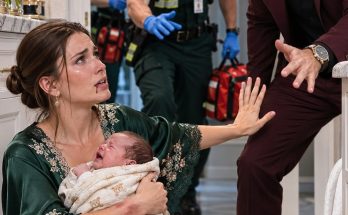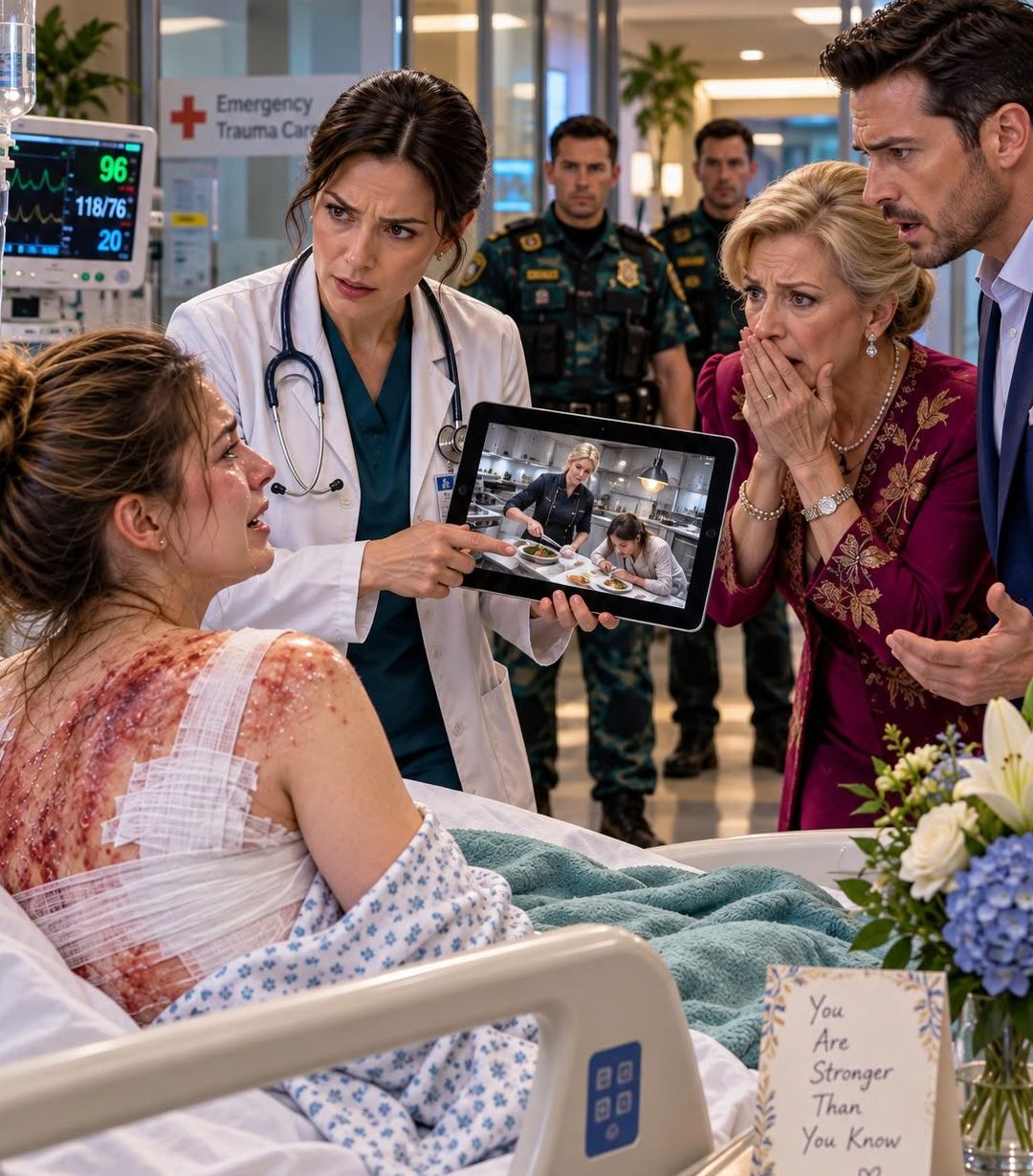
Lena crossed the room and opened the door.
Two detectives entered, followed by a woman in a navy blazer who introduced herself as an investigator from the district attorney’s office.
The first detective was a broad-shouldered man named Marcus Bell.
The second, a woman named Priya Shah, carried a folder and a small evidence bag.
Their attention went immediately to the tablet in Lena’s hands.
“Mrs.
Vale?”
Detective Shah asked.
I nodded.
“My name is Mara Vale,” I said.
My voice was weak, but it held.
“And I want to give you the recording.”
Daniel turned sharply.
“Mara, you don’t know what you’re saying right now.”
Lena’s fingers tightened around the tablet.
“She knows exactly what she’s saying.”
The investigator stepped closer.
“Mrs.
Vale, we can preserve the recording, but we need to hear from you directly.
Are you able to answer questions?”
“I can answer.”
Daniel gave a small, disbelieving laugh.
“She’s medicated.
She’s confused.
Her doctor can confirm—”
“I’m not confused,” I said.
The room became quiet.
I had spent years being told that my certainty was aggression.
That noticing inconsistencies meant I was suspicious.
That asking questions made me difficult.
Now the same habits they had mocked were the only things keeping me steady.
Detective Bell glanced at Daniel.
“Sir, please step away from the bed.”
Daniel didn’t move.
Bell repeated himself, more firmly this time.
Daniel’s mouth tightened.
“I’m her husband.”
“And she is the person we’re here to speak with.”
Vivian began crying again, but the sound no longer affected me the way it once had.
Before, her tears had always pulled Daniel toward her.
He would reach for her hand, offer her water, accuse me of upsetting her.
Now he only stared at the detectives.
I wondered if he understood what had changed.
For three years, he had controlled the room by deciding whose version of reality mattered.
But the room no longer belonged to him.
He and Vivian were asked to wait in the hall while Detective Shah took my statement.
Lena stayed beside me, silent but present.
She did not answer for me.
She did not tell me what to say.
She simply placed one hand over mine.
The same hand that had once held mine in a college library while I studied for my first law exam.
When the interview ended, Detective Bell told me the hospital had already notified the police after the attending physician found my injuries inconsistent with the explanation Daniel had given the emergency staff.
“He said you had spilled oil while cooking,” Bell explained.
“But your mother-in-law told the nurse you had been trying to hurt yourself.”
I closed my eyes.
Even their lies disagreed.
That had always been the problem with fabricated stories.
They required maintenance.
Every person had to remember the same details, use the same words, and anticipate the same questions.
Daniel had been careful.
Vivian had not.
Or perhaps neither of them had expected me to live long enough to be asked.
“The camera,” I said.
“It recorded the kitchen.”
“Was it connected to a cloud account?”
“Yes.
A secure one.”
“Who has access?”
“Only me and Lena.”
Daniel had never known about Lena.
That was why the camera had survived.
He had searched my phone, my desk, my email, even the lining of my handbags.
But he had never thought to question an old friendship he believed had faded away.
He thought my world had grown smaller.
He had never realized I had built a private corner inside it.
Detective Shah asked me where the original files were stored.
I gave her the location of the encrypted drive and the password-protected folder Lena had created months earlier.
“Months?” she asked.
I looked toward the closed hospital door.
“Six.”
Six months earlier, I had noticed the first missing statement.
It had been from an account I barely used, one opened years before with the inheritance my father left me.
The balance was not large by the standards of my trust, but a transfer had appeared and disappeared within forty-eight hours.
Daniel told me it was a bank error.
The bank told me the transaction had been authorized through an online login tied to an unfamiliar device.
I did not confront him.
Instead, I changed nothing.
I began watching.
The second clue was a letter from the trust administrator.
It was addressed to me, but Daniel opened it before I came home and placed it facedown on my desk.
When I asked whether he had touched it, he smiled.
“You worry about everything.”
The letter confirmed that no transfer from the trust could be completed without my direct approval and a secondary verification call.
Yet two weeks later, Daniel presented me with papers stating that I had assigned him complete control.
The documents looked convincing at first glance.
The seal was correct.
The language sounded familiar.
The signature resembled mine.
But one page number was missing.
Page seven followed page five.
A careless mistake.
I signed nothing.
I put the papers in a folder and pretended to believe him.
That folder had been copied and uploaded long before the kitchen incident.
By midnight, the detectives had taken the tablet, the drive, photographs of my injuries, and my clothing from the night before.
They asked whether I wanted to press charges.
“Yes,” I said.
The word did not feel dramatic.
It felt administrative.
Like filing a claim.
Like correcting a record.
Like placing a document where it belonged.
Daniel was not arrested that night.
The detectives said they needed to review the recording and consult with the prosecutor.
Vivian was taken to another room for questioning, and Daniel was instructed not to contact me.
When they finally left, the room felt unnaturally quiet.
Lena adjusted the blanket over my shoulders.
“You should rest.”
“I need to know what they found.”
“About the attack?”
“About the accounts.”
She gave me a look that was part concern, part exasperation.
“You were just injured.”
“I know.”
“You’re allowed to be afraid without solving everything tonight.”
“I’m not afraid of them anymore.”
“That isn’t the same as being all right.”
I looked down at my hands.
The IV line ran along the back of one, taped carefully in place.
“No,” I said.
“It isn’t.”
For the first time that evening, my composure slipped.
I had imagined this moment many times during the past six months.
I had imagined exposing Daniel in a courtroom, watching his confidence collapse as each document contradicted him.
I had never imagined lying in a hospital bed while Lena changed the sheets beneath me because I was too sore to move.
I had never imagined my own husband standing outside the door, telling strangers I had done this to myself.
And I had never understood how painful it would be to discover that a person could know your habits, your fears, your family history, and still choose to use all of it against you.
Lena pulled a chair closer.
“You don’t have to defend yourself to me,” she said.
“I know.”
“Do you?”
I tried to smile, but it trembled.
“I’m learning.”
The next morning, my attorney arrived.
Her name was Celia Grant, and she had worked with my father’s trust for nearly fifteen years.
I had met her only a handful of times before my father died, but she had been copied on every message I sent during the past six months.
She entered carrying a leather folder and a paper cup of coffee she never drank.
“The investigators contacted me,” she said.
“The trust is secure.”
I released a breath I hadn’t realized I was holding.
“And the bank?”
“Freezing access to the accounts connected to Daniel’s devices.
They’ve also placed an alert on any attempted transfer involving your trust.”
“Did he get anything?”
Celia sat beside the bed.
“He obtained access to household accounts, not the trust itself.
But the amounts are substantial.”
“How substantial?”
She opened the folder.
“Over the past three years, there were forty-three transfers from the joint account.
Some went to household expenses, but most were sent to a company called Vantage Renewal.”
The name meant nothing to me.
“Is that one of Daniel’s businesses?”
“That’s what we’re trying to determine.”
I stared at the statement.
Vantage Renewal.
The transfers were irregular at first—small amounts, a few thousand dollars at a time.
Then they increased.
Twenty thousand.
Thirty-five thousand.
One transfer for eighty thousand.
“Where did the money come from?”
“Mostly from the account you and Daniel shared.
But three payments came from an account in your name.”
I felt the room tilt.
“Mine?”
“Yes.”
“That account was supposed to be dormant.”
“It was.
Until Daniel added a new authorized user.”
I looked at Lena.
She had gone very still.
“When?”
Celia turned the page.
“Three years ago.
Two months after your wedding.”
I remembered that period clearly.
Daniel had encouraged me to consolidate my finances after we married.
He said it would make taxes easier.
He said separate accounts created unnecessary distance between spouses.
I had believed him.
Not because I was naïve.
Because I thought trust meant allowing someone access without demanding proof of what they intended to do with it.
“What is Vantage Renewal?”
I asked.
“That’s the question.”
Celia tapped the statement.
“The company is registered in this state, but its listed address is a mailbox in another county.
There are no employees, no public website, and no business licenses beyond a basic registration.”
“Shell company.”
“Possibly.”
“Who is the registered owner?”
Celia looked at me.
“Daniel’s mother.”
The answer landed with terrible simplicity.
Vivian.
For several seconds, I could hear only the steady monitor beside my bed.
“Why would she need the money?”
Lena asked.
Celia closed the folder halfway.
“That’s what we don’t know.”
I did.
Or at least I thought I did.
Vivian had always claimed to be struggling.
She talked about medical bills, repairs to the house she owned before moving in with us, and debts left by her late husband.
Daniel often told me that helping his mother was a moral obligation.
But I had never questioned the amounts.
Whenever I asked, he accused me of treating family like a balance sheet.
Perhaps that was why he had chosen the phrase.
He knew I would feel ashamed for asking.
“Did the money go to her personally?”
I asked.
“Not directly.
It moved through Vantage Renewal, then into several other accounts.”
“Whose?”
Celia hesitated.
“That’s where things become more complicated.”
She handed me a photocopy of a transaction summary.
The first recipient was a consulting firm in Colorado.
The second was a private lender in Nevada.
The third was an account belonging to a person named Jonathan Reed.
I recognized the name.
I had heard it once, nearly two years earlier, when Daniel received a phone call in the garage.
He had spoken quietly, then told me a former college friend needed a temporary loan.
At the time, I had asked why the money came from our household account.
Daniel had told me Jonathan was embarrassed to ask anyone else.
I had accepted that explanation.
“Who is Jonathan Reed?”
Lena asked.
“I don’t know.”
Celia studied the documents.
“He may be connected to a property transaction.
There’s a deed recorded under his name and another person.”
“Who?”
She turned to the next page.
My stomach tightened before I even saw it.
The second name was mine.
“Mara Vale,” I read.
The deed described a property in a town two hours north of the city.
A small farmhouse on nearly six acres.
I had never owned a farmhouse.
I had never signed a deed with Jonathan Reed.
“This is forged,” I said.
Celia nodded slowly.
“The signature appears to be yours, but the notary information is inconsistent.
We’re verifying it.”
“Why would they buy property?”
“Perhaps they didn’t buy it.”
She slid another document across the blanket.
It was a loan agreement.
The borrower was listed as Vantage Renewal.
The collateral was the property described in the deed.
The lender was a private investment group.
The loan amount was four hundred thousand dollars.
I stared at the number.
“Daniel used my name as collateral.”
“Apparently.”
“But if the deed is forged—”
“The lender may not know that yet.”
A cold feeling moved through me, not fear exactly, but recognition.
This was larger than Daniel taking money from our joint account.
Larger than Vivian covering household expenses.
There were other people involved, other documents, and debts moving through companies designed to make them difficult to trace.
I looked toward the window.
Morning sunlight rested across the hospital floor, pale and ordinary.
“What is at that property?”
I asked.
Celia’s expression changed.
“That’s the part we haven’t confirmed.”
“Then confirm it.”
“We’re arranging for an investigator to visit.”
“No.”
Both women looked at me.
“I want to go.”
Lena shook her head immediately.
“You can barely sit up.”
“I’m not asking to go today.”
“Mara—”
“I need to see it.”
Celia folded her hands over the documents.
“You may not be able to return home for some time.
The police will likely treat the house as a crime scene, and your attorney-client relationship with me doesn’t protect you from making unsafe decisions.”
“I’m not going alone.”
Neither of them answered.
“I’ll go with Lena,” I continued.
“And an investigator.
In daylight.
After the property is cleared.”
Lena looked at me for a long moment.
“You’re trying to turn this into work.”
“No,” I said quietly.
“Work is what I used to do when I wanted to avoid feeling anything.
This is different.”
“What’s different?”
“I’m trying to understand what happened to my life.”
That softened her expression.
Celia placed the deed back inside the folder.
“We’ll arrange it when the police approve.”
That afternoon, Detective Shah returned with an update.
The kitchen recording was clear.
It showed Vivian entering the kitchen with a pot, Daniel following her, and the two of them speaking for several minutes before I entered.
I had not known they were there.
The audio captured Daniel telling Vivian to wait until I was near the stove.
It captured Vivian saying, “She’ll make everyone think we’re monsters.”
And Daniel answering, “By tomorrow, she’ll be the one everyone pities us for.”
Detective Shah did not describe the rest in detail.
She didn’t need to.
The recording would speak for itself.
Daniel and Vivian had both been taken into custody for questioning.
The prosecutor was reviewing charges.
My husband had requested an attorney and refused to answer further questions.
“Did he say anything before that?”
I asked.
Detective Shah opened her notebook.
“He asked whether you had access to the trust.”
I looked at her.
“Not whether you were conscious.
Not how badly you were hurt.
He asked whether you had access to the trust.”
The words settled into the room.
A man could be frightened of consequences and still care about the person he had harmed.
Daniel’s first question told me which fear came first.
After Detective Shah left, I asked Celia to bring every document related to my father’s trust.
She arrived the next morning with two boxes.
Lena helped me review them from the hospital bed.
It was slow work.
I could only read for short periods before my eyes blurred, but the structure of the trust was clear.
My father had anticipated that someone might try to influence me after his death.
He had insisted on provisions that required my independent approval for any change in ownership.
He had also named a successor protector in case I became unable to act.
The name was not Celia’s.
It was my younger brother, Adrian.
Adrian and I had not spoken in nearly two years.
Not because we had stopped loving each other, but because Daniel had convinced me that Adrian wanted the trust for himself.
He had shown me messages that appeared to prove it.
At the time, I had believed I was protecting my father’s wishes by keeping Adrian away.
Now, reading the correspondence again, I saw the same pattern I had missed everywhere else.
The messages were incomplete.
Sentences ended abruptly.
Attachments were missing.
And every disagreement had begun after Daniel became involved.
Lena noticed my expression.
“What is it?”
I handed her the page.
She read it, then looked at me.
“Have you spoken to Adrian recently?”
“No.”
“Do you know where he is?”
“No.”
Celia reached into the second box and removed a thin envelope.
“This was delivered to my office three days ago,” she said.
“I didn’t open it because it was addressed to you.”
My name was written across the front in a familiar, slanting hand.
Adrian’s.
My fingers shook as I opened it.
Inside was a single sheet of paper.
*Mara,*
*I don’t know whether you’ll believe anything I say, but I need you to hear this from me before you hear it from someone else.*
*Dad did not leave the trust exactly as you were told.*
*There was a second document.*
*Daniel found it before either of us knew it existed.*
I stopped reading.
Lena took a step closer.
“What does it say?”
I looked at the final lines.
*He has been using the trust as leverage, but the money he’s moving is not for Vivian’s debts.*
*It’s connected to the night Dad died.*
*Ask Celia about the sealed annex.
Ask her why Daniel was the first person to know about it.*
Beneath the message was an address.
Not the farmhouse.
A law office downtown.
The office of the attorney who had handled my father’s estate.
Celia read the letter over my shoulder, and all the color left her face.
“What is the sealed annex?”
I asked.
For the first time since she had entered my hospital room, Celia looked genuinely afraid.
“There shouldn’t be one,” she whispered.
Then she turned the page over.
A second address had been written on the back—one I recognized immediately.
The farmhouse Daniel had supposedly purchased with money from my account.
And beneath it, in Adrian’s handwriting, were six words:
*The original proof is still there.*
-END OF PART 2, –PRESS NEX PART IN BOTTOM OF PAGE TO READ NEXT PART
PART 3: The Accounts Daniel Thought He Had Hidden
PART 3
Celia read the letter twice before folding it along its original crease.
“I need to speak with Adrian,” I said.
“I agree.”
“You know where he is?”
“No.
But I know where he was working when you stopped responding to him.”
“Why didn’t you tell me?”
Her expression tightened.
“Because Daniel told me you had asked him to handle all communication regarding the trust.”
“I never asked that.”
“I know that now.”
The words carried no defense, only regret.
Celia had been my father’s attorney for fifteen years.
She had helped organize his estate, explain the trust, and guide me through the first year after his death.
I had trusted her judgment because my father had.
But trust, I was learning, did not exempt anyone from mistakes.
“Tell me about the annex,” I said.
Celia glanced at the hospital door as though the answer might be waiting on the other side.
“The trust documents were prepared in two sets.
The primary agreement was filed and distributed to the relevant parties.
The second set contained supporting schedules, private correspondence, and instructions from your father.
It was sealed at his request.”
“Why?”
“He said the contents should remain private unless a specific condition was met.”
“What condition?”
Celia hesitated.
“That the trust’s assets were being used in a way that violated his intentions.”
A strange pressure gathered behind my ribs.
“Then why was I never told?”
“Because your father believed the annex would never be needed.”
“Or because Daniel found it first.”
Celia lowered her eyes.
“That possibility has occurred to me.”
Lena moved closer to the bed.
“How could Daniel have accessed a sealed document?”
“I don’t know,” Celia said.
“The annex was kept in a separate file at the law office.
Only three people knew of its existence.
Your father, me, and the associate who helped prepare it.”
“Who was the associate?”
“Jonathan Reed.”
The room seemed to narrow around the name.
The same Jonathan Reed listed on the financial documents.
The same man connected to the property deed.
I looked at Celia.
“You said he was a former associate.”
“He left the firm shortly after your father died.”
“Why?”
“Professional disagreement, officially.”
“And unofficially?”
Celia folded her hands in her lap.
“Jonathan believed your father had concealed information from the family.
He thought the trust was designed to deprive him of something.”
“Was he related to my father?”
“No.
He had represented one of your father’s business partners in a dispute several years earlier.
They knew each other professionally.”
“Then why would he be involved with the farmhouse?”
“We need to find that out.”
The pain medication had begun to dull the edges of my body, but it could not soften the questions forming in my mind.
Daniel had known Jonathan.
Jonathan had worked with my father’s files.
Jonathan was connected to a property purchased using money from an account in my name.
And Adrian believed the original proof was still there.
“I want the police to search the farmhouse,” I said.
Celia nodded.
“They’ll need probable cause.”
“We have a forged deed, suspicious transfers, and a letter from my brother saying evidence is there.”
“We have enough to request a warrant,” Detective Shah said from the doorway.
None of us had heard her enter.
She stepped into the room with a folder tucked beneath one arm.
Her expression was serious but not grim.
“I spoke with the prosecutor,” she continued.
“We can coordinate with the county sheriff where the property is located.
But we need to understand what we’re looking for.”
“An original document,” I said.
“Possibly the sealed annex from my father’s trust.”
Detective Shah glanced at Celia.
“Is that document connected to the financial activity?”
“We don’t know yet,” Celia replied.
“Then we’ll start with the financial records.
The bank has given us preliminary data.
Vantage Renewal received money from accounts connected to Mrs.
Vale, then transferred funds to a property holding company.
That company paid for renovations at the farmhouse.”
“Renovations?”
I asked.
“According to invoices, yes.
Roofing, electrical work, interior construction.”
“What kind of interior construction?”
Detective Shah opened the folder.
“An enclosed office.
Reinforced storage cabinets.
A security system.”
I stared at the page.
The farmhouse had not been bought as a home.
It had been prepared as a place to store something.
Or someone’s records.
“Does Daniel own the property?”
I asked.
“Not directly.
The deed lists you and Jonathan Reed.
But the mortgage payments came from Vantage Renewal.”
“Why put my name on it?”
“That’s what we’re trying to determine.”
I thought about Daniel’s constant insistence that my inheritance was untouchable.
He had told me the trust protected me from financial risk.
He had also told me the property was an investment he was considering for us, though I had never seen an offer, a listing, or even a photograph.
Perhaps the farmhouse was not an investment.
Perhaps it was a container for a false story.
Detective Shah closed the folder.
“The search team can go tomorrow morning.”
“I want to be there.”
“No.”
“I won’t enter until you clear it.”
“That isn’t the concern.
You’re recovering from a serious injury, and the location may have hazards.”
“I understand.”
“Mrs.
Vale—”
“I need to see where my name was used.”
Detective Shah watched me for a moment.
There was no impatience in her face, only consideration.
“You can come after the initial search,” she said.
“If the property is safe and your doctors approve it.”
“That’s fair.”
She nodded.
“There’s something else.
Daniel’s attorney contacted the prosecutor.”
“What did he say?”
“He claims Daniel believed the transfers were authorized by you.”
A tired laugh escaped me.
“Of course he does.”
“His attorney also says Jonathan Reed acted independently and that Daniel had no knowledge of the farmhouse.”
“Do you believe him?”
Detective Shah’s expression remained neutral.
“I believe people often become very certain about what they did not know once investigators begin asking questions.”
After she left, Lena helped me sit higher against the pillows.
My muscles ached from the effort, and I closed my eyes until the room steadied.
“You don’t have to prove everything today,” she said.
“I know.”
“You keep saying that.”
“I’m trying to make it true.”
She sat on the edge of the chair.
“Have you considered calling Adrian?”
“I don’t know what I would say.”
“You could start with, ‘I got your letter.’”
“He’ll think I’m calling because I need something.”
“Do you?”
I looked at the envelope on the bedside table.
“Yes.”
Lena’s voice softened.
“You need information.
That doesn’t make the call dishonest.”
I reached for the phone, but stopped before touching it.
“What if he doesn’t answer?”
“Then you leave a message.”
“What if he does?”
“Then you listen.”
The advice was simple.
That was why it helped.
I dialed the number written in the trust records.
It rang six times before a man answered.
“Hello?”
For a moment, I could not speak.
“Mara?”
His voice was older than I remembered.
Or perhaps my memory had preserved it in a different season of our lives.
“Hi, Adrian.”
Silence.
Then, carefully, “Are you all right?”
“I’m in the hospital.”
He inhaled sharply.
“What happened?”
“I was injured at home.
I’m safe now.”
“Was it Daniel?”
The question was quiet, but it carried the weight of years.
I looked at Lena.
She gave me a small nod.
“Yes.”
Adrian said nothing.
I heard what might have been a chair moving across a floor.
“Is he there?”
“No.
He and our mother have been questioned by the police.”
“Our mother?”
“Vivian.”
“I know who Vivian is.”
The old bitterness beneath his words surprised me.
Daniel had always described Adrian as jealous of our marriage, hostile toward Vivian, and incapable of letting go of the past.
I wondered how much of that had been true.
“I received your letter,” I said.
“I wasn’t sure Celia would give it to you.”
“She did.”
“Then you know about the annex.”
“I know there’s a sealed document.
I don’t know what’s in it.”
“You were supposed to know.”
“According to whom?”
“Dad.”
My fingers tightened around the blanket.
“Why didn’t he tell me?”
“Because he wanted to protect you.”
“That’s what everyone says when they make decisions without me.”
Adrian was quiet again.
“I’m not trying to make another decision for you,” he said.
“I’m trying to tell you what I should have told you two years ago.”
“Tell me now.”
“My father suspected someone had been diverting money from one of his companies.
Not stealing exactly.
Moving it through contracts that looked legitimate.
He thought the person had access to internal records and knew how to hide transactions.”
“Did he suspect Daniel?”
“Not at first.”
“Who did he suspect?”
“Jonathan Reed.”
The name seemed to pull every loose thread toward itself.
“Why?”
“Jonathan had handled several property negotiations.
He also helped prepare documents for your father’s charitable foundation.
After Dad died, Jonathan claimed there were unpaid fees and threatened to challenge the trust.”
“Did he have evidence?”
“He said he had copies of private agreements.
But when Celia asked to see them, he stopped responding.”
“And Daniel?”
“Daniel became involved later.”
“How?”
Adrian exhaled slowly.
“He called me after the funeral.
He said you were overwhelmed and that Dad had left unresolved debts.
He asked whether I knew about a side agreement involving the trust.”
“I didn’t know about one.”
“Neither did I.
But I asked questions.
Daniel told me I was making things harder for you.”
“That sounds like him.”
“I sent you an email.”
“I never received it.”
“I sent six.”
I looked toward Lena.
“Did Daniel tell you I wanted nothing to do with you?”
“Yes.”
“He told me you had accused me of stealing from the trust.”
Adrian made a sound that was almost a laugh, except there was no humor in it.
“I accused Daniel of using your name.
I never accused you.”
The room blurred.
For two years, I had carried the belief that my brother saw me as an obstacle.
I had repeated Daniel’s version so often that it had become part of my own memory.
“I’m sorry,” I said.
“I know.”
“No, you don’t.
I believed him.”
“I know that too.”
There was no accusation in his voice.
Somehow, that made it worse.
“I want to see the farmhouse,” I said.
“You shouldn’t go until the investigators search it.”
“They’re going tomorrow.”
“Good.”
“Were you there?”
“Once.”
“When?”
“About a year ago.”
“Why?”
“Jonathan contacted me.
He said he had something that belonged to Dad and wanted to meet privately.
I went to the property because I thought it was safer than meeting at his office.”
“What did you find?”
“Nothing.
He wasn’t there.”
“Did you enter the house?”
“The front door was unlocked.
I looked around, but most of it was unfinished.
There was a room at the back with new walls and a steel cabinet.
I didn’t open it.”
“Why not?”
“Because I heard someone outside.”
“Who?”
“I never saw them.
I left.”
“And you believed the original proof was still there?”
“I believed Jonathan had hidden something.
When I found out the property was connected to you, I started looking into it.”
“Why didn’t you tell me?”
“Because every time I contacted you, Daniel answered.”
I closed my eyes.
Adrian continued, “I tried coming to the house once.
He met me outside and told me you didn’t want to see me.
He said you were frightened of me.”
“I wasn’t.”
“I know.”
“I should have opened the door.”
“You weren’t given the chance.”
The simplicity of that statement broke through the defenses I had built around my regret.
I had spent months searching for the moment when I had failed my brother.
Perhaps there had been many moments, but not all of them had belonged to me.
“What did Dad know?”
I asked.
“I don’t know everything.
But I found a copy of a letter he sent to Celia three days before he died.”
“What did it say?”
“That he had discovered a conflict involving Jonathan, one of Daniel’s companies, and a former employee of his.”
“Daniel had a company before we married?”
“Several.”
“Why did I never hear about them?”
“Because they were dissolved.”
I thought of Vantage Renewal.
“Was Vivian involved?”
“I don’t know.
But her name appeared on a registration connected to one of them.”
Celia’s earlier discovery came back to me.
Vantage Renewal was registered to Vivian.
“Adrian, what happened the night Dad died?”
He was silent so long that I wondered whether the call had disconnected.
Finally, he said, “Dad was supposed to meet someone at his office.
He canceled the meeting and came home early.
He told me he had found proof that money had been moved through a property deal.”
“The farmhouse?”
“Maybe.
He didn’t name it.”
“What happened after that?”
“He called Celia.
Then he called Jonathan.”
“And then?”
“He had a heart attack that night.”
I remembered the official story: my father had been alone in his study, found by a housekeeper the next morning.
Natural causes.
No suspicion.
No investigation.
“Was Daniel there?”
“No.”
“How do you know?”
“Because I was.”
My breath caught.
Adrian continued, “I arrived after Dad called me.
We argued.
I wanted him to go to the hospital.
He refused.
He said he needed to finish something first.”
“What did you argue about?”
“About the trust.
He wanted you to have control.
I thought that was unfair because I had helped with his business for years.”
The admission was painfully honest.
“Did you resent me?”
“Sometimes.”
The word settled between us.
“Thank you for telling me.”
“I loved you,” he said.
“I also felt left behind.
Both things were true.”
I pressed my palm to my eyes.
“What happened after he died?”
“I found a folder on his desk.
It was empty except for a note.”
“What note?”
“‘The original is where the false title begins.’”
The farmhouse deed.
My name.
Jonathan’s name.
A property created around a document that did not belong there.
“Why didn’t you show this to Celia?”
“I tried.
But before I could, Daniel told her I was unstable and grieving.
He said I had taken papers from the office.”
“Did you?”
“No.”
“But Celia believed him.”
“For a while.”
I looked at the attorney sitting quietly across the room.
“Why didn’t she tell me?”
“Because she thought she was protecting you from a family dispute.”
I let out a slow breath.
Everyone had been protecting me from pieces of the truth until there was no truth left that I could recognize.
“Adrian,” I said, “will you come here?”
He didn’t answer immediately.
“Do you want me to?”
“Yes.”
“Even after everything?”
“Especially after everything.”
His voice changed when he spoke again.
“I’ll come tonight.”
After we ended the call, Lena remained silent.
I stared at the phone.
“He’s coming,” I said.
“I heard.”
“I don’t know what I’m going to say when he gets here.”
“You don’t have to say everything at once.”
“What if he hates me?”
“Then you’ll let him tell you.
And if he doesn’t, you’ll let yourself hear that too.”
The hospital lights dimmed for the evening.
Outside, traffic moved along the avenue in red and white lines, each car carrying people toward homes and conversations I would never know.
Celia gathered the trust documents, but left the photocopy of Adrian’s letter on the table.
Before she could leave, her phone rang.
She answered, listened, and slowly turned toward me.
“What is it?”
I asked.
She ended the call.
“The search team reached the farmhouse.”
My body went still.
“They found the steel cabinet,” she said.
“It was empty.”
I felt disappointment, but it lasted only a second.
“Then what did they find?”
Celia looked at the photocopy of the deed.
“An old foundation wall beneath the office floor.”
“That doesn’t explain anything.”
“No.
But the investigators discovered a loose stone inside it.”
She took a photograph from her bag and placed it on the blanket.
The image showed a narrow cavity in the wall.
Inside was a small metal box, dark with age.
“The box was locked,” Celia said.
“Did they open it?”
“Not yet.”
“Why not?”
“Because it has your father’s initials engraved on the lid.”
I stared at the photograph.
M.V.
My father’s initials.
Beneath them, scratched into the metal, were two letters I recognized from the trust documents.
S.A.
Sealed Annex.
Celia’s voice lowered.
“And there’s one more thing.
The key wasn’t in the farmhouse.”
“Where was it?”
She met my eyes.
“It was found in the lining of Daniel’s briefcase.”
-END OF PART 3–PRESS NEX PART IN BOTTOM OF PAGE TO READ NEXT PART
PART 4: The Accounts Daniel Thought He Had Hidden
PART 4 (THE END)
Celia’s voice lowered.
“And there’s one more thing.
The key wasn’t in the farmhouse.”
“Where was it?”
She met my eyes.
“It was found in the lining of Daniel’s briefcase.”
For several seconds, I could not make sense of the sentence.
Daniel’s briefcase had been an ordinary part of our house.
Brown leather, always polished, always placed beside the front door or beneath the desk in his study.
I had seen it nearly every day for three years.
“What was the key doing there?”
I asked.
“We don’t know yet.”
“Was it hidden?”
“Inside a stitched compartment.
The investigators found it while searching the briefcase for documents.”
A cold certainty settled over me.
“He knew about the box.”
Celia didn’t answer.
“He knew,” I repeated.
“That’s why he was so interested in the farmhouse.”
“Or he was holding the key for someone else,” she said carefully.
“Jonathan.”
“Possibly.”
The hospital door opened, and Adrian stepped inside.
He looked older than I remembered, though only two years had passed since I had last seen him.
His hair was graying at the temples.
He carried no overnight bag, no coat, nothing that suggested he had planned to stay.
He stopped when he saw me.
For one suspended moment, neither of us moved.
Then he crossed the room.
I tried to sit up, but the movement pulled at my shoulders.
Lena rose to help me, but Adrian reached the bed first.
He placed one hand lightly beneath my elbow, careful not to touch the bandages.
“You don’t have to move,” he said.
“I wanted to.”
His eyes traveled over my face, then to the dressings visible above the hospital gown.
“I’m sorry,” he whispered.
The words were simple, but they carried everything he had not said during the years we were apart.
“I’m sorry too.”
He looked away.
Celia showed him the photograph of the metal box.
Adrian studied it, then handed it back.
“Dad had that made,” he said.
“You’ve seen it before?”
“Not the box.
The symbol.”
“What symbol?”
He pointed to the letters scratched beneath the initials.
“S.A.
He used it on documents he didn’t want anyone else to recognize.
Sealed annex, sometimes supplemental archive.
He told me once that if I ever saw it, I should assume the information inside was important enough to wait for.”
“Why didn’t you tell me?”
“I didn’t know where it was.”
“You knew it existed.”
“I knew Dad had created something.
I didn’t know whether it had been destroyed, moved, or taken.”
Celia folded her arms.
“Your father gave me instructions to release the annex only if the trust was challenged or its assets were placed at risk.
I had no reason to believe either condition had been met until this week.”
“You had no reason?”
I asked.
The pain in my voice made her flinch.
“I saw the altered transfer papers,” she said.
“I assumed Daniel had fabricated them to frighten you into giving him access.
I didn’t realize he had already moved money through accounts connected to your name.”
“You should have told me.”
“Yes,” she said.
“I should have.”
There was no defense in her answer.
No attempt to make my anger smaller.
That mattered.
The next morning, after the doctors cleared me to leave the hospital for a few hours, Detective Shah arranged for me to visit the farmhouse.
I was still weak, and every movement required patience, but I refused a wheelchair until the last moment.
The investigator assigned to the search drove us in an unmarked vehicle.
Lena sat beside me.
Adrian followed in his own car.
The farmhouse stood at the end of a narrow gravel road bordered by bare trees.
It was smaller than I had imagined, with faded green shutters and a porch that sloped slightly toward the yard.
Nothing about it looked secretive.
That was what made it unsettling.
The office at the back of the house had been stripped of its furniture.
A section of flooring had been lifted, and the opening in the foundation wall was covered with a clear evidence sheet.
The metal box sat on a folding table.
Its surface was scratched, but the initials were unmistakable.
M.V.
My father had been named Martin Vale.
I stood in front of the box for a long time.
“Do you want to open it?”
Detective Shah asked.
“Yes.”
She placed the key in my hand.
It was small and old-fashioned, with a narrow brass stem.
I turned it once in the lock.
The lid rose with a faint click.
Inside were three envelopes, a compact recording device, and a stack of photocopied contracts tied with blue thread.
The top envelope was addressed to me.
*Mara,*
*If you are reading this, then something has gone wrong in a way I hoped to prevent.
I am sorry that this information comes to you through fear rather than trust.*
I stopped.
Lena moved closer, but did not touch me.
The letter continued.
*The trust was not created merely to preserve my money.
It was created to preserve your independence.
I learned that several people involved in my business were using property transactions to conceal debts and transfer liability.
Jonathan Reed was one of them, though I did not believe he was acting alone.*
*Daniel Vale became involved after approaching Jonathan about a contract dispute.
Daniel had financial problems of his own.
He presented himself as someone seeking advice.
In time, he became a participant.*
I lowered the page.
Adrian stood on the other side of the table, his face tense.
“Keep reading,” he said gently.
The letter explained that my father had discovered money moving through a series of companies, including one connected to Vivian.
He had confronted Jonathan and planned to report the matter.
He had also written to Celia, instructing her to preserve the annex.
The documents showed that Daniel had not created the scheme, but he had expanded it.
He learned that my father’s trust could not be accessed directly.
So he began building a different plan: marry me, isolate me, convince me that shared finances were a sign of loyalty, and use my name to support loans and property transactions.
The truth was more ordinary than the nightmare I had imagined.
There had been no single grand conspiracy.
There had been years of small choices.
A forged signature.
A concealed transfer.
A missing page.
A lie told because it was easier than an explanation.
Each decision had made the next one possible.
The recording device contained my father’s final interview with Celia, made two days before his death.
His voice sounded tired but steady.
“I don’t believe Daniel intends to hurt Mara physically,” he said.
“But he believes he is entitled to what she has.
That kind of thinking becomes dangerous when it is rewarded.”
Celia’s recorded voice asked, “Should we warn her?”
“I want to,” my father answered.
“But if I accuse him without enough proof, he will make himself the victim.
Mara will defend him.
She has always believed loyalty means standing beside someone until the truth is impossible to ignore.”
I closed my eyes.
He had understood me too well.
The recording continued.
“Then what do you want me to do?”
“Keep the annex sealed.
If Daniel gains control of Mara’s finances, release it.
If he attempts to transfer trust assets, release it.
And if Mara is ever told she is unstable for questioning his decisions, release it immediately.”
A pause followed.
Then my father said, “The first sign will be isolation.”
The device clicked off.
No one spoke.
Outside, wind moved through the trees.
The sound was soft, almost peaceful.
“He knew,” I said.
“He suspected,” Adrian replied.
“He didn’t know how far Daniel would go.”
“Did Daniel know Dad had this recording?”
“Maybe,” Celia said.
“Jonathan may have told him.”
I looked at the contracts tied with blue thread.
“What happened to Jonathan?”
Detective Shah answered.
“He left the country three months ago.
We have an extradition request pending, but the financial records are enough to proceed against the people still here.”
“Daniel and Vivian.”
“And two former business associates.
Daniel has been cooperating selectively through his attorney.”
“Meaning?”
“He admits to arranging some transfers but claims he believed the money would be repaid.
He says he did not forge your signature and that Jonathan handled the documents.”
I thought of Daniel’s face in the hospital room when Lena revealed the camera.
He had not looked surprised that the recording existed.
He had looked afraid of what else I knew.
“Is Vivian still saying I did it to myself?”
Detective Shah’s expression tightened.
“She has changed her statement.”
“To what?”
“She now says she was frightened and confused.
She claims Daniel told her the oil would only frighten you into leaving the house.”
The words struck me harder than I expected.
Not because they excused anything.
Because they revealed how casually they had discussed my pain.
Daniel had built his plan around the belief that I would eventually surrender.
Vivian had accepted a version of it because she wanted her financial problems solved.
Neither had thought of me as a person standing in the middle of their decisions.
Only an obstacle.
Adrian touched the edge of the table.
“Are you all right?”
“No,” I said.
“But I’m here.”
He nodded.
It was the first time anyone had asked without expecting a reassuring answer.
The investigation moved quickly after that.
The recording, the forged deed, the bank records, and the documents from the box established a pattern that Daniel could not explain away.
The prosecutor charged him with fraud, forgery, conspiracy, and aggravated assault.
Vivian faced charges for her role in the attack and the financial transactions.
Jonathan was charged in absentia, and the two former associates agreed to cooperate.
The trust remained untouched.
The money taken from the joint accounts could not all be recovered, but enough assets had been identified to create a repayment plan.
Some had been spent on debts.
Some had been moved through accounts Vivian controlled.
A portion had been used to purchase the farmhouse, which was sold after the court determined that the deed was fraudulent.
I did not attend every hearing.
At first, I believed I needed to hear every word Daniel said.
I thought closure would come from watching him admit what he had done.
Instead, I learned that closure was not something another person could give me.
Daniel apologized through his attorney.
He wrote that he had loved me, that financial pressure had distorted his judgment, that he had never intended for the situation to become violent.
I read the letter once.
Then I placed it in the evidence file.
Love did not erase planning.
Pressure did not create the choices for him.
And an apology that arrived only after discovery was not the same as accountability.
Vivian sent no letter.
Her attorney later told the prosecutor that she regretted trusting Daniel.
I believed she regretted the consequences.
I did not know whether she regretted what had happened to me.
I decided I did not need to find out.
Recovery took longer than I wanted.
The doctors told me healing would not be measured in days.
Some mornings, I woke convinced I was almost well, only to discover that lifting a cup or turning in bed required concentration.
Lena stayed in my apartment during the first month.
She worked from the small desk beside the window and made ordinary meals that tasted better than anything served in the hospital.
She never treated me like glass, but she never mistook my independence for proof that I needed no help.
Adrian came every Saturday.
At first, we spoke mostly about practical matters: documents, court dates, insurance, the trust.
Gradually, we began talking about our father.
We remembered different versions of him.
I remembered his habit of humming while reading the newspaper.
Adrian remembered how he taught him to repair an engine.
One afternoon, I asked him why he had agreed to become successor protector of the trust.
“Because Dad trusted me,” he said.
“Do you want the responsibility?”
He considered the question.
“I want you to never be alone with it again.”
The answer moved me more than any promise of protection could have.
“I don’t want another person making decisions for me,” I said.
“I know.”
“Then we do it together.
You advise.
I decide.”
He smiled.
“That sounds more like you.”
Months later, I returned to work—not as a full-time attorney, but as a consultant for a financial crimes clinic.
I helped people recognize forged documents, hidden liabilities, and coercive financial arrangements before those patterns became impossible to escape.
I did not tell every client that I had once missed the warning signs in my own life.
But I told them that intelligence did not make anyone immune to manipulation.
Trust was not the absence of questions.
Love did not require surrendering your judgment.
And asking for proof was not cruelty.
One spring morning, Celia came to my office with the final trust documents.
The sealed annex had been formally added to the record, along with a new instruction I had written myself.
No one could access my financial records on my behalf without my direct confirmation.
No spouse, sibling, attorney, or friend.
Celia read the clause and nodded.
“Your father would approve.”
“I hope so.”
“He would also tell you that independence is not the same as isolation.”
I looked through the window at Adrian, who was waiting beside his car.
“I’m beginning to understand that.”
That evening, Lena and I walked through the kitchen of my new home.
It was smaller than the house Daniel and I had shared, but the windows faced west, and sunlight filled the room at the end of the day.
For a while, I avoided cooking.
Then one Sunday, Adrian arrived with vegetables from the farmers’ market, Lena brought bread, and I decided to make soup.
My hands were still marked by faint scars.
I noticed them when I reached for the pot.
For a moment, the old fear returned.
Then Lena placed a cutting board on the counter.
“You can ask for help,” she said.
“I know.”
“And you can change your mind.”
“I know that too.”
Adrian set the bread beside the stove.
“Do we have a plan?”
I looked at the two people who had stayed when my life had become complicated, painful, and difficult to explain.
“We have ingredients,” I said.
“That’s enough for now.”
The kitchen filled with the ordinary sounds of a life being rebuilt: water running, knives against wood, quiet conversation, laughter that arrived carefully at first and then became natural.
I had once believed evidence was the strongest thing I could possess.
I still believed in records, truth, and the protection of facts.
But I had learned something else.
Evidence could prove what happened.
It could not decide what happened next.
That choice belonged to me.
And this time, I was making it with my eyes open.
– END OF PART 4 - LET SAY YES AND LIKE, SHARE THIS POST IN FACEBOOK SO THAT WE HAVE THE MOTIVATION TO SHARE MORE STORIES