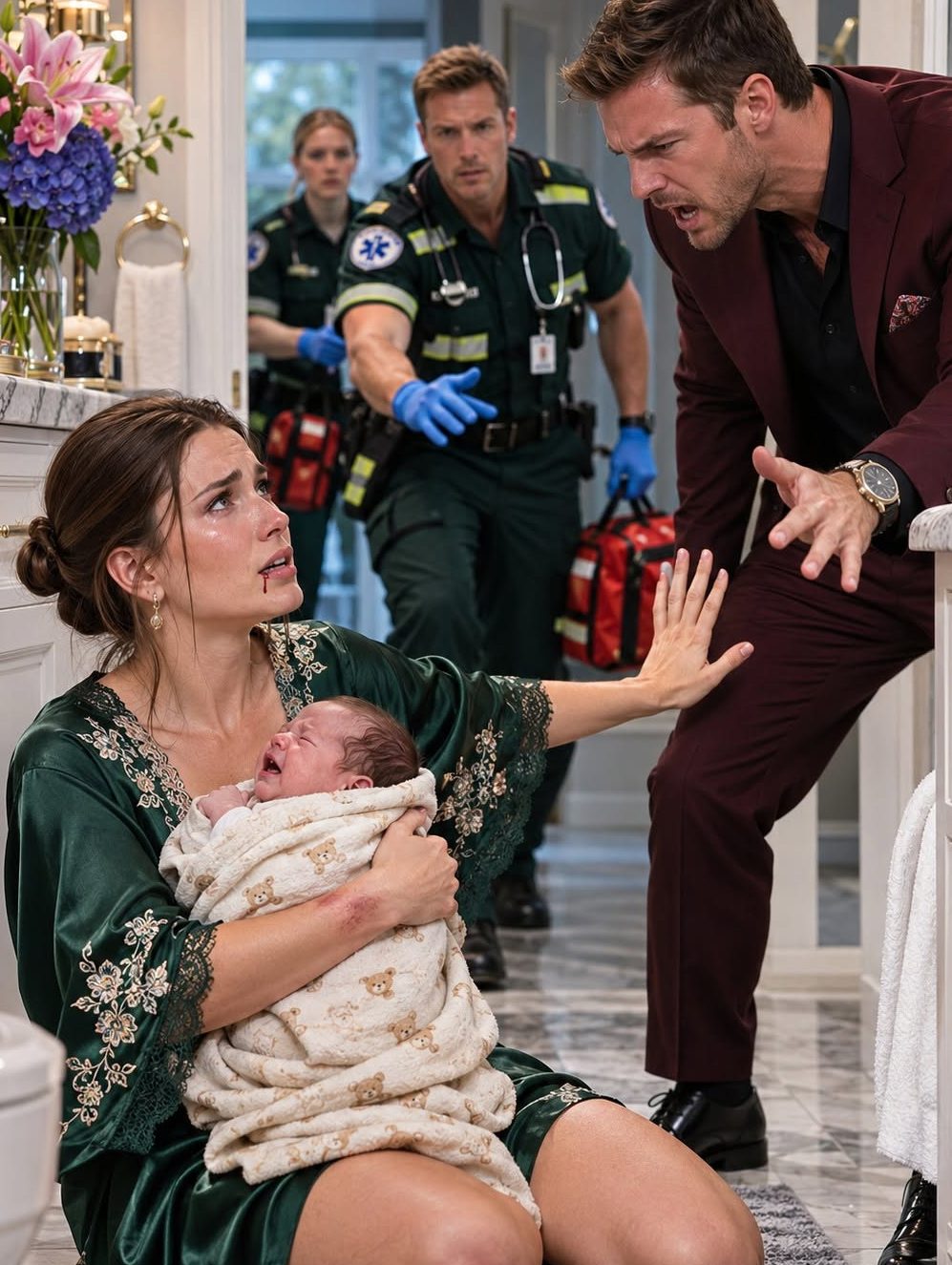
Earlier that night, when the pain had become too strong for me to stand upright, I had reached for my coat and told him I was going to the hospital whether he came or not.
He had taken my keys from the hook.
Then my wallet from my purse.
“You’re not driving like this,” he had said.
At the time, some exhausted part of me had almost accepted the explanation.
Maybe he was worried.
Maybe he was being practical.
Maybe I was, as he always told me, turning ordinary things into accusations.
But then he had gone back to the bedroom.
And I had called emergency services.
The officer looked at me.
“Ma’am, are your keys and wallet still somewhere in the house?”
I nodded.
“I think so.”
My husband’s expression changed.
It wasn’t anger.
That surprised me.
It was calculation.
I knew that face. I had seen it at family dinners, after disagreements with coworkers, during conversations with landlords and mechanics and customer service representatives.
It was the face he wore when he was rearranging facts.
“She was in labor,” he said. “I didn’t want her driving.”
The officer’s voice remained level.
“Then why didn’t you drive her?”
Silence.
Behind the responder, a woman in a dark blue jacket stepped into the bathroom doorway. She had kind eyes and a medical bag in one hand.
“My name is Elena,” she said softly. “I’m going to help you and your baby now. Is that all right?”
I looked down at the tiny face against my chest.
My daughter’s eyes were closed.
Her cheek rested beneath my collarbone as though she had decided, somehow, that I was home.
“Yes,” I whispered.
Elena knelt beside me.
From that moment, the sounds in the hallway seemed to move farther away.
The officers speaking.
A cupboard opening.
My husband insisting he had done nothing wrong.
Another officer asking him not to interrupt.
All of it became background noise.
Elena checked my daughter first.
Then she checked me.
She wrapped another blanket around both of us and spoke in an ordinary, steady voice about temperature, breathing, the ambulance, the hospital.
Ordinary words.
I had never understood how comforting ordinary words could be.
No accusations.
No questions that made me defend myself.
No one telling me what I should have done differently.
Just the next thing.
And then the thing after that.
“Can I ask you something?” I said.
“Of course.”
“Is she okay?”
Elena smiled.
“She looks strong. We’re still taking both of you in to be checked properly, but right now she’s doing exactly what I’d hope to see.”
My eyes filled.
I turned my face away because crying felt like one more thing I didn’t have strength for.
Elena pretended not to notice.
That kindness nearly broke me.
By the time they carried us out of the apartment, my husband was sitting in the living room speaking with the officers.
He looked up.
For one second, our eyes met.
I expected apology.
Or blame.
Or some private signal telling me how I was supposed to explain everything later.
Instead, he said, “Tell them this got out of control.”
I looked at him for a long moment.
Then I looked at my daughter.
“No,” I said.
It was the quietest word I had spoken all night.
It was also the first one that felt entirely mine.
At the hospital, the world became bright lights, warm blankets, forms, nurses, monitors, cups of water, and questions.
So many questions.
Some medical.
Some practical.
Some I had spent years avoiding.
A nurse named Priya asked whether there was anyone I trusted enough to call.
My first instinct was to say no.
Not because I had nobody.
Because I had spent so long making sure nobody knew enough to worry.
My older sister, Marianne, lived forty minutes away.
We used to talk every day.
Then every few days.
Then once a week.
Then mostly on holidays.
She had asked questions I didn’t want to answer.
Why did I always cancel plans at the last minute?
Why did my husband answer my phone when she called?
Why had I stopped going to the book club we had joined together?
Why did I sound nervous whenever she asked whether I was happy?
Eventually she stopped asking.
I had told myself she was judgmental.
That she didn’t respect my marriage.
That she wanted to interfere.
Now, lying in a hospital bed with my newborn sleeping safely in a clear bassinet beside me, I wondered how much of that story had really been mine.
“Call my sister,” I said.
Priya handed me the phone.
My hands began trembling before I finished dialing.
Marianne answered on the second ring.
“Hello?”
I opened my mouth.
Nothing came out.
“Hello?”
“Marianne.”
She went silent.
Then, very carefully, she said, “Where are you?”
“The hospital.”
Another silence.
“The baby?”
“She’s here.”
I heard Marianne inhale sharply.
“Is she all right?”
“Yes.”
“And you?”
That question was harder.
“I don’t know.”
“I’m coming.”
She didn’t ask what happened.
She didn’t say I told you so.
She didn’t ask whether my husband would be there.
She simply came.
Forty-three minutes later, she walked into the room carrying the coat she had thrown over her pajamas and a bag filled with things I hadn’t thought to bring.
A phone charger.
Socks.
Hair ties.
Lip balm.
A clean shirt.
The old gray cardigan I had left at her house almost two years earlier.
When she saw me, she stopped beside the door.
For years I had imagined this moment if I ever told her the truth.
I expected anger.
Vindication.
A lecture.
Instead, her face folded.
“Oh, Anna.”
That was all.
She crossed the room and hugged me carefully.
I cried into her shoulder until my daughter began making small sleepy sounds from the bassinet.
Marianne pulled away immediately.
“Can I see her?”
I wiped my face.
“Of course.”
She stepped toward the bassinet as though approaching something holy.
“Oh,” she whispered.
My daughter stretched one tiny hand into the air.
Marianne laughed through her tears.
“She has your nose.”
“She’s six hours old.”
“I know your nose.”
For the first time since the contractions began, I laughed.
It hurt.
But it also felt like returning to a room I had forgotten existed.
The next morning, a hospital social worker came to speak with me.
Her name was Dana.
She did not tell me what decision to make.
That mattered.
She explained what support was available, what the police report meant, what temporary arrangements could be made, and what questions I might want to ask before deciding where my daughter and I would go after discharge.
My husband had been released after giving a statement, but the officers had documented the scene and advised that he not contact me directly while they reviewed the case.
The dispatcher’s recording had been preserved.
My keys and wallet had been found on top of the refrigerator.
I stared at Dana when she told me that.
“On top?”
“Yes.”
I was five feet three.
My husband was six feet two.
A strange memory surfaced.
Three months earlier, I had spent half an hour looking for my passport before a prenatal appointment that required identification.
He had eventually “found” it on a high shelf in the laundry closet.
“You’d lose your own head if it wasn’t attached,” he had joked.
At the time, I laughed.
Now I didn’t.
Dana noticed my expression.
“What are you thinking?”
“I’m not sure.”
She waited.
That was another kindness I had forgotten existed: being allowed to finish a thought in my own time.
“I think there are things I explained away because each one seemed too small to mean anything.”
Dana nodded once.
“Small things can still form a pattern.”
That sentence stayed with me.
Not proof.
Not judgment.
A pattern.
Later, Marianne sat beside the window holding the baby while I ate soup.
“What are you going to name her?” she asked.
I had been avoiding the question.
My husband and I had agreed on Olivia months ago.
Or rather, he had suggested Olivia, and I had agreed after he rejected every name I liked.
Clara sounded “old.”
Nora was “boring.”
Lily was “too common.”
Evelyn reminded him of somebody he disliked in college.
Eventually I had stopped making suggestions.
Now the name Olivia seemed to belong to another life.
“I don’t know,” I said.
Marianne looked at the baby.
“You don’t have to decide today.”
“I thought I did.”
“You thought you had to decide a lot of things immediately.”
There was no criticism in her voice.
Only sadness.
I looked toward the window.
Morning sunlight had begun melting frost from the glass.
“When did we stop talking?” I asked.
Marianne’s shoulders lowered.
“I don’t know.”
“I do.”
She looked at me.
“I stopped calling because every conversation felt dangerous.”
“Dangerous?”
“Not because of you.”
I waited.
She looked down at the sleeping baby before continuing.
“Do you remember Mom’s birthday two years ago? When you came alone?”
I nodded.
My husband had said he had a headache.
“You were wearing that green dress,” Marianne said. “We were in the kitchen. You told me you’d been thinking about going back to work after the baby someday.”
“I wasn’t pregnant then.”
“I know. You were talking about the future.”
I remembered.
Vaguely.
“You said you missed doing something that was yours,” Marianne continued. “And I said I thought going back to work sounded like a good idea.”
My stomach tightened.
“When I got home, he asked what we talked about.”
“Yes.”
“How do you know?”
Marianne gave me a sad look.
“Because he called me.”
The spoon in my hand stopped halfway to the bowl.
“What?”
“The next morning.”
“What did he say?”
“He told me to stop putting ideas in your head.”
I stared at her.
“He said that?”
“He said your marriage was private and that you were overwhelmed enough without me encouraging you to make major decisions.”
“Why didn’t you tell me?”
“I tried.”
I searched my memory.
Nothing.
Marianne reached for her phone.
“I texted you.”
She scrolled for several seconds.
Then she turned the screen toward me.
There it was.
A message from two years ago.
Anna, can we talk privately sometime? Ben called me this morning about our conversation yesterday. I’m uncomfortable with what he said.
Underneath it was a reply from my number.
Please stop interfering in my marriage. Ben and I are fine. I don’t want to discuss this again.
My skin went cold.
“I never wrote that.”
Marianne studied my face.
“I wondered.”
“I never saw your message.”
She put the phone down slowly.
For a while, neither of us spoke.
A dozen memories shuffled themselves into new positions.
My missing phone.
Passwords I had shared because married people weren’t supposed to have secrets.
Messages I thought I had forgotten to answer.
Friends who gradually stopped inviting me places.
My cousin Rachel once saying, “I figured you needed space.”
Space?
I had never asked for space.
“Marianne,” I said, “how many people thought I didn’t want them around?”
Her eyes filled.
“I don’t know.”
That answer frightened me more than any number could have.
The following afternoon, Detective Lewis visited.
She was in her fifties, with silver threaded through her dark hair and the unhurried manner of someone who had learned that silence often told her more than questions.
She asked permission before sitting.
She asked permission before taking notes.
She asked permission before discussing the recording.
Every small courtesy felt enormous.
“There’s something we’re trying to understand,” she said.
I braced myself.
“Your husband told us he believed you were too distressed to make safe decisions last night.”
I almost smiled.
“That sounds like him.”
“He also said he routinely managed household matters because you were forgetful during pregnancy.”
I looked at Marianne.
Her jaw tightened.
Detective Lewis continued.
“We found your identification in your wallet. We also found several financial cards.”
“Yes.”
“One of them is attached to an account opened four months ago.”
I frowned.
“What account?”
“A savings account in your name.”
“I don’t have a savings account.”
The detective’s pen stopped.
“You’re certain?”
“Yes.”
“Do you bank with North Valley Credit Union?”
“No.”
Marianne leaned forward.
“What exactly are you saying?”
Detective Lewis remained careful.
“I’m not saying anything yet. I’m asking questions. The card appeared to be new and unused. We need to determine who opened the account and why.”
My mind reached for explanations automatically.
Maybe Ben had opened it for the baby.
Maybe it was a surprise.
Maybe he had been trying to help.
Then I heard Dana’s voice.
A pattern.
“Can you tell me how much money is in it?”
“Not without further authorization.”
I nodded.
“Okay.”
“There’s one other matter.”
Of course there was.
Detective Lewis opened her folder.
“Your dispatcher noted something during the call that didn’t seem important at first. In the background, shortly before responders arrived, she heard your husband speaking to someone.”
“He wasn’t on another call.”
“We believe he was leaving a voice message.”
I tried to remember.
Pain.
Cold tile.
My daughter’s first cry.
Ben moving through the hallway.
Words blending together.
“What did he say?”
Detective Lewis glanced at her notes.
“He said, ‘She’s going to ruin everything if she starts looking at the accounts.’”
My soup from lunch seemed to turn to stone in my stomach.
Marianne stared at me.
“What accounts?”
I shook my head.
“I don’t know.”
The detective leaned forward slightly.
“Anna, I need you to think carefully. Has anyone contacted you recently about money, property, a loan, an inheritance, or a business arrangement?”
“No.”
“Have you signed anything in the last year that you didn’t fully read?”
I almost said no.
Then I remembered the stack of papers Ben had brought to the kitchen table in June.
Insurance paperwork, he had said.
Routine changes before the baby came.
He had placed little yellow tabs beside each signature line.
I had been tired.
He had been impatient.
“It’s just beneficiary information,” he told me.
I signed.
My heart began beating faster.
“There were some forms.”
Marianne closed her eyes.
Detective Lewis did not react.
“What forms?”
“I thought they were insurance.”
“Do you still have copies?”
“No.”
“Do you know who prepared them?”
I shook my head.
Then something else returned to me.
A logo at the top of one page.
A blue tree inside a circle.
I had noticed it because my pen had stopped working and I stared at the paper while Ben found another.
“I remember a logo.”
Detective Lewis wrote down my description.
Marianne suddenly sat upright.
“A blue tree?”
“Yes.”
“In a circle?”
I looked at her.
“You know it?”
Her face had changed.
Not frightened.
Confused.
Deeply confused.
“That sounds like the logo from Dad’s estate attorney.”
I stopped breathing.
Our father had died three years earlier.
There had been no fortune.
No secret mansion.
No trust fund.
At least, that was what I had always believed.
Dad had been a high school science teacher.
Mom died before him.
The house had been sold, debts paid, and the remainder divided between Marianne and me.
Nothing complicated.
Nothing mysterious.
“What would Ben have to do with Dad’s attorney?” I asked.
“I have no idea.”
Detective Lewis looked from my sister to me.
“Do you know the attorney’s name?”
Marianne did.
Howard Bell.
Detective Lewis wrote it down.
Then she closed her notebook.
“I think the next step is for you to speak with him directly.”
Howard Bell was seventy-one and semi-retired.
He agreed to a video call that evening after Marianne explained who we were.
The moment his face appeared on the screen, he recognized us.
“Anna. Marianne. I’m sorry we’re meeting under difficult circumstances.”
I sat upright in the hospital chair.
“Mr. Bell, did my husband contact you about my father’s estate?”
Howard frowned.
“Your husband?”
“Ben.”
“No.”
Marianne and I exchanged a glance.
“Did you prepare any documents for me in June?”
“No.”
My relief lasted less than a second.
Howard continued.
“But I did send you documents in May.”
“I never received them.”
His frown deepened.
“They were delivered by certified mail.”
“To my house?”
“Yes.”
I felt cold again.
“What were they?”
Howard removed his glasses.
“When your father’s estate was settled, one matter remained unresolved.”
Marianne leaned closer to the screen.
“What matter?”
“A small parcel of land your father inherited from his uncle. At the time of probate, there was a boundary dispute, so the property could not be sold. Your father’s will directed that once the issue was resolved, ownership would pass equally to both of you.”
Marianne blinked.
“Why don’t I remember this?”
“You were informed during probate, but at the time the land had little value. Frankly, everyone assumed the eventual sale would be modest.”
“And now?” I asked.
Howard hesitated.
“That changed.”
“How?”
“The county approved a commercial development corridor near the property last year. Several neighboring parcels were purchased.”
My hand tightened around the phone.
“How much is Dad’s land worth?”
“I would rather not estimate without current documentation.”
“Mr. Bell.”
He sighed.
“The most recent offer I’m aware of was just over four hundred thousand dollars.”
Marianne sat back.
I stared at the sleeping baby beside me.
Four hundred thousand.
Split in half.
Enough to matter.
Enough to change plans.
Enough for someone to hide certified mail.
“Who made the offer?” Marianne asked.
“A development company.”
“Did they contact us?”
“They attempted to.”
I already knew the next answer.
“They sent letters to my house,” I said.
Howard nodded.
“Yes.”
I closed my eyes.
There were always explanations for the mail.
Wrong address.
Junk.
Promotional envelopes.
Ben often collected it before I got home from appointments.
“You said you sent documents in May,” I said. “What did they require?”
“Nothing urgent. They simply confirmed the boundary dispute had been resolved and requested updated contact information.”
“Not signatures?”
“No.”
I opened my eyes.
“Then whatever I signed in June did not come from you.”
“No,” Howard said.
Marianne’s voice became very quiet.
“Could someone sell Anna’s share without her knowing?”
“Not legally without valid authority.”
The word authority hung in the room.
I remembered one of the documents Ben had placed in front of me.
A page with more text than the others.
I had asked what it was.
He had tapped the yellow signature flag.
“Temporary authorization in case you’re hospitalized when the baby comes.”
I had laughed.
“That sounds ominous.”
“It’s practical, Anna.”
I had signed.
My throat tightened.
“Could a power of attorney be used?”
Howard’s expression became serious.
“Potentially, depending on what it authorizes.”
Marianne stood so abruptly her chair scraped the floor.
“Anna.”
“I know.”
But I didn’t.
Not yet.
That was the hardest part.
For years, I had lived inside explanations given to me by someone else.
Now every familiar thing seemed to contain a question.
Howard promised to send copies of all correspondence to Marianne’s address and email both of us directly.
Before ending the call, he paused.
“Anna?”
“Yes?”
“Your father used to worry that you trusted people because you wanted to see the best in them.”
I looked down.
“I suppose he was right.”
Howard shook his head gently.
“That isn’t what he said.”
I looked back at the screen.
“He said it was one of your strengths. He only hoped you would learn that trusting someone does not require surrendering your own judgment.”
After the call ended, I sat very still.
Marianne returned to her chair.
Neither of us spoke for a while.
Finally, she said, “You can stay with me.”
“I know.”
“For as long as you want.”
“I know.”
“You don’t have to decide what happens with Ben this week.”
“I know.”
She smiled faintly.
“That’s three ‘I knows.’ I’m making progress.”
I laughed softly.
My daughter stirred.
I lifted her carefully and held her against me.
“What should I do first?” I asked.
Marianne looked at her niece.
“Sleep.”
“That’s your legal advice?”
“It’s my sister advice.”
“And tomorrow?”
“Tomorrow, we figure out what papers you signed.”
I kissed the top of my daughter’s head.
“And after that?”
Marianne looked at me.
“After that, you make your own decisions.”
The words frightened me.
They also felt like a door opening.
I was discharged two days later.
My daughter still did not have a name.
The nurses had stopped asking.
Marianne drove us to her house through a pale winter afternoon.
She had turned her guest room into a temporary nursery overnight.
A borrowed bassinet stood beside the bed.
There were diapers stacked in a basket.
A neighbor had left soup in the refrigerator.
My cousin Rachel had dropped off baby clothes without asking questions.
On the dresser sat a small vase of yellow flowers.
I touched one petal.
“Who sent these?”
“Dad’s old colleague, Mrs. Alvarez.”
“She knows?”
“Only that the baby arrived unexpectedly and you’re staying here.”
I looked at Marianne.
“You didn’t tell everyone?”
“No.”
“Why not?”
“Because it’s your story.”
Something inside me loosened.
That evening, while my daughter slept safely beside me, an email arrived from Howard Bell.
Attached were scanned copies of his letters.
He had also included something else.
A document filed six weeks earlier with the county recorder’s office.
Marianne came upstairs when she heard me call her name.
“What is it?”
I turned the laptop toward her.
At first she didn’t understand.
Then she read the page again.
The property had not been sold.
But someone had submitted a notice claiming authority to negotiate on behalf of my ownership interest.
At the bottom was my name.
Anna Mercer.
Underneath it was a signature that looked almost exactly like mine.
Almost.
Except for one thing.
I always crossed the second stroke of the A in a particular way.
My father had teased me about it when I was twelve.
“You sign your name like you’re building a little roof,” he used to say.
The signature on the county document had no roof.
Marianne whispered, “Did you sign this?”
I stared at it.
“No.”
For the first time since leaving the hospital, I did not feel confused.
I did not feel guilty.
I did not search for another explanation.
I simply knew.
“No,” I repeated.
Then I noticed the date beside the notarization.
June 14.
The same day Ben had placed those papers on our kitchen table.
And beneath the signature was the name of a notary I recognized.
Not because I knew her.
Because I had seen the name three nights earlier while Detective Lewis inventoried the business cards found in my wallet.
Cynthia Wade.
Employee, North Valley Credit Union.
The same credit union where an account had been opened in my name.
Marianne sat beside me.
“What does this mean?”
I looked at my daughter sleeping beneath the soft glow of the bedside lamp.
“I don’t know yet.”
Then my phone rang.
Detective Lewis.
I answered.
“Anna, I was about to call you,” she said. “We received the preliminary records from North Valley.”
My heart began to pound.
“About the account?”
“Yes.”
“How much is in it?”
Detective Lewis paused.
“Nothing.”
I frowned.
“Nothing?”
“The account was opened four months ago, but no money was ever deposited.”
“Then why open it?”
“That,” she said, “is what we’re trying to determine.”
I looked again at the county filing.
The credit union.
The notary.
The property.
All connected by details I had once thought were too small to matter.
Then Detective Lewis added one final sentence.
“Anna, the application lists a second person authorized to access the account.”
I gripped the phone.
“Ben?”
“No.”
I stopped breathing.
“It’s someone named Cynthia Wade.”
I stared at the notary’s name on the screen.
And for the first time, I understood that whatever had been happening around me was larger than one bad night, one hidden envelope, or one marriage falling apart.
Someone I had never met had been making plans in my name.
The question was why.
And whether my husband had been helping her—
or whether he, too, had been hiding something entirely different.
-END OF PART 2, –PRESS NEX PART IN BOTTOM OF PAGE TO READ NEXT PART
PART 3 THE VOICE THAT STAYED ON THE LINE: A MOTHER’S ROAD BACK TO TRUST
For three days, Cynthia Wade was only a name.
A name on a county filing.
A name on a bank account.
A name beneath a notary seal.
I imagined her a hundred different ways before I ever met her.
Young.
Old.
Confident.
Nervous.
A stranger who had deliberately stepped into my life.
A person who had been lied to.
A person who had lied.
Detective Lewis warned me not to create answers before we had facts.
“People fill gaps when they’re frightened,” she said. “Sometimes the story we invent becomes harder to let go of than the truth.”
I knew exactly what she meant.
I had spent years filling gaps for Ben.
He forgot.
He misunderstood.
He was tired.
He meant well.
He would apologize later.
Now I was in danger of doing the opposite—turning every unknown person into an enemy because trusting anyone felt foolish.
I did not want to live at either extreme.
So I waited.
Not passively.
Carefully.
With help.
That was new.
My daughter finally got her name on the fourth morning at Marianne’s house.
I woke just before sunrise and found her blinking up at me from the bassinet.
Outside the window, the sky was changing from gray to a faint winter blue.
She had one fist tucked beside her cheek.
“Who are you?” I whispered.
She yawned.
I smiled.
For months, I had thought naming her would be something Ben and I did together.
A declaration about our family.
Now it felt more personal.
Not a symbol.
A welcome.
My eyes moved to the old cardigan hanging on the chair.
It had belonged to my mother before Marianne claimed it, then passed it to me after Mom died.
Mom’s middle name had been Claire.
I had once suggested Clara for the baby.
Ben had dismissed it.
Too old-fashioned.
I looked down at my daughter.
“Clara.”
She blinked.
I tried it again.
“Clara June.”
June had been my father’s favorite month.
He used to say the whole world seemed to have remembered how to begin again.
The baby made a tiny sound.
“That’s not legally binding,” I told her.
From the doorway, Marianne said, “Too late. I heard it.”
I looked up.
She was holding two cups of coffee.
“You like it?”
“I love it.”
I looked down again.
“Clara June Mercer.”
Marianne lifted an eyebrow.
“Mercer?”
My maiden name.
I had not consciously decided.
The name simply came out.
I let it settle.
“Yes.”
My sister smiled.
“Then welcome, Clara June Mercer.”
It was such a small thing.
A name.
But signing the paperwork later that day felt like planting a flag inside myself.
Not against Ben.
Not against anybody.
For me.
For her.
For the life ahead.
Cynthia came to the police station voluntarily.
I did not see her.
Detective Lewis called afterward.
“She is cooperating.”
“What does that mean?”
“It means her explanation is supported by some documents we’ve seen.”
I waited.
“Did she forge my signature?”
“She says no.”
“Did she open the account?”
“Yes.”
My stomach tightened.
“In my name?”
“She says she believed you had authorized it.”
“Why?”
“Because she was shown documents that appeared to grant financial authority.”
“By Ben.”
Detective Lewis paused.
“Yes.”
I sat at Marianne’s kitchen table while Clara slept nearby.
“So she believed him?”
“According to her, your husband approached the credit union several months ago asking about a temporary holding account connected to a pending property transaction.”
“Why would he need a holding account?”
“He told her you were planning to sell your interest in inherited property but wanted proceeds separated from your ordinary household finances for tax reasons.”
I laughed once.
It sounded empty.
“I didn’t even know the property had value.”
“I know.”
“Was Cynthia working with him?”
“That is what we’re determining.”
There was something in her voice.
“Detective?”
“Yes?”
“You don’t think she was.”
“I think her actions were irregular. That is different from criminal intent.”
I understood.
Barely.
“What was the account for?”
“According to Cynthia, it was never activated beyond the preliminary stage because the required documentation was incomplete. That’s why no money moved through it.”
“Then why was her name attached?”
“Internal access for account setup.”
“So the bank card in my wallet?”
“Most likely mailed to your address automatically after the initial application.”
I thought about that.
Ben must have intercepted it.
Then, for some reason, placed it in my wallet.
Unless he hadn’t.
“When was the card issued?”
“Two weeks ago.”
Two weeks.
Ben had been away overnight for work the weekend before Clara was born.
The card could have arrived while he was gone.
Maybe I had picked it up with the mail myself.
Maybe I had put it into my wallet without paying attention, assuming it was a replacement card.
The possibility unsettled me.
Not because it cleared Ben.
Because reality was becoming more complicated than the simple story my frightened mind wanted.
Detective Lewis continued.
“Cynthia also gave us something important.”
“What?”
“Copies of emails.”
My hand tightened around my coffee mug.
“From Ben?”
“Yes.”
“What do they say?”
“I can’t send everything yet, but I can summarize. He repeatedly told her you were aware of the property and wanted him to handle negotiations because pregnancy had made paperwork difficult.”
I closed my eyes.
There it was again.
Forgetful.
Overwhelmed.
Unable to manage.
The version of me he had been describing to other people.
“Did she ever ask to speak with me?”
“Yes.”
I opened my eyes.
“What?”
“Several times.”
“What did he say?”
“That you preferred not to discuss financial matters directly.”
I felt something strange.
Not rage.
Grief.
For the woman I had been in all those invisible conversations.
A fictional Anna.
Fragile.
Confused.
Dependent.
And because she shared my name, people had mistaken her for me.
“Did Cynthia believe him?”
“At first.”
“At first?”
“She became concerned.”
“When?”
“Six weeks ago.”
Around the time of the county filing.
“Why?”
“Because she noticed discrepancies in the signatures.”
My breath caught.
“She noticed?”
“Yes.”
“Then why notarize them?”
“She says she didn’t.”
I stood.
The kitchen chair scraped behind me.
“But her seal is on the document.”
“She says the seal number is hers, but the stamp impression is not from the stamp currently registered to her.”
I said nothing.
Detective Lewis continued.
“Cynthia reported a missing notary stamp to her employer in July.”
July.
The filing was dated June.
One month earlier.
“Did the police know?”
“It was treated as lost property at the time.”
I sat down again.
“So someone used her stamp.”
“That is one possibility.”
“Ben?”
“We’re still gathering facts.”
I almost told her I already knew.
Then I stopped.
I had spent too much of my life accepting certainty from somebody else.
I would not replace Ben’s certainty with my own.
Facts first.
I could do that.
That afternoon, Marianne and I went through boxes from Dad’s house.
She had kept them in her basement because I never had room.
Tax files.
Photographs.
Old lesson plans.
Mom’s recipes.
A stack of birthday cards Dad had bought in advance because he always forgot dates until the last minute.
Halfway through the third box, Marianne found a yellow folder.
“Anna.”
I looked up.
Across the tab, in Dad’s handwriting, were two words.
CEDAR PARCEL.
Inside were maps and letters relating to the disputed land.
At the bottom was an envelope addressed to both of us.
Marianne opened it carefully.
Dad had written the letter during his final year.
Girls,
If you are reading this, then Mr. Bell has finally managed to untangle the ridiculous fence dispute Uncle Robert left behind.
I am sorry to leave you one more piece of paperwork.
The land probably will not amount to much. Sell it if that makes sense. Keep it if that makes sense. Please don’t turn it into something sentimental just because it belonged to family. Land doesn’t know who owns it.
What matters to me is that you make the decision together and neither of you feels pressured.
You are very different people. Marianne asks ten questions before she trusts an answer. Anna sometimes trusts the answer before remembering she is allowed to ask questions.
Both approaches have strengths.
Borrow from each other.
Love,
Dad
I read it twice.
Then a third time.
Marianne wiped beneath one eye.
“He always had to make everything sound like a science lesson.”
I laughed.
“Hypothesis: daughters are stubborn.”
“Conclusion: confirmed.”
I folded the letter carefully.
For the first time since learning about the land, I did not think about money.
I thought about choice.
Dad had wanted us to choose together.
No pressure.
No hidden papers.
No one speaking for the other.
The exact opposite of what had happened.
“We’re not selling it yet,” I said.
Marianne looked at me.
“I agree.”
“Not until we know everything.”
“I agree.”
I narrowed my eyes.
“You’re agreeing with me too easily.”
“Don’t worry. I’ll become irritating again by dinner.”
That evening, she did.
It was wonderful.
A week later, I met Cynthia.
Not because the police required it.
Because she asked.
Detective Lewis said I was under no obligation.
I almost refused.
Then Cynthia sent a letter through her attorney.
It was only five sentences.
Anna,
I understand if you never want to speak with me. I should have insisted on direct confirmation from you much earlier than I did. I believed explanations that were convenient instead of asking why I had never heard your voice.
I am sorry.
If speaking with me would help you understand the records, I will answer any question I legally can.
Cynthia Wade
I recognized something in that letter.
Not innocence.
Not guilt.
Regret.
I had plenty of my own.
We met in a conference room at Detective Lewis’s office.
Cynthia was fifty-eight, with short blond-gray hair and reading glasses hanging from a cord around her neck.
She looked nervous.
So did I.
For the first few seconds, neither of us spoke.
Then she said, “You look like your father.”
I froze.
“You knew my father?”
Her face changed.
“I thought you knew.”
“No.”
She looked toward Detective Lewis.
The detective remained silent.
Cynthia folded her hands.
“Your father taught my son.”
I sat back.
“What?”
“Chemistry. Eleventh grade.”
“Which son?”
“Daniel Wade.”
I remembered.
Not clearly at first.
Then a face appeared in my memory.
Thin boy.
Dark hair.
Always carrying a sketchbook.
Dad had mentioned him.
Daniel had nearly failed chemistry after his mother’s divorce.
Dad stayed after school twice a week to tutor him.
“He used to draw planets instead of taking notes,” I said.
Cynthia smiled.
“He became an architect.”
The room shifted.
Cynthia stopped being a name on a suspicious document.
She became Daniel’s mother.
Someone Dad had known.
Someone who had once attended a parent-teacher meeting and probably sat in the same classroom where Marianne and I used to help Dad clean fish tanks after school.
“How did Ben know you?” I asked.
“He came into the credit union.”
“By chance?”
“I thought so.”
“You don’t anymore?”
She hesitated.
“He mentioned your father during our first conversation.”
“How?”
“He said he remembered that my son had been your father’s student.”
My skin prickled.
“How would Ben know that?”
“I assumed you told him.”
I shook my head.
“I didn’t know who you were.”
Cynthia looked genuinely troubled.
“Then I don’t know.”
Detective Lewis made a note.
“Did he ask specifically for you?” I asked.
“Yes.”
There it was.
Not chance.
A clue.
“But why?”
Cynthia shook her head.
“I wish I knew.”
The answer came from an unexpected place.
My brother-in-law, Sam.
He had been mostly quiet since I moved in with Marianne.
Not cold.
Careful.
Sam was an accountant, the kind of person who labeled shelves in the garage and read appliance warranties.
He adored Marianne but had learned long ago that my sister did not need another person talking when she was upset.
So he cooked.
He washed bottles.
He assembled the secondhand changing table.
He left tea outside my door when Clara kept me awake.
One night, after dinner, he placed a folder beside my plate.
“I found something you should see.”
Marianne looked up.
“What?”
Sam sat.
“You remember when Ben asked me about small development companies?”
I stared at him.
“When?”
“Last spring.”
“What did he ask?”
“He said he was considering investing.”
Marianne’s expression sharpened.
“You never told me.”
“It sounded ordinary.”
Sam looked apologetic.
“He asked whether I knew anything about a company called Northstar Civic Development.”
I knew the name.
The company that had offered to buy Dad’s land.
Sam continued.
“I didn’t. But after everything that happened, I checked public records.”
“What did you find?”
“The company is legitimate. They’ve bought several parcels near yours.”
“That doesn’t explain Ben.”
“No. But one of their acquisition consultants is someone Ben knows.”
My heart sank.
“Who?”
Sam turned the folder toward me.
A printout showed a professional biography.
At the top was a photograph of a man in his forties.
I recognized him immediately.
“Eric.”
Marianne leaned over.
“Who’s Eric?”
“Ben’s old college roommate.”
I had met him twice.
Once at our wedding.
Once at a barbecue four years ago.
He was friendly in the polished way that made you feel as though he was always halfway through a business meeting.
Sam pointed to the page.
“He started consulting for Northstar last year.”
Everything became clearer.
Not perfectly.
But enough.
Ben had probably learned about the development project through Eric.
Then he discovered the parcel belonged to Marianne and me.
Maybe he saw an opportunity.
Maybe he convinced himself he was helping.
Maybe he planned to surprise me with money.
But none of those possibilities explained forged documents.
None explained why he had hidden letters.
“Did Eric have anything to do with the filing?” I asked.
“Public records don’t show that.”
Detective Lewis needed to know.
I reached for my phone.
Before I could call, it rang.
Unknown number.
For one foolish second, I thought it might be Ben.
It wasn’t.
“Is this Anna Mercer?”
“Yes.”
“My name is Eric Dalton.”
I stood so quickly that Marianne looked alarmed.
“How did you get this number?”
“I’ve had it for years. Listen, I know you don’t have any reason to trust me, but I heard from an attorney that the county filing is being investigated.”
“Your attorney?”
“Northstar’s.”
Sam was already writing something on a notepad.
DON’T DISCUSS DETAILS.
I nodded.
“What do you want?”
“To tell you something before this becomes more confusing.”
“It’s already confusing.”
“I know.”
His voice sounded tired.
“Ben approached me in February.”
“About the property.”
“Yes.”
“Did he tell you I wanted to sell?”
“He told me you and Marianne had inherited the land and that both of you planned to sell once the title issue cleared.”
“We never discussed selling.”
A pause.
“I know that now.”
“Did you give him the value?”
“I told him what nearby parcels were going for.”
So that was how Ben knew.
“What happened next?”
“He asked how negotiations worked. I explained. That was all.”
“That wasn’t all.”
“No.”
Eric exhaled.
“A few months later, he sent me a copy of a document saying he had authority to represent your interest.”
“The forged document?”
“I didn’t know it was forged.”
“Did you submit it to the county?”
“No. Northstar’s legal department wouldn’t accept it.”
I gripped the phone.
“Why?”
“Because Marianne’s share wasn’t included.”
Of course.
Dad’s letter.
Make the decision together.
The property was divided equally.
Ben could not control the whole transaction through me.
“What did he do when you told him?”
“He became frustrated.”
“What did he say?”
Eric hesitated.
“He said Marianne would agree once you did.”
Marianne shook her head.
“He doesn’t know me very well,” she muttered.
Despite everything, I almost smiled.
“What else?” I asked.
“That was the last time I spoke to him about the property.”
“Then why are you calling now?”
“Because there’s one thing the police may not know.”
My fingers tightened.
“What?”
“The document Ben sent me wasn’t notarized.”
I looked at Sam.
“What?”
“The copy I received had your signature, but no notary stamp.”
My eyes moved toward the folder containing the county filing.
The filed version had Cynthia’s stamp.
Eric continued.
“Someone added that afterward.”
“Who?”
“I don’t know.”
Another gap.
Another unknown.
But this time I refused to fill it.
“Send everything to Detective Lewis,” I said.
“I already have.”
The call ended.
The room went quiet.
Marianne stared at the folder.
“So Ben created a document.”
“Maybe,” Sam said carefully.
“He sent a document with Anna’s signature.”
“Yes.”
“But someone else added Cynthia’s notary stamp later.”
“That appears to be what Eric is saying.”
I sat down.
A week ago, I would have needed one villain.
One simple explanation.
Now I understood something more uncomfortable.
People made separate bad choices.
They misunderstood one another.
They protected themselves.
They looked away.
They rationalized.
A mess did not require a mastermind.
Sometimes it only required several people deciding not to ask the next question.
Two days later, Detective Lewis called.
They had identified who filed the notarized document.
Not Ben.
A document courier named Martin Vale.
He worked independently for several real estate offices.
He told investigators he received the paperwork through an online submission portal under Ben’s name.
But the payment method used for the filing fee did not belong to Ben.
It belonged to Eric Dalton.
For several minutes after Detective Lewis told me, I said nothing.
“Eric said he rejected the document.”
“I know.”
“He said Northstar’s legal department wouldn’t accept it.”
“I know.”
“Then why would his card pay the filing fee?”
“That is the question.”
I looked through the window.
Clara was sleeping in a stroller on Marianne’s back porch, bundled safely beneath a blanket while my sister sat beside her reading.
Every few seconds, Marianne looked down to check on her.
A simple act.
Reliable.
Visible.
I had begun measuring trust differently.
Not by promises.
By consistency.
“What happens now?” I asked.
“We verify the payment records and speak with Mr. Dalton again.”
“Should I be afraid?”
“No.”
The answer came immediately.
“There is no indication that you or Clara are in danger. This is a document and financial investigation now.”
I closed my eyes.
That mattered.
I was tired of being afraid.
“What about Ben?”
“He has retained an attorney. He is cooperating through counsel.”
“Has he said why he did it?”
“Not formally.”
I thought about him.
My husband.
Clara’s father.
The man I had loved.
The man whose choices had reduced my life until I could barely recognize it.
And still, somewhere beneath all that, existed ordinary memories.
Painting our first apartment.
Burning pancakes.
Laughing during a rainstorm when our car broke down.
I hated that those memories remained real.
Then I understood I didn’t have to hate them.
A good memory did not erase a bad decision.
A bad decision did not retroactively erase every good day.
Truth did not require simplicity.
That realization gave me an unexpected kind of peace.
That evening, another email arrived from Howard Bell.
The subject line read:
YOUR FATHER’S PROPERTY — HISTORICAL DOCUMENTS
Attached was a scanned agreement from twelve years earlier.
Dad and Uncle Robert had once been approached by a developer about the same land.
They declined.
Not because the offer was too small.
Because the company wanted a private access road that would have cut through a neighboring family’s orchard.
Dad had written a note in the margin.
Money solves some problems and creates others. Decide what kind of problem you want.
I laughed when I read it.
Marianne leaned over my shoulder.
“That sounds exactly like him.”
At the bottom of Howard’s email was another note.
There may be an option you and Marianne have not considered. The county recently proposed preserving part of the parcel as a greenway. If you are interested, I can arrange a meeting. It would likely reduce the sale price but could preserve public access and still allow you to sell the remaining acreage.
I read the paragraph twice.
For weeks, the property had felt like evidence.
A secret.
A source of conflict.
For the first time, it looked like something else.
A decision.
Ours.
I turned to Marianne.
“What do you think?”
She smiled.
“I think Dad would tell us to ask ten questions.”
“And then?”
“He’d tell you not to let me ask twenty.”
We laughed.
My phone buzzed.
A message from Detective Lewis.
Can you speak tomorrow morning? We completed the payment trace. There is an explanation for Eric Dalton’s card being used, but it raises a different question about Ben’s actions.
Below it was another line.
We also recovered a deleted email from Ben’s account that I believe you should read before deciding what you want to do next.
I stared at the screen.
Marianne read my expression.
“What is it?”
I handed her the phone.
She read the message.
Then she looked at me.
“Do you want me there tomorrow?”
A month earlier, I might have said yes without thinking.
Or no because I was afraid of appearing weak.
Now I considered what I actually wanted.
“Yes,” I said. “But I want to ask the questions.”
Marianne smiled.
“Deal.”
That night, I lay beside Clara’s bassinet listening to her soft breathing.
I thought about Dad’s letter.
Borrow from each other.
Maybe that was what healing looked like.
Not becoming suspicious of everyone.
Not trusting everyone.
Learning when to ask.
Learning when to listen.
Learning that love and judgment were not enemies.
Just before sleep finally came, I found myself wondering about the deleted email.
What had Ben written?
Why had he deleted it?
And if Eric had not knowingly filed the false document, why had his card paid for it?
By morning, I would have an answer.
What I did not yet know was that the answer would change the question I had been asking from the beginning.
Not “How much had Ben hidden from me?”
But something far more difficult.
“When did he first realize that what he was doing had gone too far—and why didn’t he stop?”
-END OF PART 3–PRESS NEX PART IN BOTTOM OF PAGE TO READ NEXT PART
PART 4 (The End) THE VOICE THAT STAYED ON THE LINE: A MOTHER’S ROAD BACK TO TRUST
Detective Lewis placed the printed email on the table between us.
Marianne sat beside me.
She had promised not to speak unless I asked.
For once in her life, she was keeping that promise so diligently that it was almost funny.
Almost.
I looked at the date.
June 18.
Four days after I had signed the stack of papers at our kitchen table.
The email was from Ben to Eric.
Eric,
Forget the paperwork I sent you.
Anna didn’t understand what she was signing, and I should never have put it in front of her that way.
Do not use it.
I’ll talk to her properly after the baby is born and we can decide what to do.
I read it again.
Then again.
The room remained quiet.
Finally, I looked at Detective Lewis.
“So he knew.”
“Yes.”
“That the document wasn’t valid.”
“He appears to have realized that obtaining your signature without explaining the document was improper.”
“But the county filing happened later.”
“Yes.”
“Then he changed his mind.”
“That was our first assumption.”
I looked at the second page.
“But?”
Detective Lewis folded her hands.
“But we found evidence that the version filed with the county was uploaded from Eric Dalton’s office.”
Marianne moved slightly beside me but kept silent.
“Eric lied?”
“Not exactly.”
I waited.
“His assistant uploaded it.”
“Why?”
“She believed it was part of a legitimate acquisition file.”
“And the notary stamp?”
“That took longer to explain.”
Detective Lewis slid another page toward me.
“Cynthia’s missing stamp was found.”
“Where?”
“In a storage box belonging to a former credit union employee named Paula Reed.”
I had never heard the name.
“Who is she?”
“Cynthia’s former supervisor.”
“What does she have to do with Ben?”
“Nothing, as far as we can determine.”
I frowned.
“Then why would she have the stamp?”
“Because Cynthia didn’t lose it.”
The explanation that followed was so ordinary that, at first, I almost didn’t believe it.
Three months earlier, the credit union had renovated its offices.
Desk drawers were emptied into labeled boxes.
Cynthia’s old notary stamp, which she believed had been lost, had been swept into a box of outdated supplies and stored in a records room.
Paula later took several boxes home temporarily while organizing archived material for disposal.
The stamp went with them.
No conspiracy.
No secret partner.
No scheme.
“How did the stamp get onto my document?”
“Eric’s assistant, Megan Cho, told us she received a digital copy of the document with the stamp already visible.”
“So someone scanned it.”
“Yes.”
“Who?”
Detective Lewis pointed to an email address printed near the bottom of the page.
It looked unfamiliar.
Then she read it aloud.
I recognized the name.
“Martin Vale.”
The document courier.
“Yes.”
“He added it?”
“He says he believed he was correcting an incomplete filing.”
My eyebrows rose.
“How could anyone believe that?”
“Because he received two files. One was the unsigned authority document Ben had originally prepared. The other was a scanned notary acknowledgment from an unrelated transaction Cynthia handled months earlier.”
My head hurt.
“Why would he have that?”
“He didn’t know. The files were in a digital folder sent to him.”
“By Ben?”
“The folder was shared from Ben’s cloud account.”
There it was.
I looked down.
“So Ben did it.”
“His account did.”
I looked up sharply.
“That sounds like an important distinction.”
“It is.”
Someone else had logged into Ben’s cloud account.
Not a stranger.
Eric.
Years ago, Ben and Eric had shared a small real estate investment project that never went anywhere. They used a common document folder.
Neither of them had properly removed the other’s access.
Eric had opened the folder while trying to locate old tax forms.
He saw the authority document Ben had sent him.
He also saw scanned paperwork Ben had stored there after borrowing our home printer to help Cynthia’s branch process a completely unrelated community fundraiser months earlier.
Eric, still believing Ben intended to proceed with the sale, forwarded the folder to his assistant with one line:
Please clean up paperwork and submit for preliminary title review.
Megan assumed everything inside the folder belonged to the same transaction.
She sent the documents to Martin Vale.
Martin saw what looked like an unsigned notarial page and a separate notary acknowledgment bearing Cynthia’s information.
Instead of asking questions, he merged them into one filing package.
Then Eric’s corporate card automatically paid the filing fee.
Three careless decisions.
No hidden criminal partnership.
No elaborate plot.
Just a chain of people assuming the person before them had checked.
I sat in silence.
Marianne finally spoke.
“That is almost more frustrating.”
Detective Lewis gave a weary smile.
“Most real investigations are.”
I looked at the email again.
Ben had told Eric to forget the paperwork.
He had known.
He had tried, weakly and incompletely, to stop what he had started.
But he had not told me.
That mattered.
“Why didn’t he just explain everything to me?” I asked.
Detective Lewis did not answer.
She couldn’t.
Only Ben could.
And after three weeks of refusing every request he made through his attorney to speak with me, I finally decided I wanted the answer.
Not reconciliation.
Not forgiveness.
An answer.
There was a difference.
We met in a family mediation office.
Not alone.
Never alone.
My attorney sat beside me.
Ben’s attorney sat beside him.
A mediator named Grace explained the rules before we started.
The conversation would remain calm.
Either person could end it.
We were there to discuss parenting arrangements, property, and any questions I wanted addressed.
Ben looked smaller than I remembered.
Maybe he had actually lost weight.
Maybe I had simply spent years making him larger in my mind.
He looked at me.
“Anna.”
“Ben.”
His eyes lowered.
“How is Clara?”
The name landed between us.
He had learned it through attorneys.
“She’s healthy.”
He nodded.
“Good.”
Silence.
Grace looked at me.
“You said you had a question you wanted answered first.”
I did.
I placed a copy of the June 18 email on the table.
“You knew the paperwork was wrong.”
Ben looked at it.
“Yes.”
“Why didn’t you tell me?”
His jaw tightened.
Not defensively.
As though he had been asking himself the same question.
“I was embarrassed.”
“That’s not enough.”
“I know.”
“Then try again.”
He rubbed his hands together.
“I found out about the land through Eric. I thought it could solve everything.”
“What everything?”
“Our mortgage. The credit cards. The hospital bills we expected. I’d made some bad investments.”
That was new.
“How bad?”
“About thirty thousand.”
My attorney was writing.
I kept my eyes on Ben.
“You never told me.”
“No.”
“Why?”
“Because every time I imagined telling you, I heard how stupid it sounded.”
“So instead you decided to handle my inheritance.”
“I told myself I was helping.”
“You told yourself a lot of things.”
He flinched.
I did not enjoy it.
That surprised me.
I had imagined this conversation a dozen times.
In some versions I wanted him devastated.
Speechless.
Begging.
But sitting across from him, I only wanted clarity.
“What did you expect to happen?” I asked.
“I thought I could negotiate a good price, pay off what I’d lost, put the rest away for the baby, and then tell you.”
“Afterward.”
“Yes.”
“When I couldn’t object.”
His face lowered.
“Yes.”
There it was.
The truth.
Not a grand plan.
Not hatred.
Cowardice mixed with entitlement.
He had decided that a good outcome would excuse making the decision without me.
Then, when he realized the paperwork crossed a line, he stopped the transaction but still hid what he had done.
One secret required another.
Then another.
Until the night Clara was born and the whole structure collapsed.
“What about the account?” I asked.
“I thought the sale proceeds could go there.”
“Why was Cynthia attached?”
“She wasn’t supposed to be. That was setup access.”
“You specifically asked for her.”
“Yes.”
“Because Dad taught her son?”
Ben looked surprised.
“You know that?”
“Yes.”
He looked toward his attorney, then back at me.
“I remembered your father mentioning Daniel Wade years ago. When I saw Cynthia’s name on the credit union website, I thought she might be more willing to help.”
“Because she felt grateful to Dad.”
“Yes.”
I sat back.
Even then, he had been using relationships like tools.
Maybe he did not think of it that way.
But I did.
“And the night Clara was born?”
The room became completely still.
Ben closed his eyes.
When he opened them, they were wet.
“I don’t have an explanation that makes it better.”
“I’m not asking for one.”
“I was exhausted. I was scared. I kept thinking if I could just control the situation—”
“You could make it disappear.”
He nodded.
“I treated you like the problem instead of listening to you.”
I said nothing.
“I’m sorry.”
There had been a time when those words would have rearranged my whole heart.
Now they landed differently.
Not meaningless.
Not enough.
Both could be true.
“I believe you’re sorry,” I said.
His eyes lifted.
“But being sorry doesn’t return trust.”
“I know.”
“And Clara needs stability.”
“Yes.”
“And I need distance.”
His voice cracked slightly.
“I know.”
We moved on.
Parenting arrangements would begin cautiously, through supervised visits once the pediatric schedule settled and after the court approved the plan.
Financial disclosures would be complete.
The forged authority document would be withdrawn formally.
Ben agreed not to contest the correction.
He also agreed that my interest in Dad’s property was entirely mine.
None of it felt victorious.
It felt administrative.
Strangely, that was comforting.
Life was not a courtroom speech.
Sometimes healing looked like signatures placed in the right boxes for the right reasons.
Winter softened.
Clara grew.
At six weeks, she discovered the ceiling fan.
At seven weeks, she smiled at Marianne before she smiled at me, which I considered a personal betrayal.
“She recognizes quality,” Marianne said.
“She recognizes volume.”
Sam nearly dropped a bottle laughing.
Our days became ordinary.
Wonderfully ordinary.
Diapers.
Laundry.
Soup reheated twice because Clara always woke when I tried to eat.
Walks around the block.
Appointments.
Paperwork.
Sleep in fragments.
One afternoon, Rachel came over with photographs from high school.
Another evening, three women from my old book club arrived carrying casseroles and no questions.
“I thought you didn’t want us around,” one of them, Nina, admitted.
“I thought you stopped inviting me.”
“We did. Eventually.”
“I know.”
We sat with the discomfort.
Then Nina shrugged.
“Well, we’re inviting you now.”
It was that simple.
Not easy.
Simple.
I began rebuilding relationships one honest conversation at a time.
Some returned.
Some didn’t.
That hurt.
But I stopped treating every loss as proof that I was unworthy.
People had their own lives.
Their own limits.
Their own versions of the past.
Rebuilding trust did not mean recovering everything exactly as it had been.
It meant building differently.
In April, Marianne and I met with Howard Bell and a county planner about Dad’s parcel.
The greenway proposal was real.
A walking path would cross the northern section of the property and connect two existing parks.
The remaining acreage could still be sold for modest development.
We would earn less than Northstar’s original offer.
Much less.
Marianne turned to me after the planner left.
“Dad would hate that we’re talking about him like he’s watching from a cloud.”
“Absolutely.”
“He’d say dead people don’t get votes.”
“He’d also ask about drainage.”
“Definitely drainage.”
We laughed.
Then we made our decision.
We sold the southern portion.
We donated an easement for the greenway.
The proceeds were enough for both of us to feel secure without transforming our lives into something unrecognizable.
I used part of mine for a down payment on a small townhouse fifteen minutes from Marianne.
Two bedrooms.
A narrow kitchen.
A living room with morning sun.
A tiny fenced patio where I planted rosemary because Mom always kept rosemary by the back door.
The first night there, I placed Clara’s crib in her room and stood in the doorway.
My home.
The words felt strange.
Not because I had never owned anything before.
Because this was the first home in years where I knew every key that existed.
I had chosen the paint.
I had chosen the furniture.
I had chosen who entered.
Freedom, I discovered, was made of astonishingly ordinary things.
The legal case ended without the dramatic conclusion strangers sometimes expect from stories like mine.
There was no final courtroom revelation.
No one stood and confessed to everything.
The false property filing was corrected.
The financial documents were investigated.
Because the transaction never completed and no funds were transferred, the consequences centered largely on improper document preparation, civil liability, and the separate conduct from the night Clara was born.
Ben accepted responsibility through an agreement arranged with attorneys.
I did not follow every detail.
That surprised people.
“Don’t you want to know exactly what happens to him?” Nina asked once.
“No.”
She studied me.
“Really?”
“Really.”
Because for so long, my life had revolved around his moods, his choices, his explanations.
I did not want my future organized around his consequences too.
I cared about one thing.
Whether he would become capable of being a safe, steady father to Clara.
That question could only be answered slowly.
Not with promises.
With time.
His first supervised visit with Clara happened when she was almost four months old.
I was not in the room.
I sat in a nearby office with a cup of terrible coffee while a family specialist stayed with them.
When the visit ended, the specialist came to speak with me.
“How did it go?”
“Quietly.”
“Is that good?”
“Quiet can be very good.”
She told me Ben had held Clara carefully.
He followed every instruction.
When she fussed, he did not panic.
When she fell asleep, he sat still for twenty minutes because he was afraid moving would wake her.
I looked down at my coffee.
“Did he say anything about me?”
“No.”
That answer relieved me more than praise would have.
He was learning, perhaps, that Clara’s relationship with him did not have to pass through me.
Months went by.
Supervised visits became longer.
Then, eventually, independent daytime visits were approved.
I did not rush it.
Neither did he.
We communicated through a parenting app.
Short messages.
Clear information.
Clara ate at 1:00.
Clara has a mild cold.
Please return blue sweater.
Appointment moved to Thursday.
No old arguments.
No explanations.
No attempts to recreate what had ended.
Sometimes restraint is its own form of growth.
One year after Clara was born, the greenway opened.
The county installed a small wooden sign near the trail.
MERCER GREENWAY
Marianne complained.
“They made us sound like a law firm.”
Sam said, “You complain about everything.”
“That is how I demonstrate engagement.”
We brought Clara in a stroller.
She wore a yellow coat and spent most of the ceremony trying to remove one sock.
Howard Bell came.
Cynthia came too.
That surprised me.
She had retired from the credit union several months earlier.
We had exchanged two emails since the investigation ended.
Nothing more.
When she approached, she seemed uncertain whether she was welcome.
I smiled.
“I’m glad you came.”
Her shoulders relaxed.
“I wasn’t sure.”
“Neither was I.”
She laughed softly.
“That seems fair.”
She gave Clara a board book about planets.
“For when she’s old enough.”
I turned it over.
On the inside cover she had written:
Your grandfather once helped a boy believe one bad semester did not define his future. I thought you should have a piece of that story.
My eyes filled.
“Thank you.”
Cynthia looked toward the path.
“He was a good teacher.”
“Yes.”
“He would like this.”
I smiled.
“He’d complain about the drainage.”
She laughed.
Apparently everyone knew my father better than I thought.
Ben arrived twenty minutes later.
He had asked in advance.
I had said yes.
Not because we were becoming a family again.
We weren’t.
But because Clara was his daughter too, and the greenway belonged to her history.
He stayed on the other side of the group at first.
Then Clara saw him.
“Da!”
She kicked both feet.
He smiled.
It was the first time I had seen him smile in a way that did not ask anything from me.
He approached slowly.
“Hi, bug.”
Clara held up both arms.
He looked at me.
A question.
I nodded.
He lifted her from the stroller.
She immediately grabbed his collar.
Marianne stood beside me.
“You okay?”
I considered the question.
“Yes.”
“You sure?”
“Yes.”
She bumped my shoulder lightly.
“Look at you, answering questions like a functioning adult.”
“I learned from an irritating expert.”
We watched Ben carry Clara toward the sign.
He pointed at the trees.
She pointed at a dog.
He pointed at the trail.
She pointed at the dog again.
The dog was clearly winning.
Something eased inside me.
Forgiveness, I had discovered, was not one event.
It was not permission.
It was not forgetting.
It was not going back.
For me, forgiveness became the decision to stop carrying the hope that yesterday could become different.
Yesterday was finished.
Ben had made choices.
So had I.
We would live with them.
We would also make new ones.
That was enough.
Later that afternoon, after everyone left, I pushed Clara’s stroller farther down the trail.
The path curved through young trees and opened beside a narrow creek.
Spring sunlight scattered over the water.
Clara had fallen asleep.
I stopped beside a bench.
There was a small plaque attached to the back.
Marianne and I had ordered it without telling anyone.
FOR THOMAS MERCER
WHO TAUGHT HIS DAUGHTERS TO ASK BETTER QUESTIONS
I sat down.
For a while, I listened to birds moving through the branches.
My phone rang.
For one second, the sound carried me backward.
A cold floor.
A dispatcher’s voice.
A locked door.
My newborn daughter against my chest.
Then I looked around.
Sunlight.
Trees.
A sleeping child.
My life.
I answered.
“Hello?”
“Anna?”
I smiled.
I knew the voice immediately.
The dispatcher.
Her name was Leah.
We had exchanged one letter after the investigation ended, but we had never spoken since that night.
“I hope I’m not interrupting.”
“No.”
“I heard the greenway opened today. Detective Lewis mentioned it.”
“It did.”
“How’s your daughter?”
I looked at Clara.
“She’s wonderful.”
“And you?”
A year ago, I would not have known how to answer.
Now I did.
“I’m good.”
Not perfect.
Not untouched.
Good.
There was a difference.
Leah hesitated.
“I’ve wondered about you.”
“I’ve wondered about you too.”
She laughed.
“That’s usually not how my calls end.”
I looked toward the plaque.
“Thank you for staying on the phone.”
“It was my job.”
“I know.”
“But?”
“But you stayed.”
For a moment neither of us spoke.
Then Leah said, “You stayed too.”
I swallowed.
Clara shifted beneath her blanket.
“I didn’t feel strong.”
“You didn’t have to.”
That sentence found a place inside me.
Maybe strength had never been what I thought it was.
Maybe strength was not certainty.
Maybe it was telling the truth while your voice shook.
Calling someone after years of distance.
Reading the document instead of signing where someone pointed.
Allowing people to help.
Saying no.
Saying yes.
Changing your mind.
Naming your daughter.
Choosing a home.
Choosing peace without pretending the past never happened.
We spoke for another minute.
Then Leah had to go.
Before hanging up, she said, “Take care of yourself, Anna.”
“I will.”
And this time, I believed myself.
Three years later, Clara knew the greenway better than anyone.
She called it Grandpa’s Forest even though it was not a forest and she had never met Grandpa.
At three, accuracy mattered less to her than ownership.
She rode a small purple bicycle down the path while I walked behind her.
“Slow down near the bridge!”
“I AM slow!”
“You are shouting very quickly for someone who is slow.”
She giggled.
Marianne and Sam waited ahead with sandwiches.
Cynthia sometimes joined us.
Howard had fully retired.
Nina’s book club had somehow become my book club again, though we read fewer books than we claimed.
I returned to work part-time, then full-time.
Not because I needed to prove independence.
Because I missed it.
I liked solving problems.
I liked having colleagues.
I liked coming home to Clara afterward.
Ben remained part of her life.
Our relationship became something I never expected.
Not friendship.
Not hostility.
A respectful distance held together by shared responsibility.
He never asked me to rewrite the past.
I never demanded that he spend the rest of his life apologizing for it.
When Clara was with him, he sent pictures.
At the zoo.
At the library.
Covered in flour after making cookies.
He became more patient.
More predictable.
Maybe people could change.
Maybe some could not.
I no longer believed I had to decide that question for everyone.
I only had to pay attention.
That was enough.
One summer evening, Clara sat beside me on the bench beneath Dad’s plaque.
She sounded out the words slowly.
“Who… taught… his daughters… to ask…”
She frowned.
“Better questions.”
She looked at me.
“What better questions?”
I smiled.
There are moments when you realize your whole life has carried you toward one simple answer.
I tucked a strand of hair behind her ear.
“Questions that help you understand what’s true.”
She considered this.
“Like why worms come out when it rains?”
“Exactly like that.”
“And why Aunt Marianne says she doesn’t want dessert but eats Uncle Sam’s?”
“Especially that.”
Clara laughed.
Then she leaned against me.
“Mama?”
“Yes?”
“Are you happy?”
The question was so simple.
No hidden meaning.
No test.
No correct answer waiting somewhere outside me.
I looked down the path.
At the trees.
At the sunlight fading gold between the branches.
At the ordinary world continuing around us.
“Yes,” I said.
Clara nodded as though she had expected nothing else.
Then she jumped from the bench.
“Race you!”
“You’re on a bicycle.”
“That means I win!”
She sped away.
I followed more slowly.
I had spent years believing a good life was one where nothing went wrong.
Now I knew better.
A good life was one where truth had room to breathe.
Where love did not require silence.
Where forgiveness did not require forgetting.
Where family could be rebuilt in new shapes.
Where trust was not a door left permanently open, but something tended carefully, like a garden.
And where a frightened woman who once sat on a cold bathroom floor could someday walk beneath spring trees with her daughter and realize she was no longer waiting for someone else to tell her what happened.
Or what it meant.
Or what came next.
I knew what came next.
Dinner at Marianne’s.
Clara arguing that she deserved two desserts.
Work on Monday.
Laundry.
Bills.
Birthdays.
School forms.
Ordinary disagreements.
Ordinary laughter.
A thousand small choices nobody would ever write a story about.
And I wanted every one of them.
Clara turned at the curve in the trail.
“Mom! Come on!”
“I’m coming.”
She waited.
Not because she had to.
Because she wanted us to walk the rest of the way together.
I caught up.
She slipped her little hand into mine.
And beneath the trees my father once owned, on a path my sister and I had chosen to share, we went home.
– END OF PART 4 – LET SAY YES AND LIKE, SHARE THIS POST IN FACEBOOK SO THAT WE HAVE THE MOTIVATION TO SHARE MORE STORIES