Alden remained seated after asking to see the deed.
I looked at him across the kitchen table.
For the first time that evening, his face didn't seem to be demanding an answer.
He had asked a straightforward question.
And I had given him a straightforward answer.
"Yes, Alden. You can see the deed."
He nodded again.
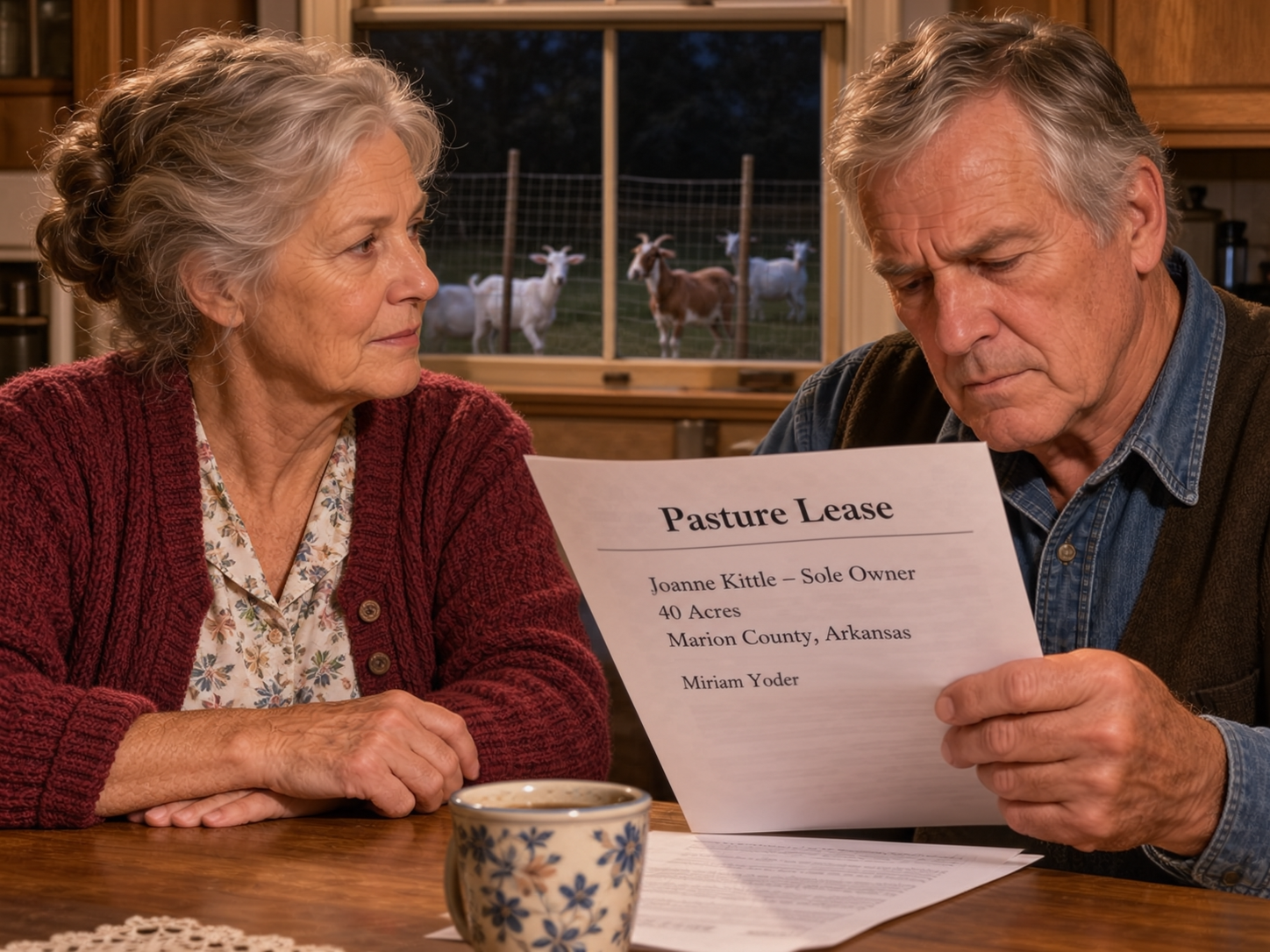
The lease remained on the table between us.
I looked at the paper and wondered how something so ordinary could make a person feel as though an entire part of her life had been brought into the light.
It hadn't been a special document.
It wasn't decorated.
It didn't arrive with an announcement.
It was simply an agreement about pasture.
But it had forced a conversation that forty-five years of marriage had somehow failed to settle.
Alden looked toward the kitchen window.
I followed his gaze.
The room was reflected in the glass.
Beyond it, the fence stood somewhere in the darkness.
The goats were still outside.
I could no longer hear the faint metallic jingling that had interrupted us earlier.
But I knew where the sound had come from.
That was enough.
Alden turned back toward me.
"I still don't understand how we got to this point."
I considered his words.
There were several ways I could have answered.
I could have reminded him of his laughter.
I could have repeated what he had said when he called the pasture his.
I could have told him how much it hurt when he warned me not to be clever.
All of those things were true.
But I wanted to answer the question he had asked.
"I think we've been talking about the land differently for a long time," I said.
He frowned.
"What does that mean?"
"You've been calling it yours. I've known it was recorded in my name."
He looked down.
"And neither of us spoke plainly enough about the difference."
He remained quiet.
I watched his face.
I could tell he wasn't pleased.
But I had stopped believing that every unpleasant expression required me to change my words.
That was something I wanted to remember.
Not only during arguments.
Not only when legal papers were involved.
Every day.
I had been married long enough to know how easily old habits returned.
One peaceful conversation would not erase them.
One disagreement would not transform our marriage.
And one evening would not undo forty-five years of learning when to speak and when to remain quiet.
But I could begin somewhere.
I had begun with a correction.
The pasture was mine.
I looked at the lease.
Miriam Yoder's name remained beside mine in the agreement.
Alden followed my eyes.
"You're comfortable with this arrangement?" he asked.
I thought about the question.
"Yes."
He looked at me.
"You don't have any doubts?"
"Not about what the document says."
He leaned back in his chair.
I could see that he wanted more.
Perhaps he wanted reassurance.
Perhaps he wanted me to explain the arrangement again.
But I couldn't give him a different answer merely because he was still uncertain.
He had the document.
He could read it.
And he could ask about anything he didn't understand.
I wasn't refusing to speak.
I was refusing to pretend the facts were undecided.
There was an important difference.
Alden rubbed one hand across his face.
"I suppose you've thought about this more than I have."
I watched him.
"About the lease?"
"About the land."
I nodded slowly.
"I've thought about what it means to own something."
He looked up.
"And what does it mean to you?"
I wasn't prepared for that question.
For a moment, I didn't answer.
Not because I didn't know.
Because I had spent so many years keeping those thoughts to myself that putting them into words felt unfamiliar.
I looked down at my hands.
They were resting near the edge of the table.
The skin across my knuckles looked thinner than it had when I was young.
Forty-five years was a long time.
Long enough for a woman's hands to change.
Long enough for her voice to become quieter without her noticing.
Long enough to mistake caution for kindness.
I looked back at my husband.
"It means something can belong to me without taking anything away from you."
Alden stared at me.
I continued.
"Being your wife doesn't mean I stop being Joanne."
He didn't answer.
I could feel my heart beating a little faster.
I hadn't planned to say that.
The words had come because he asked.
And once they were out, I knew they were true.
Alden lowered his eyes.
"I never said you weren't Joanne."
"No," I said. "You didn't."
He looked up again.
"But when you laughed at the idea that I owned the pasture, that's how it felt."
His expression changed.
I didn't know what he was thinking.
But I could see that he had heard me.
I waited.
He looked at the lease.
Then he looked at the window.
The kitchen clock continued ticking.
I wondered whether he would dismiss my words as another attempt to be clever.
That had been his response earlier.
But he didn't.
Instead, he spoke quietly.
"I wasn't expecting any of this."
"I know."
He rested his hand on the table.
"I thought I understood our farm."
I took a breath.
"We've lived here a long time, Alden. But living with something isn't the same as having your name on the deed."
He looked down.
That sentence seemed to settle between us.
I didn't need to repeat it.
I thought about the word ours.
I had used it throughout our marriage.
Our kitchen.
Our home.
Our life.
There were times when it meant exactly what I wanted it to mean.
Two people sharing a life.
Two people building familiar routines.
Two people knowing the ordinary details of each other's days.
I did not regret every time I had said it.
I didn't want to turn forty-five years of marriage into one long mistake.
That would not have been fair.
But I also understood that a shared life did not erase every individual distinction.
Some things required clearer words.
The deed was one of them.
Alden looked at me.
"So you don't think I have any say in what happens around here?"
I was careful with my answer.
Not because I was frightened.
Because the question deserved a thoughtful response.
"I think we can discuss things that affect our life together," I said.
He listened.
"But discussing something isn't the same as assuming ownership."
He pressed his lips together.
I continued.
"I don't want to spend every conversation proving that I'm allowed to say what belongs to me."
He looked away.
I could feel the old urge to apologize.
It came so quickly that I almost spoke before thinking.
Then I stopped.
There was nothing unkind in what I had said.
I hadn't insulted him.
I hadn't raised my voice.
I hadn't tried to embarrass him.
I had simply explained how I wanted us to speak.
I let the words remain.
Alden reached for the lease again.
He didn't lift it this time.
He placed two fingers on one corner and straightened the paper.
I watched the movement.
Earlier, he had slapped the document onto the table.
Now he was smoothing it.
I knew that didn't prove anything.
A man could straighten a sheet of paper without changing his mind.
Still, the difference was noticeable.
And I was allowed to notice it.
Alden looked at the first paragraph.
"Forty acres," he said.
I nodded.
"Forty acres."
"Marion County."
"Yes."
"Arkansas."
I almost smiled.
"We haven't moved the land, Alden."
He looked at me.
For a brief moment, his mouth softened.
It wasn't quite a smile.
But it wasn't the hard expression he had worn earlier.
I felt relieved.
Then I reminded myself that his expression was not something I needed to manage.
I could welcome a pleasant moment without treating it as proof that everything had been repaired.
The lease remained what it was.
An agreement naming Joanne Kittle as the sole owner of forty acres in Marion County, Arkansas.
An agreement involving Miriam Yoder.
An agreement concerning pasture.
And outside, the goats remained near the fence.
Nothing about those facts had changed since Alden first began reading.
The only thing different was the way we were talking about them.
Alden lowered his hand.
"Well," he said, "I can't argue with what's printed there."
I looked at him.
He paused.
"I can still have questions."
"Of course you can."
He nodded.
I felt something loosen inside me.
That was all I had wanted from the beginning.
Not his silence.
Not his embarrassment.
Not a victory that left one of us feeling defeated.
I wanted a conversation in which a question could be answered without the answer becoming an offense.
It sounded like such a small thing.
After forty-five years, it did not feel small at all.
Alden looked toward the window again.
"Those goats are going to keep making that noise?"
I listened.
There was no sound from the fence at that moment.
"I suppose we'll hear them when they're moving around near it."
He nodded.
"I wasn't expecting goats."
"I gathered that."
He gave me a look.
For a moment, I thought he might laugh.
Not the harsh laugh from earlier.
Something gentler.
But he only shook his head.
I didn't mind.
The conversation had already given me enough to think about.
I looked at the overhead light.
It had illuminated the lease from the beginning.
I remembered how Alden had held the paper beneath it.
How his voice had faltered when he read my name.
How he had demanded to know why his name was missing.
And how I had answered.
Because your name isn't on the deed.
I could still hear those words in my mind.
They had sounded almost too simple.
Yet speaking them had required more courage than I expected.
I thought about all the times I had chosen a softer answer when a clearer one was needed.
I couldn't go back and change those moments.
I couldn't sit down with the younger version of myself and tell her how to handle every difficult conversation.
I could only decide what I would do now.
And now, I wanted to speak plainly.
Alden looked at me.
"Joanne."
"Yes?"
He hesitated.
Then he said, "I shouldn't have laughed at you."
I hadn't expected an apology.
Not even that small acknowledgment.
I looked at him for a moment.
"Thank you for saying that."
He nodded.
I didn't ask him to explain further.
I didn't try to make him feel better about having said it.
I simply accepted the words.
That was another unfamiliar thing.
For years, if Alden admitted he had been unkind, I would often rush to reassure him.
I might say it didn't matter.
I might tell him I understood.
I might pretend I hadn't been hurt.
But it had mattered.
And I had been hurt.
I could accept his acknowledgment without denying either fact.
Alden leaned back.
The chair creaked beneath him.
He looked tired.
I felt tired too.
Not from raising my voice.
I hadn't raised it.
Not from a long physical day.
From the effort of speaking differently after spending so much of my life doing the opposite.
But it was a tiredness I could accept.
I had not spent the evening arguing over something imaginary.
I had answered questions about an actual document.
I had defended a distinction that mattered.
And I had remained seated while my husband worked through his surprise.
That was enough.
I looked toward the lease once more.
One corner lay near my hand.
I reached out and straightened it.
My fingers touched the paper lightly.
I didn't need to hold it up to prove anything.
I didn't need to place it in front of Alden again.
He had read it.
He knew what it said.
I left it where it was.
The kitchen clock continued its steady ticking.
Outside, another faint metallic sound came from the fence.
Alden heard it.
So did I.
He turned toward the window.
Then he looked back at me.
"The goats," he said quietly.
"Yes," I answered.
"The goats."
This time, neither of us seemed surprised.
I almost laughed.
There was something comforting about that.
An ordinary sound.
An ordinary answer.
A moment that did not require either of us to win.
Alden looked down at the lease.
"I'll read the deed when you show it to me."
"All right."
He nodded.
I didn't know what he would think after reading it.
I didn't know whether he would ask the same questions again.
I didn't know whether the next conversation would be easier.
There were many things I couldn't know.
But I did know what the deed said.
And I knew what I would say if he asked.
The forty acres belonged to me.
The pasture lease named me and Miriam Yoder.
The goats were outside near the fence.
And Alden's name was not on the deed.
Those facts did not depend on his mood.
They did not depend on whether he found them pleasant.
And they did not become less important because we had been married for forty-five years.
I looked at my husband.
He was still the man I had shared so much of my life with.
I could remember his familiar voice.
His habits.
The way he held a piece of paper when he wanted to understand it.
The way his chair sounded against the floor.
None of that had disappeared.
But I no longer wanted those familiar things to decide how honestly I could speak.
Marriage had given us a shared life.
It had not taken away my name.
I looked down at the lease one final time.
Joanne Kittle.
The words were ordinary.
They had always been mine.
Yet I had spent far too long allowing someone else's certainty to make them feel less important.
That evening, I finally stopped.
I didn't need to make a speech.
I didn't need to ask for recognition.
I didn't need to convince Alden that I was entitled to believe a legal document bearing my own name.
I only needed to remember what I already knew.
The truth was still there.
It had been there before he picked up the lease.
It had remained there when he laughed.
It had remained there when he slapped the paper onto the table.
And it remained there now that his voice had grown quiet.
I rested my hands on the kitchen table.
They were steady.
I wasn't holding them still deliberately.
They simply were.
Alden sat across from me.
For a while, neither of us spoke.
The silence was different from the one that had followed his first discovery.
That earlier silence had been filled with disbelief.
This one held two people who had finally managed to say something important without pretending it had never happened.
I knew there would be more conversations.
There always were in a marriage.
Some would be easy.
Others would not.
But I had learned something I did not want to forget.
I could love my husband without agreeing with every assumption he made.
I could listen to his questions without surrendering my answers.
And I could be Joanne Kittle, the woman named on that deed, without asking anyone's permission to believe what was already true.
The kitchen light shone across the lease.
Outside, the goats moved near the fence.
And I sat in my own home, no longer searching my husband's face for permission to speak.
After forty-five years, that was enough.
The End
Read more original stories on Feel Every Story.
MY HUSBAND HELD A PIECE OF PAPER IN OUR KITCHEN, AND I KNEW FORTY-FIVE YEARS OF SILENCE WERE ABOUT TO END
Part 10 of 10