I barely slept that night.
The fireworks had faded hours earlier, but Juliette's private phone call kept replaying in my mind.
I didn't know who she had called.
I didn't know what she had said.
But I knew the expression she wore when she returned.
It wasn't the face of someone who had finally understood.
It was the face of someone reconsidering her next move.
The next morning, I woke early.
Ethan was still asleep.
I made coffee and stepped onto the back porch.
The air was cool enough to raise goosebumps on my arms.
Dew covered the grass.
Birds moved through the oak trees.
For several minutes, the house was quiet.
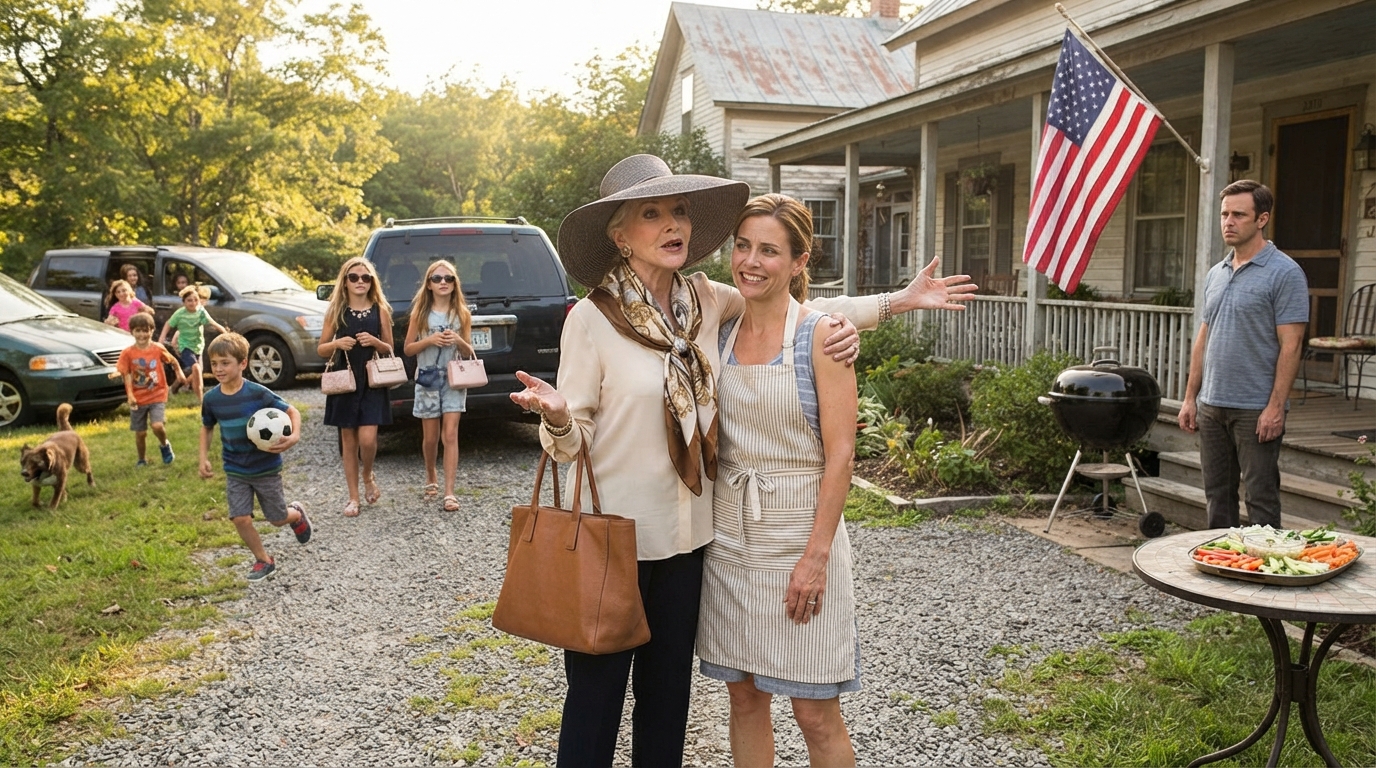
Then I heard an engine.
I looked toward the driveway.
One SUV turned in.
Then another.
Then another.
I set my coffee down.
A fourth vehicle followed.
People began climbing out.
Overnight bags.
Coolers.
Children.
More adults.
I counted.
Eleven adults.
Seven children.
Eighteen additional people.
Juliette stood in the center of the driveway with both hands clasped in front of her.
She looked delighted.
“There she is!”
I walked toward her.
“Juliette.”
“Good morning, Annie.”
I looked at the vehicles.
“Who are all these people?”
“My sister and her family.”
She pointed toward another car.
“My cousin Harold.”
Then another.
“My nephew and his wife.”
She smiled.
“They were nearby.”
I looked at the number of bags.
“You invited them here?”
“Of course.”
“Without asking?”
Juliette laughed.
“Don't be silly. They're family.”
Behind her, Monica looked horrified.
“Mom.”
Juliette turned.
“What?”
“You invited eighteen people?”
“They're family.”
Claire rubbed her forehead.
“Did you ask Annie?”
Juliette waved a hand.
“Oh, Annie loves hosting.”
She looked directly at me.
“Don't you, dear?”
I took another sip of coffee.
“I used to.”
The smile on Juliette's face disappeared.
Everyone became quiet.
I reached into my robe pocket and pulled out a folded sheet of paper.
Juliette frowned.
“What is that?”
“Something I prepared last night.”
Daniel appeared behind Ethan, carrying his own coffee.
He had apparently spent the night nearby.
He saw the paper and smiled.
“This should be interesting.”
Ethan stood beside me.
He didn't try to soften my words.
He didn't ask me to compromise.
He simply stood there.
That mattered.
I unfolded the paper.
“Effective immediately, visits to our home need to be arranged in advance.”
Juliette laughed.
“You're serious?”
“Yes.”
“Two weeks' notice?”
“Yes.”
“Annie, this is ridiculous.”
I continued.
“Every adult guest contributes in one of three ways.”
I raised one finger.
“Bring a prepared dish.”
A second.
“Pay an equal share of the grocery costs.”
A third.
“Help with preparation and cleanup.”
Nobody spoke.
I continued.
“Anyone arriving without notice should not expect food, beds, or other accommodations to be provided.”
Juliette stared at me.
“You can't make rules for family.”
“I can make rules for my home.”
She opened her mouth.
Then closed it.
Harold stepped forward.
“Wait.”
He looked at the other relatives.
“We weren't told any of this.”
Claire turned toward them.
“Mom didn't mention the rules.”
Harold looked embarrassed.
“If we'd known, we'd have stopped for groceries.”
His wife nodded.
“Of course.”
Another relative spoke.
“We thought everyone was contributing.”
Juliette's face reddened.
She looked from one person to another.
“Well, I didn't think…”
Her voice trailed off.
Harold reached into his wallet.
“How much do we owe?”
I blinked.
“You don't owe anything.”
“Yes, we do.”
He pulled out two hundred dollars.
“For groceries.”
His wife added another hundred.
“For breakfast.”
One cousin reached for his wallet.
Another opened her purse.
Within minutes, nearly a thousand dollars sat on the porch table.
I stared at it.
“I can't take this.”
Harold shook his head.
“You can.”
He smiled.
“We should have contributed before.”
Daniel leaned toward Ethan.
“Funny how quickly the truth travels once people can see it.”
Ethan gave a quiet laugh.
Juliette did not.
“This is absurd!”
Everyone turned toward her.
“You're all making me look selfish.”
Nobody answered.
She pointed at me.
“This is what she wanted.”
I shook my head.
“No.”
“Then what did you want?”
“Respect.”
“You've turned everyone against me.”
“No.”
I held her gaze.
“You did that yourself.”
Juliette's mouth opened.
Nothing came out.
For once, nobody rushed to make her feel better.
Not Monica.
Not Claire.
Not Ethan.
Not the cousins.
The silence did what an argument never could.
Then a small voice spoke from behind Monica.
“Grandma?”
Juliette turned.
It was Lily, Monica's eight-year-old daughter.
“What is it, sweetheart?”
Lily looked confused.
“Why didn't we ever help Aunt Annie?”
Nobody moved.
Juliette swallowed.
“What do you mean?”
“Mom says when someone cooks for us, we help clean.”
Monica nodded.
“That is what I tell her.”
Lily looked at her grandmother.
“So why didn't we?”
Juliette's eyes filled.
She sat down on the porch step.
For several seconds, she stared at the ground.
Then she looked at me.
“I owe you an apology.”
I said nothing.
“I treated your kindness like something you owed us.”
Her voice was quieter than I had ever heard it.
“I convinced myself that because you were capable, you didn't mind.”
“I did mind.”
She nodded.
“I know.”
“I just never said it.”
“I know that too.”
She wiped her cheek.
“And I never asked.”
That sentence seemed to cost her.
“I taught my children to expect things from you instead of appreciate what you did.”
Monica looked down.
Claire wiped her eyes.
Juliette looked back at me.
“I don't expect you to forget seven years because I said I'm sorry.”
“You shouldn't.”
She nodded.
“But I'd like the chance to do better.”
I thought about every holiday.
Every grocery receipt.
Every night spent cleaning after everyone left.
Every time I had swallowed irritation because keeping peace seemed easier.
Forgiving her would not erase those years.
But neither did I want to spend another seven years collecting evidence against my own family.
I walked toward her and held out my hand.
She looked surprised.
“I accept your apology.”
She took my hand.
“But the rules stay.”
A small laugh escaped her through her tears.
“They should.”
The change did not happen instantly.
That was the part I remember most.
Nobody became perfect overnight.
But people began helping.
Harold grilled.
The cousins prepared salads.
The teenagers washed dishes.
The grandchildren picked up trash.
Claire cleaned the guest rooms.
Monica folded towels.
And Juliette, to everyone's surprise, tied one of my aprons around her waist.
She looked down at it.
“What do I do?”
I smiled.
“You can dry dishes.”
She laughed.
“I can manage that.”
By sunset, my kitchen looked better than it usually did after a normal weekend.
Before anyone left, the guests packed leftovers into containers they had brought themselves.
No one assumed the food was theirs to take.
No one expected me to handle everything.
The next morning, the house felt different.
Not because the furniture had moved.
Not because the holiday had become quieter.
Because the responsibility had finally been shared.
Three months later, Thanksgiving approached.
My phone buzzed with a family group message.
Monica wrote that she was bringing the turkey.
Claire volunteered for dessert.
Harold offered drinks.
Another cousin said they would arrive early to help set up.
Then Juliette's name appeared.
I opened the message.
“I've already made the stuffing. And don't tell me not to come early. I'll be there at nine to help peel potatoes.”
I smiled.
Ethan leaned over my shoulder.
“Does she mean it?”
Another message arrived.
It was a photograph.
Juliette stood in her own kitchen wearing an apron.
The caption read:
“Practicing.”
Ethan laughed.
I laughed too.
That Thanksgiving was not perfect.
People still forgot things.
Children still spilled drinks.
Someone burned a batch of rolls.
The kitchen was crowded.
The dishwasher ran twice.
But nobody treated the work as invisible.
Years later, our family still remembered the Fourth of July when the receipts came out.
We eventually framed the spreadsheet and hung it in the pantry.
Whenever someone new joined the family, Juliette would point toward it.
“That,” she would say, “is the day Annie taught us the difference between being welcomed and being taken for granted.”
Then she would usually add, “And she was right.”
The number on that page stopped mattering after a while.
The $11,842.63 had once represented everything I felt nobody noticed.
Eventually it became something else.
A reminder.
Not that family should keep score.
Not that every meal requires an invoice.
But that generosity works best when it is voluntary, appreciated, and shared.
The Fourth of July had never really been about the barbecue.
It had been about what happened when one person finally stopped carrying what everyone else had decided was hers to carry.
And once the family understood that, the holidays changed for good.
Click here to continue reading: PART 5: The New Rules Worked Until Juliette Arrived With a Proposal That Looked Generous, But Quietly Put Everything Back in My Hands
She Announced Another Holiday at My House Without Asking, and This Time I Realized the Real Cost Was Far More Than Groceries
Part 4 of 20