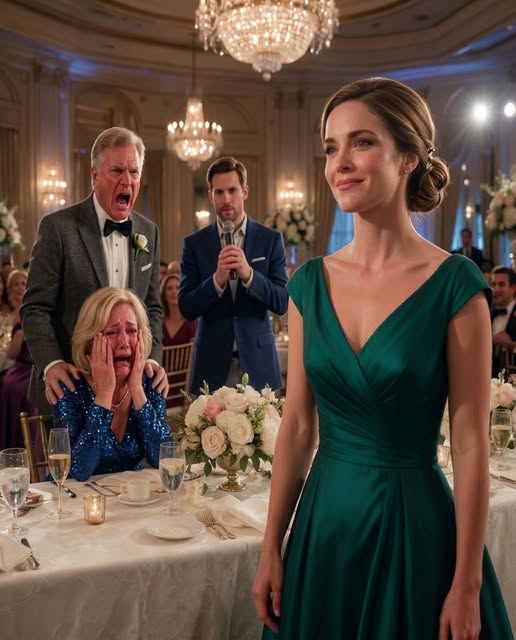
Five years after the wedding, Northstar opened its fourth office.
The launch was deliberately small.
Employees.
Clients.
A few partners.
No chandeliers.
No family speeches.
I stood near the back while our new regional director welcomed everyone.
Nobody asked me to take the microphone.
I appreciated that.
Northstar had grown far beyond the four-person rented office where it began.
We employed hundreds of people.
Served clients I once would have been afraid to pitch.
Built systems that protected organizations larger than anything I imagined at twenty-one.
None of that felt like revenge.
That surprised me.
For a while, strangers treated my success as the punchline to Mom’s wedding toast.
She called you worthless, but look at you now.
It sounded satisfying.
It was also wrong.
I had been successful before she picked up the microphone.
Her ignorance did not reduce the company.
Her discovery did not increase it.
Northstar had never needed Mom’s recognition to become real.
Neither had I.
After the opening, I returned to my office.
A package waited on my desk.
No mysterious handwriting.
No old family seal.
No hidden key.
Just a shipping label from Dad.
I called him before opening it.
“What did you send?”
“A present.”
“Why?”
“Because your office opened.”
“Is it a document?”
“No.”
“A ledger?”
“No.”
“A key?”
He laughed.
“No.”
I opened the box.
Inside was Grandpa’s old drafting ruler from the warehouse.
Scratched aluminum.
Heavy.
Worth almost nothing.
A note from Dad:
Thought this belonged with the person who finally learned when to stop looking underneath.
I smiled.
“That is annoyingly thoughtful.”
“I’m old now.”
“You were old at the wedding.”
“Cruel.”
“Accurate.”
He laughed.
“How did the opening go?”
“Good.”
“Big crowd?”
“Enough.”
“Did you give a speech?”
“No.”
“Your mother will be disappointed.”
“She has survived worse.”
Dad became quiet.
Then:
“I’m proud of you.”
There had been a time when those words could have changed my entire week.
Maybe my year.
Now they landed warmly.
Not desperately.
“Thank you.”
I meant it.
I did not need to reject his approval to prove independence.
That was another thing I had learned.
Freedom was not refusing every gift.
It was knowing which gifts did not own you.
Dad and I talked for another ten minutes.
Mostly business.
His business, not mine.
Hawthorne had stabilized.
Smaller.
Profitable.
Boring.
He sounded proud of that.
Mom called later.
She had heard about the office through Dad.
“I saw the photographs.”
“Of course.”
“You should have worn the blue suit.”
“There it is.”
“What?”
“Nothing.”
She laughed.
Then:
“I’m proud of you too.”
“Thank you.”
“And I would have been proud if the company failed.”
I became quiet.
That was new.
Mom continued.
“I mean it.”
“I know.”
“I wish I had known how to say that when you were younger.”
“So do I.”
No lie.
No automatic comfort.
She accepted it.
“I’m sorry.”
“I know.”
Our apologies had become shorter.
That was healthy.
We no longer needed to reopen the entire case every time the past brushed against the present.
Maya sent flowers.
Not expensive ones.
The card said:
From the family success story.
Underneath she added:
That’s you, unfortunately.
I called.
“You’re an idiot.”
“Congratulations.”
“Thank you.”
“Julian says congratulations too.”
“Tell him he remains unbearable.”
“He heard you.”
“Good.”
Elena sent nothing.
Instead she called that evening.
“How does it feel?”
“What?”
“Fourth office.”
“Like another office.”
“That’s disappointing.”
“Were you expecting enlightenment?”
“Possibly.”
She had become easier with me over the years.
Still careful.
Still private.
We called each other sisters now.
Not constantly.
Not ceremonially.
Just when it fit.
Dad and Elena had developed a relationship too.
Limited.
Real.
They met several times a year.
He never called himself her father unless she did first.
She rarely did.
That was theirs.
Mom and Elena were cordial.
Not close.
Nobody forced closeness.
Maya and Elena had become unexpectedly friendly.
They shared an ability to mock Dad efficiently.
I considered that dangerous.
Grandma would have loved it.
The independent trust continued sending quarterly statements.
I read them.
Not obsessively.
The first few years, I checked every footnote.
Now I usually read the summary and let professionals do their jobs.
Verification without obsession.
That might have been Grandpa’s final lesson, though I refused to give him credit for everything.
The old warehouse redevelopment succeeded.
Small manufacturers occupied the lower floor.
A robotics company rented one section.
Two nonprofit training programs used another.
Dad visited too often.
Everyone knew him.
The upstairs office became a small meeting room.
The drafting table remained.
On one wall, the trustees installed a framed photograph of Grandpa standing outside the original warehouse.
No family mythology.
No paragraph about vision.
Just his name and the year the property was acquired.
I liked that.
One afternoon I held a Northstar supplier meeting there.
Not because of symbolism.
Because the room was available.
During a break, a young founder wandered toward the window.
“Did your family own this place?”
“Still does, through a trust.”
“That sounds complicated.”
“You have no idea.”
He laughed.
Then asked:
“Did you always know you’d run a company?”
“No.”
“You seem like someone who did.”
I looked at the drafting table.
“No.”
“What changed?”
I could have told him about Grandpa.
Mom.
Dad.
Maya.
Thomas.
Elena.
The wedding.
Table twelve.
Instead I said:
“I got tired of waiting for permission.”
That was enough.
Years earlier, I thought my family’s judgment had trapped me.
Then I thought my secrecy freed me.
Neither was entirely true.
Secrecy protected me for a while.
Then it became another wall.
The real freedom came later.
Knowing what belonged to me.
Knowing what belonged to them.
Knowing when to help.
Knowing when not to.
Knowing that love without boundaries could become control.
Knowing that consequences were not revenge.
Knowing that forgiveness did not require forgetting.
Knowing that somebody could change without earning access to every part of my life.
Knowing I could change too.
On the fifth anniversary of Maya’s wedding, nobody mentioned the date until Maya texted our family group.
Five years since Mom’s greatest public-speaking performance.
Mom replied immediately:
Blocked.
Dad sent a laughing emoji.
Julian wrote:
For legal reasons, I have no comment.
Elena asked:
Was the food at least good?
Maya replied:
No.
I stared at the messages and laughed.
Then Mom wrote:
Clara, I am sorry.
The group became quiet.
Even five years later, she refused to let humor erase responsibility.
I answered:
I know.
Then:
I’m okay.
Mom replied:
Good.
No speech.
No demand that I say I forgave her.
She already knew.
Maya changed the subject by sending a photograph of her dog.
Life continued.
That evening I went home late.
Grandma’s soup pot sat in the cabinet.
Grandpa’s ruler rested on a shelf in my office.
Two useless objects.
Two of my favorite inheritances.
I poured a glass of water and stood beside the apartment window.
The city below looked nothing like the ballroom.
Still, memory brought it back.
Crystal chandeliers.
White roses.
Gold-rimmed plates.
Two hundred faces turning toward me.
Mom holding the microphone.
Dad chuckling.
Maya laughing.
Me standing there while people who knew nothing about my life accepted someone else’s description of it.
For years, that scene represented humiliation.
Then revelation.
Then the beginning of the investigation.
Now it was simply something that happened to me.
Important.
Painful.
Finished.
I remembered leaving the ballroom.
At the time, I thought I was walking away from my family.
In a way, I was.
I walked away from the version where Mom decided my value.
Where Dad’s approval determined whether I felt successful.
Where Maya’s resentment required my silence.
Where Grandma’s protection meant accepting secrecy.
Where money could substitute for truth.
Where being needed meant being loved.
Where fixing everyone else’s problem proved I belonged.
That family ended.
The people did not.
That distinction saved us.
Mom remained my mother.
Dad remained my father.
Maya remained my sister.
Elena became one.
Julian remained Julian, which was unfortunate for everyone.
Grandma remained present in strange small ways.
Even Daniel remained part of the history, though not part of my daily life.
Nobody was erased.
The roles changed.
I thought about the question strangers sometimes asked after hearing pieces of the story.
Did you win?
They meant the money.
Northstar.
The trust.
Thomas’s conviction.
Daniel’s consequences.
My parents losing the house.
Maya apologizing.
The viral video turning public sympathy toward me.
For a long time I did not know how to answer.
Because winning suggested somebody else had to lose.
That was how my family used to understand life.
Maya’s success meant my failure.
My independence meant Dad’s rejection.
Elena’s inheritance meant someone else received less.
Mom’s status required someone beneath her.
Daniel’s rescue required someone else to absorb the cost.
Thomas thrived because he understood that scarcity.
Money.
Approval.
Attention.
Belonging.
He made everyone afraid there was not enough.
So we competed for pieces of things that should never have been competitions.
Dignity was not scarce.
Neither was truth.
Neither was the right to set boundaries.
Neither was the possibility of becoming different from who we had been.
I had not won because my company was worth more than my parents imagined.
I had not won because I could have written an $85,000 check without telling anyone.
I had not won because Julian exposed the truth in front of two hundred guests.
I had not won because Mom apologized.
Those things mattered.
But they were not the victory.
The victory was quieter.
Mom could criticize my suit and I could laugh.
Dad could say he was proud and I could accept it without starving for more.
Maya could disagree with me without either of us reaching for old weapons.
Elena could disappear for three weeks on a work assignment without anyone treating distance as rejection.
I could see a family problem and ask whether it was actually mine to solve.
Sometimes the answer was yes.
Often it was no.
Both answers were survivable.
My phone buzzed.
Maya.
Dinner tomorrow?
I typed:
Where?
She sent a restaurant.
I checked it.
No ballroom.
No private room.
No microphones.
I replied:
Fine.
Then added:
If Mom gives a toast, I’m leaving.
Maya responded:
If Mom touches a microphone, I’m tackling her.
A moment later Mom entered the group chat.
I can read these messages.
Dad replied:
Good.
I laughed alone in my kitchen.
Five years earlier, laughter in a ballroom had made me feel exposed and small.
Now laughter felt like what it should have been all along.
Shared.
Safe.
Unimportant.
I put the phone down.
Outside, the city kept moving.
Nobody knew what I was worth.
Nobody needed to.
That was the part my mother had misunderstood when she stood beneath those chandeliers and called me a failure.
She thought value could be announced publicly.
Assigned by family.
Measured by money.
Confirmed by applause.
She was wrong.
I had spent years proving that to everyone else.
The final thing I learned was that I no longer needed to.
The End
Read more original stories on Feel Every Story.
I Came to Maya’s Wedding Expecting an Uncomfortable Evening, but My Mother Had Prepared Something Crueler Than Silence
Part 28 of 28