Marblehead was nearly three hours away.
Mark drove.
I sat beside him.
The key rested in the cup holder.
Small.
Brass.
Ordinary.
We did not bring Samuel.
No lawyer.
No forensic accountant.
The letter from Calvin’s estate clearly identified the storage facility and unit.
The facility manager had already been notified.
Whatever waited inside belonged to Mark.
Legally uncomplicated.
A miracle.
Lake Erie appeared between trees as we approached the peninsula.
Gray-blue water.
Cold wind.
Whitecaps farther out.
Mark glanced toward it.
“Dad used to bring us here.”
“You never told me.”
“I forgot.”
“Really?”
He nodded.
“Not completely. Just… filed it somewhere.”
Thomas had taken Mark and Melissa fishing.
Cheap motel.
Packed sandwiches.
A rented boat once.
Mark remembered being seasick.
I smiled.
“Family legacy.”
“Very dignified.”
The storage facility was small.
Older.
The manager checked Mark’s identification.
Then led us down a row of metal doors.
Unit 18.
Mark inserted the key.
It turned.
He looked at me.
“Ready?”
“It’s yours.”
He lifted the door.
Dust.
Cold air.
A smell of wood and canvas.
No boxes of money.
No filing cabinets.
No documents stacked to the ceiling.
One object occupied most of the unit.
A boat.
Not large.
An old wooden fishing boat on a trailer.
Mark froze.
“Oh my God.”
The hull had faded blue paint.
Wooden benches.
An old outboard motor.
On the side, barely visible beneath dust, was a name.
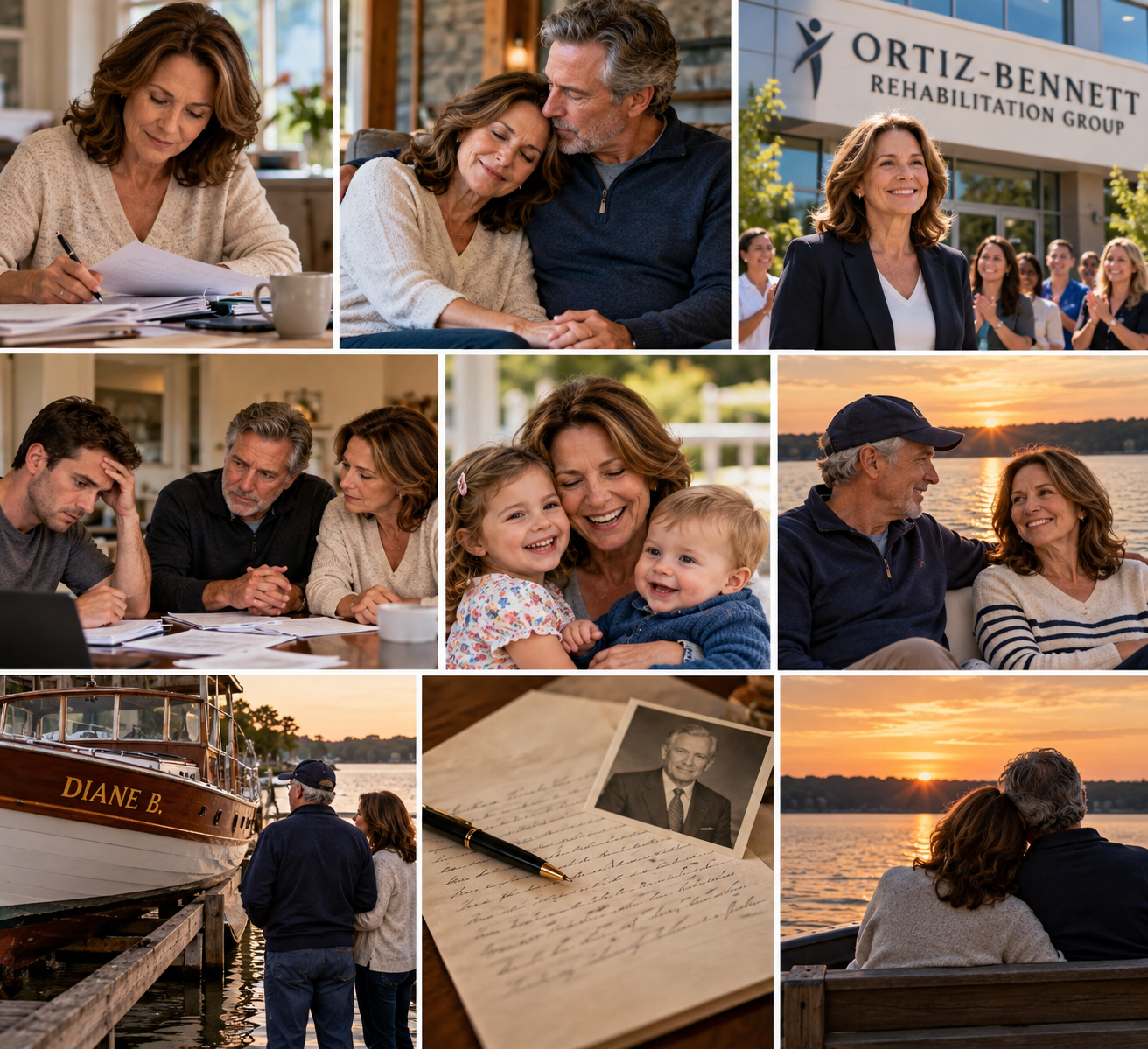
DIANE B.
Mark laughed.
Then covered his mouth.
“My dad’s boat.”
“You recognize it?”
“Yes.”
He stepped closer.
“I thought he sold it.”
Apparently not.
A plastic storage tub sat beneath the bow.
Inside were life jackets.
Old fishing tackle.
A rusted thermos.
Photographs.
And a notebook.
Mark sat on the trailer fender.
His hands shook.
The notebook belonged to Thomas.
Not a diary exactly.
Maintenance records.
Fuel.
Repairs.
Fishing dates.
Then occasional notes.
MARK CAUGHT FIRST WALLEYE.
MELISSA CRIED OVER MINNOWS.
DIANE SAYS MOTOR TOO LOUD.
WALTER STILL OWES GAS MONEY.
I laughed.
Mark did too.
Then the entries changed.
Fewer fishing notes.
More treatment dates.
AA.
Dr. Simmons.
Thirty days.
Sixty days.
Relapse.
Restart.
Thomas had tracked sobriety the way some people tracked engine maintenance.
Numbers.
Dates.
Failures.
Attempts.
Then one page contained Dad’s name.
WALTER SAYS SELL BOAT.
I watched Mark read.
Next line:
TOLD HIM NO.
Then:
HE SAYS I OWE DIANE STABILITY MORE THAN I OWE MYSELF ESCAPE.
Mark swallowed.
Another entry weeks later:
WALTER RIGHT. HATE THAT.
I smiled through tears.
That sounded familiar.
Thomas sold equipment.
Not the boat.
Used the money to pay debt.
Kept attending treatment.
Then a later note:
CALVIN SAYS HIDE RELAPSE.
WALTER SAYS TELL THEM.
TOLD DIANE.
WORST NIGHT.
BEST THING.
Mark stopped.
His eyes filled.
The lesson had been written decades before any of us repeated it.
Tell them.
Worst night.
Best thing.
Thomas had learned.
Dad had once understood.
Then years later, Dad failed to follow the same rule with me.
Humans were painfully inconsistent.
The final pages were written shortly before Thomas died.
His handwriting had weakened.
One entry addressed Mark.
Not formally.
Just:
FOR MARK.
Mark took a breath.
I moved away slightly.
“Stay.”
So I stayed.
He read aloud.
Son,
If you get this boat, Calvin outlived me, which will make him unbearably pleased.
Mark laughed through tears.
Thomas wrote that he knew Mark had spent much of his childhood watching him struggle.
Drinking.
Stopping.
Relapsing.
Working.
Failing.
Trying again.
He apologized.
Not for being sick.
For the choices he made while refusing help.
Then:
Walter kept saying no to me.
No money when I wanted another loan.
No lies when I wanted Diane protected from the truth.
No excuses when I blamed work.
I hated him for it.
Sometimes love sounds like no.
Mark stopped reading.
His shoulders shook.
I put my hand on his back.
Thomas continued.
He had left the boat with Calvin because Diane wanted it gone after his death.
Too many memories.
Mark was young and busy.
Melissa had no interest.
Thomas asked Calvin to preserve it if possible.
Not forever.
Just until Mark was older.
Then Walter and Calvin stopped speaking.
The arrangement disappeared beneath their conflict.
Years became decades.
Thomas wrote:
If the boat is rotten, burn it.
If it floats and you want it, use it.
If you don’t want it, sell it.
Do not keep a thing because a dead man wanted you to.
I laughed.
Mark stared at me.
“Apparently everyone eventually learned that.”
“Except us.”
“Late learners.”
The last paragraph was short.
I was proud of you before you earned anything.
I was proud when you were a boy who couldn't tie a hook.
Don't spend your life making people need you so you can feel worth keeping.
Mark stopped.
The unit became completely quiet.
Wind rattled the metal roof.
I looked away because the words felt too private.
Then Mark handed me the notebook.
“Read it.”
“You sure?”
“Yes.”
I read the paragraph myself.
Thomas had seen it.
Long before Mark forged my name.
Long before Melissa.
Long before inheritance.
The need to be necessary.
Maybe it began as a child’s response to an unstable father.
If Mark could help.
Perform.
Succeed.
Provide.
Maybe people stayed.
Understanding was not absolution.
But it gave shape to something.
Mark wiped his face.
“He knew me.”
“Yes.”
“I thought he barely noticed.”
“He noticed.”
We inspected the boat.
The tires were ruined.
The motor probably needed rebuilding.
The wood had dry areas but no obvious catastrophic rot.
A restoration specialist later told us the boat could be saved.
Cost?
More than it was worth.
Of course.
Mark asked me what I thought.
“Do you want it?”
“I don't know.”
“Then don't decide today.”
We arranged transport to a marine restoration shop for evaluation.
Not restoration.
Evaluation.
Important distinction.
On the drive home, Mark was quiet.
Then he said, “I want to keep it.”
“Okay.”
“I know it makes no financial sense.”
“It’s your money.”
He looked at me.
“Would you use it with me?”
I smiled.
“Maybe.”
“That sounds enthusiastic.”
“I get seasick.”
“You mocked me for that.”
“Marriage is cruel.”
He laughed.
The restoration estimate arrived two weeks later.
Twenty-eight thousand dollars.
Mark stared.
“That’s insane.”
“Yes.”
“The boat might be worth eight when finished.”
“Probably.”
He thought for several days.
Then declined the full restoration.
That surprised me.
Instead, he paid for structural stabilization, safe trailer work, and basic preservation.
Six thousand.
The boat would not immediately return to water.
Maybe someday.
For now, Mark rented a dry storage bay near home.
He visited occasionally.
Sometimes with Eric.
Once with Natalie and David.
He never turned it into a family obligation.
Melissa did not want to see it.
That was her choice.
Diane did.
We took her in a wheelchair.
When she saw DIANE B. on the hull, she covered her face.
“Oh, Tom.”
Mark knelt beside her.
“You knew?”
“No.”
“I thought you wanted it sold.”
“I did.”
“Why?”
“Because after he died, I couldn't look at it.”
She touched the old paint.
“I told Calvin to get rid of it.”
“He didn't.”
“Apparently not.”
She smiled.
“Stubborn man.”
Then her face changed.
“I remember the lake.”
Mark and I looked at each other.
“What do you remember?”
Diane stared at the boat.
“Walter and Tom fought here.”
“About what?”
“Money.”
Of course.
She closed her eyes.
Then the memory came.
Thomas wanted Dad to invest in a marina project Calvin had proposed.
Dad refused.
Thomas had already borrowed against something.
Possibly the boat.
Possibly equipment.
Diane could not remember.
The fight became ugly.
Thomas accused Walter of controlling everyone through money.
Walter told Thomas he was asking other people to finance risks he wanted to call freedom.
Mark looked at me.
Familiar.
Diane continued.
Later, Dad quietly paid one debt when Thomas entered treatment.
Not as investment.
To prevent Diane from losing the house.
That was the check Diane remembered.
No hidden property.
No lost fortune.
No remaining obligation.
Just another moment when Dad had used money to protect someone.
And, apparently, told Diane not to tell me because it had nothing to do with me.
For once, he may have been right.
Diane laughed softly.
“I carried that secret all these years for nothing.”
“Not nothing,” I said.
She looked at me.
“It mattered to you then.”
She nodded.
“But it doesn't have to matter to us now.”
That seemed to release something.
She touched the boat again.
Then asked to leave.
We did.
No investigation.
No records.
No reopening Dad’s estate.
The lake secret ended where it belonged.
In the past.
That night, Mark and I sat on our back porch.
The same porch where so many versions of us had talked.
He held Thomas’s notebook.
“What are you going to do with it?”
“Keep it.”
“Good.”
“The boat too.”
“Good.”
“Maybe restore it eventually.”
“Your choice.”
He smiled.
Then became serious.
“My dad said sometimes love sounds like no.”
“Yes.”
“I wish I had learned that before.”
“So do I.”
No need to soften it.
He nodded.
“I thought saying yes made me generous.”
“Sometimes.”
“I thought solving things made me loving.”
“Sometimes.”
“I thought providing made me necessary.”
“That one was dangerous.”
“Yes.”
He looked toward the yard.
“What did you think love was?”
The question surprised me.
I considered.
“Keeping peace.”
He turned toward me.
“I thought if I stayed calm enough, flexible enough, reasonable enough, eventually everyone would stop pushing.”
“Did they?”
“No.”
“Why?”
“Because every time I moved the boundary, I taught people the boundary moved.”
Mark absorbed that.
“So we were both doing the same thing differently.”
“Maybe.”
He made himself necessary.
I made myself accommodating.
Both of us tried to secure love without requiring the other person to choose us freely.
That realization was uncomfortable.
Useful.
Mark reached for my hand.
I let him.
“Do you think we’re done?”
“With what?”
“Fixing everything.”
I laughed.
“No.”
He smiled.
“Good.”
“Why good?”
“Because I think believing we could finish was another control fantasy.”
“That sounds like therapy.”
“It is.”
We sat until mosquitoes drove us inside.
A week later, Mark placed Thomas’s crooked old thermos from the boat on his woodworking shelf.
Not as a shrine.
He actually used it.
The first time, it leaked coffee all over his workbench.
I found him swearing.
“Sentimental value?”
“Overrated.”
“Throw it away.”
He looked horrified.
Then laughed.
Two days later, he threw it away.
I watched him put it in the trash.
No ceremony.
Thomas’s love did not live inside a rusted thermos.
Dad’s love did not live inside Hail Mechanical.
My marriage did not live inside a house.
Objects could matter.
They did not have to imprison us.
That month, Hail Mechanical’s board published its annual report.
Mark’s first full year as president had been profitable despite the client bankruptcy.
The trust investment recovered.
My clinics were both stable.
Diane remained safe.
Melissa was working.
Natalie was married.
Eric and Maya were talking about moving in together.
Ordinary problems replaced catastrophic ones.
Then Eric called.
“Mom.”
“Yes?”
“I need advice.”
My entire body almost prepared for disaster.
Then I stopped.
“What kind?”
“Maya and I found an apartment.”
“That sounds good.”
“It is.”
“But?”
“The landlord wants first month, last month, and security deposit.”
“How much?”
He told me.
It was manageable.
Then he said, “I can pay it.”
I waited.
“But if I do, my emergency savings gets low.”
“What are you asking?”
Silence.
Then he laughed.
“You really make everyone say it now.”
“Yes.”
“Could I borrow three thousand dollars?”
There it was.
A request.
Clear.
Specific.
No assumption.
No manipulation.
I smiled.
“Yes.”
“Really?”
“Yes.”
“Do you want interest?”
“Let’s talk about terms.”
He groaned.
“You’ve become Grandpa.”
“No.”
That answer came quickly.
“I’m me.”
There was a difference.
A huge one.
We wrote a simple loan agreement.
Not because I distrusted Eric.
Because clarity was not punishment.
He paid the first installment early.
Mark said nothing about it until Eric told him.
Then he smiled.
The family had not become afraid of money.
That would have been another kind of damage.
We were learning how to use it without letting it decide who loved whom.
That was harder.
And better.
At the end of summer, Mark finally asked the marine shop to restore Thomas’s boat enough to return to water.
Not museum quality.
Safe.
Functional.
The total additional cost was twelve thousand.
His money.
His decision.
He told me after he signed the work order.
Not to ask permission.
To share his excitement.
“That seems expensive.”
“It is.”
“Do you regret it?”
“Ask me after it sinks.”
I laughed.
The boat was finished in September.
Mark chose the first trip carefully.
No huge family event.
No dedication.
Just him and me.
We launched at a quiet marina.
The engine coughed.
Then started.
Mark laughed like a boy.
We moved slowly away from the dock.
Lake Erie opened ahead of us.
Cold wind.
Bright sky.
I held the side and tried not to become seasick.
Mark looked at me.
“My dad would—”
He stopped.
I raised an eyebrow.
He smiled.
“I like this.”
Better.
“So do I.”
We went farther out.
Not far.
Enough.
Then Mark shut off the engine.
The boat rocked.
Water tapped against the hull.
No dead men speaking.
No old debts demanding payment.
No secret account waiting behind a wall.
Just the two of us.
Mark looked across the lake.
“I spent years thinking inheritance meant what someone leaves you.”
I waited.
“Maybe sometimes it’s what you stop carrying.”
I squeezed his hand.
That was not Dad’s lesson.
Not Thomas’s.
Not Samuel’s.
Not therapy’s.
It was Mark’s.
He had finally earned one of his own.
Click here to continue reading: PART 29: The First Peaceful Year of Our Rebuilt Marriage Was Interrupted by a Choice That Could Have Turned Hail Mechanical Into a Family Company Again
Three Days After My Father Died, My Husband Made One Decision That Turned Grief Into Something Far More Dangerous
Part 28 of 35