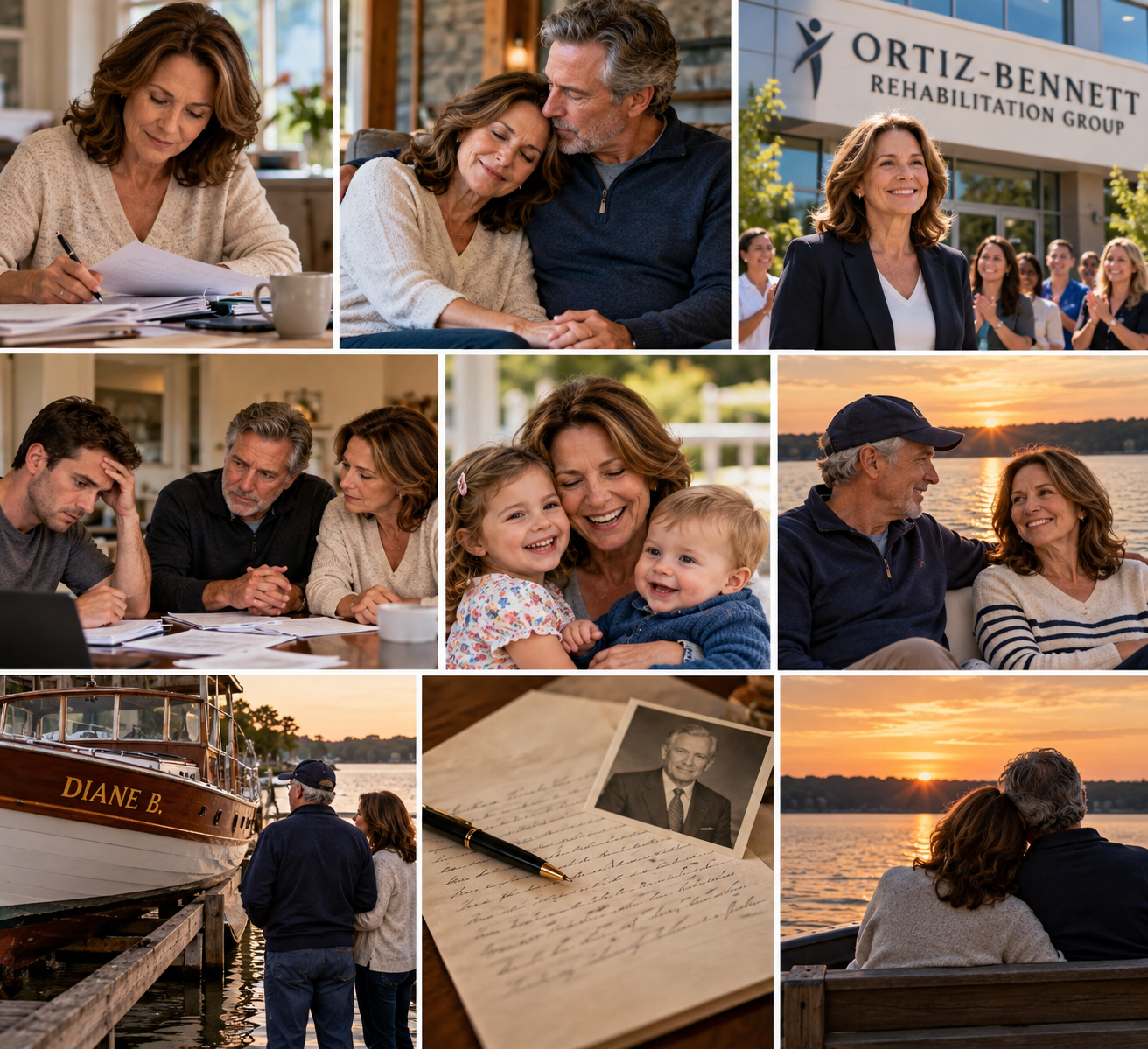
The boat trip changed something between us.
Not dramatically.
There was no sudden forgiveness, no cinematic moment where years of damage dissolved beneath the Lake Erie wind.
What changed was quieter.
Mark stopped talking about the past as if it were a courtroom he had to keep returning to.
I stopped listening for hidden meanings every time he mentioned Dad.
We came home sunburned, tired, and smelling like gasoline and lake water.
Mark parked Thomas’s boat at the marina storage lot and spent twenty minutes checking the cover.
“You know you can leave now.”
“I know.”
“You’re staring at a tarp.”
“It’s an important tarp.”
“Your father would be proud.”
Mark looked at me.
I raised a hand.
“Sorry. Dead-person voting.”
“Exactly.”
We drove home laughing.
That fall became the first season in years when nothing in our marriage was legally unresolved.
No separation.
No probation.
No active restitution schedule.
No estate administration.
No secret account investigation.
No pending family claim.
For a while, I had believed resolution would feel triumphant.
Instead, it felt like having fewer phone calls.
That was better.
Mark’s work at Hail Mechanical settled into rhythm.
He left early but not before dawn.
He came home late sometimes but told me when.
He traveled less than expected.
When company crises happened, they stayed mostly at the company.
That last part took practice.
I still received quarterly reports through the trust.
Sometimes I read something that made me want to ask him questions.
Then I asked myself whether I was asking as a spouse or as an investor.
If the answer was investor, I went through Samuel and the committee.
If spouse, I waited until Mark brought the topic home.
It felt artificial at first.
Then useful.
Boundaries often did.
My second clinic grew steadily.
I promoted one of my therapists, Lena Ortiz, to site director.
That decision terrified me more than buying the location.
Delegating meant someone else might make mistakes under my name.
Dad had hated that.
So did I.
Which was probably why I needed to do it.
Lena immediately changed part of the scheduling system.
My first instinct was to reverse it.
Instead, I asked why.
She showed me data.
She was right.
I spent the drive home irritated that healthy management kept requiring humility.
Mark found that hilarious.
“You’re becoming a terrible Walter.”
“I’m not becoming Walter.”
“I said terrible Walter.”
“That’s worse.”
“Exactly.”
We had ordinary arguments again.
Laundry.
Whether the garage counted as clean if you could still see the floor.
Why Mark owned six clamps that appeared identical.
Why I bought throw pillows no one was allowed to lean against.
Arguments with no deeper meaning.
I loved them.
Then, in late November, Hail Mechanical’s board called a special meeting.
I learned through the trust notice.
A private equity group had offered to buy a controlling stake in the company.
The proposed price was significantly above the valuation from our original investment.
Financially, the offer was attractive.
Strategically, it made sense.
Emotionally, I hated it immediately.
The buyer wanted fifty-eight percent ownership.
Existing investors could sell all, sell partially, or roll some equity into the new structure.
The Hail name would remain temporarily.
Management might remain.
Might.
That word bothered me.
Mark told me about the offer that evening only after the board authorized management to notify stakeholders.
“I assume you saw the packet.”
“Yes.”
“What do you think?”
He asked as my husband.
I answered as one.
“I hate it.”
He smiled faintly.
“So do I.”
“Financially?”
“No.”
“Emotionally?”
“Yes.”
That helped.
I wasn’t alone in the contradiction.
Then he said, “The board wants management to evaluate it objectively.”
“That sounds difficult.”
“It is.”
“Do you want to sell?”
“I don’t know.”
I appreciated that answer more than certainty.
Mark explained.
The private equity group had resources Hail Mechanical did not.
Acquisition capital.
Technology investment.
Recruiting infrastructure.
Better purchasing power.
But also an exit horizon.
They would eventually sell again.
Possibly break divisions apart.
Possibly not.
“What happens to you?”
“If they take control?”
“Yes.”
“My contract continues for twelve months.”
“And after?”
“Unknown.”
I hated that too.
Not because I believed Mark needed Hail.
Because I knew how much meaning he had stripped away from the role to make it healthy.
Now, just when the job had become simply a job, someone might take it from him.
“What does the board want?”
“Best value for shareholders.”
“Of course.”
Mark leaned back.
“There’s another option.”
I looked at him.
“What?”
“Management buyout.”
My stomach tightened.
“Explain.”
Several executives had discussed forming a group with local investors to buy enough existing shares to block the controlling sale.
Not necessarily purchase the entire company.
Just preserve dispersed ownership and local control.
Mark would be one of the management participants.
“How much money?”
“For me?”
“Yes.”
He gave a number.
Four hundred thousand dollars.
I stared.
“That’s not small.”
“No.”
“Do you have it?”
“Not liquid.”
“Retirement?”
“I won't touch that.”
Good.
“Home equity?”
“No.”
Better.
“Then?”
He looked at me.
“My Hail equity is worth about half of what I’d need if pledged.”
“And the rest?”
“I could finance it.”
My body went cold before I could stop it.
Debt.
Financing.
Collateral.
Mark saw my face.
“I know.”
“Do you?”
“Yes.”
“Who would lend?”
“A commercial bank.”
“In your name?”
“Yes.”
“Secured by?”
“My vested Hail shares and investment account.”
“Mine?”
“No.”
“The trust?”
“No.”
“Our house?”
“No.”
I exhaled.
Still.
The old memories arrived.
Credit applications.
Forged signatures.
Hartley Capital.
The $400,000 home-equity form submitted during Dad’s funeral.
Mark sat quietly while I processed.
“I’m not asking you for money.”
“I know.”
“I’m not asking you to guarantee anything.”
“I know.”
“I’m telling you before I make the decision.”
“I know.”
The phrase no longer annoyed me.
This was what it sounded like when it was true.
“What do you want?”
He looked toward the kitchen window.
“To do it.”
“Why?”
“I think the company is worth preserving.”
“Financially?”
“Yes.”
“Anything else?”
He hesitated.
“Yes.”
“Dad?”
“Partly.”
There.
Honest.
“How partly?”
“I don’t want some fund stripping it for parts.”
“That sounds like Dad.”
“I know.”
“Does that make it wrong?”
“No.”
I thought of my second clinic.
The old denied loan still influenced me.
That had not automatically made expansion wrong.
Motives could be mixed.
Choices had to survive analysis.
“Run the deal without Dad.”
Mark frowned.
“What?”
“Pretend the company is called Lawson Mechanical.”
He smiled.
“Greg would enjoy that.”
“Pretend nobody in your family ever owned it. No history. No Walter. No Thomas. Would you invest four hundred thousand dollars in this company under these terms?”
He became quiet.
“That’s the question.”
“Yes.”
He spent the next two weeks answering it.
Not emotionally.
With numbers.
Cash flow.
Debt service.
Industry multiples.
Customer concentration.
Labor risk.
Economic sensitivity.
Management succession.
He built an investment case.
Then asked a financial advisor unrelated to Hail Mechanical to challenge it.
She did.
Hard.
Her conclusion:
The investment was defensible but concentrated.
Mark could afford it, but if the company performed poorly, he would lose a meaningful portion of his personal wealth.
That was what investing meant.
Risk.
Not guaranteed rescue.
No inheritance safety net.
No wife quietly absorbing the downside.
Mark showed me the report.
“I still want to do it.”
“Then do it.”
He looked surprised.
“That easy?”
“No.”
I touched the report.
“This is not easy. This is informed.”
He nodded.
Then said, “I want one more safeguard.”
“What?”
“If I default, the bank takes my Hail equity first. Not household assets.”
“Good.”
“I had my lawyer make that explicit.”
“Good.”
“And I want you to see the final loan documents before I sign.”
I stared.
“Why?”
“Because the debt affects our household even if you’re not liable.”
That was true.
“Okay.”
He handed them over.
Not because I had legal approval rights.
Because marriage deserved information.
I read every page.
No hidden guarantee.
No joint collateral.
No trust.
No house.
No forged Clare.
Just Mark.
I handed them back.
“I understand.”
“Do you approve?”
I looked at him.
“Wrong question.”
He smiled.
“Right.”
“Do you want my opinion?”
“Yes.”
“I think it’s risky.”
“Yes.”
“I think you can survive losing the money.”
“Yes.”
“I think you’re partly doing it because you love Hail.”
“Yes.”
“And I think you’re allowed to.”
His eyes filled unexpectedly.
“Thank you.”
“For what?”
“Not saving me from risk.”
I understood.
He signed.
The management-local investor group assembled enough committed capital to present a competing transaction.
Then something unexpected happened.
The private equity buyer raised its price.
Substantially.
The financial case for selling became much stronger.
Now the board had two options.
Sell control at a premium.
Or accept the management-led structure at a lower immediate value while preserving local ownership.
The trust owned twelve percent.
My side could matter.
Mark’s group included him personally.
Conflict.
For the first time since he became president, our financial interests in Hail Mechanical were not perfectly aligned.
If the trust sold, it would earn an excellent return.
If it stayed, Mark’s management group had a better chance of controlling the company.
That tension terrified me.
Samuel called.
“We need to discuss your trust position.”
“Not with Mark present.”
“Agreed.”
The investment committee recommended selling half the trust’s shares into the private equity offer.
Retain the rest if permitted.
That would monetize gains while preserving some upside.
But the buyer wanted control.
Every share mattered.
If the trust sold half, it might help the outside group win.
If the trust held everything, it might help Mark’s group block them.
I stared at the analysis.
This was the exact kind of moment Dad had feared.
Marriage.
Money.
Company.
Pressure.
Only now no one was hiding anything.
That should have made it easier.
It didn’t.
That evening, Mark came home.
We ate dinner without discussing Hail.
It took enormous effort.
Finally, I said, “I need to make a decision about the trust shares.”
He put down his fork.
“I know.”
“You’re affected.”
“Yes.”
“I don’t want your opinion.”
He nodded.
“Okay.”
“And I don’t want you asking what I decided until it’s public.”
His face tightened slightly.
Then relaxed.
“Okay.”
“That may hurt your group.”
“Yes.”
“Or help.”
“Yes.”
“You’re really not going to argue?”
“No.”
I studied him.
“Why?”
“Because if you make the trust decision around what keeps me employed, we’re back where we started.”
My throat tightened.
Exactly.
He continued.
“I need to know the company chose my group because our offer worked. Not because my wife protected me.”
That sentence made my decision easier.
Not obvious.
Just cleaner.
The trust accepted the investment committee recommendation.
Sell half.
Retain half if the final structure permitted.
I did not tell Mark.
Three days later, the board voted.
The private equity offer won narrowly.
Hail Mechanical would change control.
Mark’s management group failed.
He lost the investment opportunity.
And twelve months later, unless retained by the new owner, he might lose his job.
When he came home after the vote, he knew how the trust had voted.
Public closing documents showed it.
He took off his coat.
Set down his bag.
Then looked at me.
“You sold half.”
“Yes.”
He nodded.
“That probably decided it.”
“Possibly.”
Silence.
My stomach tightened.
“Are you angry?”
“Yes.”
There it was.
I appreciated it.
“At me?”
“Some.”
That hurt.
But truth was allowed to hurt.
“Okay.”
“I know you did what the investment committee recommended.”
“Yes.”
“I know you had fiduciary reasons.”
“Yes.”
“I know you weren’t supposed to vote based on me.”
“Yes.”
“I’m still angry.”
“I understand.”
He sat.
“I wanted this.”
“I know.”
“I thought we could keep the company independent.”
“I know.”
He laughed once.
“Everything in me wants to tell you why the trust should’ve held.”
“You can.”
His eyes lifted.
“As my husband.”
“Yes.”
“Not to reverse anything.”
“It’s done.”
So he told me.
The employee culture.
Local ownership.
Fear of cost cutting.
Long-term relationships.
He believed the outside buyer underestimated how much value lived in people rather than contracts.
I listened.
Then I told him why the trust sold.
Concentration risk.
Valuation premium.
Governance uncertainty.
Management succession.
A chance to secure gains from Dad’s original investment capital without gambling the entire position.
We disagreed.
Completely.
And nothing broke.
That felt extraordinary.
At the end, Mark said, “I still think you were wrong.”
I smiled.
“Be wrong for yourself.”
He groaned.
“That phrase should be illegal.”
We went to bed angry.
Not afraid.
That was new.
The next morning, he kissed my forehead before work.
“I’m still annoyed.”
“So am I.”
“Dinner tonight?”
“Yes.”
Our marriage survived disagreement without requiring resolution.
That may have been the final skill neither of us knew we needed.
Then, six months after the sale closed, the private equity owners announced restructuring.
Two divisions would merge.
Some administrative roles would disappear.
Mark’s position would be reviewed earlier than expected.
He told me the same day.
“How do you feel?”
“Terrible.”
“Want advice?”
“No.”
“Want dinner?”
“Yes.”
So I made pasta.
He ate two bowls.
We did not solve his career.
The next morning, he went to work.
Not to defend Dad’s legacy.
Not to prove the trust wrong.
Just to do his job until someone decided whether he still had one.
That was where we were when the new owners called him into a closed board meeting.
And by lunchtime, Hail Mechanical had offered Mark something neither of us had anticipated.
Not the presidency.
Something bigger.
Click here to continue reading: PART 30: The New Owners Offered Mark Power Over Hail Mechanical’s Future, but Accepting It Required Him to Walk Away From the Role He Had Fought to Earn
Three Days After My Father Died, My Husband Made One Decision That Turned Grief Into Something Far More Dangerous
Part 29 of 35