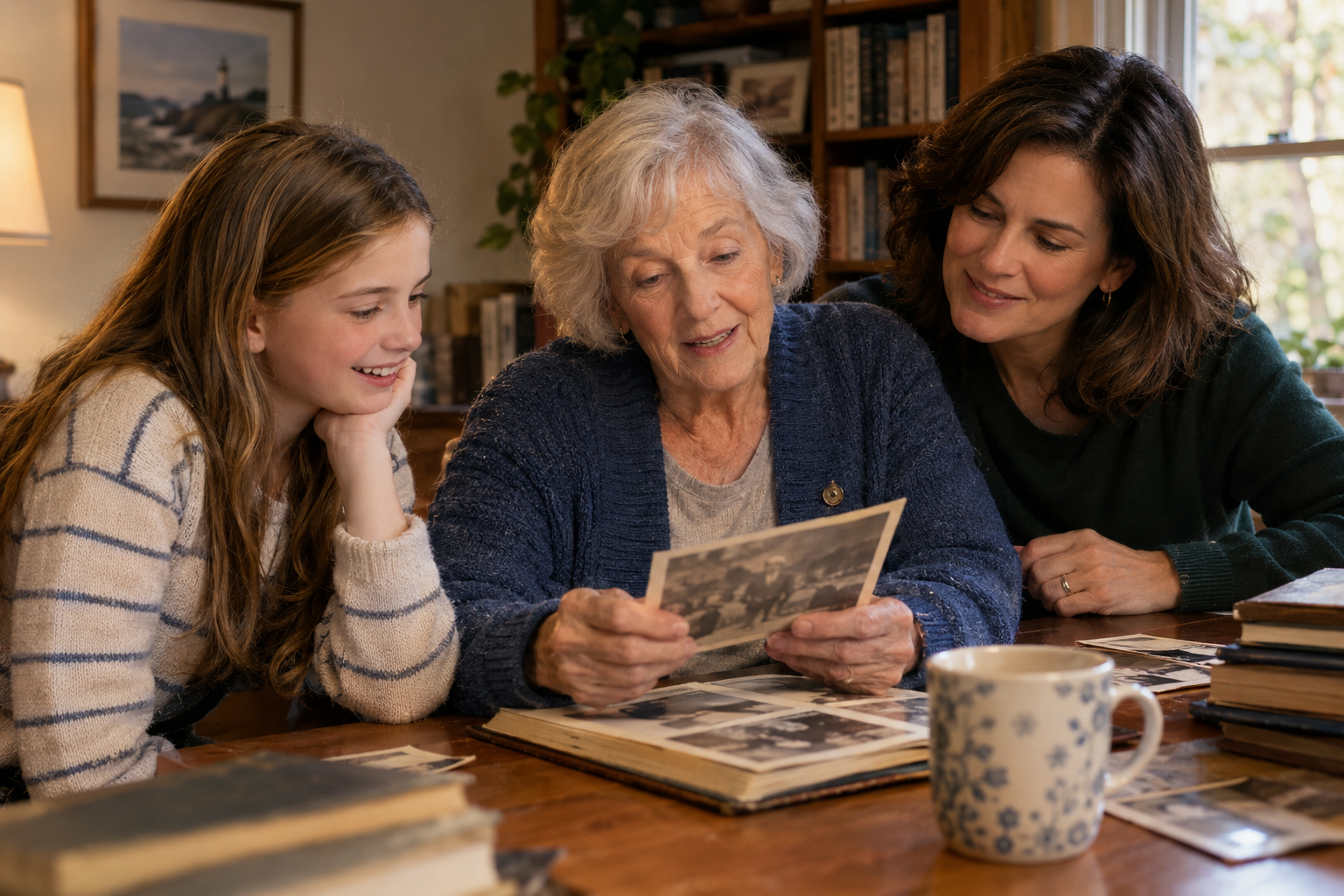
Anna’s teacher gave the class three weeks to finish the family-history project.
By the second evening, Anna had turned our dining table into an archive room.
Not metaphorically.
She had labeled three folders in thick black marker.
BEFORE SOPHIE GOT SICK.
THE HOSPITAL YEARS.
EVERYTHING AFTER.
I stood behind her with a cup of tea.
“That second folder could use a wider definition.”
Anna looked up.
“I’m trying to keep it simple.”
I laughed.
“Wrong family.”
She had already interviewed Sophie, Ruby, Emily, Marcus, and Graham.
Noah had escaped because, as Anna explained, “he married into the weirdness too late.”
Noah objected.
“I have suffered.”
“You joined voluntarily.”
“That feels unfair.”
Anna did not change her mind.
Her assignment required one central question.
She chose:
Who gets to decide what a family remembers?
When she read it aloud, the room went quiet.
Sophie looked at me.
I looked at her.
Anna noticed.
“What?”
“Nothing.”
“That’s the family face.”
“We have too many family faces,” Sophie said.
Anna tapped her notebook.
“So?”
I sat down.
“That’s a very big question.”
“It’s twelve words.”
“That doesn’t make it small.”
She was not interested in abstraction.
She wanted examples.
That was the danger and the usefulness of children.
Adults preferred themes.
Children asked what happened.
She began with Graham.
He told her about intercepting letters after the custody case.
He did not soften it.
“I made your mother’s absence look voluntary.”
Anna frowned.
“Why?”
“Because if Sophie and Ruby knew she kept writing, they would have asked why she couldn’t see them.”
“And then?”
“I would have had to admit I was helping keep her away.”
“So you controlled the story.”
“Yes.”
Anna wrote something.
“What?”
Graham asked.
“Nothing.”
“That sounds ominous.”
She turned the notebook around.
People control stories when facts make them look bad.
Graham read it.
“Accurate.”
Her interview with Emily took a different direction.
Emily explained that Anna Mercer, the woman who raised her, hid the truth of Marianne’s identity because she believed revealing it might expose Emily to danger.
“Was she right?”
Anna asked.
“About the danger?”
“Yes.”
“For a while.”
“Then why didn’t she tell you later?”
Emily smiled sadly.
“Because sometimes a decision that begins as temporary becomes easier to keep than undo.”
Anna wrote again.
Temporary secrets become permanent when nobody chooses an end date.
Emily stared at the sentence.
“That is uncomfortably good.”
Anna shrugged.
“It’s obvious.”
Adults often built whole lives around truths children considered obvious.
With Ruby, the interview became almost legal.
“What is a memory?”
Anna asked.
Ruby blinked.
“I thought this was family history.”
“It is.”
“Memory is what somebody remembers.”
“Wrong.”
Ruby leaned back.
“Excuse me?”
Anna grinned.
“Memories can be wrong.”
“Fine. Memory is a person’s recollection of past events.”
“Can courts use memories?”
“Yes.”
“Even if they’re wrong?”
“Yes, which is why corroboration matters.”
“What does corroboration mean?”
“Evidence supporting a claim.”
“So if Dad said Mom was unstable and other people repeated it, was that corroboration?”
Ruby’s expression changed.
“No.”
“Why not?”
“Because repeated allegations are not independent evidence.”
Anna underlined something.
“What?”
Ruby demanded.
“Lawyers get mad when you use their words against them.”
“Correct.”
Then Anna interviewed me.
She waited until late afternoon when the house was quiet.
No camera.
No recorder.
Only the notebook.
“Why didn’t you tell Sophie and Ruby everything when you came back?”
I knew exactly which period she meant.
“Because they were children.”
“That sounds like what everybody else said.”
Fair.
I folded my hands.
“The difference is what the truth was for.”
“What do you mean?”
“Some information belongs to adults because children don’t need to carry it yet. But withholding information to protect a child is different from withholding information to control what they believe.”
Anna considered that.
“How do you know the difference?”
“Sometimes you don’t.”
She looked surprised.
“That’s not helpful.”
“I know.”
“What did you not tell them?”
“Details about court filings. What Graham’s lawyer said about me. Things I thought would make them feel responsible for choosing sides.”
“Were you right?”
“Mostly.”
“Mostly?”
“I made mistakes.”
Anna paused over the page.
“Like?”
I smiled without humor.
“I sometimes told myself I was protecting them when really I was protecting myself from difficult conversations.”
She looked up.
“What conversation?”
“How angry I was with their father.”
“Did they know anyway?”
“Of course.”
Anna nodded.
“So hiding feelings doesn’t hide them.”
“Usually not.”
She wrote that down too.
When Sophie saw the notes later, she laughed.
“Anna is basically conducting a truth commission.”
“I warned you.”
“No, you encouraged her.”
“I answered questions.”
“That’s how it starts.”
The problem emerged during her interview with Graham’s mother, Elaine.
Elaine was old enough that we had debated whether to involve her.
Anna insisted.
“She’s part of the story.”
Sophie said, “That does not automatically mean she wants to talk about it.”
So Anna called first.
Elaine agreed.
They met at her assisted-living apartment.
I went because Sophie asked me to.
Graham stayed away deliberately.
He said his presence would influence what Elaine felt free to say.
That was a surprisingly thoughtful choice.
Elaine wore a pale blue cardigan and complained that the tea in the facility tasted like cardboard.
Anna began gently.
“What do you remember about Robert?”
Elaine smiled.
“Too much.”
“What was he like when Graham was little?”
“Demanding.”
“Nice?”
“Sometimes.”
“Scary?”
Elaine looked at me.
Then back at Anna.
“Yes.”
“Did you know he wasn’t Graham’s biological dad?”
The directness landed hard.
Elaine gave a tired laugh.
“Yes.”
“Why didn’t Graham know?”
“Because Robert decided he shouldn’t.”
“Did you agree?”
“No.”
“Then why didn’t you tell him?”
Elaine’s fingers tightened around the teacup.
“Because I was afraid Robert would leave.”
Anna waited.
“He controlled the money?”
“Yes.”
“And the house?”
“Yes.”
“Did he hit you?”
“No.”
That answer came quickly.
“Did he threaten you?”
“Not exactly.”
Anna frowned.
“What does not exactly mean?”
Elaine looked toward the window.
“He could make you understand consequences without saying them.”
I knew that kind of person.
So did Sophie.
Anna did not.
Not yet.
Elaine continued.
“If I contradicted him publicly, he would become very quiet. Then later some privilege disappeared. A bank card. A trip. Access to a car. He never said why.”
“That sounds like punishment.”
“It was.”
“Did Graham see it?”
“Some.”
“Did he learn from Robert?”
Elaine’s eyes filled.
“Yes.”
The room became still.
Anna set down her pen.
“You don’t have to keep going.”
Elaine smiled faintly.
“Your family finally learned that sentence.”
That almost broke me.
Elaine wanted to continue.
She told Anna something none of us had heard before.
When Graham was ten, he once tried to intervene after Robert locked Elaine out of their joint bank account during an argument.
Graham asked why his mother was crying.
Robert told him adults had responsibilities children did not understand.
Then he said something Elaine remembered word for word:
The person who controls the information controls the outcome.
Anna looked at me.
I felt cold.
Robert had been teaching Graham long before the Vale-Carter files.
Long before our marriage.
Control information.
Control the outcome.
A family philosophy disguised as competence.
Anna wrote the sentence.
Then crossed it out.
“Why did you cross it out?” Elaine asked.
“Because I don’t want that in the project.”
“Why?”
“It sounds too important.”
I understood immediately.
If she included it, Robert’s sentence could become the organizing quote.
A dead man who had already controlled too much would control the project too.
“What do you want instead?” I asked.
Anna looked at her notes.
“I want the point to be what everybody did after.”
That was better.
The next complication came from school.
Anna’s teacher reviewed her draft and asked whether she had documents supporting the more serious claims.
A reasonable question.
Anna came home furious.
“She thinks I made it up.”
“No,” Sophie said. “She’s asking for sources.”
“I have sources.”
“People are sources.”
“She wants documents.”
Anna looked at me.
“Can I use the Saint Matthew report?”
My first response was no.
Not because of secrecy.
Because school hallways did not need copies of medical and legal records containing other people’s names.
“We can use redacted versions.”
“What does that mean?”
“We remove private information that doesn’t belong in your project.”
“Isn’t that hiding?”
Ruby, on speakerphone, answered before I could.
“No. Privacy and secrecy are not the same.”
Anna frowned.
“Explain.”
Ruby loved being asked that.
“Privacy protects information because the person has a right to control access. Secrecy hides information in order to manipulate understanding.”
“Always?”
“No.”
“Then that definition is bad.”
“I hate teenagers.”
“I’m thirteen.”
“Close enough.”
Together we made redacted copies.
Names of unrelated patients disappeared.
Addresses disappeared.
Medical details irrelevant to Anna’s question disappeared.
The substance remained.
She included one of my old letters to Sophie and Ruby.
One of Graham’s court admissions.
A copy of Anna Mercer’s note.
Daniel Mercer’s line Safe now.
The family rules.
And a photograph of all of us at the zoo.
“Why the zoo?”
I asked.
“Because this isn’t supposed to be only about bad things.”
That answer stayed with me.
On presentation day, Sophie and I sat in the back of the classroom.
Parents had been invited because the projects were part of a larger history unit.
Anna stood beside her display board.
She did not begin with Saint Matthew.
She began with a sentence.
“My family used to think keeping information secret was the same as keeping people safe.”
The room quieted.
“Sometimes secrecy did keep people safe for a while.”
She pointed to the section about Emily.
“My relative Emily was hidden as a baby because people were trying to take her.”
Then she pointed to the section about Graham.
“Other times, secrecy protected adults from consequences and hurt children.”
No drama.
No accusation in her voice.
Just distinctions.
She described my custody separation without naming every detail.
She explained Sophie’s leukemia as the event that forced old records into review.
She described Emily’s donation.
Then she moved to the central question.
“Who gets to decide what a family remembers?”
A student raised his hand.
The teacher looked surprised.
Anna nodded.
“People who were there?”
“Partly.”
Another student said, “Whoever tells the story.”
Anna smiled.
“That’s the problem.”
She turned to the final panel.
“The answer I got from my family is that nobody should own the whole story.”
She pointed to different quotes.
“One person can remember fear. Another can remember harm. Another can remember why they thought they were helping.”
Then she looked at us.
“You don’t have to choose one person’s version if several things are true.”
I felt Sophie reach for my hand.
Anna ended with the family rule from Part 20.
THE PAST EXPLAINS. WE CHOOSE WHAT CONTINUES.
The teacher asked where the quote came from.
Anna pointed directly at me.
“My grandma wrote it.”
Every face in the room turned toward me.
I wanted to disappear.
Sophie whispered, “This is revenge for all your hospital questions.”
Afterward, Anna received the highest score in the class.
She cared for approximately twelve minutes.
Then she asked whether we could get noodles.
At dinner, Graham joined us.
He had not attended the presentation because Anna feared his presence might make certain parts harder to say aloud.
He accepted that.
She handed him the printed project afterward.
He read it slowly.
When he reached Robert’s quote, he looked up.
“You left it out of the speech.”
“Yes.”
“Why?”
“Because I didn’t want him to get the best line.”
Graham laughed so suddenly he had to cover his mouth.
Anna frowned.
“It’s not funny.”
“No.”
He wiped his eyes.
“It’s just exactly right.”
Then she showed him the ending.
Graham read:
Nobody should own the whole story.
He looked at me.
Then Sophie.
Then Ruby on the video call.
Then back at Anna.
“That might be the best rule yet.”
Anna closed the project.
“It isn’t a rule.”
“No?”
“It’s just what I think.”
That was better.
Rules had helped us.
But eventually children needed something beyond inherited rules.
They needed judgment.
And Anna was beginning to build her own.
Click here to continue reading: PART 22: When Graham Became Ill, Sophie and Ruby Had to Decide What Care Meant Without Letting Obligation Become Another Form of Control
The Blood Test That Brought Me Back to the Daughters I Had Been Forced to Leave Behind
Part 21 of 35