I was seventy-six when I decided to give away the family archive.
Not all of it.
That distinction caused trouble immediately.
Ruby wanted everything professionally preserved.
Sophie wanted most of it burned.
Emily wanted Marianne’s letters.
Anna wanted digital copies of anything related to the family rules.
Daniel wanted the historical documents for reasons he claimed were academic and everyone knew were partly sentimental.
I wanted less paper in my house.
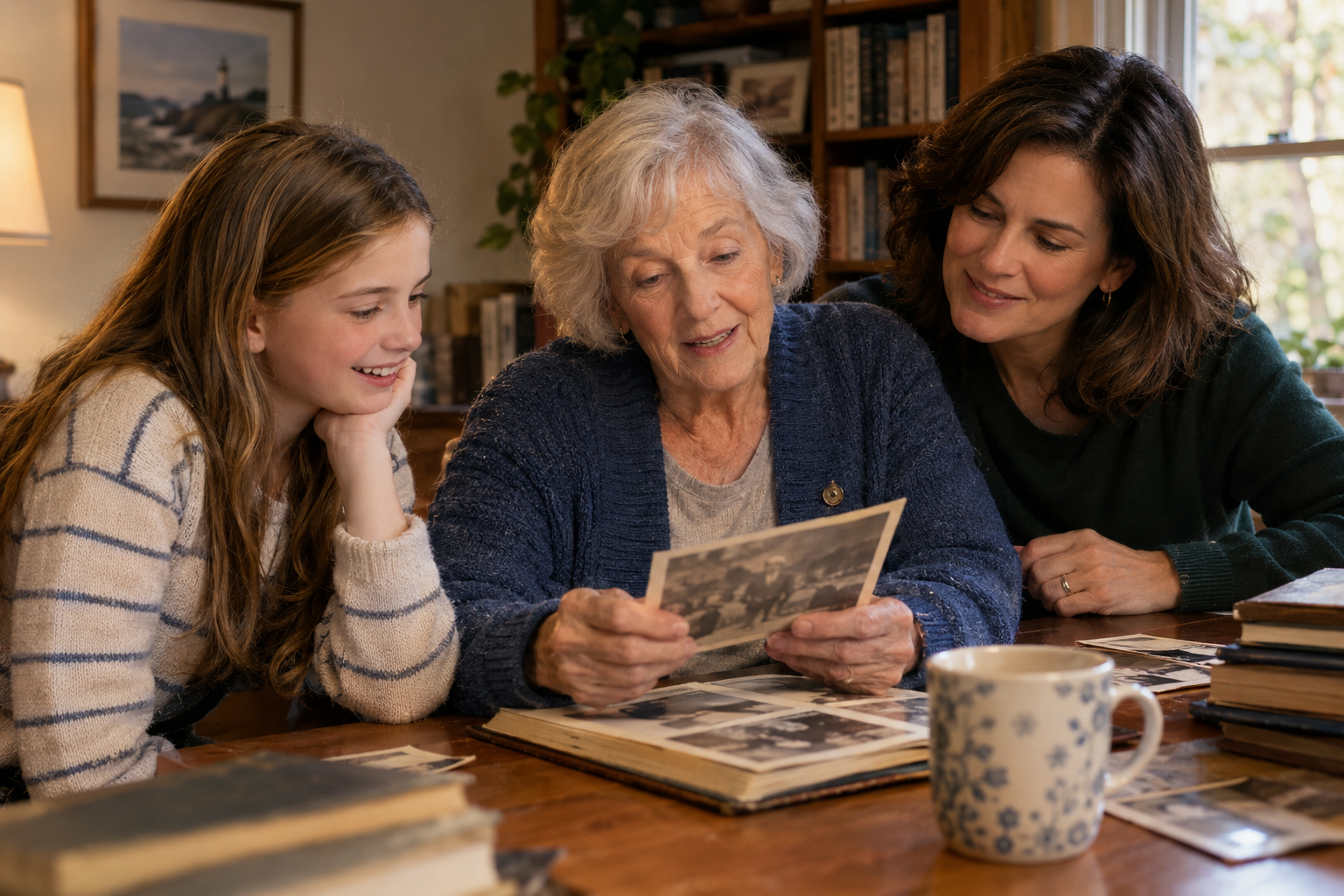
We gathered on a Saturday morning.
Three generations around the same dining table where Anna had once assembled her school project.
The archive had grown into six boxes.
Letters.
Photographs.
Court documents.
Medical records.
Copies of police reports.
Wedding programs.
Funeral notes.
School projects.
Receipts nobody could explain.
The family rulebook.
I placed a stack of colored stickers on the table.
Green meant keep.
Blue meant scan then discard.
Red meant destroy.
Ruby stared.
“You made a system.”
“I learned from surviving lawyers.”
She looked pleased.
Sophie picked up a twenty-year-old insurance statement.
“Red.”
Ruby objected.
“What if we need proof of historical coverage?”
“We are not being audited by ghosts.”
“Blue.”
“Red.”
Anna took the paper.
“Red.”
Sophie smiled triumphantly.
“Democracy.”
Emily opened Marianne’s shoebox.
Nobody joked.
Those letters carried a different weight.
She read one silently.
Then said, “Green.”
Everyone agreed.
Anna Mercer’s note remained green.
Daniel Mercer’s Safe now photograph remained green.
My letters to Sophie and Ruby stayed.
Sophie insisted.
“You tried to reach us. That matters.”
Graham’s intercepted copies were duplicates of mine.
We destroyed the duplicates.
That felt important.
We did not need two physical records of the same hurt simply because one had been hidden.
The Saint Matthew medical files required more discussion.
Some documents contained other patients’ information.
Even redacted copies carried sensitive details.
Ruby wanted legal preservation.
Anna asked whether anyone actually needed them.
No.
The official record already existed elsewhere.
We kept a short summary.
Destroyed the rest.
Sophie fed the pages into a shredder.
“This is satisfying.”
Ruby frowned.
“You’re enjoying it too much.”
“I spent my childhood being medically documented.”
“Fair.”
The Vale-Carter clinic material was more complicated.
Those records belonged partly to history beyond our family.
Evidence of consent abuses.
Financial misconduct.
Institutional failures.
We contacted a medical ethics archive at a university.
They agreed to accept redacted research material under restricted access.
No family mythology.
No private display.
Actual scholarship.
Daniel approved enthusiastically.
“Finally, historians can suffer too.”
We laughed.
Then we reached Graham’s papers.
His letters.
The VC-19 paternity report.
The copies of his criminal plea.
His medical directive.
The recording transcript he left the girls.
Ruby looked at Sophie.
“What do you want?”
“Some.”
“Which?”
“The pancake letter.”
I had forgotten it.
Graham once sent Sophie a note with a recipe after she mocked his pancakes.
It contained nothing profound.
Butter the pan first.
Low heat.
Stop flipping too early.
At the bottom he had written:
I am learning patience in all available forms.
Sophie kept it.
Ruby kept one photograph of Graham holding her yellow rabbit when she was five.
She did not keep the paternity report.
“Dad knew who his father was by the end.”
She placed VC-19 in the red pile.
No one objected.
That file had terrified Robert enough to burn once.
Now we destroyed the surviving copy without fear.
Not to hide anything.
Because it no longer had work to do.
The difference mattered.
At noon, Noah ordered food.
Anna’s daughter—my great-granddaughter, named Elise—arrived with crayons and immediately began drawing on the back of a photocopied court filing.
Ruby nearly fainted.
“That was red,” Anna said.
“Still a legal document.”
“It’s trash.”
Elise drew a purple horse over a custody exhibit.
I laughed until I had tears in my eyes.
For decades, paperwork had carried enormous power in our family.
Orders.
Reports.
Records.
Labels.
Proof.
Now a five-year-old colored over it.
Good.
After lunch, we reached the family rulebook.
The cover was worn.
Coffee stained one corner.
Some pages had fallen loose.
Anna opened it.
Rule One.
NO SECRET MEDICAL FILES.
Rule Two.
NO LYING ABOUT WHO SOMEONE’S MOM IS.
Rule Three.
NO WEIRD RICH PEOPLE TRACKING BABIES.
Everyone laughed again.
Rule Four.
BEING SCARED DOESN’T LET YOU CHOOSE FOR EVERYONE.
Rule Five.
YOU CAN LOVE SOMEONE WITHOUT LETTING THEM CONTROL YOU.
Rule Six.
THE PAST EXPLAINS. WE CHOOSE WHAT CONTINUES.
Anna ran her fingers over the handwriting.
“Green.”
Obviously.
Then Elise asked, “What are rules?”
Anna lifted her onto her lap.
“They’re things our family learned the hard way.”
Elise frowned.
“Why didn’t you learn easy?”
Nobody answered.
Because families rarely do.
The archive sorting lasted all afternoon.
By evening, six boxes became two.
One box of family material.
One destined for the ethics archive.
Everything else went into secure shredding bags or recycling.
I stood beside the reduced pile.
“So much smaller.”
Ruby looked almost sad.
“It feels like losing something.”
“It is.”
“What?”
“Weight.”
Sophie touched one box.
“Good.”
Later, after everyone left, Anna stayed.
She was forty-two now.
Older than Sophie had been at the survivorship anniversary.
That fact startled me.
Age kept moving even when memory did not.
We sat at the kitchen table.
“You okay?”
“Yes.”
“You looked tired.”
“I am tired.”
“That’s allowed.”
“Apparently.”
She smiled.
Then she opened the rulebook again.
“There’s a blank page.”
“There are several.”
“Do we need Rule Seven?”
“No.”
“Why not?”
“Six is enough.”
She looked disappointed.
“You always like endings.”
“I used to.”
“What changed?”
“I learned most endings are only places people stop telling the story.”
Anna considered that.
“That’s depressing.”
“It’s freeing.”
“How?”
“You don’t have to make everything resolve perfectly.”
She looked toward the box.
“Do you think we did okay?”
“As a family?”
“Yes.”
“No.”
She laughed.
“That was quick.”
“We made terrible mistakes.”
“I mean after.”
“We did better.”
“Is that enough?”
“It has to be.”
No family gets a second draft of reality.
We only get later choices.
Anna closed the rulebook.
“Mom says you’re giving the house to her and Ruby.”
“Eventually.”
“She says you’re not allowed to die.”
“That sounds controlling.”
“I told her.”
“Good.”
The years had made our language gentle through repetition.
Control.
Choice.
Fear.
Truth.
Words that once arrived inside emergencies now lived in ordinary jokes.
That felt like success.
A month later, the university archive collected the Vale-Carter materials.
The archivist asked whether we wanted a donor plaque.
“No,” I said immediately.
He looked surprised.
“Anonymous?”
“Not exactly.”
Ruby explained.
“Catalog the collection accurately. No plaque.”
The archivist nodded.
He understood.
Documentation without monument.
Perfect.
The remaining family box moved to Sophie’s house.
Not because she was the eldest.
The twins were twins.
Because Sophie had space.
That practical reason pleased me.
No symbolic custodian.
No keeper of secrets.
Just a closet with good shelving.
Years passed.
My health remained decent until suddenly it did not.
A stroke changed my balance.
Then another changed my speech temporarily.
I recovered enough to return home, but everyone became nervous.
Sophie tried not to manage me.
I watched her struggle.
“You can say it.”
“What?”
“You think I shouldn’t live alone.”
She sat across from me.
“Yes.”
“Why?”
“Because you fell twice.”
“Good reason.”
She blinked.
“You’re agreeing?”
“I dislike stairs.”
Ruby joined by video.
“We found a place near Sophie.”
“I know.”
“You toured it?”
“Yes.”
“Without telling us?”
“I am seventy-eight, not twelve.”
She smiled.
“Fair.”
I moved voluntarily.
That mattered to everyone.
Especially me.
My new apartment had one bedroom.
A balcony.
No stairs.
Enough room for tea.
The family archive did not come.
Good.
It belonged to the next generation now.
On my eightieth birthday, everyone gathered.
Sophie.
Ruby.
Emily.
Marcus.
Noah.
Anna.
Daniel.
Their partners.
Children.
Grandchildren.
The room was too small.
People sat on the floor.
Someone spilled juice.
A toddler screamed because another child touched her cracker.
I watched the chaos and thought about the first hospital call.
Not with pain.
Not even with fear.
More like seeing an old road from high above.
You recognize the turns.
You remember where you nearly crashed.
But you are no longer driving there.
After cake, Anna handed me a flat package.
“What is this?”
“Open it.”
Inside was a framed copy of the final page from her old school project.
The bottom sentence remained.
Nobody should own the whole story.
Beneath it, she had added the family rule:
THE PAST EXPLAINS. WE CHOOSE WHAT CONTINUES.
I stared at it.
“You changed the layout.”
“I’m an adult now. I’m allowed.”
“Apparently.”
Sophie sat beside me.
“Do you like it?”
“Yes.”
I looked around the room.
“What continues?”
Ruby answered first.
“Bad jokes.”
Emily said, “Overcomplicated genetics.”
Noah said, “Pancakes.”
Sophie pointed at him.
“Only if you stop burning them.”
Anna said, “Questions.”
That quieted everyone.
Questions.
Not secrets.
Not obedience.
Not certainty.
Questions.
That was perhaps the best inheritance we managed.
When the evening ended, Sophie helped me clear plates.
I moved slowly.
She moved slower than necessary so I would not feel hurried.
“Mom.”
“Yes?”
“Are you happy?”
The question felt too large and too simple.
“Yes.”
“Really?”
“Yes.”
“After everything?”
“Because after everything still had ordinary days in it.”
She leaned against the counter.
“What do you mean?”
“This.”
I gestured toward dirty plates.
Cake crumbs.
Children’s fingerprints on the glass door.
A half-empty coffee cup.
“Most of life.”
She smiled.
“That’s very philosophical for dishes.”
“I’m eighty.”
“Excuse.”
“Privilege.”
She washed.
I dried.
For a while we said nothing.
Silence had once frightened me.
Silence meant concealment.
Threat.
Someone deciding what could not be spoken.
Now silence could mean two people washing dishes because there was nothing urgent to say.
That was different.
When Sophie left, she kissed my forehead.
“Call if you need anything.”
“I will.”
“Promise?”
I looked at her.
The word had traveled through our family for decades.
Promises to stay.
Promises to tell.
Promises not to control.
“Yes.”
She smiled.
Then left.
I stood by the window and watched her walk toward the parking lot.
She turned once.
Waved.
I waved back.
Then she got into her car and drove home.
No one was missing.
No one was hidden.
No one needed to be found.
For our family, that was enough of an ending.
Click here to continue reading: PART 25: When My Own Memory Began Failing, Sophie Faced the Same Choice I Once Faced With My Mother—When to Correct and When to Stay
The Blood Test That Brought Me Back to the Daughters I Had Been Forced to Leave Behind
Part 24 of 35