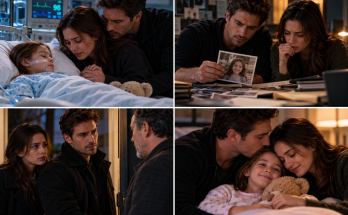
Emily died two years after Marcus.
She had been eighty-one and irritated by the phrase “a good long life.”
“People say that when they want death to sound like a completed assignment,” she told Sophie during her final hospitalization.
Sophie laughed.
“So what should they say?”
“That I’m old and annoyed.”
“You are.”
“Better.”
Emily’s heart had weakened over several years. There was no hidden genetic surprise, no overlooked hospital error, no secret medication code. Doctors adjusted what they could. Eventually her body stopped responding.
Daniel was with her when she died.
He called Anna first.
By then, Anna had become the person everyone called without officially deciding she was.
Not because she controlled anything.
Because she answered.
That distinction mattered.
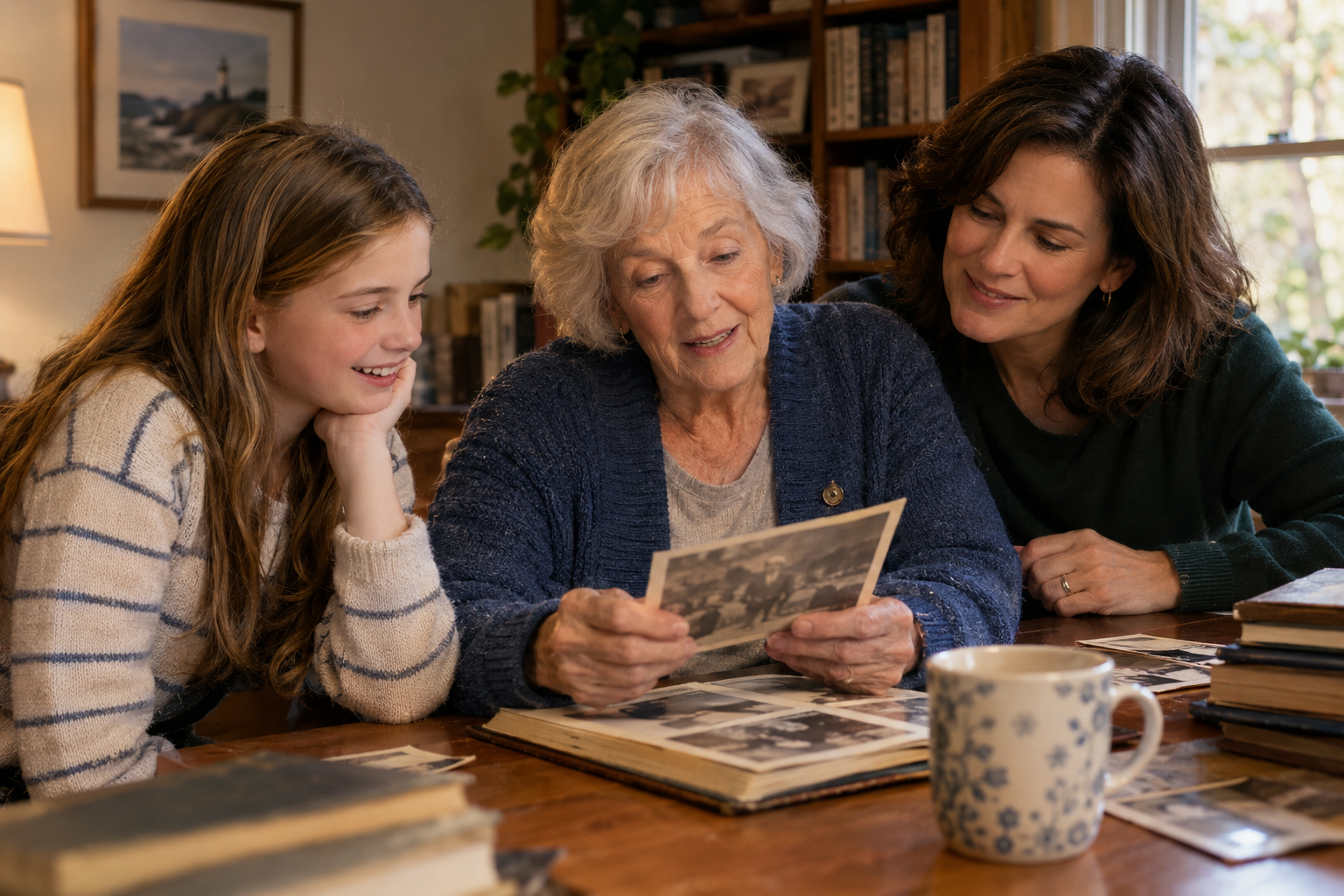
When Anna told me, I stood in my kitchen and looked at the photograph from the coastal weekend.
Emily stood near the center, laughing because Marcus had placed a plate in front of her dress.
For decades she had been an impossible fact.
An anonymous bone-marrow donor.
Then a cousin.
Then Marianne’s daughter.
Then simply Emily.
It seemed unfair that death reduced her again to a relationship.
“She was more than the person who saved Sophie,” I told Anna later.
“I know.”
“Make sure everyone knows.”
Anna raised an eyebrow.
“That sounds controlling.”
I sighed.
“Fine.”
“You can say it at the memorial.”
“I hate when the family rules work against me.”
“So did Grandma.”
The memorial took place in a botanical garden Emily loved.
No church.
No formal eulogies.
Daniel arranged photographs along a long wooden table.
Anna Mercer holding baby Emily.
Marianne in the few pictures that survived.
Emily as a teenager.
Emily signing up for the donor registry.
Emily meeting Sophie in the park.
Her wedding to Marcus.
Daniel as a child.
Grandchildren.
The coast.
Years of ordinary life.
A hospital volunteer who had worked with donor families asked whether Emily’s marrow donation should be given a central display.
Daniel said no.
“It mattered. It didn’t define her.”
I almost hugged him.
That was exactly right.
The donation belonged in the story.
It was not the whole story.
Sophie spoke briefly.
“Emily saved my life before she knew my name.”
She paused.
“For years I thought that was the biggest thing one person could do for another.”
The crowd was quiet.
“Then I knew her long enough to understand the bigger thing was what came after. She kept showing up when there was nothing heroic left to do.”
That was better than anything I could have said.
Daniel spoke about his mother’s terrible habit of leaving half-filled water glasses in every room.
Anna spoke about Emily supporting her through divorce without ever once saying I told you so.
I spoke last.
Not because I wanted to.
Because Daniel pointed at me.
I stood.
“Emily once told us family was what happened after you found one another.”
I looked toward Daniel.
“She was right.”
I sat down.
That was enough.
After the memorial, Daniel gave Anna three boxes.
“Mom’s papers.”
Anna stared at them.
“No.”
He laughed.
“Yes.”
“I already have the family archive.”
“Congratulations.”
“Why me?”
“Because Mom said you’d know what to do.”
Anna looked offended.
“That is manipulative from beyond the grave.”
“Also accurate.”
The boxes went home with her.
She left them unopened for a month.
That was new.
Years earlier, a sealed box would have dominated everyone’s attention.
Now life continued.
Work.
Children.
Bills.
One of Elise’s sons broke an arm skateboarding.
Sophie needed cataract surgery.
I developed arthritis in one knee and complained so much that Noah gave me a cane as a joke.
I used it out of spite.
Eventually Anna opened Emily’s papers on a rainy Saturday.
She called me that evening.
“There’s nothing dramatic.”
“Excellent.”
“Mostly tax records, photographs, letters from Marcus.”
“Good.”
“Mom kept every birthday card Sophie ever sent her.”
I smiled.
“Also good.”
“There’s one thing.”
Of course.
“What?”
“A letter from Grandma Isabelle.”
Mom.
“How old?”
“Written after Emily’s wedding.”
“Was it sent?”
“No.”
I felt a familiar tightening.
“Why did Emily have it?”
“There’s a note. Grandma gave it to her later.”
“What does it say?”
Anna paused.
“Do you want to know?”
That question still had power.
For decades, our family had assumed information wanted to be known.
Now we asked.
“Yes.”
Anna read.
Mom had written to Emily after the wedding because she was struggling with something she had not known how to say aloud.
She thanked Emily for donating marrow.
Then admitted that for a long time she had resented her.
I sat down.
“What?”
“Keep listening.”
Anna continued.
Mom wrote that after Emily appeared, everyone celebrated the extraordinary coincidence that connected us.
Sophie had survived.
A lost relative had been found.
A donor became family.
It was beautiful.
And Mom hated that beauty sometimes.
Because people began telling the story as if Sophie’s cancer had brought the family together.
Mom wrote:
I know nobody means harm when they say something good came from her illness. But I still want to scream when I hear it. Cancer did not give me my daughters back. It nearly took Sophie from me. People made choices after the illness exposed the truth. The disease deserves no gratitude.
I closed my eyes.
I remembered Mom saying something like that at the hospital anniversary.
Not as sharply.
Not with resentment.
The letter continued.
She confessed that Emily’s presence sometimes made that narrative harder to resist.
The donor.
The cousin.
The miracle.
Everything aligned too neatly.
Mom feared we would turn suffering into destiny because destiny felt easier to live with than randomness.
Then she apologized.
Not for feeling it.
For once treating Emily coldly at a family dinner because someone had described the transplant as “meant to be.”
Emily apparently never mentioned it.
At the end Mom wrote:
You were not meant to save Sophie. You chose to. That matters more.
Anna stopped.
For several seconds I heard only rain through the phone.
“Why did Emily keep it?” I asked.
“Her note says: Because Isabelle finally said the thing everyone else was too sentimental to say.”
I laughed.
That sounded like Emily.
Anna asked, “Should this go in the archive?”
“Yes.”
Immediate.
Then I changed my answer.
“Wait.”
“Why?”
“Because it’s partly about Emily.”
“She kept it.”
“Did she want it public?”
“Family public or archive public?”
Good question.
“Family.”
Anna checked.
“There’s a note on the envelope.”
“What?”
READ WHEN I’M DEAD IF ANYONE STARTS TURNING ME INTO A SAINT.
I laughed so hard my knee hurt.
“Archive.”
“Agreed.”
The letter changed something in the family telling.
Not the facts.
The proportion.
At later gatherings, when someone younger referred to the transplant as fate, Daniel corrected them.
“No. My mother registered because Anna taught her to. Then she chose to donate. That’s enough.”
Sophie appreciated that.
“So do I,” she told me.
“Did people really say your cancer was meant to happen?”
“Not exactly.”
“Then what?”
“That everything happened for a reason.”
“How did that feel?”
“Like they were asking me to be grateful for leukemia.”
She said it without anger now.
Age had worn down some edges.
Not the truth.
“I’m glad Emily wrote back.”
“She didn’t.”
“What?”
“She never answered Grandma’s letter.”
“Really?”
“She kept it.”
I thought about that.
Maybe not every honest statement needed response.
Sometimes being received was enough.
Anna reorganized the family archive after Emily’s death.
Not by person.
That had made the relationships too fragmented.
Instead she created sections.
HEALTH.
LAW.
FAMILY ORIGINS.
LETTERS.
PHOTOGRAPHS.
CHOICES.
I mocked the last category.
“What goes under choices?”
“The things people decided when they could have done something else.”
“That’s vague.”
“It’s supposed to be.”
Inside she placed:
Mom driving to the hospital after years away from Sophie.
Emily joining the donor registry.
Daniel Mercer blocking the private ambulance.
Anna Mercer agreeing to raise Emily.
Graham returning Mom’s intercepted letters.
Sophie choosing her own medical care.
Mom surrendering her driving license.
No heroic labels.
No moral ranking.
Only choices.
I understood what Anna was trying to preserve.
Not outcomes.
Agency.
The family had spent generations talking about circumstances.
Fear.
Power.
Illness.
Systems.
Secrets.
But people still made choices inside them.
Not perfectly free choices.
Not equal choices.
Still choices.
One evening Anna showed the new archive structure to Sophie.
Sophie stood in front of the shelves.
“You’ve turned our family into a library.”
“Better than a crime scene.”
“Debatable.”
Anna pulled out the family rulebook.
It remained in one piece, barely.
“We should digitize this.”
Sophie grabbed it.
“No.”
“Why?”
“I like the coffee stain.”
“We can scan the coffee stain.”
“That is not the same.”
Anna rolled her eyes.
For once, preservation lost.
The original remained physical.
A fragile object.
That seemed right too.
Not everything had to become permanent through technology.
Objects could decay.
Ink could fade.
The ideas had already moved beyond the pages.
Years later, Elise asked whether she could borrow the rulebook for her daughter’s wedding.
Anna stared.
“Why?”
“She wants it on the family table.”
Sophie, now well into her seventies, objected from across the room.
“No display.”
Elise groaned.
“Why not?”
“Because it’s not scripture.”
“It’s family history.”
“So are tax returns.”
“Not the same.”
“What if we copy one page?”
“Which?”
Elise showed them.
Rule Five.
YOU CAN LOVE SOMEONE WITHOUT LETTING THEM CONTROL YOU.
Her daughter wanted it because she and her fiancé had included a line about autonomy in their vows.
Sophie softened.
“Copy it.”
“Not the original?”
“No.”
Good.
The rulebook stayed home.
The words traveled.
That was the balance.
During the wedding reception, I watched a generation of people who knew the Saint Matthew story only in outline dance beneath strings of lights.
No one was carrying folders.
No one was waiting for DNA results.
No one was looking over shoulders for the return of a hidden past.
A teenager asked me whether all the stories about our family were true.
“Depends which ones.”
“The baby-switching thing.”
“There was no successful baby switch.”
“But someone tried to steal a baby.”
“Yes.”
“And Sophie’s donor turned out to be family.”
“Yes.”
“And Graham framed Grandma Isabelle.”
I disliked the phrasing.
“He participated in falsifying evidence that separated her from her daughters.”
The teenager stared.
“That sounds worse.”
“It was more accurate.”
He nodded thoughtfully.
“Why didn’t anyone make a movie?”
I nearly choked.
“Because most of the story happened in paperwork.”
“That sounds boring.”
“Exactly.”
He wandered off.
I smiled.
Good.
Let them find it boring.
Let the next generation know the story without needing adrenaline from it.
That was how trauma finally lost status.
Not by disappearing.
By becoming information instead of atmosphere.
Click here to continue reading: PART 34: Sophie’s Final Years Forced Anna to Learn That Honoring the Past Sometimes Meant Refusing to Repeat Even Its Most Beloved Traditions
The Blood Test That Brought Me Back to the Daughters I Had Been Forced to Leave Behind
Part 33 of 35