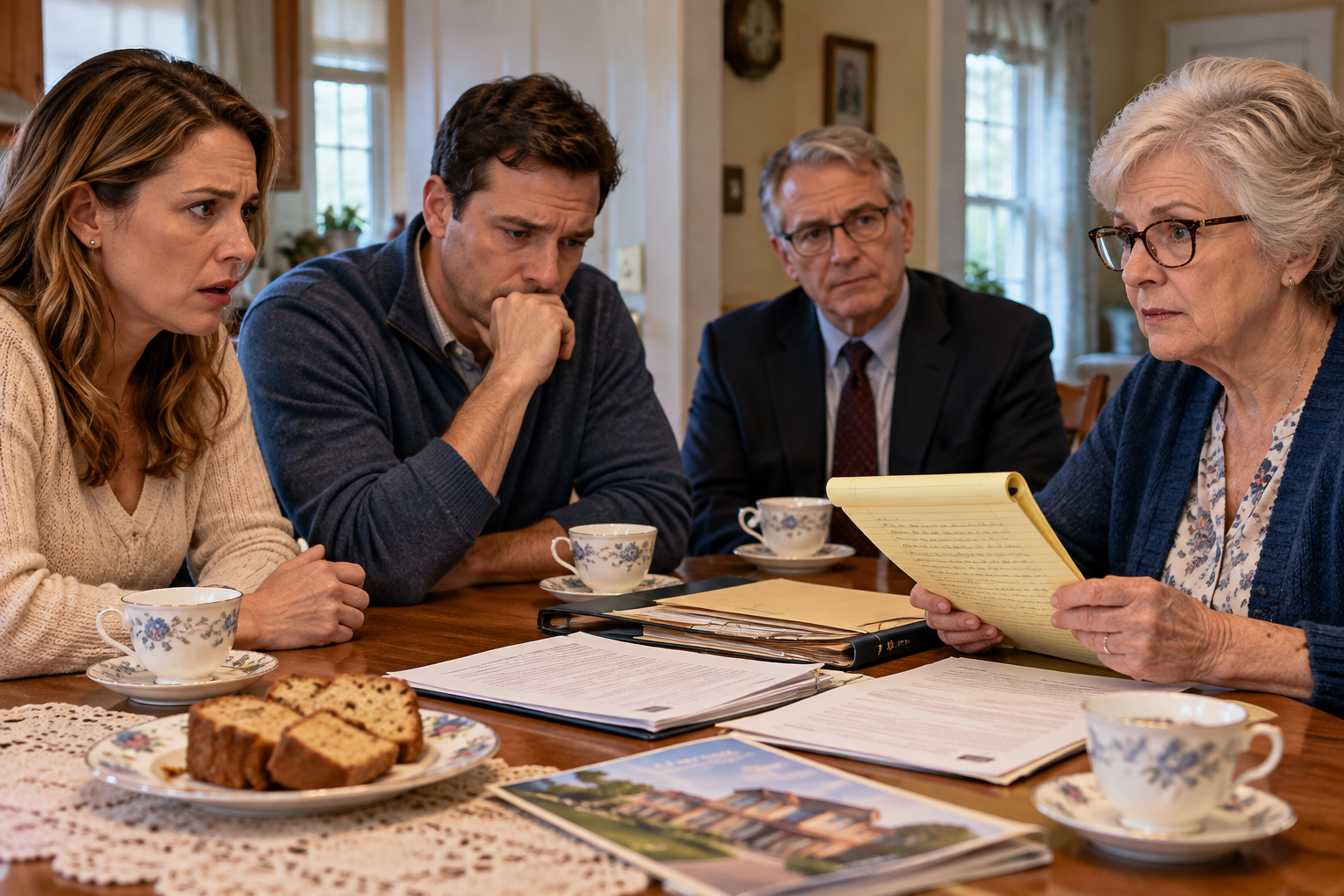
Alicia looked at my glasses.
I saw her do it.
Her eyes moved toward my face and stayed there for a moment.
I wondered whether she was remembering the plan from the car.
I certainly was.
In that conversation, she had told Mark what to do if I wanted to read the papers.
He was supposed to find a reason to take my glasses away.
Something harmless.
Something polite.
A small inconvenience that would leave me unable to see the print clearly.
I had listened to that suggestion while sitting in this very kitchen.
Now the glasses were on my face.
And Alicia was looking at them.
Neither of us said anything.
Mark reached for his tea.
His hand was not entirely steady.
Perhaps he was nervous.
Perhaps the conversation wasn't going as he had expected.
I couldn't know what he was thinking.
I only knew what I could see.
Alicia turned the brochure slightly.
“There's no need to get into all the details right this minute.”
I kept my voice gentle.
“Then why did you bring them?”
She blinked.
“We wanted you to have an idea of what's available.”
I nodded.
“And I'd like to understand it.”
Mark cleared his throat.
“Mom, nobody's forcing you to do anything.”
I looked at him.
That was a sentence I wanted to believe.
I wanted it so badly that I almost thanked him.
But he had been in the car.
He had heard Alicia say I would sign.
He had brought the folder.
And now he was telling me there was no pressure.
I didn't accuse him.
Not yet.
I simply asked another question.
“Then you'll be comfortable giving me time to read everything?”
He looked at his wife.
I watched his eyes move.
The answer should have been easy.
If there was no pressure, there was no reason to refuse.
Alicia spoke first.
“Of course, Mother D.”
She smiled.
“We just don't want you worrying over complicated paperwork.”
I looked down at my hands.
They were old hands.
The skin was thinner than it used to be.
There were spots across the backs of them.
My fingers sometimes stiffened in cold weather.
But those hands had spent years managing a household.
They had counted money.
Signed checks.
Sorted bills.
Kept records.
Held a child through illness.
They had worked.
They had learned.
They had not suddenly become useless because I turned seventy-three.
I looked back at Alicia.
“Complicated things are easier when I read them slowly.”
She didn't answer.
I touched the side of my glasses.
“They help.”
Mark shifted in his chair.
Alicia gave another small laugh.
I recognized it immediately.
The sound she made when she wanted to turn an uncomfortable moment into something ordinary.
“Of course they do.”
She looked at Mark.
“Don't they, Mark?”
He nodded.
“Yes.”
I waited.
Nobody reached for my glasses.
Nobody offered to clean them.
Perhaps Alicia had decided the excuse would look strange now.
Perhaps she was waiting for a better moment.
I didn't know.
I wasn't interested in helping her find one.
I had already decided my glasses would stay with me.
Alicia closed the brochure.
“Maybe we're getting ahead of ourselves.”
I looked at her.
“Maybe.”
She seemed relieved.
Then I added something I had been thinking since the call.
“I'm curious about what happens to this house if I move.”
Mark raised his head.
Alicia became very still.
For a moment, there was no sound except the refrigerator.
I could see the plate of banana bread between us.
The slice Alicia had taken was still untouched.
Mark set his cup down.
“What do you mean, Mom?”
I looked around the kitchen.
“The house doesn't disappear because I live somewhere else.”
He nodded slowly.
“Right.”
“So what have you been thinking about that?”
Alicia answered.
“Well, there would be choices.”
I waited.
She continued with a few general remarks.
A house needed upkeep.
An empty property could become a burden.
There would be practical things to consider.
Everything she said sounded sensible.
That was what made the conversation so difficult.
She knew how to wrap a decision in ordinary concerns.
But I had heard the words she used when she thought I wasn't listening.
I had heard the price.
The sale.
The boat.
I had heard how easily she moved from discussing my living arrangements to discussing what they could buy.
I looked at Mark.
“Have you spoken to anybody about the house?”
His eyes moved toward Alicia.
There it was again.
That small glance.
I had noticed it several times since they arrived.
He seemed unwilling to answer until he knew what she wanted him to say.
Alicia leaned forward.
“People talk about houses all the time.”
I turned toward her.
“That's true.”
She relaxed slightly.
“So there's nothing to worry about.”
I looked back at Mark.
“But I asked whether you've spoken to somebody about mine.”
He swallowed.
I could see the movement in his throat.
Alicia interrupted.
“Dorothy, we don't need to turn this into something serious.”
I sat back.
“It is serious to me.”
She looked surprised.
I hadn't raised my voice.
I hadn't spoken sharply.
But I had stopped helping her move past the question.
That was new.
New for her.
And, if I was willing to admit it, new for me too.
For years, I had let other people change the subject when something made them uncomfortable.
I told myself it was better to keep peace.
Sometimes that was sensible.
Sometimes it meant I never got an answer.
This time, I wanted one.
Mark looked toward the living room.
He knew Bruce.
He knew that man had been inside the house.
He knew why the property mattered to Alicia.
I could see him thinking.
Or perhaps I was only hoping he would.
I reminded myself to be careful.
I couldn't see inside his mind.
I could only hear what he said.
And so far, he had said very little.
“Mom,” he began, “we've talked about possibilities.”
I nodded.
“What possibilities?”
He rubbed the side of his cup.
Alicia opened her mouth.
I raised one hand.
Not angrily.
Just enough to ask her to wait.
“I'd like Mark to answer.”
The words surprised me.
They surprised Alicia too.
She sat back.
Mark stared at me.
For a moment, he looked like the boy who had broken the old cup and was trying to decide whether to tell me.
I felt that memory come back.
I almost softened.
Then I remembered that my son was not a boy anymore.
He was a grown man.
A husband.
A father.
A person capable of making choices.
He needed to answer for them.
“We've wondered whether keeping the house makes sense,” he said.
I waited.
“Because it's a lot to look after.”
I nodded.
“It's my house.”
He looked down.
“I know.”
I wanted to ask whether he really did.
Instead, I let his words sit between us.
Alicia reached for the brochure again.
She seemed determined to return to the part of the conversation she could control.
“Let's just focus on Silver Meadows for now.”
I looked at her.
“That's difficult when the house is part of the plan.”
Her hand stopped.
Mark looked up.
I had not told them about the phone call.
I had not mentioned the notepad.
I had not said I knew about Bruce's estimate.
But I had asked the one question they could not comfortably separate from their proposal.
What happens to my home?
Alicia closed the brochure again.
Her smile had become thin.
I sat quietly.
I had spent years believing that if I asked people directly, they would answer honestly.
That belief was changing.
I was learning that sometimes a person needed to stop talking long enough to see who was avoiding the answer.
And Mark was avoiding mine.
I looked at him.
“I'd like to know exactly what you've discussed.”
He opened his mouth.
Then closed it.
Alicia shifted in her chair.
The fourth cup stood untouched at the end of the table.
I looked at it briefly.
I hadn't forgotten why it was there.
I had invited someone who knew the records.
Someone who understood the history of this house.
Someone who would not be persuaded by a pleasant brochure or a worried expression.
I turned back to Mark.
“We can take our time,” I said.
And I meant it.
I was no longer in a hurry to make the conversation easy for them.
Click here to continue reading: PART 8: With the Brochure Between Us and My Husband’s Empty Chair Nearby, I Finally Stopped Making Excuses for the People I Loved
When My Daughter-in-Law Called Before Breakfast, I Answered Without Knowing I Was About to Hear My Own Future Being Decided
Part 7 of 20