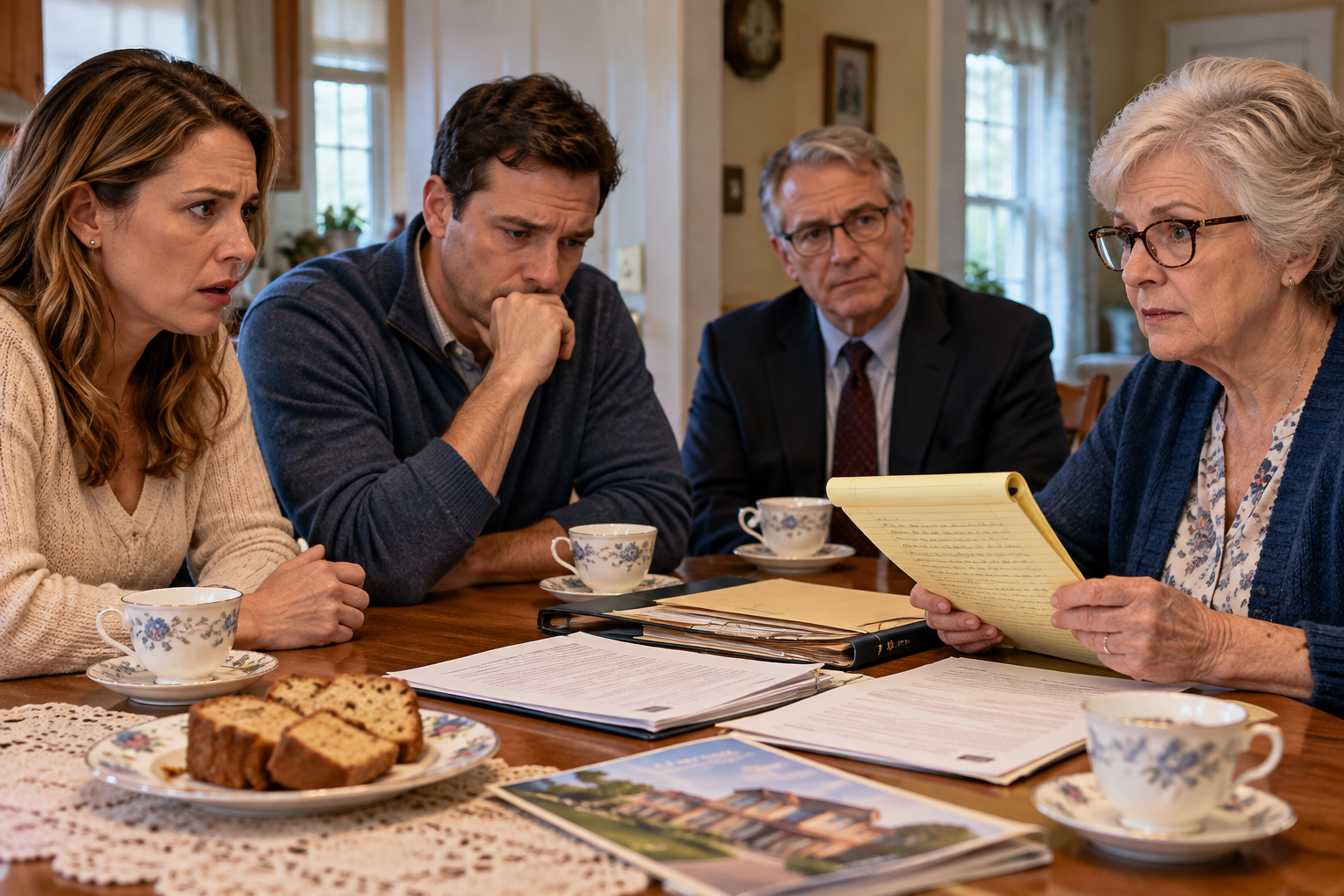
My guest had brought records relating to the house.
I watched him place them on the table.
The sight made something in me soften.
Raymond had always cared about those papers.
He treated them almost as carefully as he treated photographs.
Not because the documents were beautiful.
Because they represented years of work.
Years of payments.
Years when we had chosen to save instead of spending money on things we didn't need.
I remembered sitting beside him with bills spread across the kitchen table.
We would add the numbers.
Check what remained.
Then decide what could wait until another month.
It wasn't glamorous.
Most of married life wasn't.
But it was ours.
And it had given us a home.
My guest arranged the papers neatly.
He explained that the history of the property mattered when considering any future decision.
I nodded.
Mark watched.
Alicia remained quiet.
I wondered whether she had expected the conversation to turn toward old records.
Perhaps she thought the house was simply something that could be converted into money.
I couldn't know what she believed.
But I knew how she had described it in the car.
One hundred and eighty thousand dollars.
A number she had spoken with excitement.
A number followed by plans for a trip and a boat.
I looked at the documents.
Then at Mark.
“Do you remember when your father and I finished paying for this house?”
He nodded.
“1998.”
I felt a small, painful warmth.
He remembered.
Of course he did.
Mark had been old enough to understand why we were so pleased.
Raymond had talked about the final payment for weeks.
We had spent years making that mortgage part of our monthly budget.
Then, suddenly, it was finished.
The house belonged to us without that debt hanging over it.
I remembered how proud Raymond had been.
He had stood in the backyard and smiled in a way I hadn't seen for a long time.
We had celebrated in our own quiet way.
There was no expensive party.
No grand announcement.
Just the relief of knowing that something important had been completed.
I looked at my son.
“Your father worked hard for that.”
Mark nodded.
“I know.”
“So did I.”
He raised his eyes.
“Yes, Mom.”
I let the words settle.
I had not always insisted that people recognize my part in things.
Raymond earned money.
So did I, in the ways our life required.
We made decisions together.
We kept the household running.
We sacrificed.
We managed.
But when people spoke about what Raymond had built, I sometimes allowed my own part to disappear.
I didn't want to do that anymore.
The house had been our achievement.
And now it was my responsibility.
My guest looked at the records.
He confirmed the important history we had discussed.
The mortgage had been settled years earlier.
The property was mine.
I felt grateful to hear those facts spoken aloud.
Not because I had doubted them.
Because Mark and Alicia were sitting there.
Listening.
Hearing the same facts.
There was no room for a different version.
I looked at Alicia.
She had been very quiet.
Her hands were folded in front of her.
I wondered whether she remembered what she had said that morning.
The claim that they had been paying for my house for four years.
I could still hear her voice.
Confident.
Impatient.
As if something I owned had become a burden they were carrying.
I didn't repeat her words yet.
Instead, I asked Mark a question.
“Have you ever believed this house belonged to you?”
He looked startled.
“No.”
I waited.
He shook his head again.
“No, Mom.”
I nodded.
“Good.”
Alicia looked toward the records.
I continued.
“Then I want us to be careful about how we talk about it.”
Mark lowered his eyes.
I was not trying to humiliate him.
I wanted him to understand why the conversation mattered.
A person's home was not something to discuss casually as though it were already available.
Especially when that person was still living there.
Especially when that person had made no decision to leave.
My guest asked whether I had authorized anyone to sell the house.
I answered clearly.
“No.”
He nodded.
I looked at Mark.
Then Alicia.
“I haven't asked Bruce to sell it either.”
Alicia shifted.
“Bruce was only giving us an idea.”
I turned toward her.
“An idea of what?”
She hesitated.
“The value.”
I nodded.
“That is what I understood.”
Mark looked down.
I kept my voice steady.
“Did you ask him because you thought I wanted to sell?”
Alicia looked at Mark.
He didn't answer.
Then she said they had been exploring possibilities.
Possibilities.
That word had become very useful to her.
It could describe almost anything.
A harmless thought.
A serious plan.
A decision already made.
I wanted more than that.
“What possibilities?” I asked.
She looked uncomfortable.
I waited.
Then Mark spoke.
“We thought if you moved, selling might make sense.”
I nodded.
“For whom?”
He didn't answer immediately.
Alicia leaned forward.
“For everyone involved.”
I looked at her.
I had heard those words before.
I was tired of them.
I wanted to know who everyone was.
And what each person expected to gain.
I glanced at the records.
Then at the folder.
There was a simple fact beneath every explanation.
I owned the house.
Nobody else had the right to decide its future for me.
My guest didn't need to raise his voice to make that clear.
He simply referred to the records.
I appreciated that.
Raymond had trusted him for exactly this kind of reason.
He cared about what the documents actually showed.
Not about which person spoke most confidently.
I looked at Mark.
“Your father and I paid for this home.”
He nodded.
“And when he died, I remained here.”
“Yes.”
“I've handled the bills.”
He nodded again.
“The upkeep.”
“Yes, Mom.”
“The taxes and insurance.”
He looked down.
I didn't need to continue.
The facts were plain.
Alicia had spoken as though they had been supporting my home for four years.
But when asked directly, Mark knew they hadn't.
I felt sadness more than anger.
I wondered when the story had changed in their minds.
How a gift I gave them had become part of a larger sense of entitlement.
How helping them buy a home had somehow made mine available.
Perhaps they hadn't thought it through.
Perhaps they had simply allowed convenience to become a justification.
I couldn't know.
But I could refuse to accept it.
I looked toward the fourth cup.
My guest had hardly touched his tea.
He was still examining the papers.
I thought about the yellow notepad I had put away earlier.
The notes I had written while Alicia spoke in the car.
Those pages were another kind of record.
Not legal documents.
Not proof of ownership.
Just my attempt to remember accurately.
Times.
Names.
Words.
I had written them because Raymond had taught me that memory could become unreliable when feelings were involved.
Now I was glad I had listened.
I knew exactly what I had heard.
And I knew what the house records showed.
The two things belonged in the same conversation.
But I wanted to choose the moment carefully.
I looked at my son.
He seemed smaller in his father's chair.
Not physically.
Something about his posture.
The way he kept his hands near his cup.
The way his eyes moved toward the table whenever I asked something difficult.
I remembered the little boy who had learned to ride a bicycle outside this house.
Eleanor had watched him from across the street.
Raymond had run beside him.
I had stood near the driveway, worried he would fall.
He had fallen once.
Scraped his knee.
Then insisted on trying again.
He had been determined.
I remembered being proud of him.
I was still proud of many things about my son.
That made this morning harder.
I didn't want one terrible choice to erase his entire life.
But I couldn't ignore it either.
My guest placed one of the records down.
He looked toward me.
I understood that he had confirmed what mattered about the house.
The rest would depend on what I chose.
I sat a little straighter.
Then I looked at Mark and Alicia.
“I want to be very clear.”
Both looked at me.
“I haven't agreed to move.”
I paused.
“I haven't agreed to sell.”
Then I rested my hand on the folder.
“And I haven't agreed to sign these papers.”
Mark nodded.
Alicia looked down.
My guest remained quiet.
There was nothing else to add at that moment.
The records had said what they needed to say.
Now my family had heard it.
And I felt, for the first time that morning, that Raymond's careful habits were still protecting me.
Click here to continue reading: PART 16: I Looked at the Woman Who Had Planned My Move and Realized I No Longer Needed Her Permission to Say What I Knew
When My Daughter-in-Law Called Before Breakfast, I Answered Without Knowing I Was About to Hear My Own Future Being Decided
Part 15 of 20