I stood in the hallway after closing the door.
For a few moments, I didn't move.
I could hear Mark's car starting outside.
Then the sound faded.
The house settled around me.
The old floor creaked.
The refrigerator hummed.
Somewhere above the stove, the kitchen clock continued ticking.
Ordinary sounds.
The same sounds I had heard every morning since Raymond died.
But I felt different.
I had been expecting something else from that morning.
Perhaps that sounds foolish.
After hearing the phone call, I had imagined the moment when Mark and Alicia would understand that I knew.
I thought there might be a confession.
A clear explanation.
Some words that would make everything fit together.
Instead, there had been discomfort.
Partial answers.
Apologies.
And silence.
The truth hadn't arrived in one dramatic moment.
It had come in pieces.
The folder.
The brochure.
The realtor.
The house records.
The words on my yellow notepad.
Each piece had told me something.
Together, they showed me how much my family had been willing to decide without me.
I walked back into the kitchen.
The man Raymond had trusted was still there.
He had been gathering the records.
I thanked him again.
Not once.
Several times.
I knew I was repeating myself.
He didn't seem to mind.
I told him I was grateful he had come.
Grateful he had helped me understand the papers.
Grateful he had treated my questions seriously.
He reminded me that important decisions should not be rushed.
I nodded.
That was something Raymond would have said.
I looked at the folder.
The documents were still unsigned.
I felt a small measure of relief.
No agreement had been made.
I had not consented to leave.
I had not authorized anyone to list the house.
The property remained mine.
The morning had been painful.
But I had protected my right to choose.
That mattered.
My guest gathered the relevant records.
We spoke briefly about keeping the documents organized.
I knew where the important house papers belonged.
Raymond had always kept them carefully.
I intended to continue doing the same.
When the man was ready to leave, I walked him to the door.
I thanked him one last time.
Then I watched him go.
I was alone again.
For the first time since Alicia's accidental call.
I stood near the front window.
Across the street, Eleanor's house looked exactly as it always had.
I thought about her.
The woman who had watched Mark learn to ride his bicycle.
The neighbor who had known Raymond for decades.
The friend I could call before breakfast without having to explain why I needed help.
I felt grateful.
I hadn't expected to need her that morning.
But I was glad I had asked.
I went back to the kitchen.
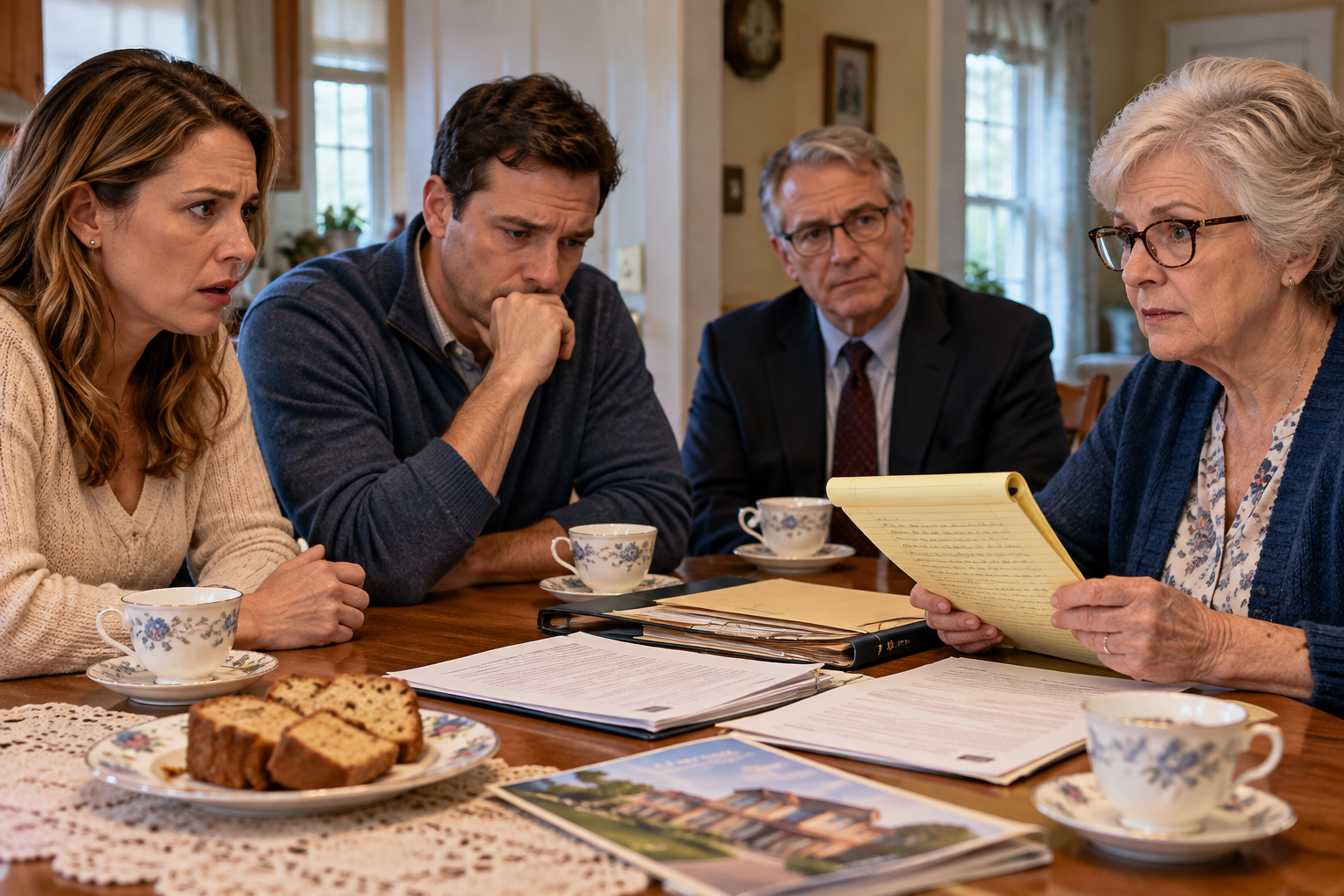
Four cups remained on the table.
Three had been used.
The fourth belonged to the unexpected guest.
The banana bread was still there.
Alicia's piece remained on her plate.
I looked at it.
Then I laughed once.
A small, tired sound.
For years, she had complimented my banana bread and rarely eaten any.
That morning had been no different.
Some things were almost absurd in their predictability.
I picked up her plate.
Then I stopped.
I looked at the little piece of bread.
It wasn't proof that Alicia was a bad person.
It was only bread.
I didn't want to turn every small memory into an accusation.
She had done enough that mattered.
I didn't need to make the harmless things ugly too.
I carried the plate to the sink.
Then I began clearing the table.
The cups.
The saucers.
The crumbs.
I worked slowly.
I had made everything ready before they arrived.
Now I was putting it all away.
The simple work helped me think.
I remembered how I had felt at 7:15.
Alicia's name on my phone.
My first thought had been that something was wrong with the twins.
I had answered because I cared.
Because they were family.
Because a call from someone I loved deserved my attention.
I had no idea what I was about to hear.
Nineteen minutes.
That was all it took.
Nineteen minutes to discover a plan involving my home.
Nineteen minutes to hear my daughter-in-law discuss my glasses as though they were an obstacle.
Nineteen minutes to hear my son agree to pretend sadness.
I wondered whether I would ever stop remembering the sound of his voice.
That quiet yes.
It had hurt more than Alicia's laughter.
I could argue with Alicia.
I could tell her she had overstepped.
I could refuse her plans.
But Mark was my son.
He was the person I had spent my life trying to protect.
Knowing he had helped plan something against my wishes changed the way I saw him.
I didn't want that change.
I hadn't asked for it.
But I couldn't undo what I had heard.
I took off my glasses.
I placed them beside the sugar bowl.
The scratched right lens caught the light.
I looked at them for a long moment.
Such an ordinary object.
I had worn those glasses for years.
I had misplaced them countless times.
Sometimes Mark would laugh when I searched for them while they were sitting on top of my head.
I had laughed too.
There was nothing wrong with needing reading glasses.
Nothing shameful about growing older.
But Alicia had thought of a way to use that need against me.
I found that difficult to forgive.
Not because the plan had succeeded.
It hadn't.
Because she had considered it.
And Mark had heard her.
I touched the frames.
Then I put them away where I could find them again.
I thought about the house.
Raymond and I had worked so hard to pay for it.
We had burned the mortgage in 1998.
I remembered the relief.
The pride.
The feeling of having finally reached something important.
We didn't owe the bank another payment.
The house was ours.
After Raymond died, it became mine.
I had continued paying the expenses.
I had handled the repairs.
I had managed the property.
Some days were harder than others.
I wasn't going to pretend otherwise.
There were things I had once relied on Raymond to do.
I missed having someone to discuss them with.
But difficulty didn't mean incapacity.
And needing help didn't mean surrendering control.
That was the lesson I would carry from the morning.
I went into the living room.
The crown molding caught my eye.
I remembered Bruce standing beneath it.
Alicia smiling.
Her explanation that he simply admired the old details.
Perhaps he did.
Perhaps he also saw a property that could be sold.
I couldn't know exactly what Bruce had been told.
I hadn't asked him.
And I wasn't going to accuse him of something without evidence.
But I knew what Alicia and Mark had discussed.
The sale.
The estimated price.
The plans for the money.
Those were enough.
I sat in Raymond's old chair.
For a moment, I imagined him beside me.
I wanted to tell him what had happened.
I wanted to hear what he thought.
I wanted him to say something practical.
Something calm.
Something that would help me understand why Mark had agreed to such a plan.
But Raymond was gone.
Four years.
Some days, I still felt the absence as sharply as I had in the beginning.
That afternoon, I missed him in a different way.
I missed having someone who knew the whole history.
Someone who understood what we had sacrificed.
Someone who would never ask me to justify wanting to remain in the home we had made.
I looked toward the kitchen.
The yellow notepad was still on the table.
I went back for it.
I sat down again and read the notes.
Slowly.
The first time.
7:15.
The call.
Then 7:19.
The glasses.
Then Silver Meadows.
The cousin.
The discount.
The claim about supporting the house.
Then 7:26.
Bruce.
The estimated sale price.
The lake trip.
The boat.
Then 7:31.
The instruction to look sad.
And finally 7:34.
The call ending.
I had written those details while they were fresh.
I was glad.
Because even now, only hours later, I could feel myself wanting to soften them.
Perhaps Alicia hadn't meant it.
Perhaps Mark had been pressured.
Perhaps they truly thought I would be happier somewhere else.
I could imagine explanations.
I had spent years doing that for people I loved.
But explanations didn't change the words.
And intentions didn't erase consequences.
I folded the pages carefully.
Then I placed them with the documents I wanted to keep.
I wasn't going to read them every day.
I didn't want my remaining years shaped by bitterness.
But I also wasn't going to throw them away because remembering hurt.
The truth mattered.
Even when it was painful.
I thought about the forty thousand dollars.
The gift I had given Mark and Alicia when they were expecting the twins.
I remembered how worried they had been about finding a home.
I had wanted to help them.
I still didn't regret that.
I wanted my grandchildren to grow up feeling secure.
I wanted Mark and Alicia to have a chance at the kind of stability Raymond and I had worked to build.
That gift had come from love.
I wasn't going to turn it into a debt now.
But I wouldn't allow them to turn my generosity into a claim against my house either.
The money I gave them was theirs.
The house remained mine.
Those were two separate truths.
I wished they had understood that before the morning began.
I looked at the clock.
Five o'clock on Sunday came to mind.
Mark's usual calling time.
Eleven minutes.
I wondered what our next conversation would be like.
Would he sound nervous?
Would Alicia be nearby?
Would he ask about the twins?
Would he pretend the morning had never happened?
I didn't know.
I could not decide his behavior for him.
I could only decide mine.
I would answer when I was ready.
I would listen.
I would speak honestly.
And I would no longer say everything was fine simply because I wanted him to feel comfortable.
That would be a change.
Perhaps a difficult one.
But a necessary one.
I thought about Alicia's name for me.
Mother D.
For years, I had heard affection in it.
Then I began noticing the impatience beneath the sweetness.
Now I knew I would listen differently.
I didn't want to spend every visit searching for hidden motives.
That would be a miserable way to live.
But trust would have to be rebuilt through actions.
Not compliments.
Not a warm voice.
Not a nickname.
I had learned that trust could be damaged in minutes.
Repairing it would take longer.
If it happened at all.
That uncertainty hurt.
I loved my son.
I loved my grandchildren.
I didn't want to lose my family.
But I had finally understood that keeping a relationship at any cost could mean losing something else.
My judgment.
My independence.
My peace.
I wasn't willing to pay that price anymore.
I stood and walked through the house.
The hallway.
The living room.
The kitchen.
Everything was familiar.
The cupboard that needed lifting before it closed.
The step that creaked.
The window that required an extra push.
The little uneven place beneath the mantel Raymond had repaired.
I knew every detail.
Some had been there for decades.
Others had appeared after he died.
I could still care for them.
And if someday I couldn't, I would decide what help I needed.
I would ask questions.
I would read the paperwork.
I would choose whom to trust.
That was not stubbornness.
It was responsibility.
I went to the front door and opened it.
The street was quiet.
Eleanor's house stood across from mine.
I remembered Mark learning to ride his bicycle there.
Raymond running beside him.
Me standing near the driveway, afraid he would fall.
He had fallen once.
Then he stood up.
I had been proud of him.
I still remembered the boy.
I probably always would.
But he was a grown man now.
And I needed to love him as one.
That meant allowing him to be responsible for what he did.
It meant not explaining away his choices before he had to face them himself.
It meant understanding that an apology could be sincere and still not repair everything.
I closed the door.
Then I returned to the kitchen.
There was one cup left on the table.
Mine.
The tea inside had gone cold.
Again.
I looked at it and smiled sadly.
Twice in one morning.
Two cups of tea.
Two very different reasons for forgetting to drink them.
I carried the cup to the sink.
I poured the tea away.
Then I washed it.
I dried it carefully.
And I put it back in the cupboard.
The house was mine.
No papers had been signed.
No move had been agreed to.
No sale had been authorized.
The plan I overheard had not taken my home away.
But it had taken something.
The easy trust I once had in my son.
The belief that my family would always put my interests beside their own.
The comfort of assuming that a sweet voice meant a kind intention.
I couldn't recover those things simply by deciding to forgive.
I would need time.
Perhaps Mark would show me that he had changed.
Perhaps Alicia would learn to respect my decisions.
Perhaps our family would find a way to move forward.
I hoped so.
I truly did.
But I couldn't promise an ending that hadn't happened.
What I could say was this.
I was seventy-three.
I was a widow.
I lived alone in the home Raymond and I had paid for together.
And I was still capable of deciding what happened next.
I looked toward my husband's empty chair.
For the first time that day, I didn't wish someone else would tell me what to do.
I already knew.
I would stay in my home.
I would keep my records.
I would ask for help when I needed it.
And I would never again mistake silence for agreement simply because the person asking was someone I loved.
That morning, my daughter-in-law called me by accident.
She never intended for me to hear what she and my son were planning.
But I did.
And because I listened, I understood something I might otherwise have learned too late.
My family could love me imperfectly.
They could disappoint me.
They could make choices I would never have imagined.
But they could not take my voice unless I stopped using it.
I had been quiet for too long.
Not anymore.
The End
Read more original stories on Feel Every Story.
When My Daughter-in-Law Called Before Breakfast, I Answered Without Knowing I Was About to Hear My Own Future Being Decided
Part 20 of 20