The message arrived that evening.
Julian wanted to discuss Maya's school schedule and the arrangements for the coming week.
The message itself was ordinary.
The last line was not.
He wrote that Maya had been placed under unnecessary pressure and that I needed to think about the damage I was causing.
I read it twice.
Then I set my phone on the table.
I knew how easily a conversation with Julian could turn into an argument about my character.
I could begin by answering a simple question about pickup time.
Ten minutes later, I might find myself defending my decision to leave work, my spending, my memory, or my ability to care for our daughter.
I had done it for years.
I had thought that if I explained myself clearly enough, he would eventually understand.
Now I knew that explaining and being heard were not the same thing.
I replied only to the practical question.
I confirmed the time we had discussed for Maya's next scheduled exchange and asked that any changes be sent in writing.
I did not respond to the accusation.
The next morning, I spoke with Maya's child advocate.
I wanted to make sure Maya had support that did not depend on either parent.
The advocate listened while I explained my concerns.
I said I did not want Maya to feel she had to defend me or Julian.
I did not want her to believe that the video made her responsible for the case.
The advocate agreed that Maya's emotional safety needed attention.
She also reminded me not to question Maya about the recording in a way that could make her feel responsible for explaining it.
I had no intention of doing that.
Still, I was grateful to hear it from someone whose job was to protect children caught in adult disputes.
At home, I made a small change.
I stopped discussing court matters within Maya's hearing.
I kept the documents in a closed folder in a drawer.
If my attorney called while Maya was nearby, I stepped into another room or arranged a time to call back.
I did not want the sound of legal language to become part of her daily life.
For a few days, the house felt quieter.
Maya went to school.
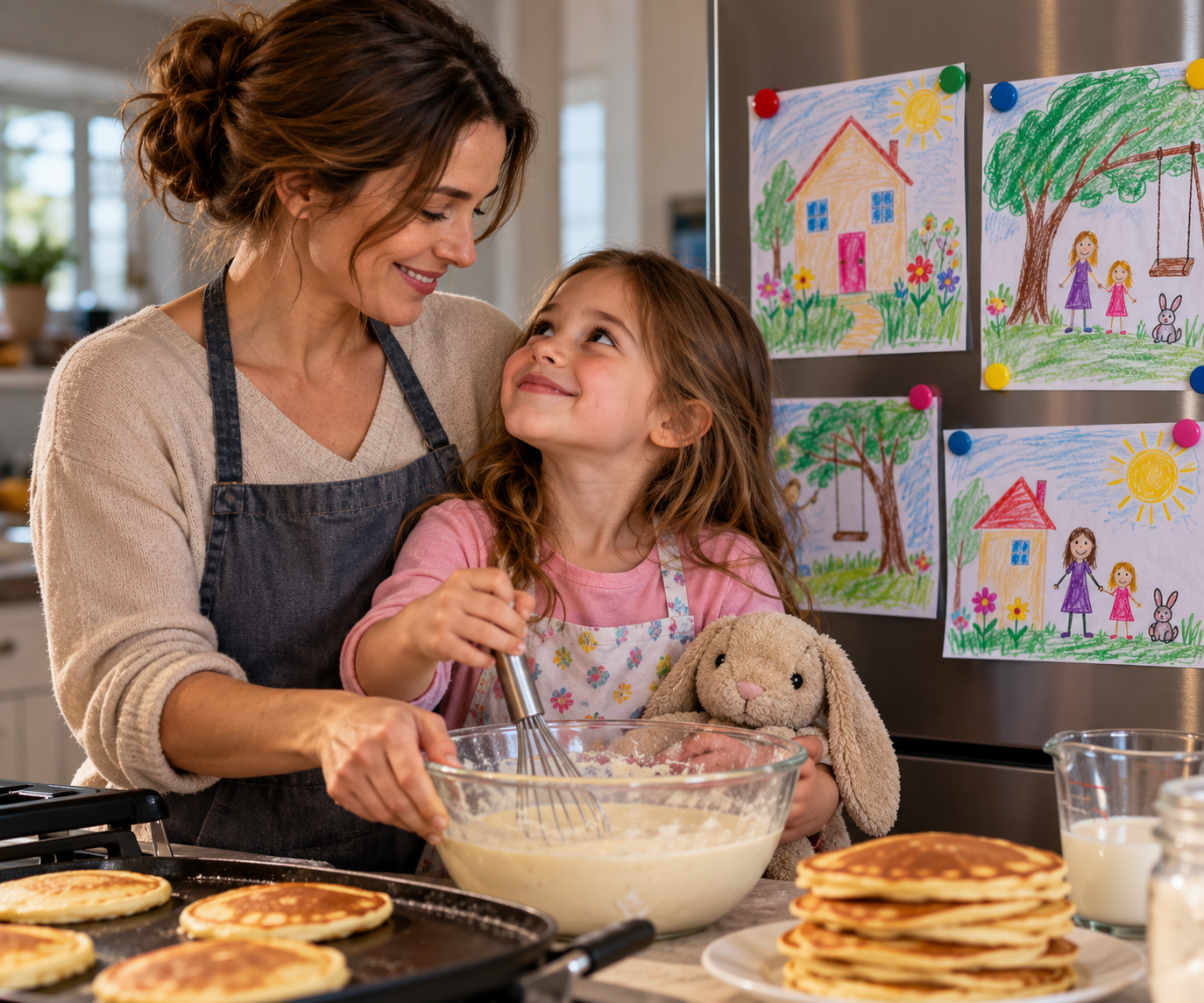
She ate breakfast, watched cartoons, and asked me to help with a drawing she wanted to finish.
Sometimes she seemed like herself.
Other times, she watched my face before asking a question.
I noticed it most when the phone rang.
If I glanced at the screen, she would stop what she was doing.
“Is it Daddy?”
“Sometimes,” I said. “Sometimes it's someone else.”
“Are you going to be mad?”
“No, sweetheart.”
She looked down at her drawing.
“I don't like when people are mad.”
I sat beside her.
“Neither do I.”
She pressed the crayon too hard against the paper and broke its tip.
I helped her sharpen it.
We did not discuss the video.
I wanted her to have ordinary moments that belonged only to her.
Meanwhile, my attorney sent a formal request for the supporting records behind the disputed payments.
The request was specific.
It identified the transactions and asked for invoices, descriptions of the services, and documents showing the purpose of the expenses.
It did not accuse Julian of a crime.
It asked him to explain the entries.
That distinction mattered.
I read the request before it was sent.
For once, the wording did not sound like a fight.
It sounded like a question that deserved an answer.
A few days later, Julian sent another message.
He said he hoped we could stop turning private matters into public disputes.
I read it while standing beside the kitchen sink.
The tap was running, and a plate rested in my hand.
I turned off the water.
There had been a time when I would have apologized just to end the tension.
I might have told him I wanted peace, too.
I might have offered to withdraw the questions if he promised to be more open.
But peace that depended on my silence was not peace.
I put the plate in the rack and answered that the financial issues would be handled through our attorneys.
Then I put the phone away.
That night, I found Maya sitting on the floor beside her bed.
Her stuffed rabbit was in her lap, and she was looking at the doorway.
“What are you doing down here?”
She shrugged.
“I wanted to sit.”
I sat on the floor beside her.
For a while, neither of us spoke.
Then she asked, “If grown-ups get divorced, do they stop being a family?”
I took a breath.
“I think families can change without every part of them disappearing.”
She considered that.
“But Daddy won't live here?”
“No, not if we live in separate homes.”
“And you won't live with Daddy?”
“No.”
She lowered her eyes.
“I wish people would stop asking me things.”
The words hurt because they were so simple.
“Have people been asking you questions?”
She hesitated.
I remembered the advocate's advice and kept my voice gentle.
“You don't have to tell me anything you're not ready to talk about.”
Maya leaned against my shoulder.
“I just want to go to school and play.”
“Then that's what we're going to focus on.”
I did not ask who had spoken to her.
I did not ask whether Julian had discussed the video.
I let the silence stay.
After a while, she climbed into bed.
I tucked the blanket around her and put the rabbit beside her pillow.
The next morning, I wrote down what she had said so I could discuss it with the advocate.
I recorded her words as accurately as I could remember them.
I did not add a theory about what they meant.
That was another lesson from my old work.
A record was useful only if it separated what had happened from what I thought might have happened.
Later that week, I received a call from my attorney.
Julian's side had acknowledged the request for documents.
They needed time to gather the records.
There was no admission, and no explanation yet.
I thanked her and wrote down the next date.
Then I returned to the kitchen.
The folder was still in the drawer.
I could have pulled it out and studied the transactions again.
Instead, I made lunch.
I had spent months feeling that every minute away from the records was a minute Julian could use against me.
Now I was learning that constant fear would not make the evidence stronger.
It would only make me less present for Maya.
When she came home from school, she told me about a classmate who had brought a toy dinosaur.
She acted out the way the dinosaur had knocked over a tower of blocks.
I laughed before I realized how long it had been since I had laughed without forcing it.
Maya smiled at me.
“There,” she said.
“What?”
“You look normal.”
The word caught me off guard.
I hugged her.
“I feel a little more like myself today.”
She hugged me back, then returned to her story about the dinosaur.
That evening, I placed my phone on silent while we read together.
The court case was not finished.
The money was not explained.
Julian was still Julian, and I could not control what he would say next.
But I could control how much of the conflict I carried into my daughter's room.
For that night, I chose the book in my hands over the phone beside me.
It was a small decision.
It was also one I could keep making.
Click here to continue reading: PART 12: The Financial Records Finally Arrived, and I Had to Separate What They Actually Proved From Everything I Feared They Might Mean
My Husband Wanted Everything, but I Had No Idea What My Little Girl Was Carrying Into That Courtroom
Part 11 of 20