The final financial review began with a stack of documents and a list of unresolved entries.
My attorney had prepared the list carefully.
Every item included the date, the amount, the description in the account statement, and the information that had been supplied in response to our earlier requests.
She had also identified which questions had been answered.
I read the list before we entered the courtroom.
The wording was plain.
It did not accuse Julian of anything the records could not establish.
It did not excuse anything that remained unexplained.
I felt nervous, but I knew what I was there to do.
When Judge Thorne entered, we stood.
After everyone was seated, the attorneys summarized the remaining issues.
Julian's attorney explained that additional records had been provided and that his client considered the disputed expenses to be legitimate business costs.
My attorney acknowledged the material that had been supplied.
She then identified the entries that still required clarification.
She did not ask the judge to assume the worst.
She asked him to consider the documents and determine what further disclosure was appropriate.
Judge Thorne reviewed the list.
He asked several questions about the dates and the supporting records.
My attorney answered from the documents.
Julian's attorney responded where he had information available.
At times, the explanations addressed our concerns.
At other times, the answer was that more information would be needed to clarify the entry.
The hearing moved slowly.
There was no single revelation that explained every payment.
There was no moment when Julian suddenly admitted to everything I had feared.
Instead, the judge separated the issues that could be addressed from those that remained unresolved.
Some transactions had sufficient supporting material for the purpose of the hearing.
Others still needed clarification.
The judge directed the parties to complete the remaining disclosure steps according to the court's instructions.
I wrote down the deadlines.
I had imagined that the final review would give me a clean ending.
It did not.
It gave me a clearer record of what was known and what remained uncertain.
That was less satisfying than a confession.
It was more useful than another argument.
After the financial discussion, the court returned to the parenting arrangements.
Our attorneys presented the revised schedule.
It included clear pickup times, a plan for school nights, and instructions for communicating changes directly between the parents.
The goal was to reduce confusion and keep Maya out of the middle.
Judge Thorne asked whether both parents understood the proposal.
Julian's attorney answered for him.
My attorney answered for me.
The judge reviewed the terms and asked a few additional questions.
He wanted to know how the arrangement would support Maya's school routine.
He also wanted to know whether both parents could follow the schedule without using the child to communicate changes.
We confirmed that we could.
Judge Thorne said he would consider the proposed terms with the other information before him.
The court did not issue every final order that day, but the process was becoming more focused.
For the first time in months, I could see the shape of an arrangement that did not depend on Julian and me agreeing about the past.
We did not need to agree about every argument.
We needed to follow clear rules for the future.
When the hearing ended, I gathered my papers.
Julian stood near his attorney, reading a document.
I watched him for a moment.
I had spent so much time wondering what he thought of me.
Did he believe I was unstable?
Did he think I had invented the financial questions?
Did he resent me for refusing to withdraw them?
I might never know.
And even if he told me, I could not be sure that his answer would be honest.
I was tired of trying to build my sense of reality from his reactions.
My attorney walked beside me toward the exit.
“The next steps are clear,” she said.
I nodded.
“Do you think he'll ever explain everything?”
She paused before answering.
“I can't tell you what he'll do. We can keep asking for what the court requires.”
I appreciated that she did not pretend to know.
Outside, the air felt warmer than it had when I arrived.
I sat in my car for several minutes before starting the engine.
I thought about the video Maya had shown.
I still did not know everything that had led her to it.
I knew she had been worried.
I knew she had asked the judge for permission to speak.
I knew the recording had caused the court to ask questions that needed to be examined.
Beyond that, I had to be careful.
The video was not a substitute for the financial records.
And Maya was not a witness I wanted to turn into a source of answers for me.
I could respect what she had done without asking her to carry more.
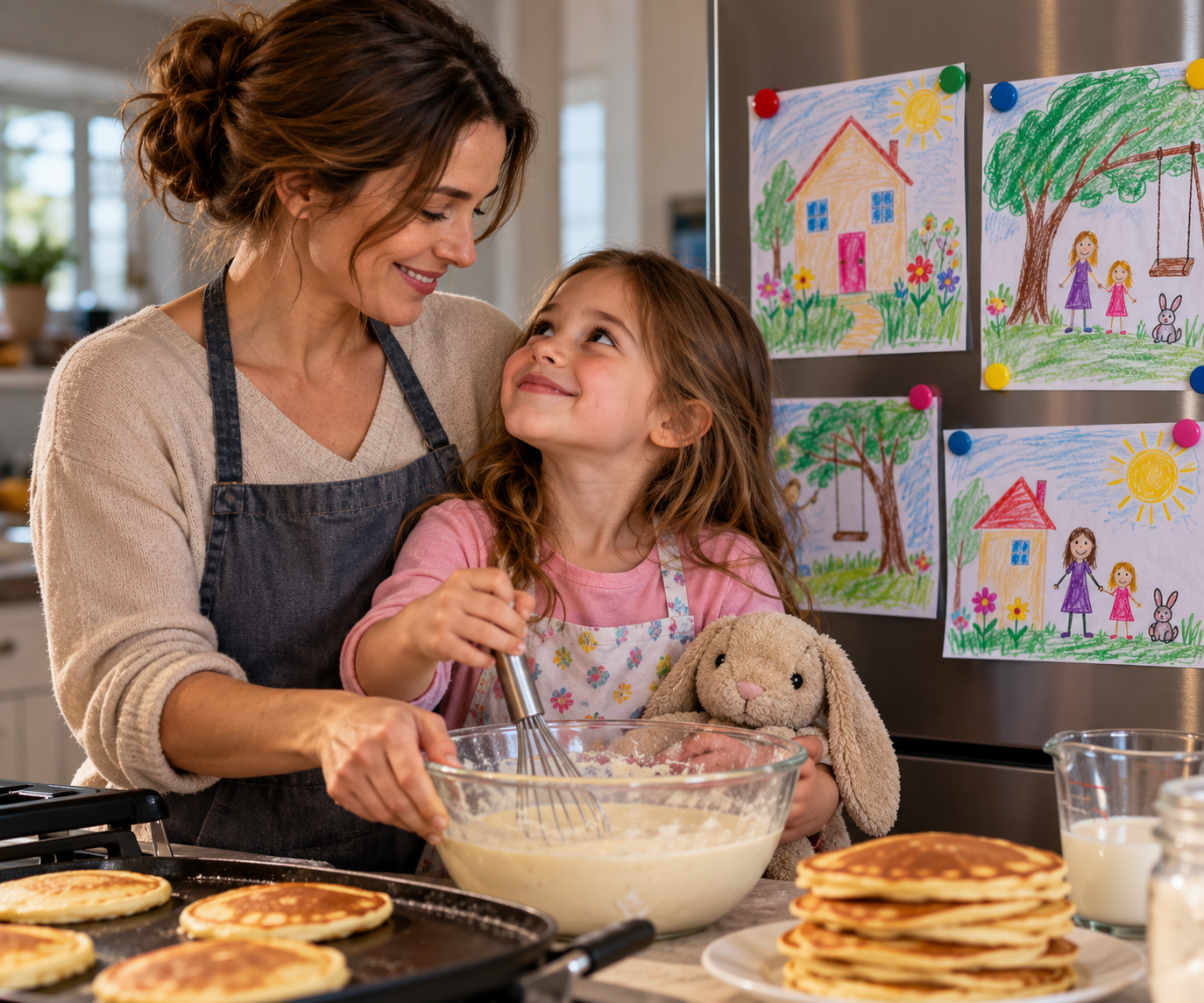
When I arrived home, the refrigerator was covered with her drawings.
The house with the bright front door.
The picture of the park.
The two figures beneath the tree.
I stood there looking at them.
For months, I had thought of the house as something I needed to defend against Julian.
Now I was beginning to see it as a place I needed to make livable again.
The walls had not changed.
The kitchen table was the same one where I had reviewed the first bank statement.
The drawer still held the folder.
But I could decide how much of the house belonged to the conflict.
I could leave the folder closed during dinner.
I could let Maya draw on the table without moving her crayons aside for legal papers.
I could make pancakes without checking the clock every few minutes.
Those things would not solve the case.
They would help us live while the case continued.
That afternoon, I received a message from Julian about a small change to the next pickup.
He asked whether we could adjust the time by half an hour.
I checked the calendar.
The change was possible.
I agreed and confirmed the revised time in writing.
He replied with a brief acknowledgment.
That was all.
No accusation.
No argument.
I put the phone down.
I did not mistake one calm exchange for a new relationship.
I simply accepted it as one calm exchange.
Later, Maya returned home from school.
She ran into the kitchen and put her backpack on the floor.
“Can we make something?”
“What do you want to make?”
“Cookies.”
I looked at the clock.
I had planned to review the next set of papers.
The review could wait.
We measured flour, sugar, and butter.
Maya wanted to pour everything into the bowl herself.
I let her do most of it.
When the dough was ready, she rolled a small piece between her palms.
“It looks like a rock.”
“A very delicious rock.”
She laughed.
We placed the cookies on the tray and waited while they baked.
The smell filled the kitchen.
Maya stood beside the oven, watching through the glass.
“Are they ready?”
“Not yet.”
“How about now?”
“Still not yet.”
She groaned dramatically.
I laughed.
It was a normal afternoon.
I wanted more of them.
After dinner, she asked whether the judge had decided everything.
I sat beside her.
“Some things are getting clearer. Other things still need to be worked out.”
“Does that mean we're okay?”
I thought carefully before answering.
“It means the adults are still working on the arrangements. And it means you don't have to fix anything for us.”
She rested her head against my arm.
“Okay.”
I kissed the top of her head.
I wanted to tell her that the court would protect us from every possible problem.
But I could not promise that.
What I could tell her was that I would keep showing up, keep listening, and keep asking for help when I needed it.
I could make sure she had support from people whose job was to help children through difficult changes.
I could keep the legal details away from her daily life.
And I could stop asking myself whether Julian's approval would finally make me feel safe.
That night, I opened the notebook and recorded the court's directions.
I wrote down the dates.
I listed the remaining financial questions.
Then I closed it.
I did not write a conclusion about Julian's character.
I did not write that every suspicion had been confirmed.
I wrote what had happened.
For the first time, that felt like enough.
Click here to continue reading: PART 19: My Daughter Asked Whether We Would Ever Be Happy Again, and I Realized the Most Important Promise Was One I Could Keep Without Knowing the Future
My Husband Wanted Everything, but I Had No Idea What My Little Girl Was Carrying Into That Courtroom
Part 18 of 20