The deadline for the remaining financial records passed on a Friday.
My attorney called that afternoon.
Julian's side had provided some additional material, but the response did not fully address every question in our request.
She explained which items had been supplied and which explanations remained incomplete.
I wrote down the details.
For a moment, I felt the old frustration rising.
I wanted to know why Julian had made the payments.
I wanted him to explain the vague invoices and the transfers that had first drawn my attention.
I wanted him to admit that I had not imagined the problems.
But my attorney reminded me that a delayed or incomplete response did not establish the reason for it.
“We can ask the court to address what's still outstanding,” she said. “We cannot fill in the gaps ourselves.”
“I know.”
I did know.
I had repeated that principle in my own notes so often that I could recite it without looking.
Still, I had to remind myself that uncertainty was not evidence of the worst possible explanation.
I spent the weekend sorting the documents we did have.
I made one list of confirmed entries.
I made another list of entries that still needed clarification.
I kept the two lists separate.
The difference was important.
I was not going to let my fear turn an unanswered question into a proven fact.
On Saturday morning, Maya asked if we could go to the park.
I nearly said I needed to finish the paperwork.
Then I looked at the clock.
I had already spent most of the morning at the kitchen table.
The documents would still be there when we returned.
“Get your shoes,” I said.
She ran down the hallway.
At the park, she climbed the steps to the slide and called for me to watch.
I watched every time.
She slid down, ran back up, and did it again.
After a while, she asked me to push her on the swing.
I stood behind her and gave the chains a gentle push.
“Higher!”
I pushed a little harder.
She laughed.
For several minutes, I did not think about Julian's accounts or the court schedule.
I thought about whether Maya was getting too close to the ground when she swung back.
I thought about the loose strand of hair sticking to her cheek.
I thought about how much she loved being pushed high enough to feel the air move around her face.
It was ordinary.
That was why it mattered.
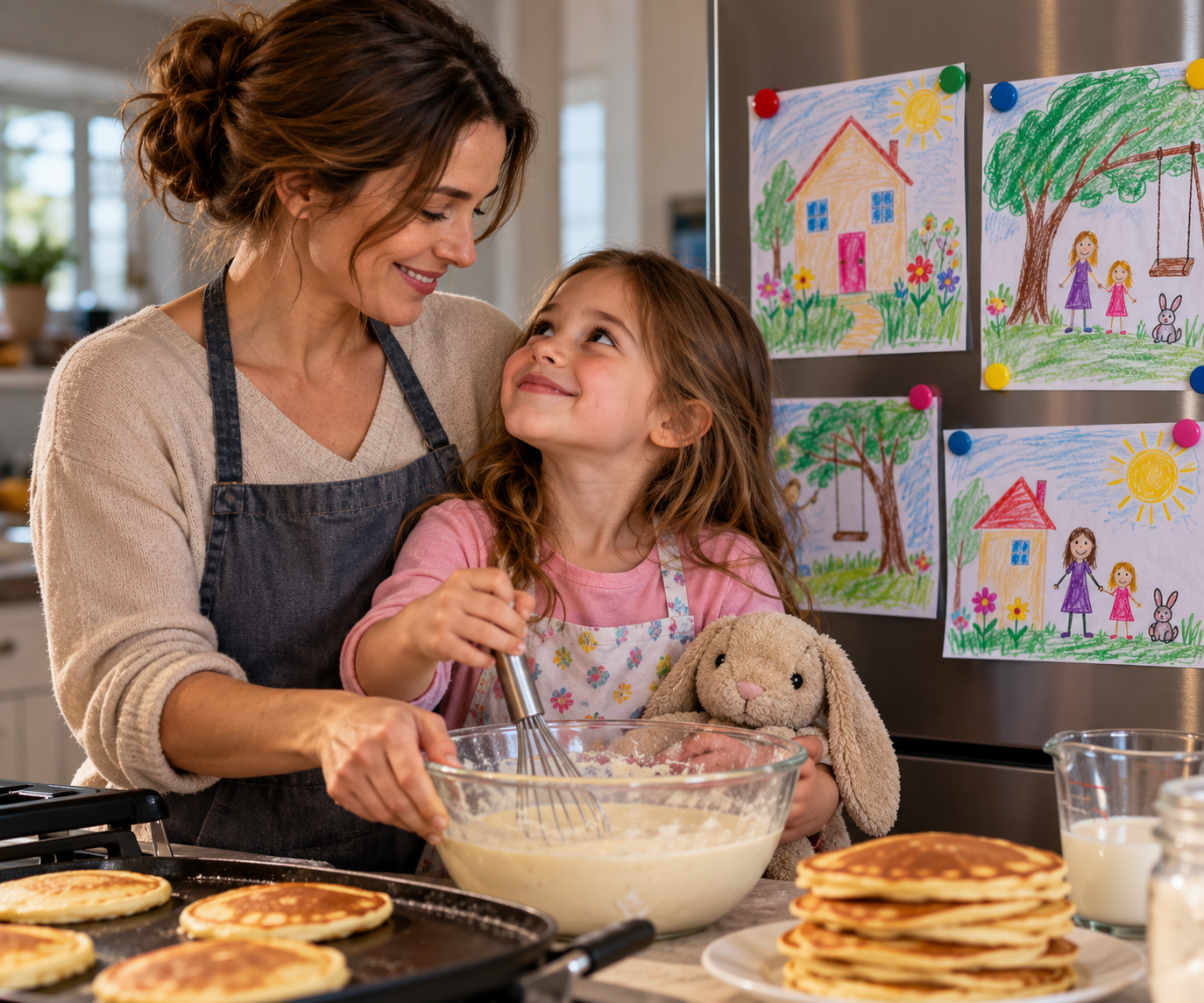
When we returned home, she wanted to make a picture of the park.
I found paper and crayons.
She drew the swing, the slide, and two people standing nearby.
One had long hair.
The other had a small round head.
“That's you,” she said, pointing to the smaller figure.
“I'm glad you made me tall enough to reach the swing.”
She giggled.
Then she drew a rabbit in the grass.
I put the picture beside the earlier drawing on the refrigerator.
The bright front door was still visible underneath it.
I thought about how much of our lives had been reduced to documents and arguments.
The drawings reminded me that our family was not only a case file.
The following Monday, my attorney filed a request asking the court to address the remaining disclosure issues.
She included the original requests, the responses received, and a clear description of what was still needed.
I read the filing before it was submitted.
It did not accuse Julian of hiding every answer.
It showed the court what had been requested, what had been provided, and what remained unresolved.
I signed where necessary.
Then I put the papers away.
I had expected the legal process to give me a moment of certainty.
Instead, it was teaching me to tolerate the parts I could not yet know.
I did not like that lesson.
I needed it anyway.
That evening, Julian sent me a message about Maya's next visit.
He wanted to change the pickup time.
I checked the school schedule and replied with the times I could manage.
We agreed on an adjustment.
The exchange was brief.
There was no argument about money.
There was no accusation about the video.
For a moment, I wondered whether this was how we might communicate from now on.
Not warmly.
Not as friends.
Just clearly enough to make decisions for our daughter.
I hoped we could.
The next day, Maya returned from school with a note about an upcoming classroom activity.
She wanted help choosing what to bring.
We looked through the kitchen cupboards.
She chose a box of crackers and asked if she could help arrange them in a container.
I let her.
She placed them carefully, one after another.
When she finished, she looked pleased.
“Can I show Daddy what I made?”
“Of course.”
Her face brightened.
I helped her put the container in the refrigerator so it would be ready in the morning.
Then I realized how much I wanted her to feel free to share ordinary happiness with both of us.
I did not want every mention of Julian to make me tense.
I did not want her to study my expression before saying his name.
That night, I spoke with the child advocate about the concerns Maya had expressed.
I described the questions she had asked and the way she sometimes seemed worried about upsetting one of us.
The advocate listened and suggested that we continue giving Maya simple, consistent reassurance.
She also recommended keeping adult discussions away from her and letting her express her feelings without asking her to choose between parents.
I agreed.
I was grateful that the advice was practical.
I could not erase the conflict.
I could make our home a place where Maya did not have to solve it.
A few days later, Julian's attorney contacted mine about the outstanding records.
They said they were working to clarify the remaining entries.
There was no complete explanation yet.
My attorney said we would keep the issue before the court.
I wrote the update in my notebook.
Then I closed it.
I thought about the first day I noticed the money was missing.
At the time, I had believed that if I found the right transaction, I would find the explanation.
I had imagined one hidden payment leading to another, until the entire story became obvious.
The reality was slower.
Some entries were supported.
Some remained unclear.
Some explanations might still arrive.
The evidence would have to be assessed carefully, and the court would decide what conclusions it supported.
I could keep working through that process.
But I could no longer make my sense of worth depend on Julian admitting that I had been right to ask questions.
His agreement would not change the records.
His denial would not erase them.
I knew what I had seen.
I also knew what I had not yet established.
That was enough to keep going.
On Friday night, Maya asked me to read her favorite book.
I sat beside her while she tucked the rabbit under one arm.
I read the first page, and she corrected me when I skipped a word.
“You missed that part.”
“You're right.”
I went back and read it again.
She smiled and settled against the pillow.
When the story ended, she asked for one more page.
I read it.
Then she closed her eyes.
I stayed beside her until she fell asleep.
The court could wait until morning.
The questions about the money could wait, too.
For the first time in a long time, I did not feel that putting the folder away meant I was giving up.
It meant I was allowed to live while the answers were still being found.
Click here to continue reading: PART 16: The Judge Asked Us to Put Maya First, and I Realized the Outcome I Wanted Was Bigger Than Winning the Divorce
My Husband Wanted Everything, but I Had No Idea What My Little Girl Was Carrying Into That Courtroom
Part 15 of 20