The decision was simple.
That was what made it frightening.
Months before Christmas, I had decided not to sell the house.
I remembered the conversation.
A real estate agent had approached me after a neighborhood property sold for an unusually high price.
She said mine would attract interest.
I had considered it.
For perhaps two weeks.
Then I decided to stay.
I had lived there too long.
The garden mattered.
The rooms held memories.
I didn't want to start over.
I had forgotten the conversation entirely.
Someone else had not.
Ruiz explained that the surveillance began shortly after the agent's report showed that I had rejected several informal offers.
If I had sold, the scheme would have collapsed.
If I had refinanced, the property structure would have changed.
If I had moved, they would have needed another target.
But I stayed.
That made the house worth pursuing.
I sat quietly.
“So they were waiting to see whether I would sell.”
“Yes.”
“And when I didn't?”
“They continued.”
The revelation was strangely unsettling.
My ordinary decision had become the hinge of someone else's criminal plan.
I had thought I was simply choosing where to live.
They had seen an asset that remained available.
That difference between perspectives explained almost everything.
I asked Ruiz one question.
“Could they have succeeded?”
He answered honestly.
“Yes.”
The word hurt.
“Without the failed attempts?”
“Possibly.”
“Without the surveillance?”
“Possibly.”
“Without the Christmas trip?”
“They would have needed another opportunity.”
I nodded.
The truth was uncomfortable.
Nothing had been guaranteed.
The house survived because multiple protections failed and multiple others worked.
A rejected document.
A cautious employee.
A question I asked.
A refusal to sign.
A changed lock.
A conversation.
A piece of evidence.
A person who finally told the truth.
No single moment saved me.
The whole chain did.
That afternoon, I walked through the house.
The office.
The kitchen.
The hallway.
The reading room.
Everything looked ordinary.
I touched the doorframe.
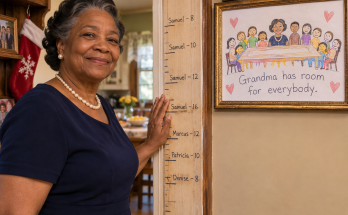
There were still small marks from when Caleb was a child.
Pencil lines showing how tall he had been each year.
I had almost painted over them.
Instead, I had kept them.
That felt right.
Some traces deserved to remain.
Not all traces were warnings.
Some were proof of love.
That evening, I called Caleb.
“Come over.”
“Everything okay?”
“Yes.”
He arrived quickly.
I told him what Ruiz had found.
He listened without interrupting.
“So staying here protected you.”
“In a strange way.”
He looked around.
“I always thought this house was just a house.”
“So did I.”
“Now?”
“Now I think it's a witness.”
He smiled.
“A witness to what?”
“To everything we were before.”
He understood.
We sat in the reading room.
The wooden box was on the shelf.
I opened it.
Inside were the old key, the dinosaur card, copies of fraudulent documents, and the evidence I had chosen to keep.
Caleb looked at the collection.
“Do you want to throw it away?”
“Not yet.”
“Why?”
“Because I'm still learning how to remember without reliving.”
He nodded.
“That makes sense.”
We closed the box.
Then I handed him the old key.
He looked surprised.
“What am I supposed to do with this?”
“Keep it.”
“Really?”
“Yes.”
“But I don't live here.”
“I know.”
He turned the key in his hand.
“What does it mean?”
“It means you're my son.”
He looked at me.
“And?”
“It doesn't mean you automatically get access to everything.”
He laughed.
“I figured.”
“But if you need me, you know where I am.”
His eyes became wet.
“I know.”
We didn't hug immediately.
We just sat there.
The moment didn't need to be bigger than it was.
Finally, he reached across the table.
I took his hand.
That was enough.
The following months were uneventful.
The additional investigation concluded.
No new major charges were filed.
The remaining records were preserved.
The old fraudulent accounts were formally closed.
Caleb's credit history was corrected.
The bank's settlement remained intact.
The title company changed its verification process.
The property management company tightened access to owner records.
None of those things made the past disappear.
They made the future less vulnerable.
That was what mattered.
I received a final letter from Ruiz.
The investigation was officially closed.
This time, I believed him.
I placed the letter in the safe.
Then I took the wooden box from the shelf.
I opened it one last time.
The old key.
The dinosaur card.
The first fraudulent account.
The photograph of my signature.
The notes about my property.
The failed transfer.
The surveillance photograph.
All the pieces.
I didn't need them anymore.
I took them out.
The court records went into a labeled file.
The financial documents went into the safe.
The photograph of the house went into the archive.
The dinosaur card stayed.
The key stayed.
Those two things belonged to a different story.
They belonged to family.
Not fraud.
Not money.
Family.
I carried the empty box to the reading room.
Then I filled it with photographs.
Caleb as a child.
The beach.
Christmases before everything changed.
The garden.
The house in summer.
Ordinary moments.
I closed the lid.
That was how I chose to remember.
Not by keeping the evidence of what they had done.
By keeping evidence of what I had survived.
One Sunday, Caleb came for breakfast.
He brought pastries again.
“Twelve?”
“Eight.”
“Progress.”
He laughed.
We ate.
He told me he was saving for a house.
I asked where.
He named a neighborhood.
I asked whether he had checked the title history.
He groaned.
“Of course you would ask that.”
“I hope you do.”
“I will.”
“Good.”
He smiled.
“I learned from the best.”
I shook my head.
“No.”
He looked at me.
“I learned from your mistakes too.”
I laughed.
“That is probably more useful.”
After breakfast, we went into the garden.
The sun was warm.
The flowers had opened.
Caleb helped me repair a loose section of fence.
At one point, he stopped.
“You know what I think?”
“What?”
“You didn't lose your family.”
I looked at him.
“You lost the version of your family that depended on pretending nothing was wrong.”
I was quiet.
“That sounds complicated.”
“It is.”
He drove the final screw into the fence.
“But I think we're better now.”
I looked at the repaired section.
Solid.
Simple.
Necessary.
“Yes,” I said.
“I think we are.”
That evening, after he left, I walked through the house alone.
The kitchen was clean.
The reading room was quiet.
The old office held no threatening papers.
The safe was locked.
The doors were secure.
The garden moved gently outside.
I realized that peace had not returned all at once.
It had arrived in pieces.
A locked door.
A corrected record.
A truthful conversation.
A completed payment.
A Sunday breakfast.
A room filled with books.
A son who no longer hid his mistakes.
A mother who no longer confused love with unlimited access.
That was the real ending.
Not revenge.
Not a dramatic victory.
Just the slow return of ordinary life.
I turned off the lights.
Before going upstairs, I checked the front door.
Locked.
I smiled at myself.
Once, that simple action had come from fear.
Now it was habit.
I went upstairs.
The house was quiet.
But this time, the quiet didn't feel like something waiting to happen.
It felt complete.
I had spent months believing the most important thing I had to protect was my property.
I was wrong.
The house could be repaired.
Money could be recovered.
Documents could be replaced.
The thing I had almost lost was my ability to trust myself.
That was what I finally got back.
And when I turned off the last light, I knew I didn't need to be afraid of the past anymore.
It had already taught me what I needed to know.
The End
Read more original stories on Feel Every Story.
I Thought the Christmas Trip Was My Gift to the Family Until I Found My Name Missing From Their Plans
Part 20 of 20