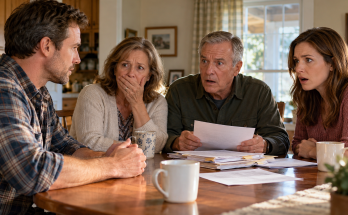
The Thanksgiving meal ended without anybody really finishing it.
People cleared plates.
Someone carried dishes into the kitchen.
The usual conversations returned in small, awkward pieces, but nobody seemed able to forget what Grandma had asked.
Neither could I.
I kept thinking about the amount.
One hundred and eighty thousand dollars.
It wasn't just money that had failed to arrive.
It was part of my husband's plan for the future he knew he might not get to see.
He had wanted to leave us something secure.
Something that would help me care for our daughter without having to worry about every unexpected expense.
I had trusted that those arrangements would be respected.
I had never considered that I might need to prove what he had intended.
Later, Grandma asked me to sit with her away from the dining room.
The house was quieter by then.
I could hear dishes being stacked in the kitchen and the occasional murmur of relatives talking in another room.
She looked tired.
But her attention was sharp.
She wanted to know exactly what I remembered about the financial arrangements.
I told her what I knew.
I explained that I had been dealing with my recovery and caring for my daughter.
I had not been following every document as closely as I might have under different circumstances.
That admission embarrassed me.
I had always been independent.
I disliked the idea that somebody could take advantage of a time when I wasn't able to manage everything myself.
Grandma didn't criticize me.
She simply listened.
Then she said there were records that needed to be examined.
I asked what kind of records.
She told me she had reason to believe that the money had been moved through an account associated with my name.
I stared at her.
My name?
She didn't have all the details yet, but she wanted to establish where the funds had gone and who had authorized the transactions.
I asked whether she thought somebody had taken the money.
She paused before answering.
"I think we need to know what happened before we decide what to call it."
That was the most careful thing anybody had said all day.
I agreed.
I wanted facts.
I wanted dates and documents that could tell me whether this was a mistake or something far worse.
Mostly, I wanted to know whether my husband had been trying to protect us while somebody else had quietly undone what he had arranged.
The following days felt longer than they should have.
I tried to keep my attention on ordinary responsibilities.
My daughter needed feeding.
There were things to clean and appointments to keep.
Life continued to ask for my attention even while my mind remained fixed on the missing money.
Every time the phone rang, I wondered whether it would bring an answer.
Every time somebody mentioned my husband, I thought about the arrangements he had made before he died.
I remembered the way he had handled important papers.
The careful labels.
The folders.
The quiet insistence that preparation mattered.
I wished I had asked more questions when I had the chance.
Looking back, that regret was unfair to myself.
I had been dealing with an accident, a death, and a newborn child.
I had been trying to stand upright in a life that had suddenly lost its balance.
I couldn't have anticipated every possible problem.
Still, I kept asking myself what I might have noticed if I had been less overwhelmed.
Grandma continued looking into the matter.
She did not promise me that the money would be recovered.
She did not tell me she knew who was responsible.
She only said that the documents would have to speak for themselves.
Eventually, she arranged for Miles to review the records with us.
I knew his name before I met him.
Grandma had mentioned that he was helping establish what had happened to the funds.
I didn't know what to expect from him.
I only knew that he would be bringing information I had been waiting for since Thanksgiving.
When we finally sat down together, I tried to prepare myself for disappointment.
Perhaps the account had been opened by mistake.
Perhaps somebody had entered the wrong information.
Perhaps there was an explanation that would leave my family relationships intact.
I held on to those possibilities because I wasn't ready to consider the alternatives.
Miles arrived carrying a folder.
He greeted us and took a seat.
Grandma sat beside me.
I could tell she had been thinking about the meeting for days.
She had arranged the papers in front of her, leaving room for the documents Miles had brought.
He opened the folder.
For a moment, nobody spoke.
Then he began explaining what the records showed.
There had been an account at Westbridge Community Bank.
It was associated with my name.
The account had been opened on March 11.
The first transfer had taken place three days later.
I listened carefully.
The dates were precise.
The bank was real.
The account number was written on the document in front of him.
But I had never opened an account there.
I had never visited the bank to establish an account for the money.
I had never knowingly authorized anyone to receive my husband's funds through an account I didn't control.
I told Miles that.
He listened without interrupting.
Grandma's expression grew more serious.
She asked how the account had been established.
Miles explained that the records attributed the application to me.
He said the file contained a copy of my driver's license and a signed authorization form.
My stomach tightened.
A copy of my license could be obtained from documents I had used before.
My personal information wasn't a mystery.
But an account opened in my name was something else entirely.
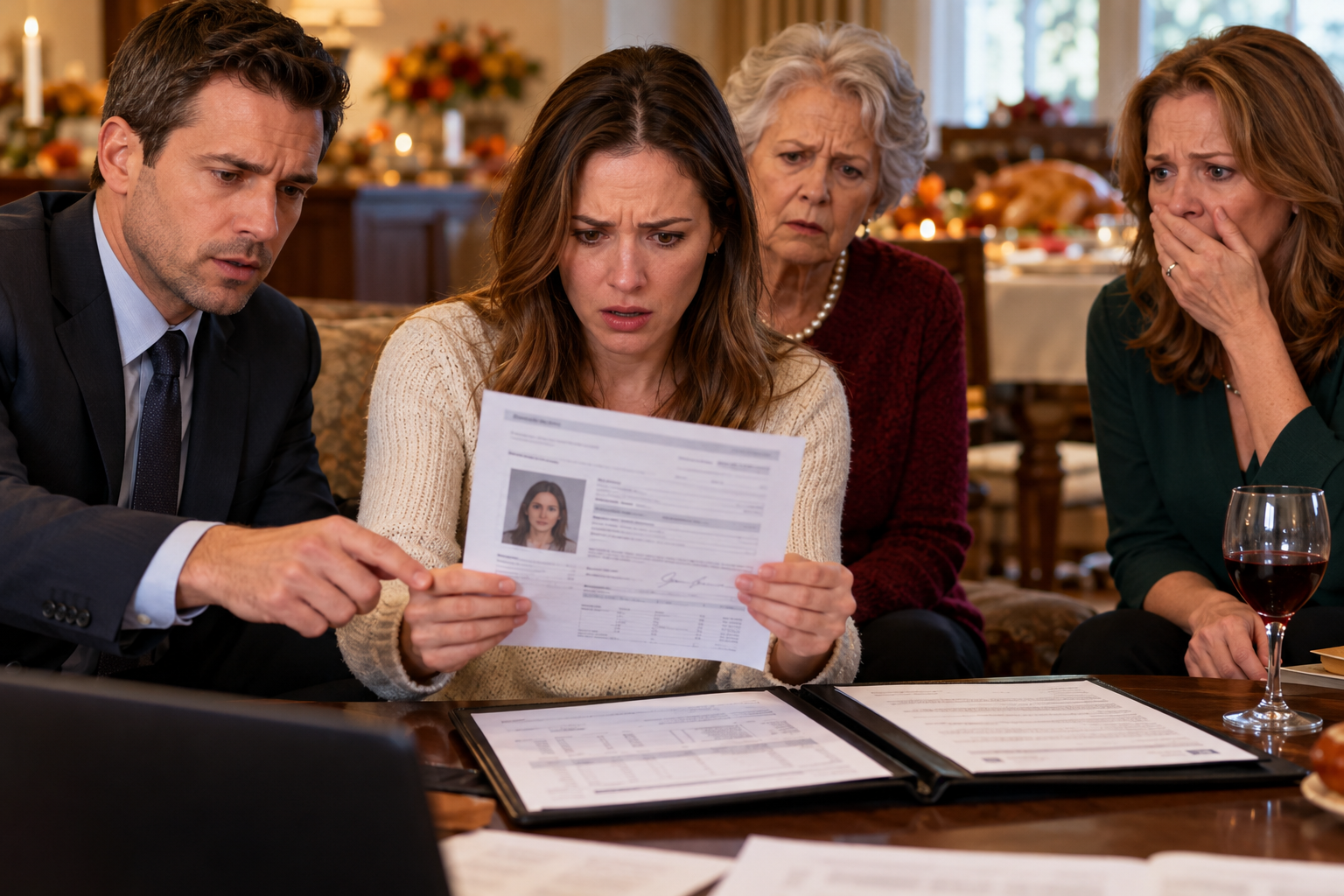
Miles placed the application on the table.
I looked at the photograph first.
It was unmistakably mine.
The address matched.
My date of birth was correct.
For several seconds, I could only stare at the page.
It looked official.
It looked complete.
It looked like the kind of document I would have expected to find if I had opened the account myself.
Except I hadn't.
I moved my eyes to the signature.
That was where everything changed.
The writing looked wrong.
Not unfamiliar in the way a rushed signature might look unfamiliar.
Wrong.
I knew how I signed my name.
I had signed forms at hospitals, insurance offices, and medical appointments.
I had signed documents while tired and distracted.
Even then, the shape of my handwriting remained recognizably mine.
The signature on that page did not.
I leaned closer.
My hands had begun to feel cold.
"That isn't my signature."
Nobody answered immediately.
I looked again, hoping I might discover something that would explain the difference.
I didn't.
Miles waited while I examined the page.
Grandma watched me with an expression I couldn't quite read.
She seemed to be measuring the distance between what we had believed and what the documents now suggested.
My mother, Laura, was also there.
She had been quiet throughout the discussion.
Until that moment.
She placed her wineglass down and turned toward me.
Her voice became gentle.
Almost reassuring.
She suggested that perhaps I had signed the paperwork during my recovery.
She reminded me that I had been taking strong medication after the accident.
Maybe I had signed something without remembering it.
Maybe I had been too exhausted to pay attention.
For a moment, I didn't know what to say.
Her explanation touched the one part of my history that made me vulnerable.
I had been injured.
I had been medicated.
I had depended on other people.
And I couldn't remember every conversation from that period of my life.
But I could remember enough.
I remembered the effort it took to do simple things.
I remembered trying to hold my newborn daughter securely.
I remembered how much concentration it required just to manage my own body.
Opening a new bank account had never been part of those memories.
I looked at my mother.
"Mom, I was struggling to hold my baby with one functioning hand."
The words came out more quietly than I expected.
I wasn't trying to win an argument.
I was trying to make her understand what that period had actually been like.
I had not been living normally and forgetting ordinary errands.
I had been fighting to recover from an accident while learning how to care for a child without my husband.
The distinction mattered.
My mother didn't immediately respond.
Miles left the application between us.
The page remained there, with my photograph and my personal information above a signature I knew I hadn't written.
I looked at the account number again.
The account existed.
The transfer had occurred.
The paperwork claimed that I had authorized it.
But I had not received the money.
And now somebody was suggesting that I might have done all of it without remembering.
I couldn't accept that explanation simply because it was convenient.
For the first time since Thanksgiving, I stopped trying to make the situation sound less serious than it was.
Somebody had used my name.
Somebody had created a record that made it appear I had agreed to something I had never knowingly approved.
And the money my husband had intended for me had not reached my hands.
Those were the facts in front of us.
Whatever came next, I could no longer pretend this was only a delay.
Click here to continue reading: PART 3: My Mother’s Explanation Should Have Comforted Me, but Every Detail of My Recovery Made Her Story Harder to Believe
The Thanksgiving Question That Turned a Family Gathering Into Something None of Us Could Pretend Was Ordinary Anymore
Part 2 of 20