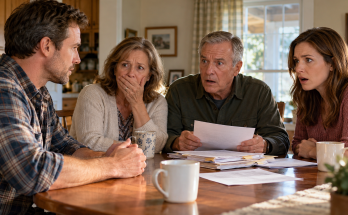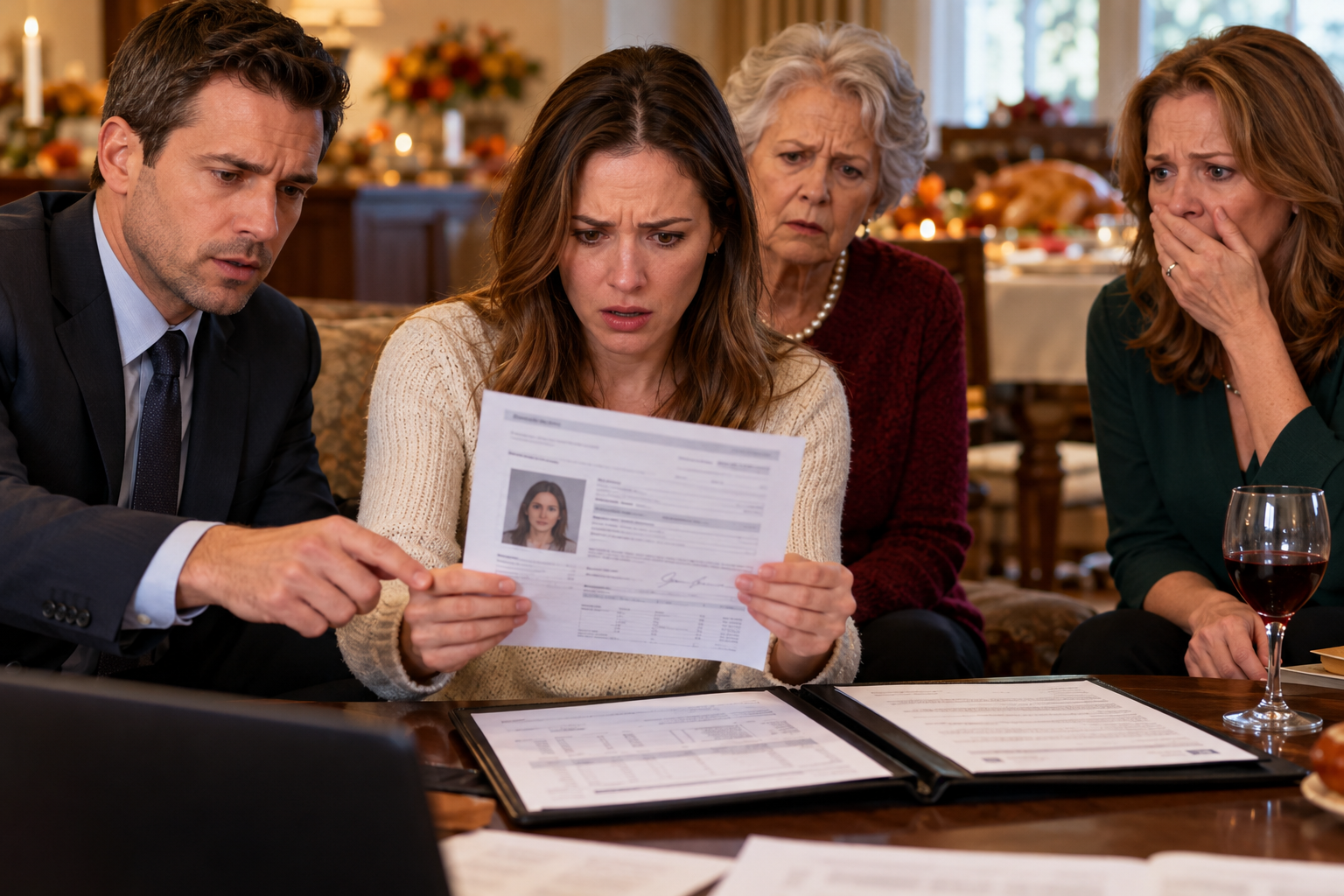
I kept looking at the authorization form after my mother finished speaking.
I wanted to find a reason to agree with her.
That would have made everything easier.
If I had signed something while recovering, then perhaps the missing money could be explained by a mistake I had made without realizing it.
I could be embarrassed.
I could apologize.
I could move on.
But the signature on the page kept bringing me back to the same conclusion.
It wasn't mine.
I had spent too much time signing medical forms and insurance documents to confuse my own handwriting with something that looked so different.
Even when I was tired, I recognized the way I wrote my name.
I knew where my pen slowed down.
I knew which letters I joined and which ones I formed separately.
The signature in front of me didn't follow those habits.
I looked at Miles.
He had not told us who opened the account.
He had only shown us what the bank's records claimed.
That distinction mattered.
A record could say that I had done something.
It could not, by itself, prove that I had actually done it.
Grandma seemed to understand that, too.
She asked whether the application had been signed in person.
Miles reviewed the information available to him.
He explained that the documents attributed the account opening to me, but the paperwork itself did not settle the question of who had completed it.
That was all he could tell us from what he had presented.
I felt a small measure of relief.
At least nobody was asking me to accept the signature as proof simply because my name appeared beside it.
My mother, however, seemed determined to return to the possibility that I had forgotten.
She reminded me how difficult those months had been.
She spoke about the medication.
She mentioned the exhaustion and the confusion that could follow a serious accident.
I knew she remembered those things because she had been around me.
She had seen me struggle.
She had watched me attempt tasks that once would have required no thought at all.
That made her explanation especially painful.
She knew how badly I had been hurt.
She knew how much of my attention had been devoted to my daughter and my recovery.
Yet she was using those facts to suggest that I might have authorized a financial transaction without remembering it.
I wanted to ask why she was so certain that I had signed the form.
Instead, I asked something simpler.
"Do you remember me opening an account at Westbridge?"
She hesitated.
It was brief.
But I saw it.
She said she couldn't remember every detail from that period.
That answer should have been reasonable.
Nobody remembers everything.
But it didn't explain why she had been so quick to suggest that I had signed the documents.
I looked down at the application again.
The copy of my driver's license seemed almost insulting.
My identity had been reduced to a photograph, an address, a birth date, and a signature.
All the details were correct enough to make the document convincing.
None of them proved that I had willingly opened the account.
I thought about my husband.
He had made arrangements because he wanted our daughter and me to be protected.
He had known that I might someday have to handle things alone.
He had tried to prepare for that possibility.
Now I was sitting in a room with a document that appeared to turn his intention into something else.
I felt angry.
Not the kind of anger that makes a person shout.
Mine was quieter.
It made me careful with every word.
I didn't want to accuse someone without evidence.
I also didn't want my silence to be mistaken for agreement.
Grandma asked Miles what the records showed about the transfer.
He returned to the papers in his folder.
The account had been opened shortly before the first movement of the funds.
The timing stood out.
The account was established on March 11.
The first transfer followed on March 14.
Three days.
I repeated the dates to myself.
They were close enough together that the account opening appeared connected to the transfer.
But I didn't know who had arranged either event.
I couldn't say who had filled out the application.
I couldn't say who had supplied the copy of my identification.
I couldn't even say how the bank had been persuaded to accept the signature.
Those questions remained unanswered.
I needed to keep them separate from what I knew.
What I knew was that I had not knowingly opened the account.
What I knew was that I had not received the money.
And what I knew was that the explanation offered by my mother had not made the document any more believable.
She sat quietly after that.
I wondered whether she was upset by the situation or by my refusal to accept her explanation.
I couldn't tell.
That uncertainty made me feel worse than I wanted to admit.
I had always thought I knew how to read my mother.
I knew when she was worried.
I knew when she was trying to avoid a difficult conversation.
I knew when she was being kind because she genuinely wanted to help.
But that afternoon, I couldn't decide which version of her I was looking at.
Perhaps she really believed I might have signed the form.
Perhaps she was trying to protect me from a conclusion she feared.
Perhaps there was something else she hadn't told us.
I didn't have enough information to choose between those possibilities.
For once, I let the uncertainty remain.
Grandma asked whether there were other documents associated with the account.
Miles had brought records showing how the account was established and identifying the transfer that followed.
He continued reviewing the information with us.
I listened closely, hoping that another page might answer the question the first one had raised.
Instead, each detail made the situation harder to dismiss.
The account wasn't just a name written incorrectly on a piece of paper.
It was a bank account attributed to me.
It had been opened at a specific institution on a specific date.
The application included my personal information.
The authorization form carried a signature that I did not recognize as my own.
And money intended for me had moved through that account without reaching me.
There was no single detail that explained everything.
Together, they formed a problem I could no longer ignore.
I glanced at Grandma.
She had stopped trying to reassure herself that the situation might be ordinary.
She was studying the records with the same focus she used when she wanted to understand something fully.
She didn't look pleased.
She looked determined.
I was grateful for that.
I had spent months being told that I needed rest, that I needed time, that I shouldn't overwhelm myself with difficult questions.
Some of that advice had been right.
But there was a difference between allowing myself time to recover and allowing other people to decide what had happened to me.
I could not change the past months.
I could not go back and ask my husband to explain every arrangement he had made.
But I could refuse to accept a story that didn't fit the facts.
I looked at my mother again.
She avoided my eyes for a moment.
Then she looked back at me.
I wanted her to say something that would settle the matter.
I wanted her to tell me she had no idea how my information had been used.
I wanted her to be as troubled by the signature as I was.
Instead, she returned to the possibility that I might have forgotten.
That was when I realized how much I needed to stop asking other people to tell me what I remembered.
I had been there.
I knew what my recovery had required.
I knew what I had and had not done.
My memory might not have been perfect, but it was not empty.
I had not knowingly opened that account.
I had not knowingly authorized that transfer.
I had not received the money.
Those statements were the clearest things I had said since Thanksgiving.
Miles gathered the documents together, but he left the application visible long enough for us to examine it again.
Grandma asked that the records be kept available as the questions were examined further.
Nobody argued.
I looked at the signature one last time.
It was a small mark on a page.
A few strokes of ink.
Yet it had been used to connect my identity to an account I didn't recognize.
I had spent so long thinking about the money itself that I hadn't understood how personal the problem was.
The money was missing.
But my name had also been used to make the missing money appear legitimate.
That was harder to accept.
I left the meeting without an answer about who had opened the account.
I didn't know who had handled the paperwork.
I didn't know who had received the benefit of the transfer.
And I wasn't ready to accuse my mother of anything.
But I was no longer willing to let the uncertainty become an excuse for doing nothing.
I needed the records examined.
I needed the account explained.
And I needed the truth to come from evidence, not from somebody's suggestion that I might have forgotten my own life.
Click here to continue reading: PART 4: The More Carefully We Examined the Application, the Less I Could Accept That My Missing Money Was Simply an Honest Mistake
The Thanksgiving Question That Turned a Family Gathering Into Something None of Us Could Pretend Was Ordinary Anymore
Part 3 of 20