I thought often about the word gift.
It was how I had come to understand my husband's money.
He had wanted to leave something for me and our daughter.
He had wanted us to have a little more security after his death.
He had wanted his final arrangements to make our lives easier, not harder.
I had never thought of the money as something I was entitled to take for granted.
I understood that it represented work, planning, and care.
That was why its absence hurt so much.
I wasn't simply missing an amount that should have appeared in an account.
I was missing something my husband had intended to provide.
The Thanksgiving question had forced me to see that the arrangement had not worked as I believed.
Grandma had expected me to have received the money.
I had expected the arrangements to be handled.
Neither of us had understood that an account at Westbridge Community Bank had been opened in my name.
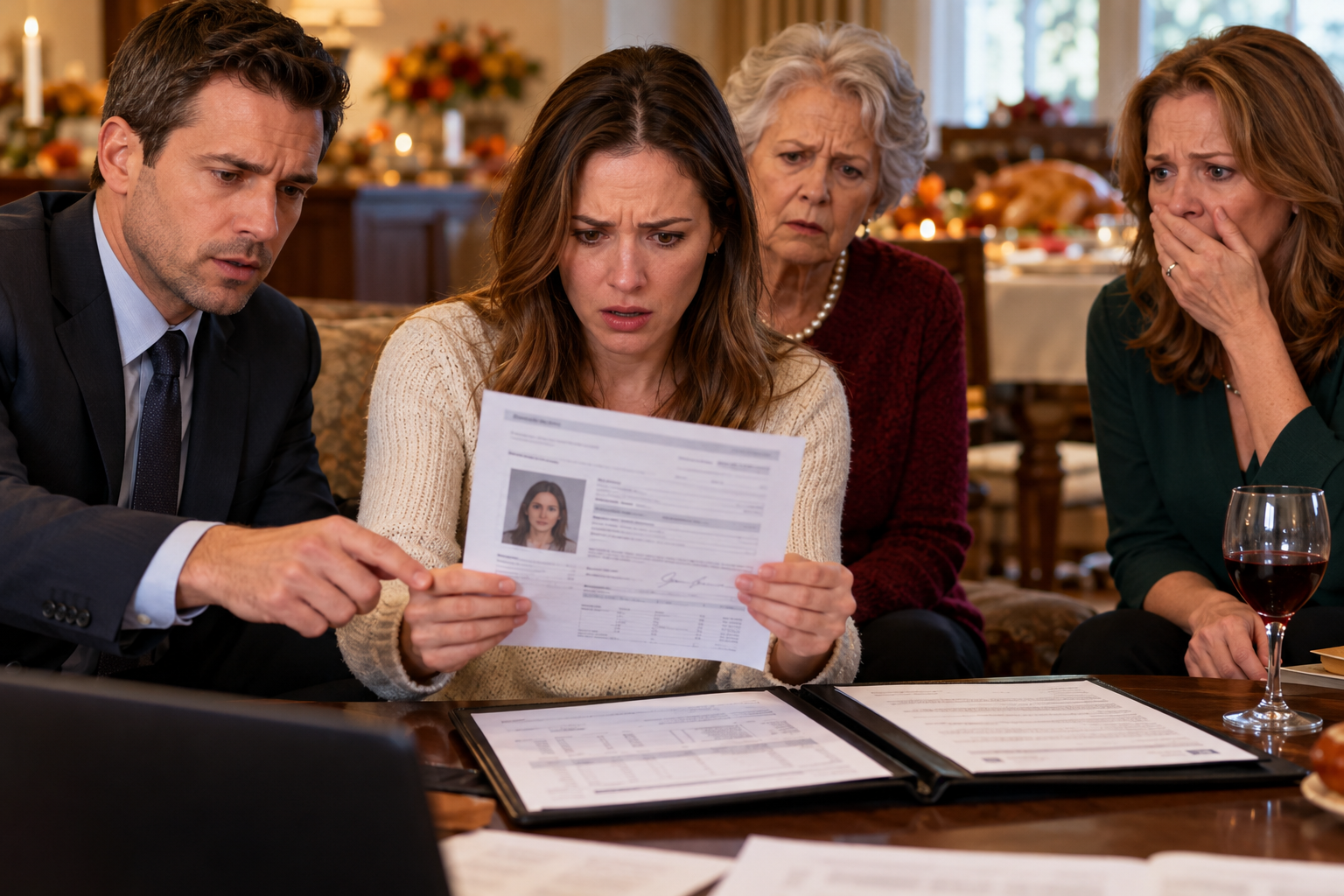
When Miles showed us the application, the problem became impossible to dismiss.
The documents claimed that I had opened the account.
I knew I hadn't knowingly done so.
The signature was unfamiliar.
And the first transfer had followed only three days after the account was established.
I kept coming back to those details because they were the clearest information I had.
I didn't know the entire story.
I didn't know who had prepared the application.
I didn't know who had arranged the transfer.
But I knew the money had not reached me.
I knew I had not knowingly authorized the account.
And I knew that somebody needed to explain the discrepancy.
Grandma had never asked me to pretend otherwise.
That mattered.
I had been so worried about upsetting my family that I had almost treated the question as something shameful.
I had wondered whether I was being selfish by insisting on the money.
I had worried that I was making a difficult time harder for everyone.
But I had begun to see how unfair those thoughts were.
The money was meant for my future.
It was meant to help me care for my daughter.
Wanting to know what happened to it was not selfish.
It was responsible.
I could appreciate the people who had helped me after the accident and still ask what had happened to my husband's arrangements.
I could be grateful for my mother's presence during my recovery and still dispute her explanation.
I could care about my family and still insist that my name not be treated as proof of something I had not knowingly done.
Those things did not contradict one another.
They were all part of facing the situation honestly.
I also began to understand that the truth might not arrive in the form I wanted.
I had imagined that somebody would eventually explain everything in a way that made the problem feel simple.
Perhaps a misunderstanding had occurred.
Perhaps an administrative error had created the confusion.
Perhaps the records would reveal something none of us had considered.
I remained open to those possibilities.
But I could not assume that one of them would turn out to be true.
The evidence had to determine what we believed.
That was the point of continuing.
My mother had suggested that my medication might explain the signature.
I still remembered how quickly she had offered that possibility.
I had not forgotten it.
But I was careful not to treat the memory as proof that she knew more than she had said.
I did not know what she knew.
I did not know what she suspected.
I did not know whether she had been frightened by the discovery or simply trying to make it less alarming.
Those questions remained open.
I wanted to answer them, but I could not do so by imagining what might have been in her mind.
I had to wait for what she actually said and what the records could establish.
That was not easy.
It would have been simpler to decide that I understood everything.
It would also have been dishonest.
I was no longer willing to trade accuracy for the temporary comfort of certainty.
I wanted to know what happened, even if the answer was complicated.
I wanted the money accounted for, even if the process took longer than I hoped.
And I wanted to understand how the account had been opened, even if the explanation forced me to reconsider things I had believed about my family.
I could not promise myself that I would be happy with the outcome.
I could only promise that I would face it.
That evening, I thought about my husband and the care he had taken when preparing for the future.
I remembered how he believed that planning was another way of loving someone.
I had teased him about his folders.
Now I understood why he had kept them.
He had wanted to leave things in order.
He had wanted to make sure we would not have to guess about everything after he was gone.
I wished I could ask him what he would have thought about the application.
I wished I could hear him tell me what he had intended.
But he was gone, and I had to work with the information left behind.
I could not change that.
I could still honor what he had wanted for us.
I could keep asking questions.
I could protect my daughter as best I could.
And I could refuse to let the money disappear into a story that nobody had properly explained.
Grandma had started this by asking a question that made everyone uncomfortable.
I was grateful she had not swallowed it.
The money had never reached me.
That fact deserved more than silence.
Click here to continue reading: PART 19: I Was Still Waiting for Answers When I Finally Understood That Protecting My Daughter Meant Refusing to Let the Questions Disappear
The Thanksgiving Question That Turned a Family Gathering Into Something None of Us Could Pretend Was Ordinary Anymore
Part 18 of 20