I used to believe that the hardest questions were the ones nobody could answer.
Now I think the hardest questions are the ones you are afraid to ask because you already know the answer might change your life.
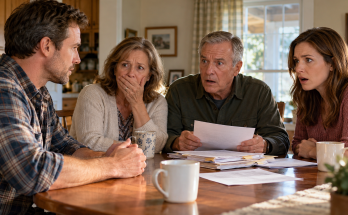
Grandma's question at Thanksgiving had been simple.
Why hadn't the money reached me?
She had believed that my husband had arranged for me to receive one hundred and eighty thousand dollars.
I had believed the arrangements were being handled.
Neither of us had expected the answer to lead to an account at Westbridge Community Bank.
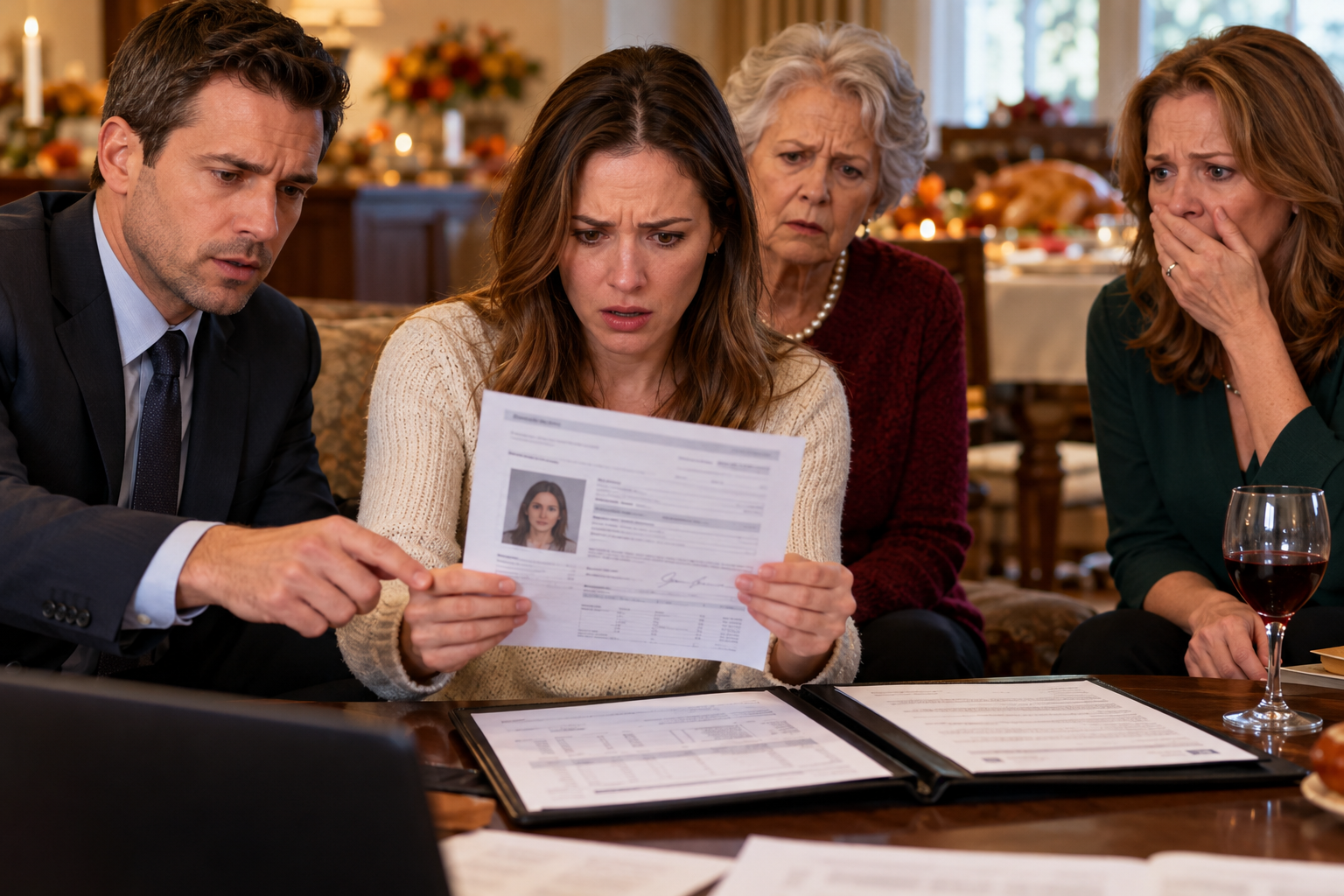
When Miles showed us the application, I recognized my own photograph.
I recognized my address.
I recognized my date of birth.
I did not recognize the signature.
That was where the problem became real.
The application claimed I had opened the account on March 11.
The first transfer had followed on March 14.
I had not knowingly opened the account.
I had not knowingly authorized the transfer.
And I had never received the money.
Those facts remained at the center of everything.
I wanted to know who had opened the account.
I wanted to know how my information had been used.
I wanted to know where the money had gone and why I had been left unaware of the arrangement.
I also wanted to understand why my mother had suggested that I might have signed the form while recovering from the accident.
I could not answer those questions merely by thinking about them.
I had to be willing to examine the evidence and accept whatever it established.
That was the decision I had made.
It did not give me an immediate resolution.
It did not tell me who was responsible.
It did not guarantee that the money would be recovered.
But it gave me a way to move forward without pretending that the situation was settled.
I had spent too long hoping that a reassuring explanation would make everything easier.
I had wanted to believe that the account was an ordinary mistake.
I had wanted to believe that my mother had simply been trying to calm me.
I had wanted to believe that the missing money could be explained without changing the way I saw my family.
Those hopes were understandable.
They were not evidence.
I had to stop treating them as if they were.
I could still hope for a clear explanation.
I could still hope that my family would face the facts honestly.
I could still hope that the money would be accounted for and that the arrangements my husband had made would serve their intended purpose.
But I could not promise myself that the truth would be painless.
I could only promise that I would face it.
Grandma had helped me understand that.
She had asked the question because she believed the money should have reached me.
When I told her it hadn't, she did not tell me to let the matter go.
She wanted to know what had happened.
I would always be grateful for that.
Her question had made me look at something I might otherwise have accepted without examination.
It had shown me that my assumptions about the money did not match the records.
And it had given me a reason to keep looking.
I had also learned something about myself.
I had spent months recovering from an accident, grieving my husband, and caring for our newborn daughter.
I had needed help.
I had been vulnerable.
I had not always been able to manage everything alone.
For a long time, I treated those facts as reasons to doubt my own judgment.
I no longer wanted to do that.
Needing help did not mean I had given up my right to understand my own life.
Being medicated did not mean I had knowingly signed a document I did not recognize.
And trusting my family did not mean I had to accept an explanation that failed to answer my questions.
I could be fair without being silent.
I could be cautious without being passive.
I could love my mother without pretending the application was harmless.
Those were not easy things to learn.
They were things I needed to remember.
I thought about my husband often during that time.
I remembered how carefully he planned for the future.
I remembered how he believed that preparing for difficult days was a way of caring for the people you loved.
I had once teased him about his folders and his attention to paperwork.
Now I understood the love behind that habit.
He had wanted to leave us something useful.
He had wanted our daughter and me to have a measure of security after he was gone.
That intention had not changed.
Whatever had happened to the money, his reason for arranging it remained part of our story.
I did not want the missing funds to erase that.
I wanted to honor his care by making sure the questions were taken seriously.
I also wanted my daughter to grow up understanding that love did not require a person to ignore the truth.
I wanted her to know that family could matter deeply without making every family member right.
I wanted her to understand that asking for an explanation was not cruelty.
Sometimes it was the only way to protect what someone had tried to give you.
I could not know what the eventual outcome would be.
I could not honestly say who had opened the account.
I could not say where the money had gone beyond what the records established.
And I could not say whether the family relationships I had known before Thanksgiving would return to what they had been.
I would not invent an ending just to make the story feel complete.
The facts had to be allowed to stand on their own.
The account existed.
The application carried my personal information.
The signature was one I did not recognize.
The money had not reached me.
Those were the facts that required an answer.
I had learned that uncertainty did not make them less important.
I had also learned that I could not control every part of what came next.
I could not make other people speak honestly.
I could not force a particular outcome.
I could not recover the time I had spent believing everything was in order.
But I could continue to ask questions.
I could keep my attention on the records.
I could refuse to accuse anyone without evidence.
And I could refuse to let my own experience be dismissed simply because the truth was uncomfortable.
That was what I had left to do.
The money still mattered.
The signature still mattered.
The future my husband had tried to protect still mattered.
But the greatest change was that I no longer believed I had to choose between protecting my family and trusting myself.
I could care about the people I loved and still insist on answers.
I could grieve my husband and still work to protect the future he had intended for us.
And I could admit that I did not know the entire story without pretending that nothing had gone wrong.
I had wanted Thanksgiving to be an ordinary family gathering.
Instead, it became the day I learned that a question could reveal how much remained unknown.
I would never forget Grandma asking why the money had not reached me.
I would never forget the application with my photograph on it.
And I would never forget the feeling of seeing a signature that claimed to be mine when I knew I had not knowingly written it.
Those details had changed the way I understood the situation.
They had also changed the way I understood trust.
I used to think trust meant believing the people closest to me.
Now I understood that trust also required honesty, accountability, and the willingness to face questions without hiding behind comforting explanations.
I still wanted to believe that the truth could bring clarity.
I still wanted the money accounted for.
I still wanted to understand what had happened to my husband's final gift.
But I no longer needed to pretend that I already knew the ending.
I only needed to keep looking until the facts could tell me what happened.
My husband had tried to leave us a future.
I intended to keep protecting it.
And this time, I would not confuse silence with peace.
The End
Read more original stories on Feel Every Story.
The Thanksgiving Question That Turned a Family Gathering Into Something None of Us Could Pretend Was Ordinary Anymore
Part 20 of 20