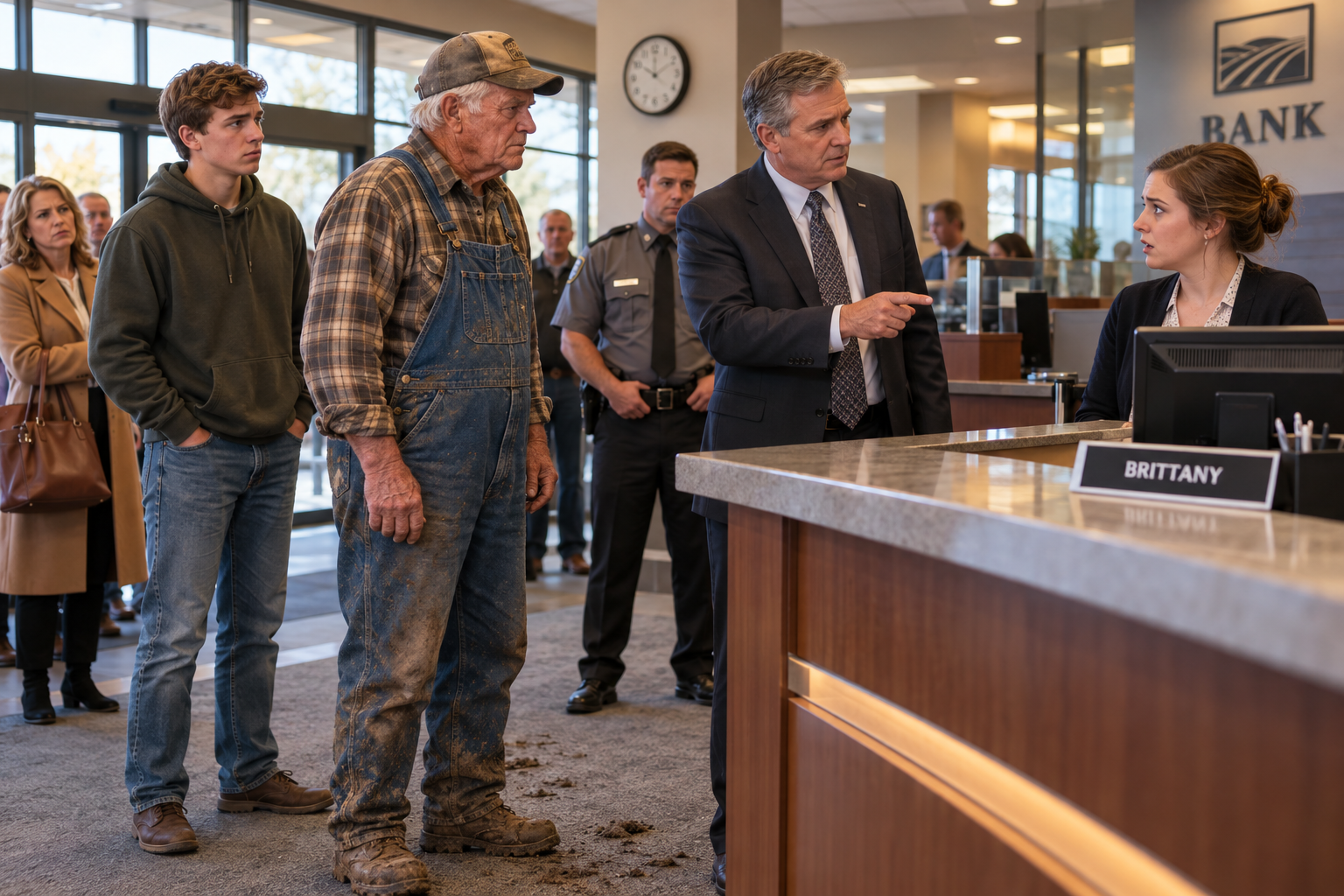
The thing I remember most clearly was how quickly the room had changed.
At first, Grandpa had been just another customer.
An older man in work clothes.
Someone who looked as though he had come straight from a farm.
Then Tom Callahan recognized his name, and the people around us learned about the land he had pledged to help the bank expand.
Nothing about Grandpa himself had changed.
The room had changed its opinion of him.
I couldn't stop thinking about that.
I had seen people judge Grandpa's clothes before.
Usually, it happened in small ways.
A salesperson would speak to me instead of him.
Someone would repeat a question as though Grandpa hadn't understood it the first time.
A stranger might look at his boots and assume he had nothing interesting to say.
Most of those moments passed without becoming a story.
Grandpa rarely bothered to mention them.
He had work to do.
He had crops to check.
He had a house to maintain and bills to pay.
He didn't spend his evenings discussing every person who had underestimated him.
That morning was different because the judgment had happened in front of me.
I had watched it unfold.
I had heard the teller suggest that he use another service instead of dealing with him at the counter.
I had seen the guard approach.
And I had felt the same helpless irritation I had felt as a child when somebody treated Grandpa as though he were less important than everyone else.
Only this time, I was old enough to understand that my own reaction mattered.
I couldn't keep pretending that respect was something other people were responsible for providing.
I had to consider what I did when someone failed to provide it.
Grandpa and Tom continued their conversation.
Tom had stopped treating the situation as a minor inconvenience.
He was attentive now, making sure Grandpa had the chance to explain what he needed.
The manager's change in manner was obvious.
He was careful with his words.
He gave Grandpa his full attention.
I didn't hear every detail of their exchange, and I won't claim that I did.
What stayed with me was the way Grandpa handled the attention.
He didn't become boastful.
He didn't start listing everything he had done for Marlow.
He didn't remind Tom of his age or the number of years he had farmed.
He let the manager do what a manager was supposed to do.
I found myself wishing I could borrow some of that steadiness.
At college, I often worried about how I came across.
I wanted professors to take me seriously.
I wanted classmates to understand that studying agriculture wasn't an easy path I had chosen because I couldn't imagine anything else.
Sometimes I tried too hard to prove that I belonged.
Grandpa had spent a lifetime doing difficult work without constantly explaining why it mattered.
I wondered when I had started believing that a person's worth depended on whether strangers recognized it.
The answer wasn't simple.
Maybe I had absorbed it from school.
Maybe it came from watching people judge one another in town.
Maybe it was just part of being twenty, when every room seems full of people deciding who you might become.
Whatever the reason, I had brought that insecurity into the bank with me.
I had noticed the carpet.
I had noticed the customers.
I had worried about what they thought of us.
Grandpa had walked in because he had business to conduct.
I had walked in beside him and worried about appearances.
That realization embarrassed me more than anything Brittany had said.
I looked at his boots.
They were old, scuffed, and stained from the fields.
The soles had been repaired.
The leather had softened around his feet.
They were not the kind of boots anyone would display in a store window.
They were useful.
They had carried him through years of planting and harvest, through muddy fields and cold mornings, through work that had to be done whether he felt like doing it or not.
I thought about how much those boots had seen.
Then I thought about the carpet.
The carpet could be replaced.
The land Grandpa had put at risk to help the bank could not have been replaced so easily.
That was the difference I had missed.
Tom had explained the importance of the old loan, but Grandpa had never used that history to demand admiration.
He had not entered the bank expecting everyone to know his name.
He had not expected his past generosity to buy him a better place in line.
He had expected to be treated as a customer.
Nothing more.
Nothing less.
I watched Tom listen to him, and I began to understand why Grandpa had never told me about the 1974 agreement.
He didn't seem to measure his life by the number of people who knew what he had done.
He measured it by whether he had done what he believed was right.
That was harder to imitate than it sounded.
Anyone could tell a story about being generous.
Anyone could remind people of a favor they had done years earlier.
It took a different kind of confidence to help someone and then let the memory fade without demanding anything in return.
I didn't know whether Grandpa had thought about the loan often over the years.
I didn't know whether he remembered every detail of the agreement.
I only knew he had never used it to make himself seem important in front of me.
I had grown up around him.
I had watched him work.
I had eaten at his table and ridden beside him in the truck.
Yet I had never asked him about that part of his life.
I had never thought to ask what he had risked before I was born.
That bothered me.
There were things about Grandpa I knew because I had been there.
There were other things I knew only because I had never bothered to ask.
The morning was still unfolding around us.
Customers moved through the lobby again.
The clock continued to tick.
The coffee machine hissed as somebody prepared another cup.
The muddy marks remained on the carpet.
And Grandpa, who had caused none of the trouble, stood waiting for the matter he had come to resolve to be handled properly.
I felt proud of him.
Then I felt ashamed of how much of that pride depended on learning that other people had reason to respect him.
He had been worthy of respect before Tom arrived.
He had been worthy of it before Brittany read his name.
He had been worthy of it before the bank's history came into the conversation.
I had known that in theory.
Now I understood how easily I could forget it when the person standing in front of me looked ordinary.
Grandpa finally shifted his attention away from the counter and toward me.
It was a brief glance.
He didn't ask whether I was angry.
He didn't ask whether I had noticed the people watching.
He didn't need to.
I straightened up.
For the first time since we had entered the building, I stopped worrying about the mud on his boots.
I looked at the man wearing them.
He was eighty-four years old.
He had spent most of his life farming the same land his father had worked before him.
He had helped a local bank take a risk when other people had declined.
And when a young teller brushed him aside, he hadn't tried to make himself look powerful.
He had asked for the manager.
I had thought that was a small thing.
It wasn't.
It was the kind of thing that told me who my grandfather had been long before I was old enough to understand him.
Click here to continue reading: PART 5: The Bank Lobby Had Gone Back to Business, but I Could No Longer Look at My Grandfather Without Wondering What Else He Had Never Told Me
The Morning My Grandfather Walked Into the Bank Looking Like Every Other Farmer in Iowa, Nobody Expected the Room to Change
Part 4 of 20