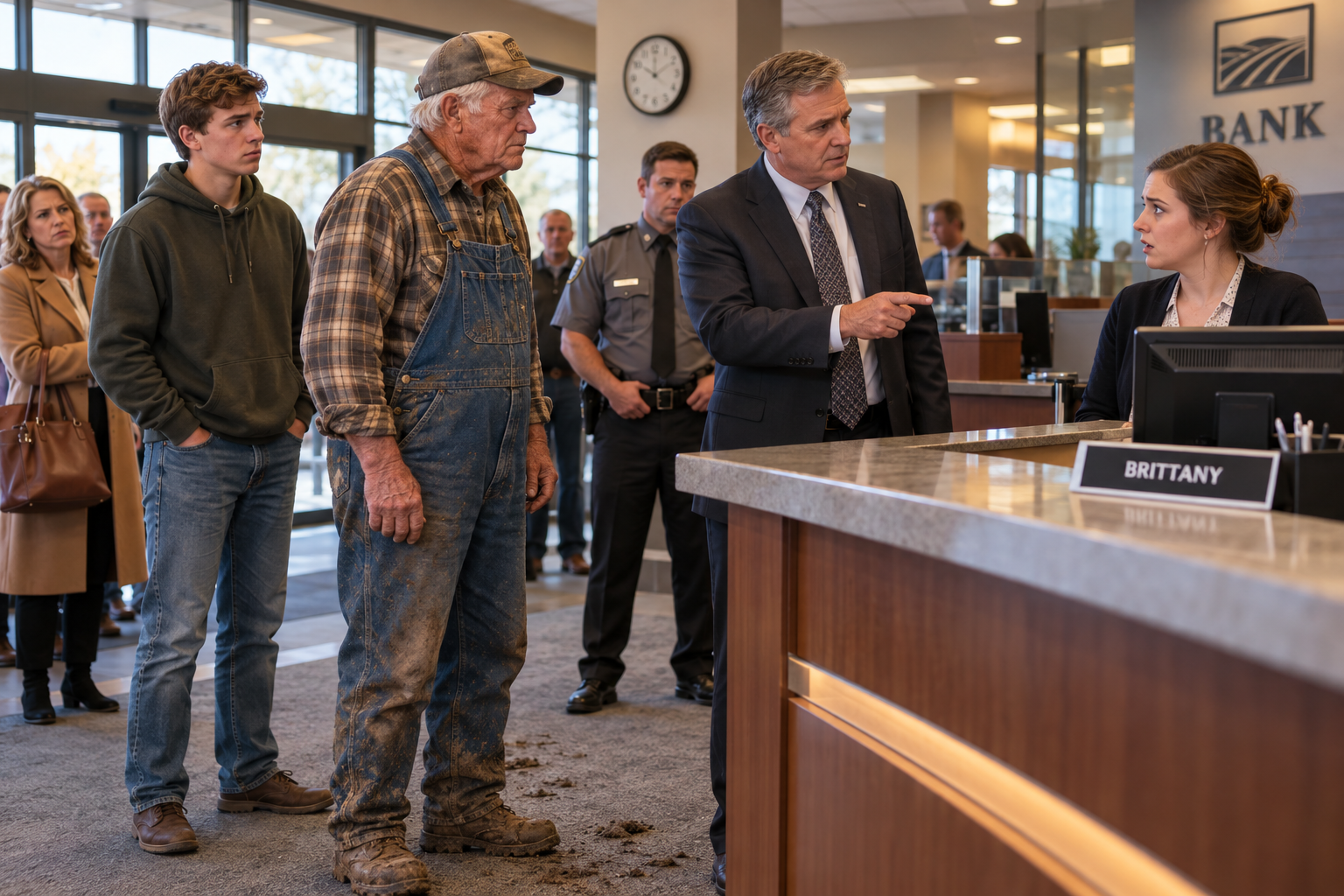
I followed Grandpa toward the counter.
Nobody stopped us.
Nobody looked at his boots again.
That was the part I couldn't get out of my head.
A few minutes earlier, those same boots had seemed to tell everyone what kind of customer he was.
Now they were just boots.
Grandpa didn't seem interested in the difference.
He was focused on finishing his business and getting back to the farm.
October didn't leave much room for unnecessary trips into town.
The fields were waiting.
So was the equipment.
And Grandpa had never been a man who enjoyed sitting around when there was work to do.
Tom stayed nearby while Grandpa continued with his business.
He spoke to him directly and waited for answers instead of making assumptions.
I noticed that.
I noticed everything that morning.
The manager's attention had become almost painfully careful.
He seemed determined not to make another mistake.
Grandpa, meanwhile, behaved as though he expected nothing more than an ordinary conversation.
That was probably the most uncomfortable thing for the rest of us.
He wasn't giving anyone a chance to turn the moment into a performance.
He wasn't angry enough to make a scene.
He wasn't pleased enough to offer forgiveness before anyone had asked for it.
He was simply there.
I stood beside him and tried to understand how he managed it.
At college, I had a habit of replaying conversations in my head.
If someone spoke sharply to me, I thought about what I should have said afterward.
If somebody underestimated me, I imagined the perfect answer on the drive home.
Grandpa didn't seem to carry those conversations around.
Or perhaps he carried them differently.
He had never explained himself to me.
He had never said that people were wrong to judge him.
He just kept doing what needed to be done.
I wondered whether that was strength or whether it was simply the result of having lived long enough to know which battles were worth the time.
Maybe it was both.
Tom said something to Grandpa, and Grandpa answered with a small nod.
The exchange was brief.
I couldn't hear every word.
But I saw that Tom wasn't rushing him.
That mattered more than the careful tone.
Respect wasn't in the manager's voice alone.
It was in the fact that he had stopped treating the conversation like something he needed to get through.
I looked toward Brittany.
She was working again, though she seemed quieter than before.
Her eyes occasionally moved toward Grandpa and then returned to her screen.
I wondered what she would remember from the encounter.
Would she remember the farmer she had tried to redirect?
Would she remember Tom explaining the old loan?
Or would she remember the moment she realized she had made a judgment about someone she barely knew?
I hoped it was the last one.
Not because I wanted her to feel bad forever.
I didn't know enough about her to decide what kind of person she was.
I wanted her to remember because I knew how easy it was to make a mistake and then move on without learning anything from it.
I had done that myself.
I had watched Grandpa be dismissed and told myself I was waiting for the right moment to speak.
That explanation had let me feel better about doing nothing.
I didn't want to keep using it.
Grandpa adjusted the cuff of one overall strap.
The movement was so familiar that, for a second, I was back in the passenger seat of his truck, watching him prepare to climb down into a field.
He had done that same small adjustment countless times.
Before checking a fence.
Before opening a gate.
Before stepping into a machine shed to look at a broken part.
He never seemed to think about whether anyone was watching.
He just got ready to work.
I wondered how many important things in his life had happened with the same lack of ceremony.
The bank loan in 1974.
The years he had spent farming.
The decisions he had made after Grandma died.
The things he had given up because somebody had to keep the farm going.
I knew the outline of his life.
I knew the land and the buildings.
I knew which tools belonged in which drawers.
I knew how he liked his coffee and which weather reports he trusted.
But I didn't know all the decisions that had brought him here.
That bothered me more than I expected.
When I was younger, I thought older people told you everything important simply because they had lived long enough to know it.
Now I understood that a person could spend decades beside you and still keep whole parts of his life private.
Not out of secrecy.
Sometimes because nobody had asked.
Sometimes because the story had never seemed necessary.
And sometimes because the person telling it had no desire to make himself the hero.
Grandpa was like that.
If he had helped somebody, he rarely brought it up again.
If he had done something difficult, he treated it as a job that had needed doing.
I had mistaken that habit for simplicity.
I was beginning to understand that it might have been discipline.
He had learned to separate what mattered from what merely attracted attention.
That morning, attention had found him anyway.
Tom had told the room about the old agreement because the teller's treatment of Grandpa had made the history relevant.
But Grandpa hadn't asked Tom to explain it.
He hadn't stood at the counter waiting for somebody to announce his importance.
The recognition had come from someone else.
And Grandpa seemed content to let it pass.
I looked at the gray carpet once more.
The muddy marks were still visible near the entrance.
They seemed less important now.
The carpet was there to be walked on.
The boots were there to carry a farmer through his work.
Neither one had anything to say about the worth of the person wearing them.
I felt foolish for having spent so much time worrying about the room's opinion of us.
Then I realized I had been doing exactly what I disliked in other people.
I had allowed the possibility of being judged to shape how I felt about my grandfather.
I hadn't looked down on him.
But I had worried about how he might look to strangers.
That was close enough to make me uncomfortable.
Grandpa glanced at me again.
This time, I held his gaze.
He didn't smile.
He didn't ask me what I was thinking.
He simply turned back toward Tom.
I was grateful he hadn't asked.
I wasn't ready to explain what I had learned.
I wasn't sure I could have said it properly.
All I knew was that I wanted to remember the morning without changing it into a story about how impressive my grandfather was.
He had been impressive long before anyone in that bank recognized him.
The difference was that I had finally begun to notice.
Click here to continue reading: PART 6: The Old Loan From 1974 Stayed in My Mind as We Finished Our Errand, Because Grandpa Had Never Once Used It to Impress Me
The Morning My Grandfather Walked Into the Bank Looking Like Every Other Farmer in Iowa, Nobody Expected the Room to Change
Part 5 of 20