The farm appeared beyond the road as we approached the turn.
I knew every part of the place.
The driveway.
The buildings.
The fields stretching away from the house.
I had been coming there every October since I was nine, and the sight of it usually made me feel as though I had returned to the part of my life that made the most sense.
That morning, it felt familiar and different at the same time.
Grandpa turned into the driveway.
The truck moved over the uneven ground.
I looked down at his boots.
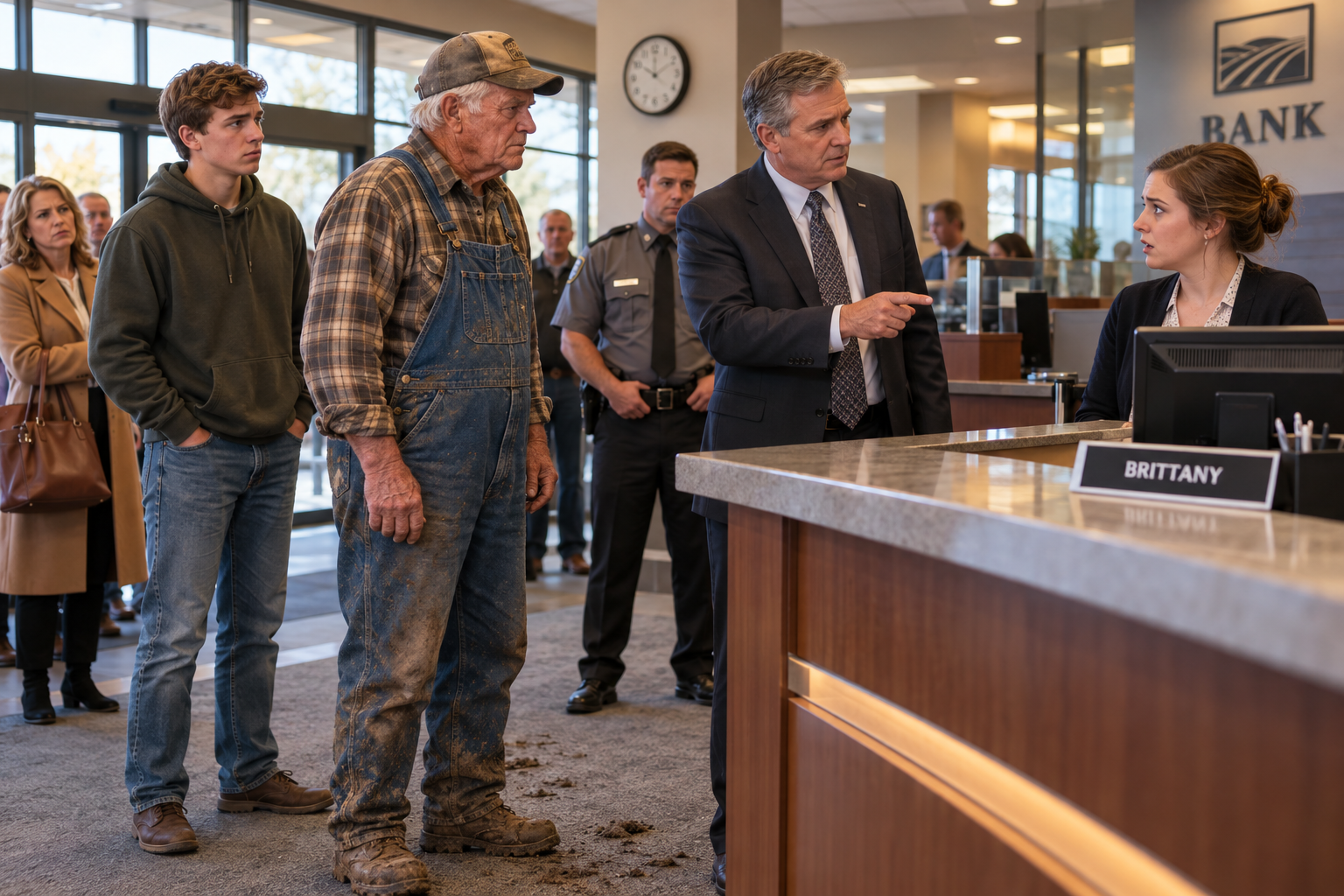
They had brought mud into the bank.
That was all.
The mud had not made him careless.
It had not made him ignorant.
It had not erased the years he had spent working the land.
It had simply told the truth about where he had been before entering the building.
He had come from the farm.
He had not pretended otherwise.
I wondered why that had seemed so important to the teller.
Maybe she had seen customers arrive dressed in a certain way and learned to expect certain things from them.
Maybe she had been having a difficult morning.
Maybe she had made a quick judgment without thinking about it.
I couldn't know.
I didn't want to turn her into a villain just because I had been angry with her.
But I also couldn't pretend the judgment hadn't happened.
She had looked at Grandpa and decided that helping him at the counter wasn't worth her time.
That was the part that mattered.
The truck stopped near the house.
Grandpa switched off the engine.
For a few seconds, the cab was quiet.
Then he reached for the door handle.
I got out after him.
The air smelled of soil and dry vegetation.
Somewhere on the farm, equipment needed checking.
There would be things to do before the day was over.
Grandpa walked toward the house.
I followed.
He moved at the same pace he had used inside the bank.
No hurry.
No unnecessary gestures.
No sign that he intended to spend the afternoon thinking about the people who had misjudged him.
I wanted to ask about the loan.
The question sat at the back of my throat.
I could have asked right then.
Instead, I looked toward the fields.
Harvest had its own demands, and Grandpa had always been careful about what deserved his attention.
I decided I would ask when the time felt right.
That decision wasn't an excuse to avoid the question.
At least, I hoped it wasn't.
I was beginning to see how often I had waited for other people to make uncomfortable moments easier for me.
At the bank, I had waited for Grandpa to respond.
On the drive home, I had waited for him to explain what the morning meant.
Now I was waiting for the right time to ask him about something that mattered to me.
Maybe that was reasonable.
Maybe I was still learning how to speak when I had something worth saying.
Grandpa opened the door and stepped inside.
The house smelled familiar.
The kitchen was quiet.
The ordinary objects were where they belonged.
Nothing in the room suggested that anything unusual had happened that morning.
I stood near the doorway for a moment.
Grandpa removed his cap and set it down.
Then he went about what he needed to do.
He didn't announce that the trip had been difficult.
He didn't tell me what I should have learned.
He didn't ask whether I had been embarrassed.
I was starting to understand that he might never bring it up again.
The bank would remain the place where the encounter had happened.
The farm would remain the place he returned to afterward.
Between the two, I had learned something about myself.
I had always thought that knowing someone meant knowing what they did.
I knew Grandpa farmed.
I knew he worked hard.
I knew he kept his promises and disliked wasting money.
I knew he had loved Grandma Ruth and continued to miss her in ways he rarely discussed.
But I had confused familiarity with understanding.
I had been beside him for years without asking what he had risked, what he had believed, or what he had done when nobody was watching.
I didn't want to keep doing that.
The old loan had opened a door in my understanding of him.
It hadn't changed his character.
It had shown me a part of it I had never thought to look for.
I wanted to know more.
Not because I wanted to tell people that my grandfather had helped build a bank.
Not because I wanted to use his history to win an argument.
I wanted to know because he was my grandfather, and I had been given more time with him than I had ever stopped to appreciate.
I looked at his boots again.
The mud was drying along the edges.
Soon, it would flake away.
The marks on the bank carpet would be cleaned.
The customers would return to their routines.
Brittany would serve the next person in line.
Rick would stand near the entrance.
Tom would return to his work.
The morning might become no more than a story people told occasionally.
But I would remember what had happened before Tom spoke.
That was the part I didn't want to lose.
Grandpa had deserved courtesy before anyone recognized his name.
He had deserved it before the manager explained the loan.
He had deserved it when the teller first looked at him and saw only an old farmer in work clothes.
I had known that in principle.
Now I knew how easily I could forget it when the judgment belonged to someone else.
Grandpa moved through the house, preparing to return to the day's work.
I watched him for a moment.
Then I followed.
There was still a harvest to finish.
There were still things I could learn.
And for the first time that morning, I understood that the most important thing Grandpa had carried out of the bank wasn't his reputation.
It was his dignity.
He had taken it in with him.
He had kept it when the teller dismissed him.
And he had brought it home without needing anyone's permission.
Click here to continue reading: PART 9: I Went Back to Work Beside Grandpa, but the Story of the Bank Loan Followed Me Into Every Quiet Moment on the Farm
The Morning My Grandfather Walked Into the Bank Looking Like Every Other Farmer in Iowa, Nobody Expected the Room to Change
Part 8 of 20