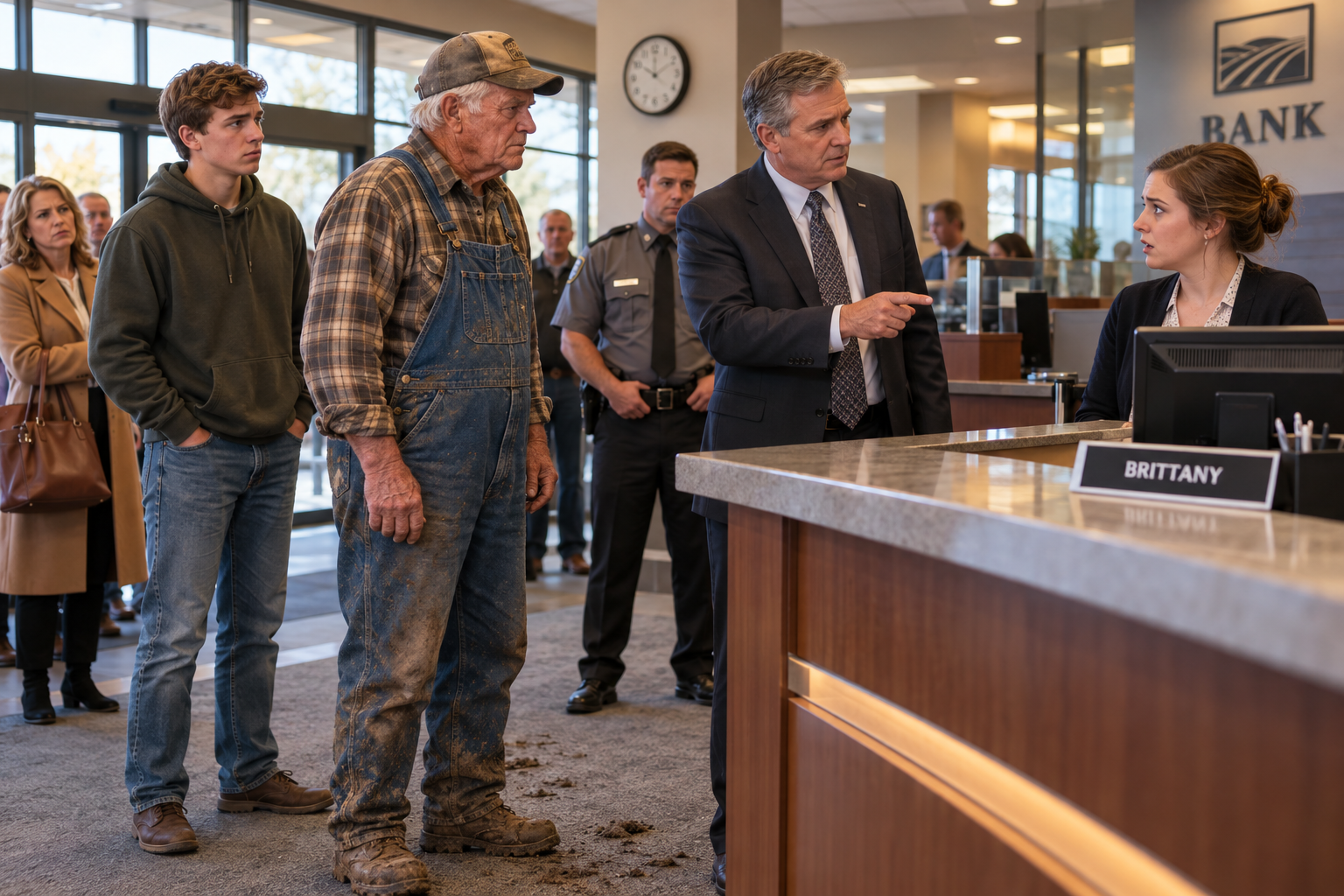
I kept one picture of the bank morning in my mind more clearly than the others.
It wasn't Tom standing near the counter.
It wasn't Brittany's face when he explained the loan.
It wasn't even the woman in the camel coat leaving through the glass doors.
It was Grandpa waiting.
He had asked for the manager.
Then he had waited for the manager to arrive.
There had been no performance.
No demand that the whole lobby pay attention.
Just a man expecting the person responsible to deal with his concern.
I thought about how much effort I had spent imagining what I would have said in his position.
I had come up with arguments.
I had imagined sharper responses.
I had pictured myself telling the teller exactly why she was wrong.
Those imagined conversations had made me feel better.
They had also allowed me to avoid the harder question.
What would I actually do the next time I saw somebody being treated unfairly?
It was easy to be brave afterward.
It was easy to think of the right words when nobody was waiting for me to say them.
The bank had been different.
I had been there.
I had watched the interaction happen.
And I had stayed quiet.
I couldn't change that.
I could only be honest about it.
I didn't want to remember the morning as a story about how Grandpa had defeated a rude teller.
That made the encounter sound like a contest.
It suggested that the important thing was who had won.
But Grandpa hadn't entered the bank to win anything.
He had gone there to conduct business.
The disrespect had interrupted an ordinary errand.
The manager's arrival had allowed the matter to move forward.
The old loan had explained why Tom knew Grandpa's name.
That was the sequence.
Everything else was what I had brought to it.
My embarrassment.
My pride.
My wish to see the people who had judged Grandpa realize they were wrong.
I had been so focused on their reaction that I had nearly missed the most important part of his.
He hadn't changed his behavior to suit the room.
He hadn't become smaller when Brittany dismissed him.
He hadn't become bigger when Tom explained the bank's history.
He had remained himself.
That was what I wanted to remember.
I also wanted to remember that Grandpa's calmness did not mean he accepted disrespect.
He had spoken to Rick when the guard approached.
He had asked for the manager when the teller brushed him aside.
He had taken action.
He simply hadn't allowed the situation to decide what kind of person he would become.
I had once thought that restraint meant letting people get away with things.
Now I understood that restraint could mean addressing a problem without giving it control over you.
There was a difference between refusing to fight and refusing to be pushed around.
Grandpa had shown me that difference without ever explaining it.
I hoped I could remember it when I was older.
I hoped I could pass it on without turning it into a lecture.
Most of all, I hoped I would stop treating people as though their importance had to be demonstrated before they deserved my attention.
The woman in the camel coat had laughed because she thought she understood the situation.
Brittany had dismissed Grandpa because she thought she knew what kind of customer he was.
I had worried about the room because I thought I knew how people would judge us.
We had all made assumptions.
Only Grandpa had refused to let those assumptions determine his next move.
That didn't make him perfect.
It made him steady.
And steadiness was something I wanted to learn.
By then, I no longer needed to imagine Brittany feeling embarrassed.
I hoped she had thought about the encounter.
I hoped she would treat the next customer more carefully.
But I didn't need her regret to make Grandpa's behavior meaningful.
The lesson wasn't dependent on her learning it.
It was mine to carry whether she learned it or not.
I couldn't control what the people in the bank remembered.
I couldn't decide whether Tom told the story to anyone afterward.
I couldn't know whether the old loan would ever come up in another conversation.
But I could choose how I remembered the morning.
I would remember the muddy boots.
I would remember the gray carpet.
I would remember the quiet moment when Rick moved his hand away from his belt.
And I would remember Grandpa asking for the manager rather than begging the room to understand him.
Those details mattered because they reminded me that respect should not be reserved for people whose histories impress us.
It should be the starting point.
Everything else comes afterward.
Click here to continue reading: PART 20: Years From Now, I May Forget the Words Everyone Spoke in That Bank, but I Will Remember the Man Who Never Needed to Prove He Belonged There
The Morning My Grandfather Walked Into the Bank Looking Like Every Other Farmer in Iowa, Nobody Expected the Room to Change
Part 19 of 20