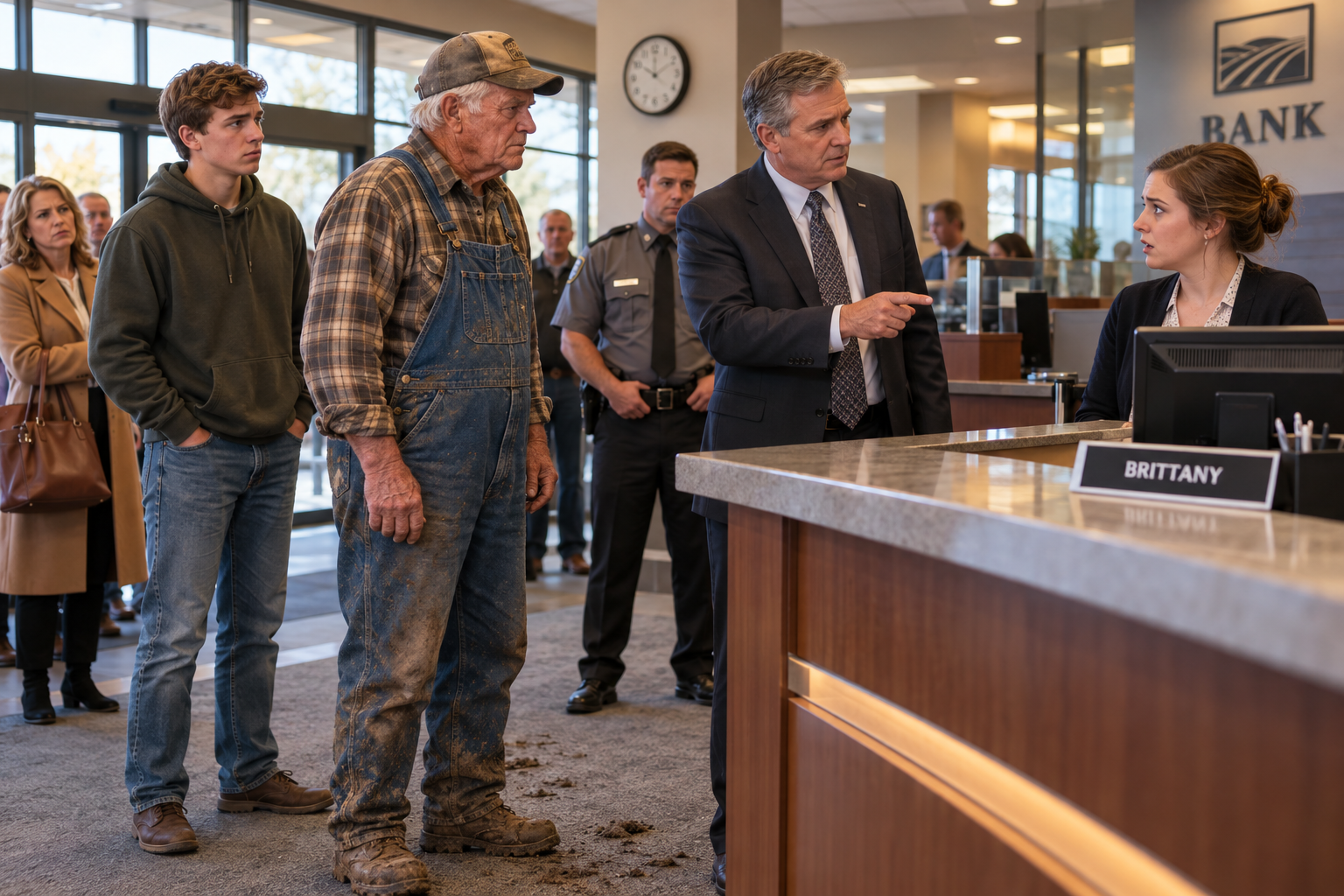
By the middle of October, I had stopped thinking about the bank every hour.
Not because I had forgotten what happened.
Because the farm had a way of pulling me back into the present.
There was always something that needed attention.
A machine to check.
A field to finish.
A decision that couldn't wait until I had finished thinking about something else.
Grandpa understood that better than I did.
He had spent eighty-four years learning when to think and when to act.
I was still learning how to tell the difference.
One morning, I found him near the equipment shed, examining something that had been bothering him the previous afternoon.
He had his cap pulled down and his hands resting against the edge of the machine.
I stood beside him and waited.
He pointed out what he wanted me to look at.
I checked it.
We discussed what needed to be done.
Then we got to work.
Nothing about the exchange was remarkable.
That was why I remembered it.
Grandpa didn't need to explain his decisions to make them worthwhile.
He didn't need to turn every problem into a lesson.
He simply expected me to pay attention.
I thought about the bank again.
Brittany had looked at his clothes and made a decision about him.
I had looked at the same clothes and worried about what the other customers might think.
Our reactions had been different, but both had begun with appearances.
I hadn't treated Grandpa badly.
Still, I had allowed somebody else's judgment to make me uncomfortable about standing beside him.
That was difficult to admit.
I loved my grandfather.
I was proud of the farm.
I wanted to follow the example he had set.
Yet a part of me had still cared about looking respectable to people who knew nothing about us.
I had wanted the teller to treat him properly.
I had also wanted her to stop making the situation embarrassing.
Those desires were not the same.
One was about Grandpa.
The other was about me.
I had needed the bank to recognize him before I could relax.
That was the part I regretted most.
Grandpa had never needed the room's approval.
I had.
I couldn't change that morning, but I could stop pretending I had behaved perfectly.
The realization made me more careful around other people.
Not perfect.
Just more careful.
I tried to listen before deciding what somebody meant.
I tried to remember that a person's clothes told me very little about the choices they had made.
And when I caught myself forming an opinion too quickly, I tried to leave room for the possibility that I was wrong.
It wasn't easy.
Old habits rarely disappeared because you had one uncomfortable experience.
Sometimes I caught myself making the same assumptions all over again.
Then I remembered Grandpa's boots on the bank carpet.
I remembered Tom Callahan explaining the loan from 1974.
And I remembered that Grandpa had deserved courtesy before anyone knew about the agreement.
That brought me back to the point.
One afternoon, while we were taking a short break, I asked Grandpa whether he had ever regretted helping the bank.
I tried to ask it casually.
I didn't want him to think I was looking for a dramatic answer.
He considered the question.
Then he told me that the decision belonged to the past.
He had made it when the circumstances called for it.
He wasn't going to spend the rest of his life wishing he had chosen differently.
His answer was brief.
It was also more complicated than it sounded.
I had expected him to tell me whether the risk had been worth taking.
Instead, he reminded me that a decision could be made honestly without guaranteeing the outcome.
I thought about that for a long time.
I was studying agronomy because I wanted to understand the land better.
But no amount of knowledge could remove every uncertainty from farming.
You could study the soil.
You could watch the weather.
You could plan carefully.
You could still lose a crop.
A person had to make decisions without knowing everything that would happen afterward.
Grandpa had done that with the farm.
He had done it with the bank.
And he had continued living without demanding that the past prove he had been right about every choice.
I admired him for that.
I also understood that I couldn't borrow his confidence simply by admiring it.
I would have to build my own.
That evening, we finished our work and headed back toward the house.
Grandpa walked ahead of me.
His boots were dirty again.
The sight no longer reminded me of the bank's carpet first.
It reminded me of the ground he had spent his life working.
I had known that ground since childhood.
I had ridden across it in the truck.
I had watched Grandpa work it through different seasons.
I had learned from him without realizing how much I was learning.
Now I was old enough to understand that the farm had taught me more than how to grow crops.
It had taught me that worthwhile work did not always attract attention.
It had taught me that doing something properly mattered even when nobody was watching.
And, through one uncomfortable morning in town, it had taught me that a person did not need to look impressive to deserve respect.
Grandpa had known that all along.
I was finally catching up.
Click here to continue reading: PART 18: I Stopped Waiting for Grandpa to Explain Himself, Because I Finally Saw That His Life Was Already Telling Me What I Needed to Know
The Morning My Grandfather Walked Into the Bank Looking Like Every Other Farmer in Iowa, Nobody Expected the Room to Change
Part 17 of 20