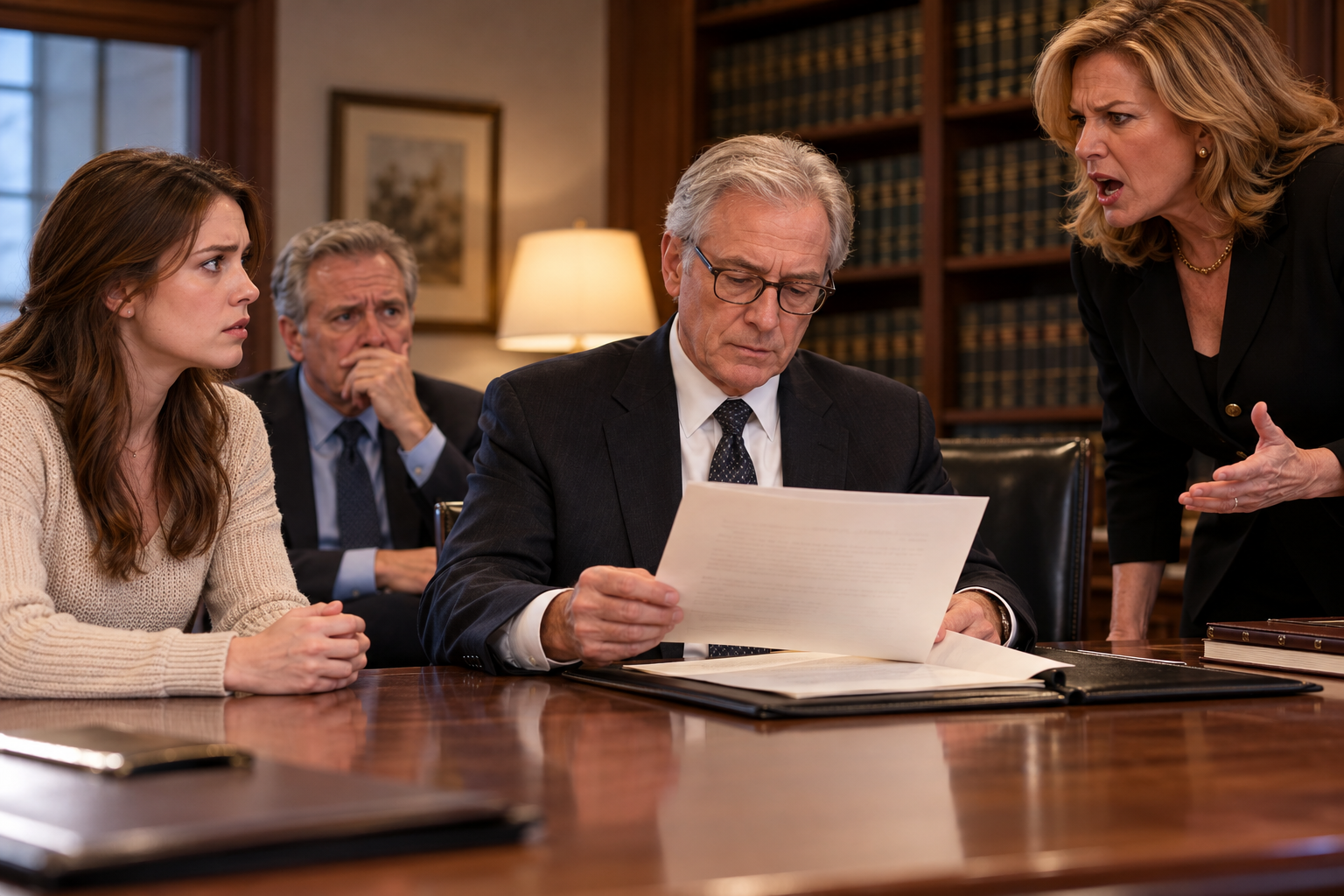
It was my father’s expression that finally changed the way I understood the room.
My mother was still the loudest person there.
She had challenged the amendment.
She had questioned Nana’s condition.
She had tried to make Mr. Caldwell’s announcement sound impossible.
But I was no longer looking only at her.
I was looking at him.
My father had gone pale with worry.
At least, that was how he appeared to me.
There was no angry demand.
No confident objection.
Just a frightened look that I could not stop thinking about.
I knew my father well enough to recognize that something was troubling him.
I did not know what it was.
That distinction matters.
Because afterward, it would have been easy to pretend I understood everything at once.
I did not.
In that moment, all I had was a reaction.
A face.
A feeling that something was wrong.
But sometimes the way a person reacts tells you that a question is worth asking.
My mother had made her position clear.
She did not want the amendment accepted.
My father had not made any position clear.
And somehow that unsettled me more.
Mr. Caldwell had already explained that Nana signed the document three days before she died.
He had explained that two independent witnesses were present.
He had explained the notarization.
He had explained the physician’s written confirmation.
Those were the things we actually knew.
Nothing about his explanation had revealed the amendment’s full contents.
Nothing had told me what I would receive.
Nothing had told me what my parents would receive.
Nothing had even told me why Nana decided to make a change so close to the end of her life.
Yet both of my parents appeared deeply disturbed.
I could not make sense of that.
Unless the amendment itself represented something they did not want to face.
The thought came slowly.
I did not want to believe it immediately.
It was easier to imagine a disagreement about money.
That was the setting, after all.
A will reading.
An estate.
Instructions about what would happen to property after someone died.
People could become upset about those things.
I knew that without needing anyone to explain it.
But my father’s expression made me question whether money was the whole story.
I looked at him again.
He still had not given me an explanation.
And the more I watched, the less I believed this was simply an argument over how Nana’s belongings would be divided.
I felt a kind of dread I could not properly name.
I was not afraid of receiving nothing.
At that point, I did not even know what the amendment contained.
I was afraid that something about Nana’s final decision mattered in a way I had never considered.
Something that my parents seemed to understand before I did.
I hated that feeling.
Being in the same room.
Hearing the same words.
Yet feeling as though everyone else knew why those words mattered.
I could not prove that was what was happening.
Maybe my father was afraid of a dispute.
Maybe he was worried about what my mother would say next.
Maybe he had reasons I could not see.
I had to leave room for those possibilities.
But even with those doubts, the look on his face remained.
And I could not forget it.
I thought about Nana.
The lawyer had described an amendment she had signed during the final days of her life.
Whatever her reasons, she had gone through the formal process of changing instructions that already existed.
That took a decision.
It was not something I could dismiss merely because my mother disliked hearing about it.
I did not want to put words into Nana’s mouth.
I did not want to claim she had been trying to expose anyone.
I did not want to imagine that I knew what she had intended before the lawyer read it.
I wanted the truth in her own instructions.
That was all.
And suddenly, that seemed like the one thing my mother did not want the room to reach.
I felt ashamed that my first instinct had been to remain quiet.
Not because silence was always wrong.
There are times when listening is exactly what a person should do.
But I had been letting my mother’s reaction take over the reading.
I had been treating her anger as though it deserved more attention than Nana’s signed wishes.
That bothered me.
The woman whose estate we were discussing could no longer sit there and explain herself.
She could not answer my mother.
She could not tell my father why she had made her decision.
All we had was the document.
And the lawyer who had been entrusted with reading it.
I looked at Mr. Caldwell.
He was still there with the papers.
I looked at my mother.
Her objection had already been answered.
Then I looked at my father one last time.
The fear I saw in his expression stayed with me.
I did not know what Nana had left behind.
But I was beginning to believe it had consequences my parents were not prepared to face.
Perhaps those consequences involved money.
Perhaps they involved something else.
I refused to decide before hearing the amendment.
The one thing I did know was that we could not learn anything more while my mother kept interrupting.
So I made a choice.
I was going to speak.
Not to accuse anyone.
Not to claim an inheritance.
Not to announce that I knew a secret.
I was going to ask the lawyer to finish.
It was a small decision.
But for me, sitting in that room with my parents, it did not feel small.
I had spent those minutes watching what everyone else would do.
Now I was ready to do something myself.
I turned my attention back to Mr. Caldwell.
And I asked him to go on.
Click here to continue reading: PART 4: I Finally Refused to Let My Mother Silence Me, and the Lawyer Turned to the Next Page of Nana’s Amendment
I Thought My Grandmother’s Will Would Finally Bring Us Answers, Until the Lawyer Announced Something My Mother Refused to Accept
Part 3 of 20