Three days before Nana’s death.
That was the detail I kept returning to.
I could not explain why it affected me so strongly.
Perhaps because it made the amendment feel so deliberate.
Perhaps because I knew those final days could never be repeated.
Whatever had happened, the date was fixed.
Nana had signed the change before she died.
And now we were hearing about it.
I looked at my mother and wondered whether she had expected the old instructions to remain unchanged.
It seemed possible.
But I had no proof.
I did not know what anyone had been told before the reading.
I did not know what Nana had discussed with my parents.
I did not know why she had made the amendment.
Those details were not available to me.
And I was becoming more aware of how much I did not know.
That was a difficult feeling to accept.
I had entered the conversation believing that a will reading would at least give us definite information.
Instead, the first definite information had caused an argument.
The amendment existed.
My mother rejected it.
The lawyer defended the formal circumstances under which it was signed.
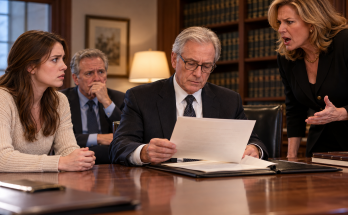
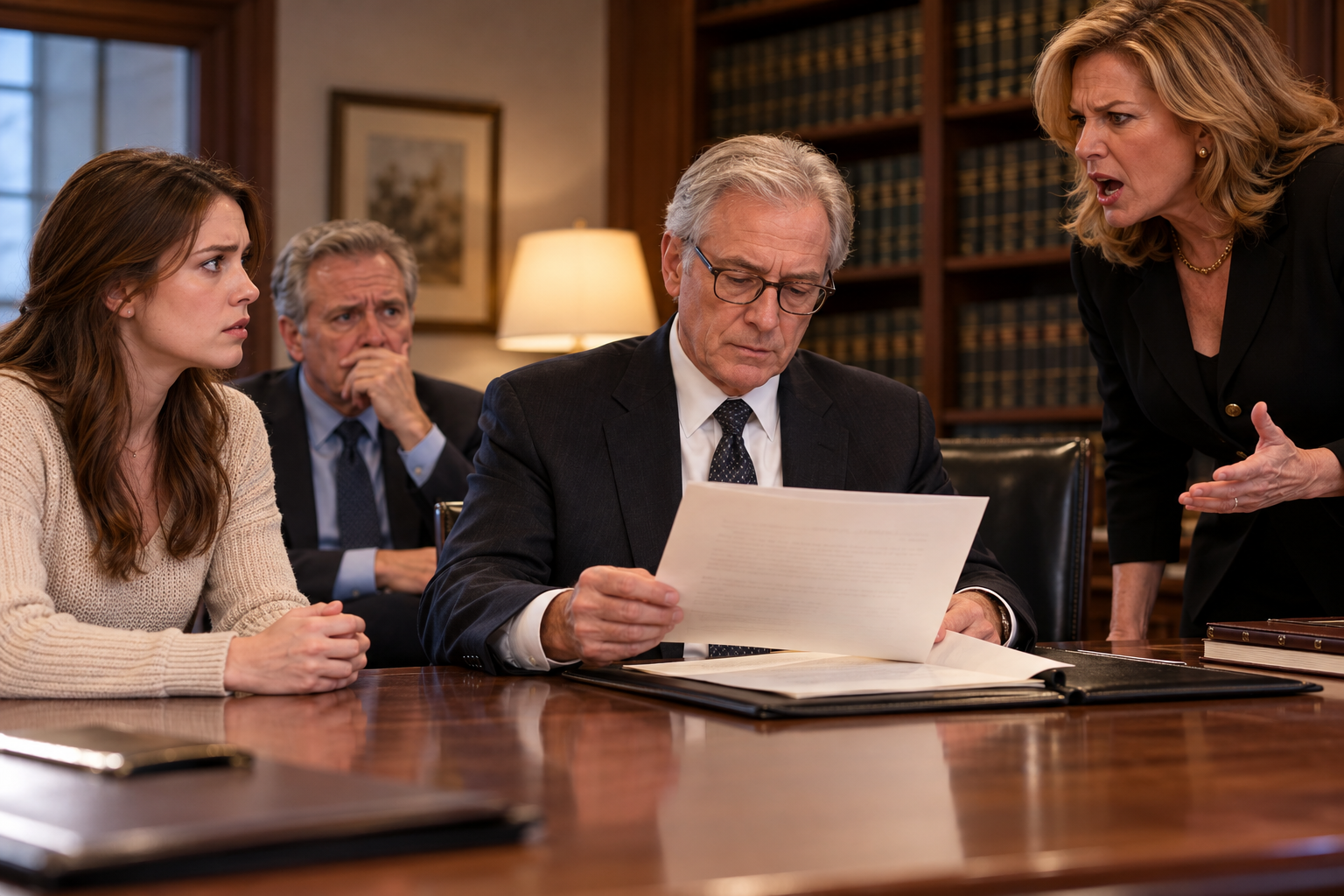
And my father looked afraid.
I had to start there.
Not with a theory.
Not with an accusation.
With what I had actually witnessed.
Mr. Caldwell had been precise.
He had given us the signing date.
He had explained that there were two independent witnesses.
He had said the amendment was notarized.
Then, when my mother questioned Nana’s mental state, he had referred to the physician’s written confirmation.
Each detail mattered for a reason.
They were answers to the concerns my mother had raised.
She could not simply declare the document impossible without confronting the facts Mr. Caldwell presented.
I thought about the witnesses.
I did not know their names.
I did not know what they had seen beyond what the lawyer described.
I did not know anything else about them.
But I knew the lawyer had identified them as independent.
That was significant.
Then there was the notary.
Another formal step.
Another part of the process Mr. Caldwell said had been completed.
And finally, the physician.
The doctor’s written statement mattered most to me because of the accusation my mother had made.
She had not simply objected to the amendment.
She had suggested Nana was no longer capable of understanding it.
That was a serious thing to say.
It affected how Nana’s final decision would be viewed.
I had no reason to ignore the concern entirely.
People could become confused when gravely ill.
That was a real possibility.
But Mr. Caldwell had told us that Nana’s physician had assessed her.
According to that written confirmation, Nana was competent when she signed.
I had to give that fact its proper weight.
My mother had spoken as though Nana’s approaching death settled the question.
The doctor’s statement said otherwise.
I did not know whether my mother believed her own accusation.
Perhaps she did.
Perhaps her fear had made her speak too quickly.
Perhaps there was some other reason.
I could not tell.
But I knew how it sounded to me.
As though Nana’s wishes mattered only if they matched what my mother expected.
I did not like that thought.
And I did not like how quickly I had begun judging her.
Both feelings existed together.
I was angry at the way she had spoken about Nana.
I was also aware that I did not know her full reasoning.
That was the uncomfortable position I found myself in.
Trying to respect the facts.
Trying not to invent motives.
Trying not to surrender my own right to listen.
I looked toward my father.
The fear I had seen in his face remained the strongest clue I had about the family’s reaction.
But it was only a clue.
It did not explain the document.
It did not tell me what would happen to the estate.
It did not establish wrongdoing.
I had to remind myself of that.
I was starting to understand that suspicion and knowledge were very different things.
Suspicion could make me look closer.
Knowledge required evidence.
And the evidence we had heard so far concerned the amendment’s execution and Nana’s mental competence.
Not the amendment’s contents.
That distinction became important to me.
I could not responsibly decide that Nana had exposed some hidden truth.
I could not say she had protected me.
I could not say she had punished my parents.
Nothing Mr. Caldwell had read so far established those things.
All I knew was that the estate instructions were being reviewed under a later amendment.
And that my mother did not want to accept it.
I thought again about my own words.
I had told her I would not remain silent.
For once, I meant to stay involved.
But involvement did not require me to take over.
I did not need to demand explanations from everyone in the room.
I did not need to make a speech about Nana’s rights.
I did not need to accuse my parents of anything.
I only needed to keep listening.
I was beginning to see that listening could be an active choice.
Especially when someone wanted me to stop.
Mr. Caldwell was there to read the document.
My mother was there, objecting to what he had announced.
My father was there, showing fear I did not understand.
And I was there, trying to hear the words Nana had left.
That was the situation.
Simple to describe.
Hard to live through.
I wished I could ask Nana why she had waited until those final three days.
Then I corrected myself.
I did not even know whether she had waited.
I did not know what had happened before the signing.
I knew only the date Mr. Caldwell had given.
It was another assumption I had almost turned into a fact.
That bothered me.
I wanted to tell the story accurately, even to myself.
And accuracy meant admitting where the information ended.
Three days before she died, Nana signed an amendment.
Two independent witnesses were present.
The document was notarized.
Her doctor confirmed in writing that she understood what she was doing.
My mother challenged the amendment.
My father looked afraid.
I asked the lawyer to continue.
My mother tried to silence me.
I refused.
Those were the things I could honestly say had happened.
I held on to them.
Because whatever came next, I did not want to lose sight of what was actually known.
The second page had been unfolded.
I was ready to hear it.
And I understood that hearing Nana’s words mattered more than any explanation I could invent for the reactions around me.
Click here to continue reading: PART 8: After My Mother Tried to Silence Me, I Made One Promise to Myself About Nana’s Will and the Truth Still Unread
I Thought My Grandmother’s Will Would Finally Bring Us Answers, Until the Lawyer Announced Something My Mother Refused to Accept
Part 7 of 20