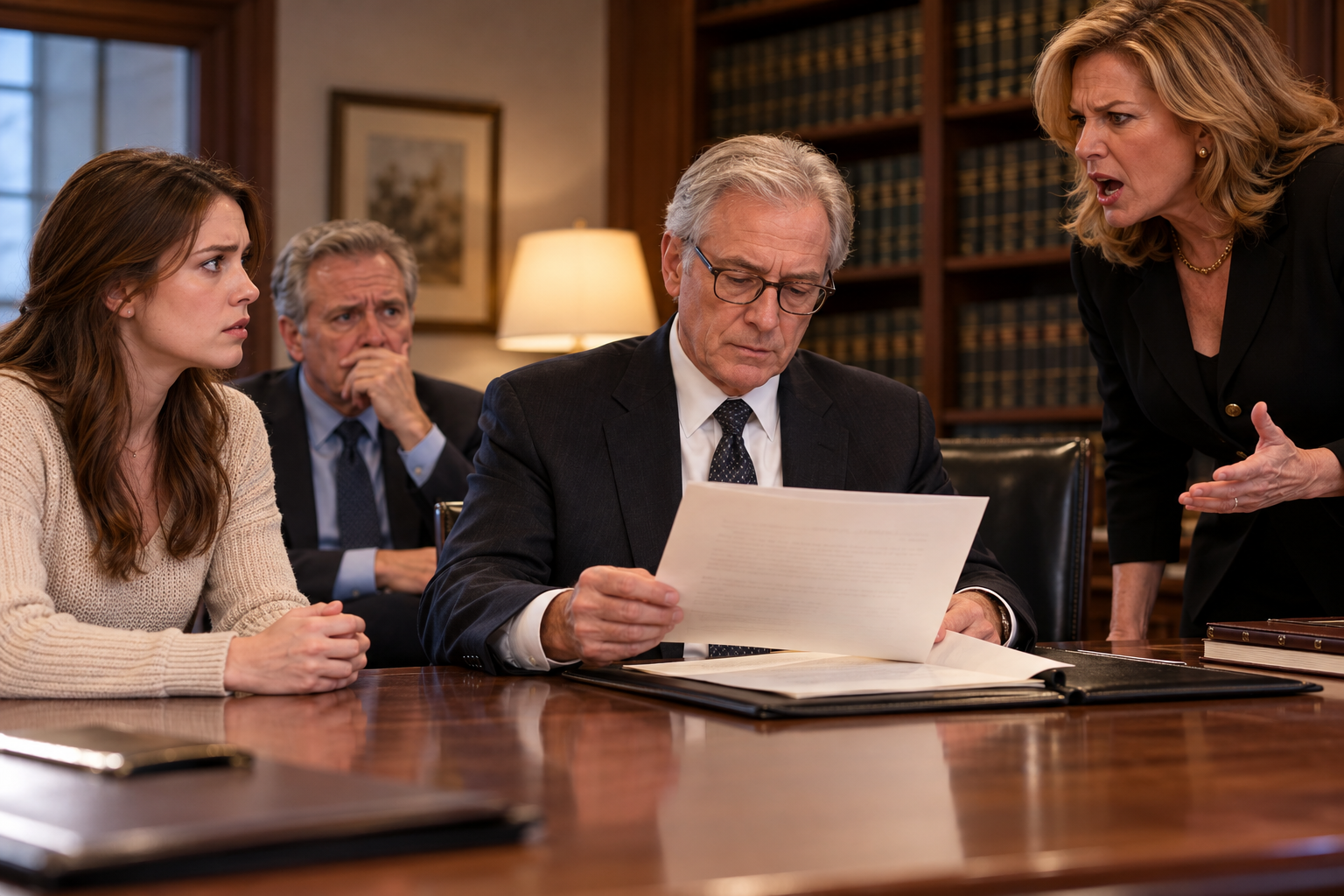
I had never seen my mother lose control so quickly.
One moment, she was sitting there listening to Mr. Caldwell.
The next, she was standing.
Her face had changed.
So had her voice.
And all because of something my grandmother had signed before she died.
I was sitting at the reading of Nana’s will when it happened.
I had expected the meeting to be difficult.
I had not expected to watch my parents react as though a few pages of paper could ruin everything.
But that was exactly what I saw.
Mr. Caldwell was speaking when my mother interrupted him.
He had just explained that Nana had made a late change to her estate instructions.
Not a small clarification.
Not a correction to an address or a name.
Something that affected the instructions already in place.
Something that required those earlier decisions to be examined again.
My mother did not wait for him to finish explaining.
She got to her feet.
She told him he had to be wrong.
I remember looking at her before I looked at the lawyer.
It was her reaction that caught me.
Not the announcement itself.
I had no idea what the amendment contained.
I did not know who would receive anything.
I did not know whether the change helped me, hurt me, or had nothing to do with me at all.
There were still pages to be read.
That was what made her reaction so strange.
She was furious before any new distribution had been explained.
Looking back, I think that was the first detail I should have paid closer attention to.
My mother was not asking what Nana had wanted.
She was objecting to the possibility that Nana had changed her mind.
There was a difference.
A large one.
At the time, I only knew that the room had suddenly become uncomfortable.
Mr. Caldwell did not raise his voice.
He did not stand to argue with her.
He simply looked up from the document.
Then he explained that Nana had signed the amendment three days before she died.
Three days.
That detail stayed with me.
I had known Nana was near the end of her life.
But hearing the exact timing made the document feel different.
Those were some of her final days.
And during those days, she had made a decision important enough to put into legal writing.
Mr. Caldwell went on to explain how the amendment had been completed.
There had been two witnesses.
Neither was described as someone with a personal interest in the estate.
The document had also been notarized.
He was giving us facts.
Dates.
Procedures.
The kind of details that could be checked.
My mother did not seem interested in any of them.
She was still standing.
Still angry.
Still unwilling to accept what he was saying.
I stayed in my chair.
I wish I could say I immediately understood why Nana had made the amendment.
I did not.
I wish I could say I knew what my mother was afraid of.
I did not know that either.
All I had was the way she reacted.
And the way Mr. Caldwell continued speaking despite it.
I had spent so much of that moment watching my mother that I almost forgot to look at my father.
When I finally did, something about him seemed wrong.
He was not arguing.
He was not defending her.
He was not demanding that the lawyer stop.
He had gone quiet.
I could not explain what I saw in his face yet.
But I knew it was not ordinary irritation.
My mother was making her anger impossible to miss.
My father was showing something else.
Something quieter.
Something I had not expected.
Mr. Caldwell kept the document in front of him.
My mother kept refusing to believe it.
And I sat between those two realities, trying to understand why an amendment nobody had fully heard could cause so much trouble.
For the first time, I began to wonder whether my parents had expected Nana’s will to say something very different.
That was only a question.
I had no proof.
And I did not want to turn a look or an angry interruption into an accusation.
Still, the question remained.
Why was my mother so determined to reject the change before she knew what the lawyer was about to read?
I looked back at Mr. Caldwell.
The amendment was still there.
So were the words Nana had signed.
My mother could interrupt.
She could object.
She could insist that something was impossible.
But none of those things changed the fact that the document existed.
Nana had made a decision three days before her death.
And my mother had just made it clear that she did not want that decision accepted.
I did not yet know what the amendment would mean.
I only knew I wanted to hear it.
Click here to continue reading: PART 2: My Mother Tried to Dismiss Nana’s Last Decision, but the Lawyer Had One Important Detail She Had Not Expected
I Thought My Grandmother’s Will Would Finally Bring Us Answers, Until the Lawyer Announced Something My Mother Refused to Accept
Part 1 of 20