I kept thinking about the way my mother had spoken to me.
She had not asked why I wanted Mr. Caldwell to continue.
She had not explained what worried her about my involvement.
She had simply told me to stay out.
I had answered her.
I was staying.
Those words were not complicated.
But they mattered to me.
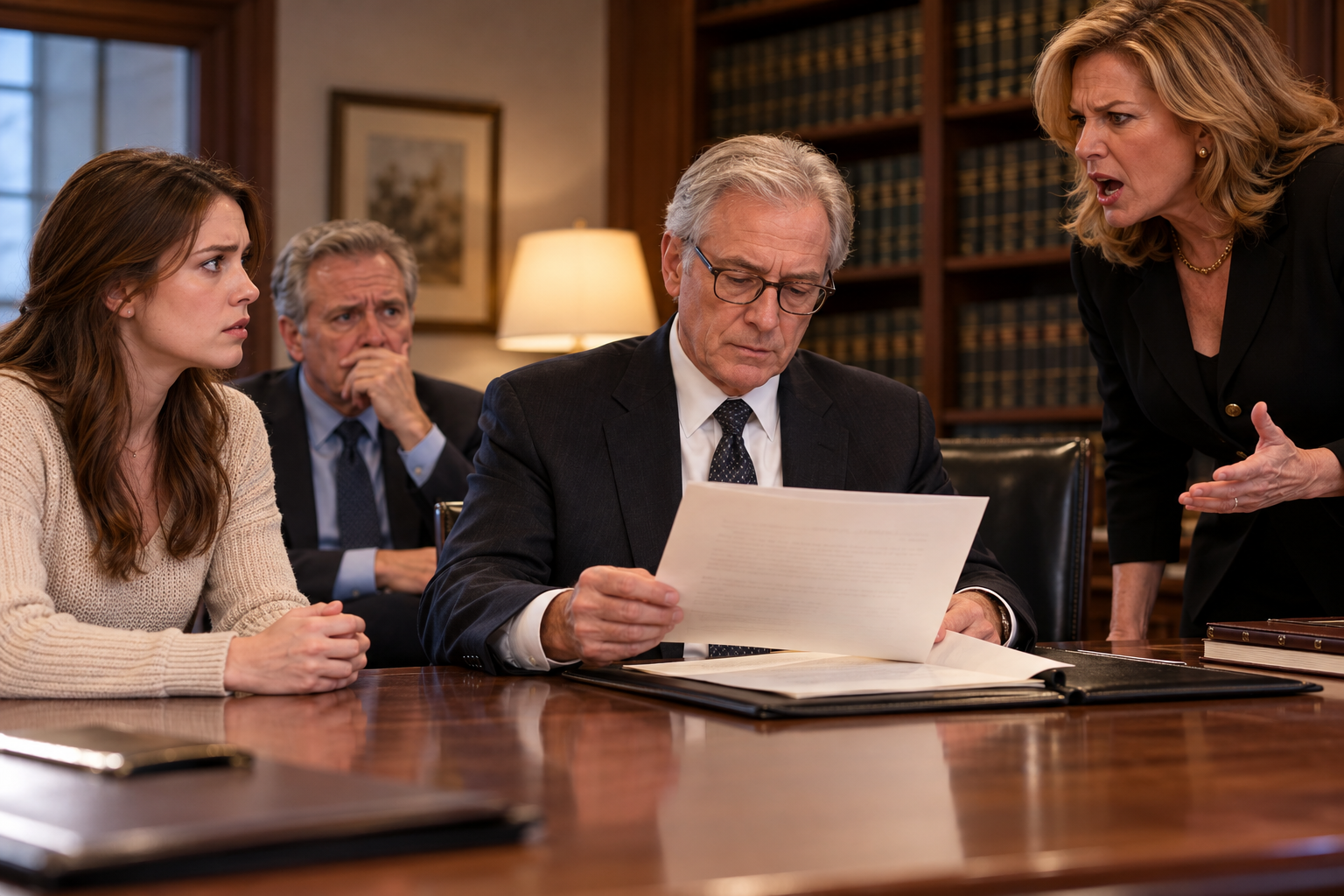
I had spent the earlier part of the reading watching other people decide how the conversation would proceed.
My mother interrupted.
Mr. Caldwell answered.
My mother challenged him again.
And I stayed quiet.
At first, I thought silence was the sensible choice.
The lawyer knew what he was doing.
My mother was upset.
There seemed little reason for me to add another voice.
Then I saw my father’s face.
And something changed.
He looked frightened.
I did not know why.
But I knew the amendment mattered in a way I had not expected.
That realization made my mother’s attempts to stop the reading harder to ignore.
I wanted to hear Nana’s own instructions.
Not my mother’s interpretation.
Not my father’s silence.
The actual document.
I had asked Mr. Caldwell to continue.
And my mother immediately tried to dismiss me.
That was the moment I understood that staying quiet was no longer the choice I wanted to make.
I could respect my mother without obeying every order.
I could listen to her concerns without accepting every claim.
And I could remain in the room without claiming to understand what the amendment contained.
Those distinctions helped me.
I did not need to turn the argument into something larger.
I did not need to tell my mother she was a terrible person.
I did not need to accuse my father of hiding anything.
I simply needed to hold my position.
I was there.
Nana had left a formal amendment.
And I wanted to hear it.
My mother’s earlier objection still bothered me.
She had claimed Nana was too ill to understand her decision.
That accusation was not a small matter.
It challenged the meaning of one of Nana’s final acts.
Mr. Caldwell had explained that her physician provided written confirmation of her competence.
He had also described the witnesses and notarization.
The lawyer’s explanation gave us reasons not to dismiss the amendment immediately.
Yet my mother’s anger remained the strongest sound I remembered.
I thought about that.
Sometimes the loudest thing in a room was not the most reliable thing.
I had learned it in an uncomfortable way.
The facts Mr. Caldwell provided were calm and precise.
My mother’s objections were forceful.
For a moment, I had nearly allowed the force of her words to matter more than the evidence.
That was the mistake I did not want to repeat.
I looked toward the second page.
I still did not know what it contained.
The amendment could have disappointed me.
It could have surprised everyone.
It could have concerned matters I had not even considered.
None of those possibilities changed Nana’s right to make a decision while competent.
And none gave me permission to invent her decision.
I needed to remember that.
My father had remained silent during the exchange.
The fear I had noticed was still unexplained.
I wondered whether he agreed with my mother.
I wondered whether he was afraid she would continue arguing.
I wondered whether he knew what the next page said.
But I had no evidence.
I could not tell his story for him.
That realization was uncomfortable.
I wanted to understand both my parents.
I wanted their reactions to make sense.
And I wanted to know whether Nana’s amendment was the reason the room felt so tense.
But I had to accept that I did not know everything.
The only person who had spoken with authority about the document was Mr. Caldwell.
And even he had not yet revealed its full contents in the available account.
I had learned the circumstances of its signing.
I had learned that Nana’s competence had been confirmed.
I had learned that my mother objected.
And I had learned that I could refuse to be silenced.
Those were the facts I could carry forward.
I thought about what would happen if the amendment said something I disliked.
Would I have the courage to accept it?
I wanted to believe so.
But I did not know.
It was easy to defend Nana’s right to choose before hearing the choice.
The harder test would be respecting that right afterward.
I could not claim to have passed a test that had not happened.
So I made myself a quieter promise.
I would listen before judging.
I would distinguish evidence from suspicion.
And I would not make Nana’s will about my pride.
My mother had already turned the reading into an argument about whether the amendment should be accepted.
I did not want to turn it into a contest between us.
It was Nana’s estate.
Her final instructions.
Her signature.
I wanted those things to remain at the center.
I looked at the paper in Mr. Caldwell’s hands.
There was no revelation I could honestly describe beyond that point.
No confirmed distribution.
No statement explaining my father’s fear.
No final decision resolving the dispute.
The words on the next page had not been supplied.
I could not pretend otherwise.
But I could describe the change in myself.
I had started by wondering whether speaking would make my mother angrier.
Now I understood that her anger was not a reason to abandon my place in the discussion.
I had asked a reasonable question.
I had made a reasonable request.
And I had every intention of hearing whatever Nana had left behind.
For once, remaining quiet would have felt like giving up.
I had chosen not to.
Click here to continue reading: PART 19: The Last Page I Could Account for Was Still in the Lawyer’s Hands, and I Refused to Invent the Secret My Parents Feared
I Thought My Grandmother’s Will Would Finally Bring Us Answers, Until the Lawyer Announced Something My Mother Refused to Accept
Part 18 of 20