I had wanted a simple reading.
That was what I kept thinking.
A lawyer.
A will.
My grandmother’s final instructions.
I knew the occasion would be difficult.
But I had not expected the argument to begin before we understood the change Nana had made.
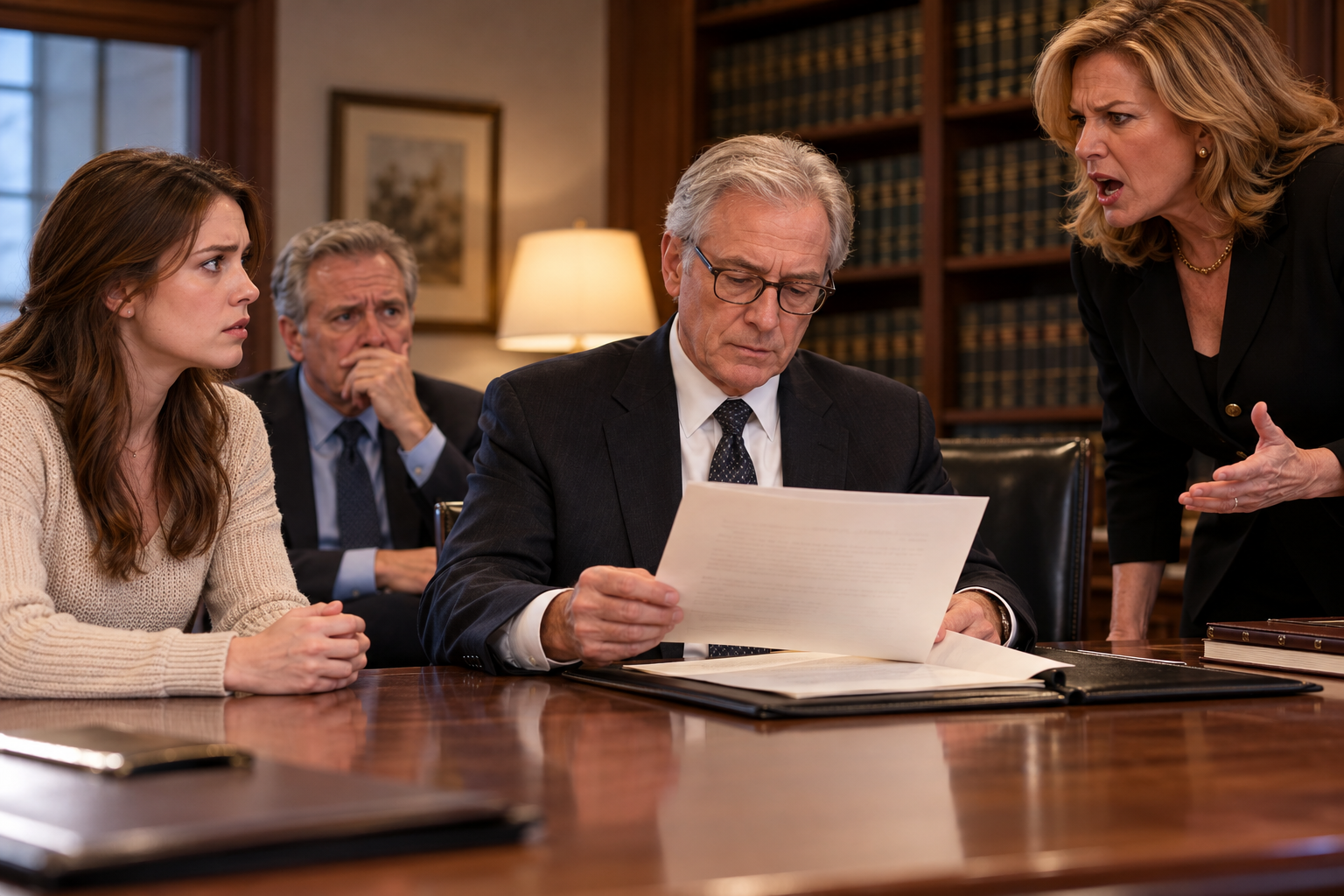
My mother had risen from her chair.
She had challenged the amendment.
Mr. Caldwell had explained when it was signed.
Then she had attacked Nana’s competence.
He had answered that too.
My father had looked frightened.
And when I asked the lawyer to continue, my mother had tried to silence me.
Those were the events that brought me to the second page.
There was no way to undo them.
I could not make my mother calm.
I could not make my father explain what frightened him.
I could not bring Nana back to speak for herself.
But I could decide what I would do.
I had already made that decision.
I would remain.
I would listen.
And I would not allow my mother’s anger to determine my understanding of Nana’s wishes.
It sounded simple when I put it into words.
It had not felt simple in the room.
I had been frightened of speaking.
I had been uncertain about what the amendment contained.
I had wondered whether I was making the situation worse.
Yet none of those feelings changed the reason I was there.
My grandmother had left instructions concerning her estate.
Those instructions had been amended.
And the lawyer had begun explaining the amendment.
I wanted to hear the rest.
I looked at the paper in Mr. Caldwell’s hands.
The document had become the center of everything.
My mother’s objections concerned it.
My father’s expression had changed while it was being discussed.
My decision to speak had been made because I wanted it read.
Yet I still did not know its full contents.
That was what made the moment so difficult.
Everyone was reacting to something.
But I did not know what the something was.
At least, not beyond the fact that the previous estate instructions were subject to review.
I thought about how quickly my mind had tried to fill the gaps.
Maybe Nana had changed who received her belongings.
Maybe the amendment contained something my parents feared.
Maybe there was a reason they had reacted before the instructions were disclosed.
But those were only possibilities.
I had no right to present them as events.
I did not know what the amendment said.
I did not know whether it favored me.
I did not know whether it disadvantaged my parents.
I did not know whether it revealed anything beyond a change in estate instructions.
The uncertainty remained.
And I had to accept it.
I wished I could tell myself that everything became clear the moment Mr. Caldwell opened the second page.
That would have made the account easier to finish.
But the available events did not contain that explanation.
They ended at the point where the page was unfolded.
Anything beyond it would have to come from Nana’s actual words.
Not from my imagination.
I could not invent a legal revelation simply because my father looked afraid.
I could not invent a punishment for my mother because she had tried to silence me.
And I could not invent a reward for myself because I had finally spoken.
That would turn a real conflict into something else.
I wanted to be honest about what had happened.
Even when the truth was incomplete.
Especially then.
My mother had spoken with certainty.
That was one thing I would always remember.
She seemed sure the amendment should not be accepted.
Mr. Caldwell had responded with records and formal details.
He had not needed to shout.
He had simply explained what could be verified.
I thought about the contrast.
My mother’s anger was immediate.
The lawyer’s answers were measured.
And I had been caught between the two, trying to decide whether I was allowed to ask for more.
That was the part I understood best.
My mother wanted me out of the discussion.
I had refused.
For once, I had not let her order end the matter.
I could acknowledge that without exaggerating what it meant.
It did not make me the winner of the dispute.
It did not mean Nana had chosen me.
It did not mean my parents had been exposed.
It meant I had decided to hear the reading for myself.
That was enough to matter.
I looked toward my father again in my memory.
The fear on his face was still unexplained.
I could not turn away from it.
But I could not resolve it either.
I wanted to understand why a late amendment could frighten him so much.
I wanted to know whether he had been expecting different instructions.
I wanted to know whether he understood something about Nana’s decision that I did not.
Those questions were real.
The answers were not available.
So I left them unanswered.
I thought about Nana’s final three days.
I wondered what it had meant to her to sign that document.
The lawyer had told us she was mentally capable.
He had described independent witnesses and notarization.
I knew she had made a formal change.
I did not know why.
I could not claim she had been trying to protect me.
I could not claim she had been trying to punish my parents.
I could not claim the amendment carried a secret beyond what had been disclosed.
But I could acknowledge that her decision deserved to be heard.
That had been my position from the moment I asked Mr. Caldwell to continue.
And it remained my position.
I had learned something about how I wanted to handle the uncertainty.
I did not want to be intimidated by anger.
I did not want to confuse silence with agreement.
I did not want to mistake suspicion for evidence.
And I did not want to attach words to someone who could no longer correct me.
Nana’s final instructions belonged to her.
Whatever they contained.
Whatever they changed.
Whatever consequences followed.
I could not tell the rest of that story without the missing pages.
I knew the title of the conflict.
I knew the people in the room.
I knew the formal details of the amendment.
And I knew exactly where the established account stopped.
Mr. Caldwell had unfolded the second page.
I had refused to leave the discussion.
My mother remained opposed to the amendment.
My father’s fear had not been explained.
And Nana’s actual revised instructions had not yet been revealed.
There was no final outcome I could truthfully describe.
No distribution I could confirm.
No hidden confession I could attribute to anyone.
No settlement I could claim had occurred.
The only decision I could honestly carry forward was my own.
I would stay.
I would listen.
And I would judge Nana’s wishes by what she had actually written, not by how frightened or angry anyone became when those wishes were mentioned.
Click here to continue reading: PART 13: I Kept Watching the Second Page of Nana’s Amendment, Knowing My Mother’s Anger Could Not Tell Me What Was Written There
I Thought My Grandmother’s Will Would Finally Bring Us Answers, Until the Lawyer Announced Something My Mother Refused to Accept
Part 12 of 20