
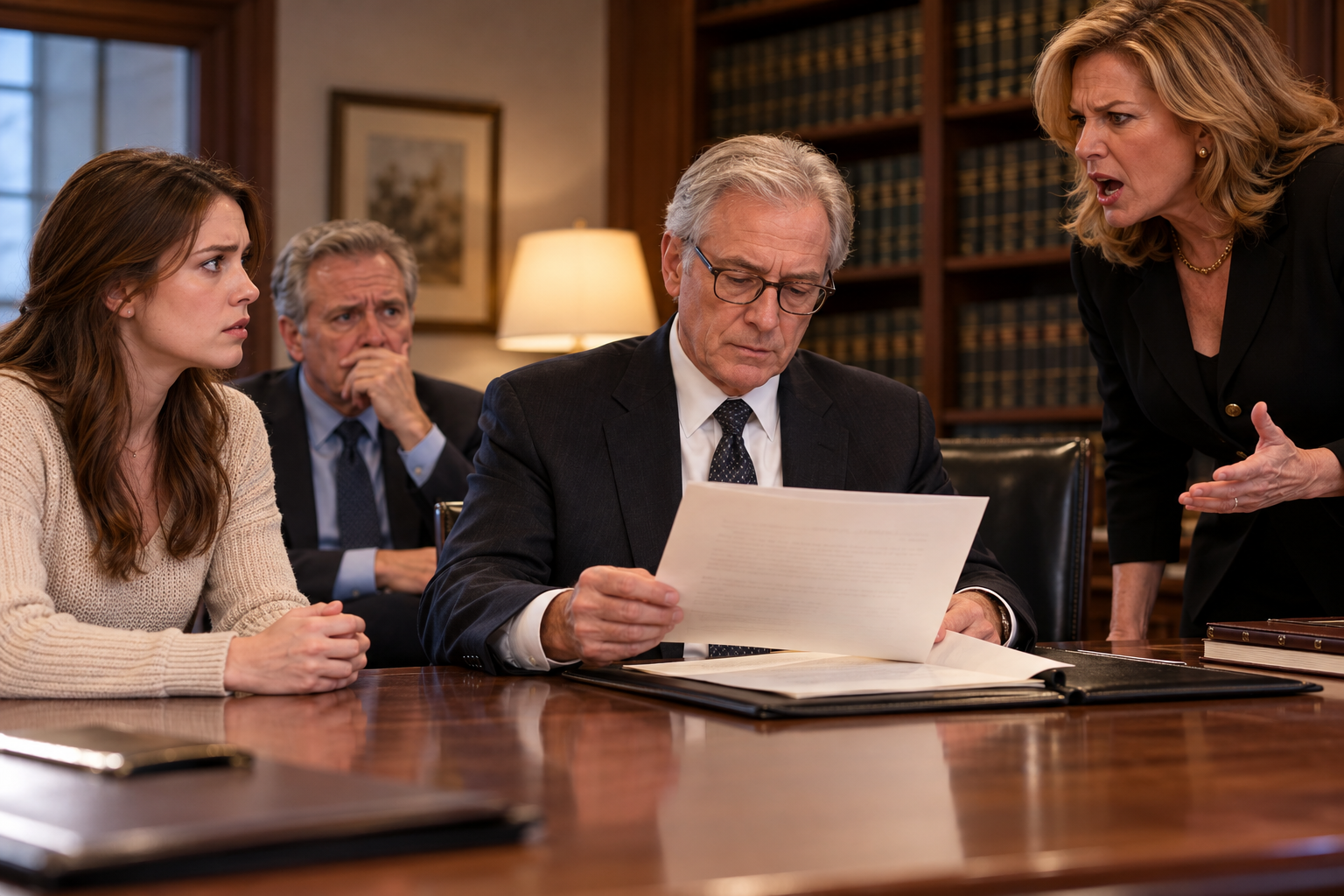
I kept thinking about my father.
Even with Mr. Caldwell holding the amendment, my attention returned to him.
My mother’s anger had been easy to recognize.
She had objected openly.
She had questioned the document.
She had challenged Nana’s ability to make the decision.
My father had done none of those things.
But his expression had troubled me more.
I wanted to understand it.
I wanted him to explain it.
I wanted one ordinary sentence that would make the feeling go away.
I did not get one.
He remained silent in the portion of the reading I could remember.
And I was left with what I had seen.
Fear.
I had called it that in my own mind.
Then I had questioned whether I was being fair.
A person could look frightened for many reasons.
A family argument could be upsetting.
A disagreement over an estate could create uncertainty.
The circumstances of Nana’s death were already difficult.
I knew all of that.
Yet his face had changed when Mr. Caldwell described the amendment.
That timing bothered me.
It did not prove anything.
But I could not forget it.
I looked toward my mother again.
She seemed determined to prevent the amendment from being treated as valid.
At least that was what her objections suggested.
She had insisted that such a change could not have happened.
When the lawyer explained when and how it was signed, she had argued that Nana was too ill.
Then Mr. Caldwell had mentioned the physician.
Written confirmation.
I remembered those two words because they seemed to take the argument out of the realm of personal opinion.
My mother could say Nana had been confused.
Mr. Caldwell could point to a medical assessment made at the relevant time.
That did not tell us what the amended instructions were.
It did not resolve every question anyone might ever raise.
But it gave us a reason to continue rather than dismiss the document immediately.
I thought about how carefully I needed to listen.
It would have been easy to take sides before understanding the facts.
My mother was angry.
So perhaps I should be angry with her.
My father was afraid.
So perhaps I should assume the worst.
Mr. Caldwell had a properly executed amendment.
So perhaps I should assume Nana had solved every problem.
None of those conclusions was justified yet.
I had to admit that.
Even though admitting it made the uncertainty harder to bear.
I wanted to believe I knew my family.
That was the uncomfortable truth.
I wanted the people in that room to be understandable to me.
I wanted my mother’s objections to have a simple explanation.
I wanted my father’s fear to be something ordinary.
I wanted Nana’s amendment to contain instructions that could be read without another argument.
But wanting those things did not make them true.
I had learned something about myself during those few minutes.
When I was afraid of an answer, I sometimes tried to reach it before the facts arrived.
I would imagine what someone meant.
Then react to the meaning I had invented.
I did not want to do that with Nana.
She had taken the trouble to sign an amendment.
Her lawyer had brought it to the reading.
There were witnesses.
There was notarization.
There was a physician’s statement about her competence.
Those were the facts available to me.
I repeated them because they gave me somewhere solid to stand.
Everything else was still an unanswered question.
Why had Nana changed her instructions?
What had changed?
Who would be affected?
Why were my parents reacting so strongly?
I could not answer any of those questions from the material we had heard.
I did not want to pretend otherwise.
My mother had told me to keep out of it.
I had refused.
I was still thinking about that exchange.
She had said my name sharply.
Sarah.
Then she had tried to end my participation.
I had not raised my voice in return.
I had simply told her that I intended to remain.
That moment mattered to me because I had been frightened of making things worse.
I had felt the old temptation to stay quiet.
To let my mother speak.
To wait until the disagreement was over.
But the disagreement concerned Nana’s final written wishes.
And I was already present.
Silence would not make me more respectful.
It would only mean I had given up the chance to hear the reading without interruption.
I was glad I had spoken.
Still, I did not mistake that choice for proof that I was right about everything.
It gave me no special knowledge.
I had not suddenly discovered the contents of the amendment.
I had not uncovered a lie.
I had not learned what frightened my father.
I had only decided not to let my mother answer for me.
That was enough.
For the moment, it had to be enough.
I looked again at the papers in Mr. Caldwell’s hands.
I kept noticing how ordinary they were.
Pages.
Printed words.
A legal amendment.
Nothing about the appearance of paper could explain the emotions surrounding it.
The meaning was in the instructions.
And those instructions had not yet been disclosed in the source of the moment I remembered.
I found myself wishing Nana could speak.
Not to argue with anyone.
Not to defend me.
Only to tell us what she had meant.
But that was impossible.
We were at the reading because she had died.
That fact made every objection feel heavier.
She could not answer my mother’s accusation that she had been confused.
She could not explain why she signed the amendment three days before her death.
She could not tell me whether my father’s expression had anything to do with her decision.
All she had left was the document.
I understood then why I needed to hear it without deciding its meaning in advance.
It was the closest thing we had to her own final instructions.
I would not claim to know more than the pages revealed.
And I would not let my fear turn unanswered questions into accusations.
I could be unsettled.
I could be suspicious.
I could be hurt by my mother’s attempt to silence me.
But I still had to be fair.
I stayed where I was.
Mr. Caldwell had opened the second page.
And I was prepared to listen to whatever could actually be established from Nana’s words.
Click here to continue reading: PART 7: I Could Not Forget the Three Days Before Nana Died, or the Care She Had Taken to Make Her Final Decision Official
I Thought My Grandmother’s Will Would Finally Bring Us Answers, Until the Lawyer Announced Something My Mother Refused to Accept
Part 6 of 20

One Comment on “PART 6 – My Father’s Frightened Expression Stayed With Me as I Tried to Separate What Nana Had Actually Signed From Everything I Feared”