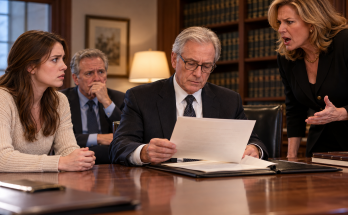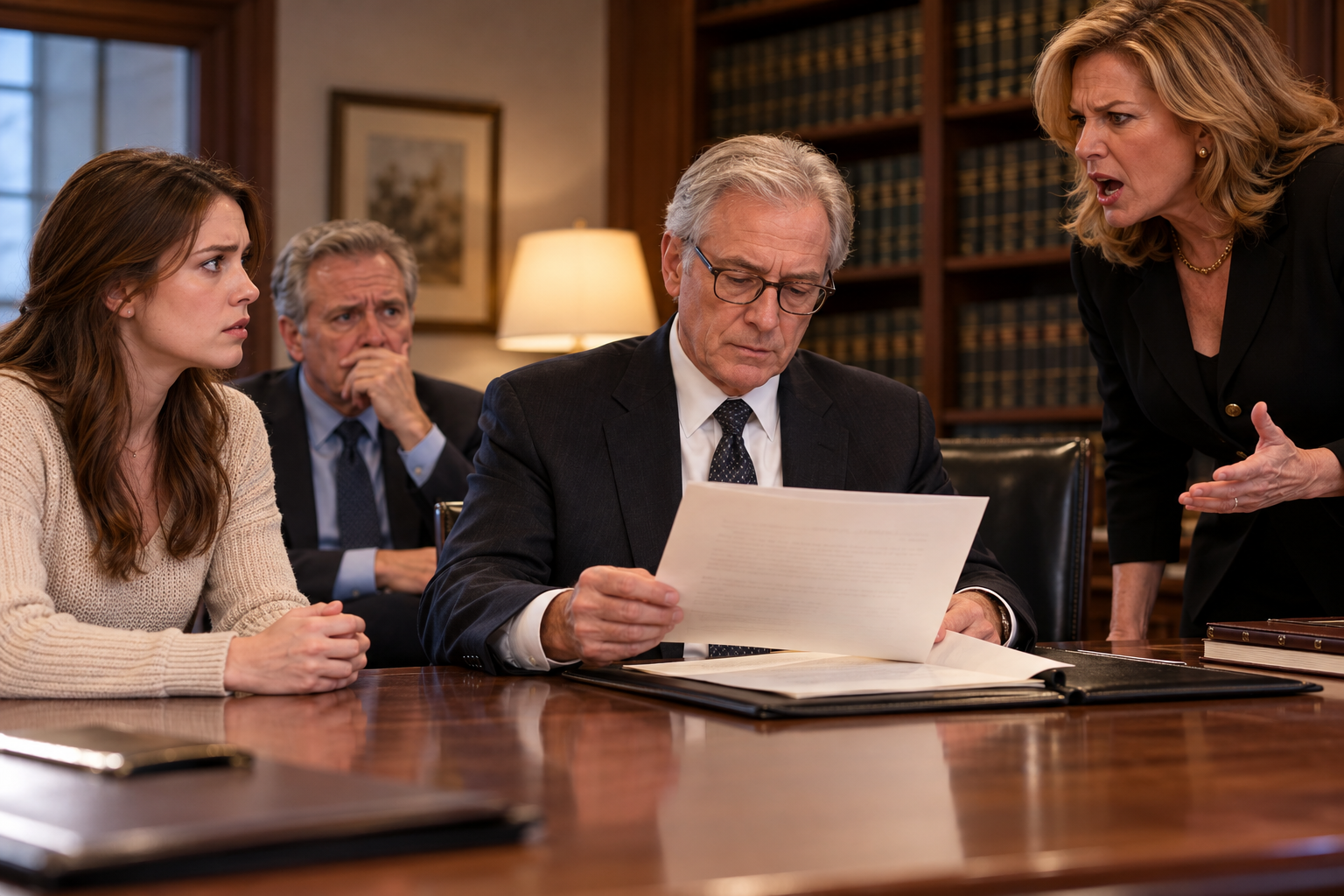
I kept hearing my mother say my name.
Sarah.
One word.
Then an order to keep out of the discussion.
It had been such a brief exchange.
Yet it stayed with me longer than the shouting.
Maybe because it had forced me to make a choice.
I could remain quiet.
Or I could insist on hearing Nana’s instructions.
I had chosen to stay involved.
I had not known what that choice would cost me.
I still did not.
But I knew why I made it.
Mr. Caldwell was reading an amendment Nana had signed shortly before her death.
It concerned the distribution of her estate.
My mother was challenging it before we had heard the substance.
I wanted the reading to proceed.
That was not a demand for money.
It was not an accusation.
It was a request to hear what my grandmother had written.
I kept returning to that distinction.
My mother’s reaction made everything feel personal.
The way she spoke to me made it seem as though I had become part of the dispute simply by opening my mouth.
But the amendment had not been created by my decision to speak.
Nana had signed it three days before she died.
Its existence did not depend on me.
Neither did its contents.
I could not change those facts.
I could only decide how I responded.
For a moment, I wondered what my mother believed I was trying to do.
Did she think I wanted something from the estate?
Did she think I was questioning her authority?
Did she simply want the lawyer to stop?
I did not know.
She had given me an order.
She had not explained her reasons.
I had to resist the temptation to supply those reasons myself.
That was becoming a repeated lesson during the reading.
People showed me emotions.
I wanted to turn those emotions into facts.
My mother showed anger.
I wanted to know what she feared losing.
My father showed fear.
I wanted to know what he believed Nana had left behind.
But neither reaction could answer those questions.
I had to listen to the amendment.
That was the only reliable way forward.
I thought about Mr. Caldwell’s answers.
He had not argued with my mother about whether she was a good daughter.
He had not criticized her for being upset.
He had simply explained how the amendment had been executed.
A signature three days before Nana’s death.
Two independent witnesses.
Proper notarization.
Written confirmation from her attending physician.
Those details mattered because my mother had attacked the document’s reliability.
The lawyer had addressed the reasons she gave.
He had not supplied the rest of Nana’s wishes.
Not yet.
I looked down at the opened page.
I tried not to imagine what it contained.
That was harder than I expected.
When someone reacts strongly to a document, it is natural to wonder what is hidden inside.
Especially when the reaction comes before the document has been fully read.
But there was a difference between wondering and knowing.
I did not want to forget it.
I had already begun to suspect there was something more troubling to my parents than a change in money.
My father’s expression had led me there.
It was the most disturbing moment I remembered.
He looked terrified.
I could not find another word that fit what I had seen.
Still, I had no proof that his fear concerned anything beyond the estate itself.
I did not know what he expected the amendment to say.
I did not know whether he had known it existed.
I did not know whether my mother had spoken to him about it.
The source of his fear remained unknown.
I had to leave it that way.
I wanted answers.
But I did not want invented answers.
That mattered more as I thought about Nana.
She had been the person whose wishes were being discussed.
She was no longer present to clarify them.
If I guessed wrong about her intentions, she could not correct me.
If I decided she had written the amendment to punish someone, I could be wrong.
If I decided she had written it to protect me, I could be wrong about that too.
Nothing I had heard established either conclusion.
The only clear fact was that she had made a formal change.
And the circumstances of that change had been documented.
I felt a strange responsibility to be careful.
Not because anyone had assigned me that responsibility.
But because I had watched how quickly the conversation had moved from the amendment to accusations about Nana herself.
My mother had claimed Nana was too ill to understand.
Mr. Caldwell had answered with the physician’s confirmation.
I could not simply disregard that confirmation because my mother was upset.
Nor could I use it to invent a larger story about motives I did not know.
Both would be mistakes.
I wanted to avoid them.
The room had become a place where words mattered.
Every claim changed how I understood the people around me.
Every answer revealed the limits of what had been established.
And every unanswered question tempted me to fill the silence.
I was learning to let those questions remain open.
Not forever.
Only until there was something reliable to answer them.
I thought about what I had said to my mother.
I had refused to withdraw.
That did not mean I needed to keep speaking.
Sometimes standing by a decision meant becoming quiet afterward.
Not the defeated silence I had almost chosen.
A different kind.
The silence of someone who was listening carefully.
I did not need to interrupt Mr. Caldwell.
I did not need to demand that my father explain his face.
I did not need to match my mother’s anger.
I needed to hear the next part of Nana’s instructions.
That was enough.
I was still frightened.
I was still confused.
And I was still troubled by the thought that my parents understood something I did not.
But I did not allow those feelings to settle the question.
I looked at the second page.
Its contents remained unknown to me in the account I could honestly tell.
Whatever happened after that point had not been provided.
I would not pretend to remember words that were never given.
I would not create a confrontation to make the scene more dramatic.
And I would not claim a revelation had occurred merely because the atmosphere suggested one might.
There was already enough truth in what I had seen.
Nana had signed an amendment.
My mother had challenged it.
Mr. Caldwell had explained the formal evidence supporting its execution.
My father had looked afraid.
And I had refused to be silenced.
Those events had changed how I felt in the room.
I no longer wanted to be a passive witness to the argument.
But I also did not want to become someone who decided the truth before hearing it.
I could speak for myself.
I could remain where I was.
And I could acknowledge the limits of what I knew.
That was the decision I held on to.
Click here to continue reading: PART 11: The Doctor’s Written Confirmation Changed How I Viewed Nana’s Final Decision, Even Though the Amendment’s Most Important Words Remained Unread
I Thought My Grandmother’s Will Would Finally Bring Us Answers, Until the Lawyer Announced Something My Mother Refused to Accept
Part 10 of 20